Last updated 10.11.2026
Thailand stretches more than 1,600 kilometres from north to south. Along the way you pass hill villages where people light fires on January mornings, the ruins of two former capitals, Khmer temples built on an extinct volcano, a rainforest older than most of Europe’s woodland and islands on two different seas, each with its rainy season at a different time of year. So when you start listing the places to visit in Thailand, the first question is not “what” but “where and when”. We have put together fifty places, grouped by region. For each one you will find why it is worth the trip, how much time to set aside, how to get there and the entry fee wherever an official source publishes it. There are deliberately more than anyone can fit into one trip. In two weeks, we reckon you can comfortably cover three regions, not five.
Places to visit in Thailand at a glance
- Thailand has nine UNESCO World Heritage Sites. The ones that matter most to travellers are Ayutthaya and Sukhothai (both inscribed in 1991), the Dong Phayayen–Khao Yai forest complex (2005) and the newest addition, Wat Phra Mahathat temple in Nakhon Si Thammarat, inscribed in 2026.
- Two seas, two seasons. The Andaman Sea (Phuket, Krabi, Phi Phi, Lanta, the Similans) is at its best roughly from November to April. The Gulf of Thailand (Samui, Pha Ngan, Tao) gets most of its rain at the end of the year and is usually the nicer side in summer.
- The Similan Islands are only open part of the year. For the 2026/2027 season they open from 15 October 2026 to 15 May 2027 (according to the park authority). An adult foreign visitor pays 500 THB (about £11).
- The Grand Palace in Bangkok costs 500 THB (about £11), including the Temple of the Emerald Buddha. You will not get in with bare shoulders or knees.
- Go north before February. From February until about April farmers burn their fields in the hills around Chiang Mai, Chiang Rai and Pai, and the valleys fill with smoke.
- Elephants, but only ethically. No riding, no shows, no bathing on command. That is why the only elephant places on this list are sanctuaries where you simply watch the animals.
- Entry rules have changed several times in recent years (how long you can stay without a visa, the TDAC digital arrival card). They also differ by passport. British travellers should check the current rules on GOV.UK Foreign travel advice and the official Thai e-Visa website before booking.
- Exchange rate: 1 Thai baht is roughly £0.022 (€1 ≈ 38 THB). All conversions in the text are rounded.
Where to stay in Thailand
We cover accommodation in detail for each area: Bangkok neighbourhood by neighbourhood in our Bangkok guide, Phuket’s beaches in our Phuket guide, Ao Nang and Railay in our Krabi guide and Phi Phi in our Ko Phi Phi guide. For the places on this list that do not have their own article yet, here are three hotels we would pick ourselves:
- Sala Ayutthaya sits right on the river opposite Wat Phutthaisawan, so in the evening you watch the floodlit ruins from the terrace. It is the reason to spend a night in Ayutthaya instead of doing it as a day trip.
- The Float House River Kwai is a set of floating villas on the River Kwai, deep in the jungle beyond Kanchanaburi, and a good base for Hellfire Pass and Erawan.
- Rachamankha Hotel is a Lanna-style boutique hotel inside Chiang Mai’s old city, a short walk from Wat Phra Singh.
Otherwise, search by base: hotels in Chiang Mai, hotels in Chiang Rai, hotels near Sukhothai Historical Park, hotels on Ko Lanta and hotels on Ko Samui.
50 places to visit in Thailand
We have grouped the places by region so you can build a route straight from the list. Bangkok, Phuket, Krabi and Phi Phi get just one entry each, because each has its own detailed guide that we link to. That leaves more room for places the usual “top ten” lists tend to skip.
Bangkok and day trips from the capital
Almost everyone who travels to Thailand lands in Bangkok, and most people treat it as a place to change planes. That is a shame. From the capital you can reach two UNESCO sites, the bridge on the River Kwai, the floating markets and an island with white sand, each in a day.
1. Bangkok: the Grand Palace, Wat Pho and Wat Arun
The capital’s three headline sights fit into one morning by the river. The Grand Palace with the Temple of the Emerald Buddha (Wat Phra Kaew) costs foreigners 500 THB, about £11, and the ticket also covers the Queen Sirikit Museum of Textiles inside the grounds (royalgrandpalace.th). Staff check what you wear: no vests, shorts, miniskirts, ripped or skin-tight trousers. A few minutes away is Wat Pho with its 46-metre gilded Reclining Buddha, and across the river stands Wat Arun, reached by the cross-river ferry from Tha Tien pier.
The easiest way to the palace is by water. Take the BTS Skytrain to Saphan Taksin, walk down to Sathorn pier and ride the orange-flag Chao Phraya Express boat to Tha Chang pier. How many days to spend in Bangkok, where to stay and what else to see, from Chinatown to the Chatuchak weekend market, is all in our Bangkok guide. We would give the city at least three days. Our favourite view of Bangkok is from a boat in the evening, when the temples on both banks light up.
2. Ayutthaya, the old capital of Siam
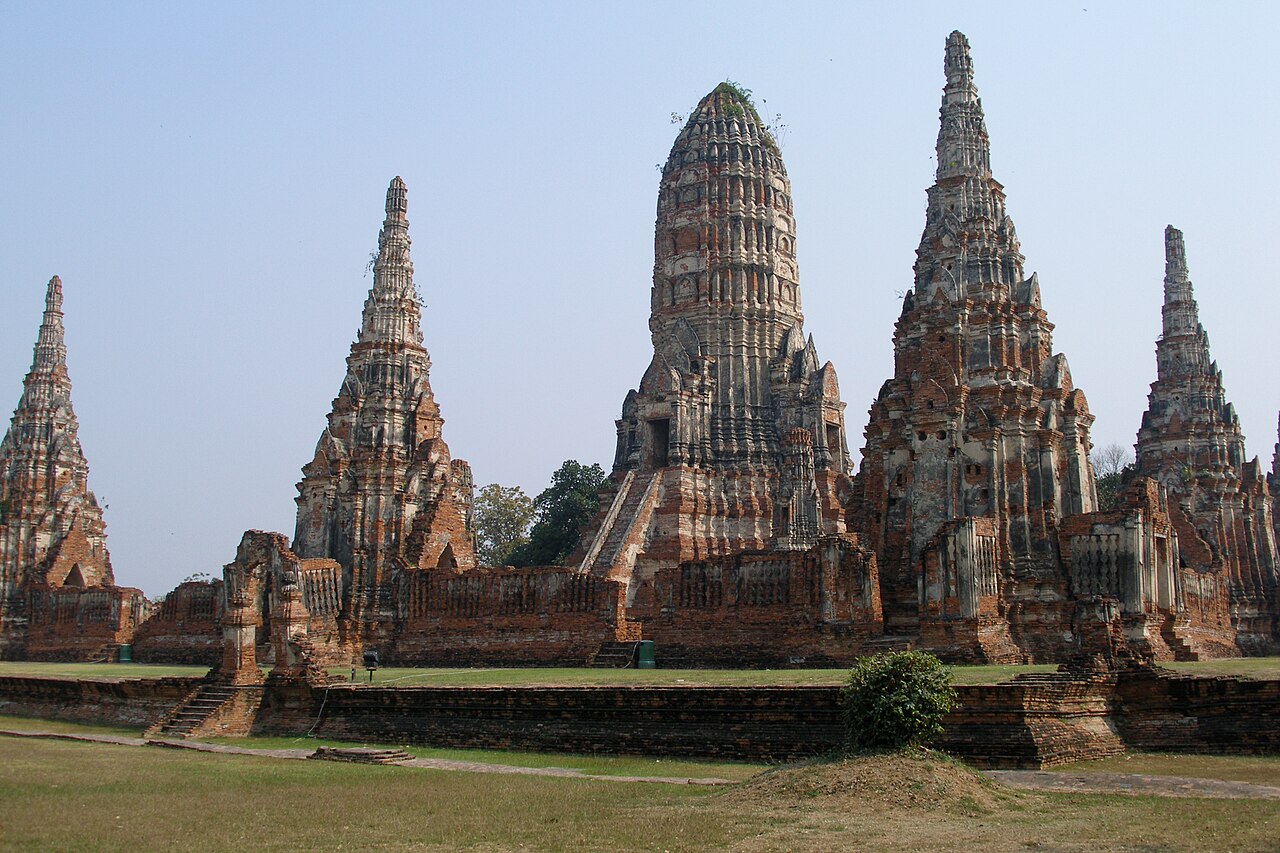
Around 80 kilometres north of Bangkok lie the ruins of the city that was the centre of the Siamese kingdom for more than four hundred years, until the Burmese army burned it in 1767. The historical park has been on the UNESCO list since 1991. The most photographed spot is the Buddha head wrapped in tree roots at Wat Mahathat, but our favourite is Wat Chaiwatthanaram on the riverbank, which looks like a smaller Angkor and is at its best towards evening.
You pay at each temple separately or buy a combined ticket. The sites are kilometres apart, so hire a bike near the station or take a tuk-tuk for a loop. Trains run from Bangkok several times a day. A day trip is enough, but if you want the ruins without the crowds, stay overnight and head out early in the morning.
3. Floating markets: Damnoen Saduak or Amphawa
Everyone knows the picture of little boats piled high with fruit, but there are two markets and they are quite different. Damnoen Saduak, about a hundred kilometres south-west of Bangkok, is the biggest and best known, and also the most touristy. People come in the morning, most of the selling is aimed at visitors, and plenty of them leave feeling they have just walked through a film set. Amphawa is smaller and comes alive mainly on weekend afternoons and evenings. Thais do their shopping here, and you sit on the steps by the canal while grilled seafood is passed up to you straight from the boats.
We would go to Amphawa. Stay until dark and you can take a boat out to see the fireflies that light up the trees along the water after sunset.
4. Maeklong Railway Market
Not far from Amphawa, in the town of Samut Songkhram, the market is held right on the railway line. Several times a day a train rolls in, the stallholders pull back their awnings at the last moment and slide their baskets of vegetables a few centimetres out of the way. The train passes, and a minute later the market is back. It sounds like a tourist show, and it partly is, but it is still a normal market where local people buy their fish and vegetables. Check the train times before you go, or you will only see the market. Maeklong and Amphawa make an easy combined day out.
5. The Bridge on the River Kwai and the Death Railway
Kanchanaburi lies about 130 kilometres west of Bangkok, and people come for the bridge that became the symbol of the Thailand–Burma Railway built during the Second World War. The line was built by prisoners of war and forced labourers from across Asia, and tens of thousands died doing it, hence the name Death Railway. The bridge itself is an unremarkable iron structure you can walk across. What stays with you more is the war cemetery in town and a train ride along the original line beside the cliff at Tham Krasae, where a wooden viaduct hangs above the river.
Give Kanchanaburi at least two days so you have time for places 6 and 7 as well. Our favourite part is sleeping in a floating hotel right on the river.
6. Hellfire Pass
This is the stretch of the railway where prisoners cut through solid rock by hand, at such a pace and in such conditions that it became known as Hellfire Pass. There is a museum and a memorial walking trail along the old railbed, through the cutting and on into the forest. It is a place where people lower their voices, and to us the most powerful stop in the whole region. It lies well beyond Kanchanaburi town on the road towards the Myanmar border, so you need a car, a scooter or a tour.
7. Erawan National Park
A seven-tier waterfall with turquoise pools you can swim in. The lower tiers are an easy walk, the upper ones a proper climb over roots and rocks, so wear shoes, not flip-flops. Entry to the park costs 300 THB (about £7) for an adult foreigner and 200 THB for a child (tourismthailand.org). Arrive as soon as it opens: around midday the coaches from Bangkok pull in and the pools start to look like a public swimming bath. And never leave food unattended, the monkeys here steal with real professionalism.
8. Khao Yai National Park
Thailand’s oldest national park and, since 2005, part of the Dong Phayayen–Khao Yai Forest Complex UNESCO World Heritage Site. It lies about three hours’ drive north-east of Bangkok and is one of the few places in Thailand where you have a real chance of seeing wild elephants, sometimes right on the road through the park. Add gibbons, hornbills and deer. You may recognise Haew Suwat waterfall from the film The Beach. Entry costs 400 THB (about £9) for an adult foreigner and 200 THB for a child (tourismthailand.org).
Getting around without a car or a guide is hard, as distances inside the park are long. For wildlife spotting we have had the most luck early in the morning and in the late afternoon.
9. Ko Samet
The nearest proper island to Bangkok, about three and a half hours away including the ferry from Ban Phe pier. The whole island is part of a national park, so you pay the park fee on arrival. The sand is fine and white, there are hardly any cars and it rains less here than in the south. At weekends and on Thai public holidays, though, half of Bangkok moves in. We would go on a weekday for two or three nights, as a break between the city and the next leg of the trip.
10. The Sanctuary of Truth in Pattaya
For most people Pattaya means nightlife and nothing else. On the edge of town, though, stands one of the strangest buildings in Thailand: a huge temple made entirely of wood and covered in carvings from the foundations to the tips of its spires. Work started in 1981 and it is still not finished, so next to the completed sections you can watch the carvers at work. We would not waste time on Pattaya itself, but the Sanctuary of Truth is worth a stop on your way east, for example to Ko Samet or Ko Chang.
11. Hua Hin
Thailand’s oldest seaside resort, about 200 kilometres south of Bangkok, where the royal family has spent its summers since the 1920s. The sea is not the turquoise of the south and the beach feels more like a town beach, but it is calm, the night markets have excellent food and the town has one of the prettiest railway stations in the country, built of wood, with an old royal waiting pavilion. It suits families and anyone who wants a few days by the sea without another flight. And it is close to place 12.
12. Phraya Nakhon Cave in Khao Sam Roi Yot
In the national park south of Hua Hin there is a cave with a collapsed roof, where in the late morning a shaft of sunlight falls straight onto a small pavilion built for King Chulalongkorn. It is one of the most photographed scenes in Thailand, and unlike many others it is not a camera trick. You reach the cave from Laem Sala beach by a steep uphill path, and you get to the beach itself either on foot over a rocky headland or by boat. Expect a hot climb and bring water. The light beam is at its best in the late morning.
Central and north-east Thailand: Khmer temples and the first kingdom
Between Bangkok and Chiang Mai lies a region most tourists fly over. Yet this is the cradle of the Thai state, and in the north-east, in the region of Isan, you find temples built by the same Khmers who built Angkor.
13. Sukhothai
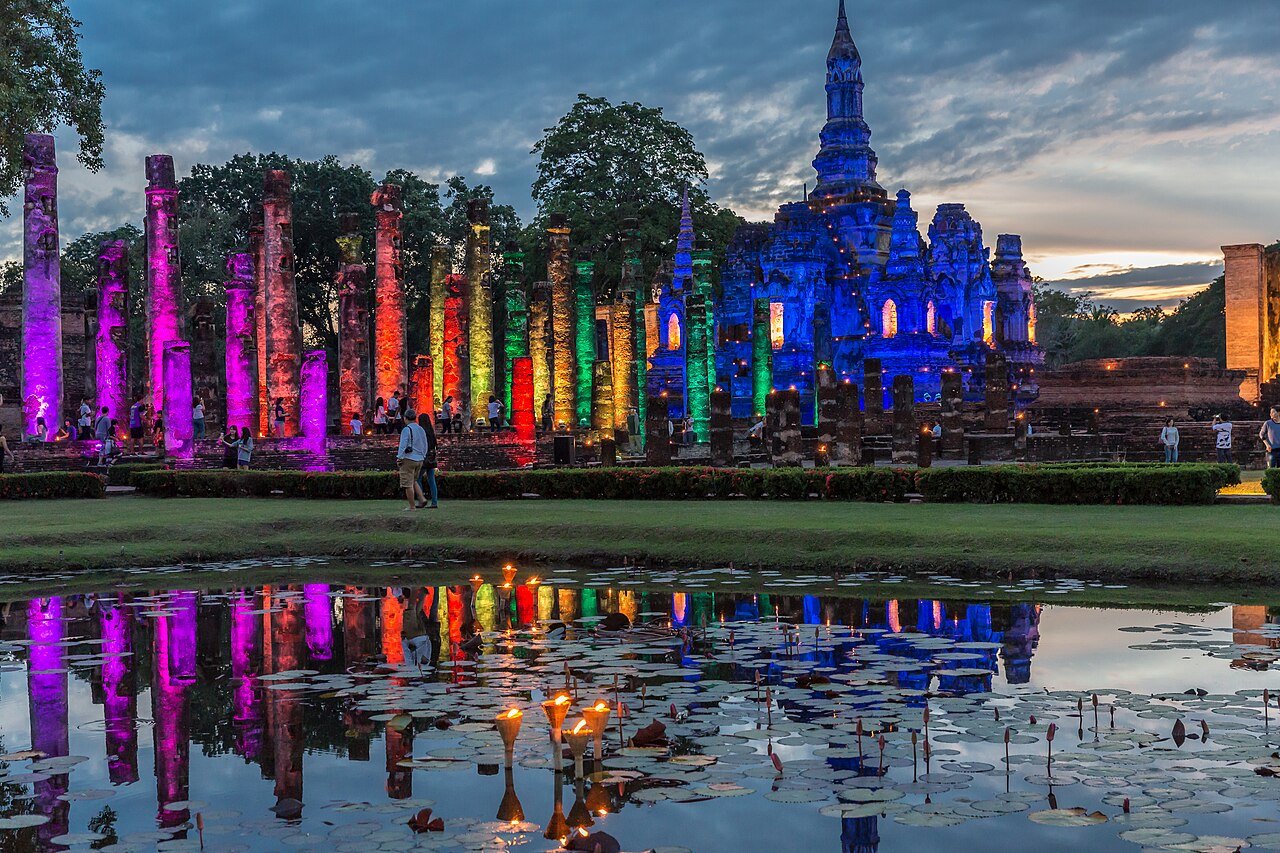
The first Thai kingdom was founded here in the 13th century, and its capital is now a historical park on the UNESCO list (1991). Compared with Ayutthaya there is more greenery, more lotus ponds and more peace, and the Buddha statues have the slender, graceful lines typical of the Sukhothai style. You can cycle round the central zone with Wat Mahathat in a morning. Beyond it is Wat Si Chum, where a huge seated Buddha peers out through a narrow gap in the wall.
The park lies roughly halfway between Bangkok and Chiang Mai, about six to seven hours from Bangkok by bus. It makes an ideal stop on the way north, and one or two nights are enough. In November the town celebrates Loy Krathong with candles floating on the water, and we think it is one of the most beautiful places in the country to see it.
14. Si Satchanalai and Kamphaeng Phet
Two associated historic towns belong to the same UNESCO inscription as Sukhothai. Si Satchanalai, about an hour to the north, is Sukhothai without the people: ruins in the forest, a temple ringed by stone elephants at its base and hardly anyone around. Kamphaeng Phet lies to the south, on the way from Bangkok, with laterite temples hidden among the trees. If you have time in the north, add at least Si Satchanalai to Sukhothai. We liked it more than the main park.
15. Phanom Rung
A Khmer temple of sandstone and laterite, built on the rim of an extinct volcano in Buri Ram province. A long processional walkway lined with stone posts and a staircase decorated with naga serpents lead up to the main sanctuary. A few times a year the sun rises or sets exactly through all fifteen doorways of the main axis, and thousands of people come to watch. Just below the hill is the smaller Muang Tam temple with its ponds. If you love history and have already seen Ayutthaya and Sukhothai, this is the logical next step.
16. Phimai
Another Khmer temple, this time right in the middle of a small town in Nakhon Ratchasima province, about four hours from Bangkok. It is older than Angkor Wat in Cambodia and resembles it in many ways, and because tour groups rarely come here you will have it almost to yourself. Phimai and Phanom Rung can be combined into one trip of two to three days, with Khao Yai on the way back.
17. Chiang Khan and Loei province
Loei, in the north-east on the border with Laos, is one of the few places in Thailand where you will want a jacket in winter. The little town of Chiang Khan has a street of wooden houses along the Mekong, where monks collect alms early in the morning and where everyone strolls along the river in the evening, looking across to Laos. Thais come here mostly in winter, and you will meet few foreigners. Nearby is the Phu Kradueng plateau, a climb of several hours on foot, which is usually closed to visitors during the rainy season.
Northern Thailand: Chiang Mai, Chiang Rai and the mountains
The north is a different Thailand: cooler nights, mountains, the culture of the former Lanna kingdom, cafés and markets. The best time to go is November to January. From February until about April the fields are burned and smog settles in the valleys, which at times puts Chiang Mai among the cities with the worst air in the world.
18. Chiang Mai Old City
King Mangrai founded Chiang Mai in 1296 as the capital of the Lanna kingdom. The old city is an almost perfect square with sides of about 1.6 kilometres, surrounded by a moat and the remains of brick walls. Inside are dozens of temples, the most important being Wat Chedi Luang with its massive, partly collapsed chedi, and Wat Phra Singh. On Sunday evenings the main street turns into the Sunday Walking Street, a huge market of food and crafts, and on Saturdays a similar market runs on Wualai Road.
Chiang Mai is the best base for the whole north: Thai cooking classes, massages, cafés, markets and trips into the hills. Give the city itself at least three days. From Bangkok it is about an hour’s flight, or you can take the overnight train, which is an experience in itself.
19. Wat Phra That Doi Suthep
The most sacred temple in the north stands on the mountain above the city, and on a clear day its terrace looks out over the whole valley. A staircase of more than three hundred steps, flanked by two long naga serpents, leads to the golden chedi, and there is also a cable car. From town a winding road of about fifteen kilometres climbs up the mountain, served by red shared songthaews. Go early in the morning before the tour groups arrive, or late in the afternoon. Cover your shoulders and knees, and take your shoes off.
20. An ethical elephant sanctuary
There are dozens of “elephant parks” around Chiang Mai and only some of them deserve the name. Riding, painting, tricks and bathing on command all mean the animal has been through brutal training. A good sanctuary offers only observation from a distance, small groups and elephants that move around freely. The best known is Elephant Nature Park, home to elephants rescued from circuses and the logging industry. Book ahead, as places sell out. Our rule of thumb: if the programme includes the words “ride” or “bathing”, look elsewhere.
21. Doi Inthanon
Thailand’s highest mountain (2,565 m) and a national park about two hours’ drive from Chiang Mai. At the summit it is ten or more degrees cooler than in town, with a moss forest and the short Ang Ka nature trail on boardwalks. Below the summit stand two royal chedis surrounded by gardens, and on the way up you pass the Wachirathan and Mae Ya waterfalls and hill-tribe villages with rice terraces. Bring a jumper, and if you want sunrise above the clouds, set off while it is still dark.
22. Chiang Dao
An hour and a half north of Chiang Mai, the limestone massif of Doi Chiang Dao, one of the highest mountains in the country, rises above the plain. At its foot is a cave with a temple and passages a kilometre long, which you can explore with a local guide and a paraffin lamp, and around it are small eco-lodges and cafés with mountain views. For us, Chiang Dao is the best place in the north to slow down. There is nothing you have to do here, and that is the whole point.
23. Pai
A small town in a mountain valley, reached from Chiang Mai along Route 1095 with its 762 bends. A minivan takes about three hours, and if you get travel sick, take a tablet. Pai is famous for its laid-back atmosphere, yoga and the evening market on Walking Street. Around town are the Pai Canyon viewpoints (best at sunset), hot springs, Pam Bok waterfall, the Boon Ko Ku So bamboo bridge across the rice fields and the Chinese village of Santichon.
Pai is very touristy these days, but in the morning, when the mist lifts from the valley, it is still worth it. Two or three days are enough. And only hire a scooter if you already know how to ride one. Bandaged knees are the most common souvenir here.
24. Mae Hong Son and Tham Lod cave
Beyond Pai the road climbs on into the mountains to Mae Hong Son, a hill town near the Myanmar border with Burmese-style temples beside a lake. The full loop from Chiang Mai via Pai, Mae Hong Son and Mae Sariang and back is around 600 kilometres and is the most famous motorbike route in South-East Asia. On the way, stop at Tham Lod (also called Nam Lod) cave near Pang Mapha. A river flows through it, you explore it on a bamboo raft, and in the evening thousands of swifts fly out of it. Allow four to seven days for the loop, and if you have never ridden a motorbike in the mountains, do not start here.
25. The White Temple (Wat Rong Khun)
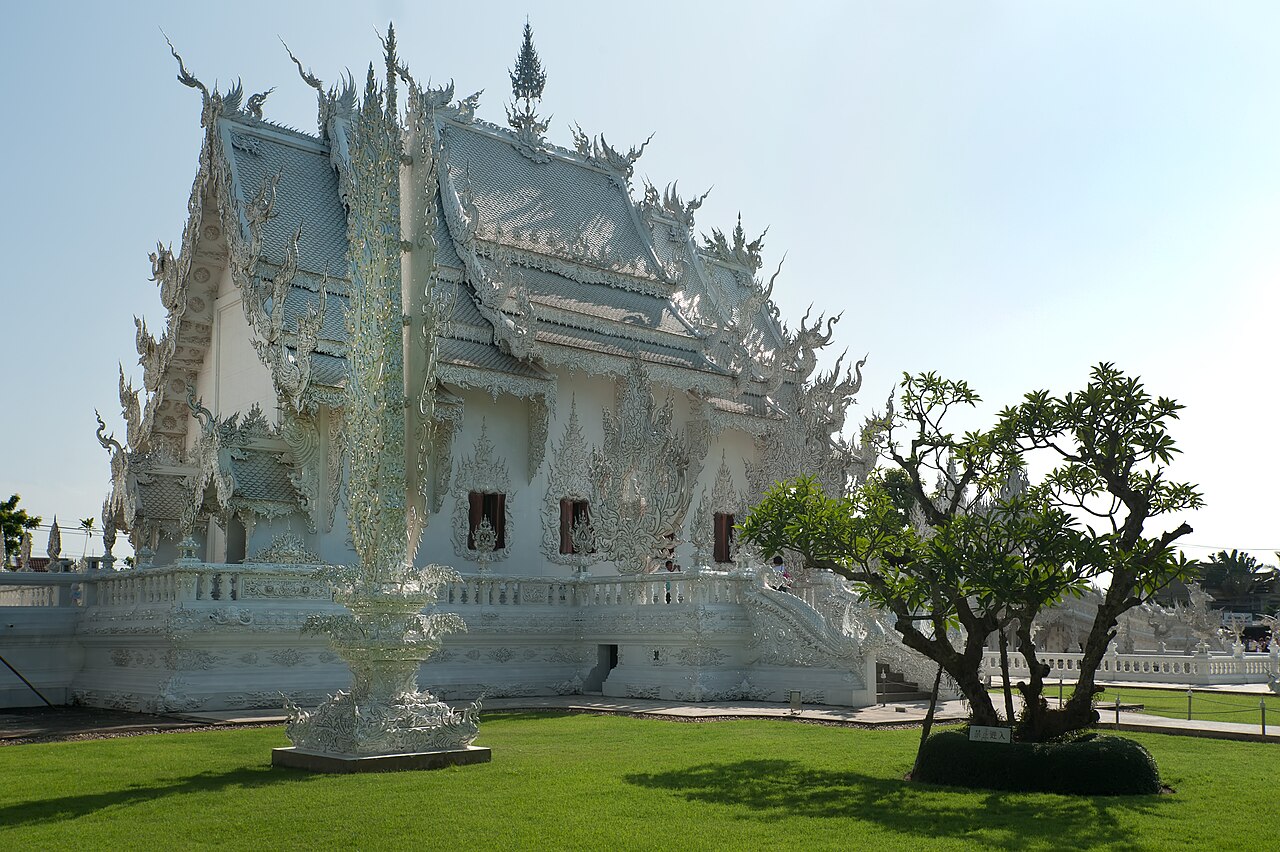
About 13 kilometres south of Chiang Rai stands a temple that looks less like a temple and more like a sculptor’s dream. It is entirely white, studded with fragments of mirror, and a bridge leads across “hell”, where hundreds of sculpted hands reach up towards you. The artist Chalermchai Kositpipat has been building it with his own money since 1997, and it will not be finished for a long time. Inside are murals in which you can spot characters from films and comics. Entry for foreigners is 100 THB (about £2, tourismthailand.org). Come first thing in the morning, later on it gets packed.
26. The Blue Temple (Wat Rong Suea Ten)
Right in Chiang Rai itself: deep blue with gold details and a large white Buddha inside. It is newer and smaller than the White Temple and was built by a pupil of Chalermchai Kositpipat. There are fewer people and more calm, and the colours inside make your head spin a little. We liked it almost more than its more famous white neighbour.
27. The Black House (Baan Dam)
The opposite of the White Temple. A complex of around forty dark buildings on the northern edge of Chiang Rai, created by the painter Thawan Duchanee. Inside you find hides, horns, bones and crocodile skulls laid out on tables. The whole place feels dark and unsettling, and some people find it too much. It is more a museum and an art project than a temple. The White Temple, the Blue Temple and the Black House fit easily into one day.
28. The Golden Triangle
The spot where the borders of Thailand, Laos and Myanmar meet at the confluence of the Mekong and Ruak rivers. Once the centre of opium growing, today it has a viewpoint, a big golden Buddha, souvenir stalls and the Hall of Opium, a museum about the history of the drug trade. The triangle itself is mostly symbolic and what you actually see is two rivers. The museum is good, though, and so is a boat trip on the Mekong. Combine it with the little town of Chiang Saen and its ruins and you have a pleasant day out from Chiang Rai.
29. Nan
A province on the Lao border that very few foreigners ever reach. The main reason to come is Wat Phumin and its 19th-century murals, including the famous scene of a whispering couple that appears on posters and postcards all over Thailand. Around the town are rice fields and the mountains of Doi Phu Kha National Park. Nan is one for your second or third trip to Thailand, when you already know what to expect from the north and want it without the crowds.
The Andaman Sea: limestone cliffs and the west coast islands
The west coast is the Thailand of the posters: limestone towers rising out of the sea, longtail boats with coloured ribbons on their bows and islands with no roads. The season here runs roughly from November to April. During the south-west monsoon (roughly May to October) the sea is often rough and some boat routes and national parks do not operate.
30. Phuket
Thailand’s largest island and the easiest place to reach by the sea, with an international airport and hundreds of hotels. It is busy and the main beaches such as Patong are crowded, but it also has quieter bays in the south and north, the colourful Phuket Old Town with its Sino-Portuguese shophouses, the Big Buddha statue on a hilltop and the Promthep Cape viewpoint at the southern tip. For us, Phuket is above all a good base for boat trips. Which beach to choose and where to stay is covered in our Phuket guide.
31. Krabi and the Railay peninsula
Krabi province has more dramatic scenery than Phuket and a little more peace. The main base is Ao Nang, where the boats leave for the islands, but the highlight is the Railay peninsula. Limestone walls cut it off from the mainland, so you can only get there by boat. There is Phra Nang beach beneath the cliffs, world-class climbing routes, and a viewpoint and lagoon you reach by scrambling up ropes. Add the Tiger Cave Temple with more than a thousand steps, and trips to the Four Islands or the Hong Islands. It is all in our Krabi guide.
32. Ko Phi Phi
The islands where The Beach was filmed. Only Phi Phi Don is inhabited, with the village of Tonsai, a viewpoint and beaches. Its neighbour Phi Phi Leh, home of Maya Bay, is an uninhabited national park: swimming in the bay is banned and it closes for a set period each season. Most people come on a day trip from Phuket or Krabi and head back in the evening. We would stay at least one night, because in the morning, before the first boats arrive, Phi Phi is a completely different place. Ferries, fees and where to stay are in our Ko Phi Phi guide.
33. Phang Nga Bay and James Bond Island
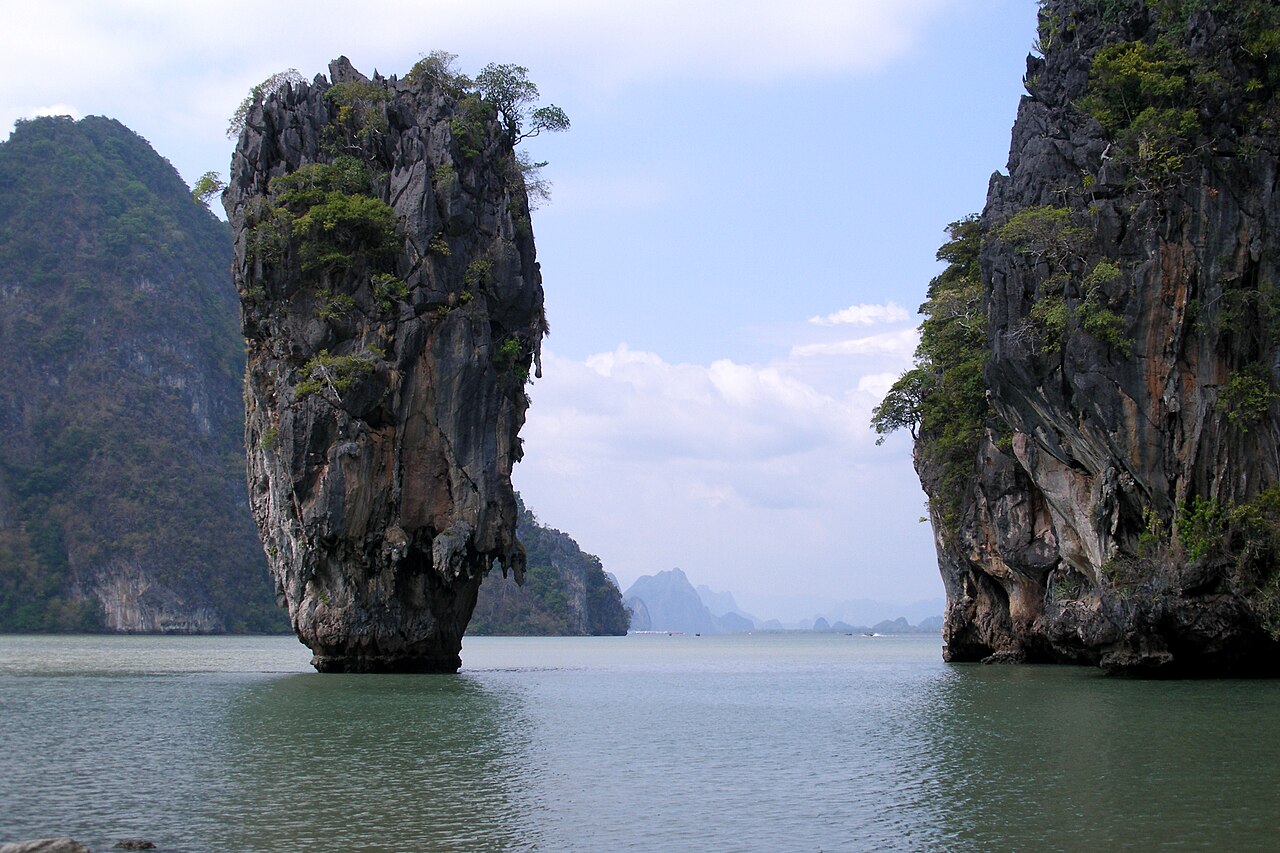
Between Phuket and Krabi lies a shallow bay with hundreds of limestone rocks and islets. The most famous is Ko Tapu, a slender rock needle, and the neighbouring Khao Phing Kan, where the 1974 Bond film The Man with the Golden Gun was shot. Boats are not allowed to approach Ko Tapu, so you photograph it from the beach on Khao Phing Kan. That beach is packed in high season, which is why we think “James Bond Island” itself is the weakest part of the whole trip.
The rest of the bay is better: Ko Panyee, a Muslim village built entirely on stilts over the water, with a football pitch on a floating platform, and above all the kayaking. Hidden inside the limestone islands are lagoons (hongs) that you paddle into through caves at low tide, and no big boat fits through. If you can, choose a trip that includes kayaks.
34. Ko Yao Noi and Ko Yao Yai
Two islands in the middle of Phang Nga Bay, exactly halfway between Phuket and Krabi, with boats from both. Most people here live in Muslim fishing communities, rubber and coconut plantations alternate with rice fields, and in the evening there are no bars and no loud music. From the beaches you look out at the limestone towers of the bay, the same view people on Phuket pay to see from a boat, here for free from a hammock. If you want the Andaman without the resorts, we think this is the easiest option.
35. Khao Lak
A stretch of long beaches on the mainland north of Phuket, quieter and more family-friendly than Phuket and the best base for trips to the Similan and Surin Islands. The 2004 tsunami hit Khao Lak harder than anywhere else in Thailand. A reminder is the police boat the wave carried far inland, which now stands as a memorial in the middle of the fields. Khao Lak suits people who want peace and quiet by the sea, diving and short transfers.
36. The Similan Islands
A national park out in the open sea, about an hour and a half by speedboat from Thap Lamu pier near Khao Lak. Granite boulders, white sand and water often described as the clearest in Thailand, and according to the Tourism Authority of Thailand one of the best dive sites in the world. The park is only open part of the year. For the 2026/2027 season it is open from 15 October 2026 to 15 May 2027 (park announcement, Bangkok Post), and after that it closes so that nature can recover. The fee for an adult foreign visitor is 500 THB (about £11) and 250 THB for a child. Daily visitor numbers are capped, so in high season book your trip well ahead.
A day trip is mostly about the boat ride and the crowd on the one beach where everyone lands. If you dive, choose a liveaboard trip and you will see the park in peace.
37. The Surin Islands
Further north than the Similans, closer to the Myanmar border, and with even fewer people. The snorkelling straight off the beach is better, and there is a village of Moken sea nomads, who live on land for only part of the year. The fee is the same as on the Similans, 500 THB for an adult foreigner (tourismthailand.org), and boats leave from Khura Buri. For snorkellers we think this is a better choice than the Similans.
38. Ko Lanta
A long island south of Krabi and a quieter alternative to Phuket and Phi Phi. The beaches run one after another down the west coast, and the further south you go, the fewer people there are. On the east side is Lanta Old Town, an old fishing village of wooden houses on stilts over the water, and at the southern tip lies Mu Ko Lanta National Park with its lighthouse. From Lanta you can go snorkelling and diving around Ko Rok and Ko Ha. It suits families and couples who want a week in one place. Do not come for just one night: the trip from Krabi takes a few hours, including two ferries.
39. Ko Muk and Ko Kradan
Islands in Trang province south of Lanta that rarely make it into the usual guides. Ko Muk has the Emerald Cave (Tham Morakot): at low tide you swim into a dark tunnel in the rock and, after about eighty metres in the dark, come out into a small lagoon with a beach, enclosed on every side by cliffs. Neighbouring Ko Kradan has no roads, and the coral reef starts a few metres from the shore. Out of season many hotels and restaurants close, so this is a typical December to March destination. For us, one of the most beautiful places on the whole Andaman coast.
40. Ko Lipe
A small island right in the far south, close to the Malaysian border, near Tarutao National Park. The sea is crystal clear, Sunset Beach and Pattaya Beach have the most beautiful sunsets we know of in Thailand, and you get around the island on foot. The journey is long: from Bangkok it takes almost a full day, with the speedboat leaving from Pak Bara pier. In season, boats also run from the Malaysian island of Langkawi, so Lipe fits nicely into a trip to Malaysia. We have a separate article on Langkawi island. For a one-week trip to Thailand, Lipe is not worth it. For three weeks, it is.
41. Ranong and Ko Phayam
At the very northern end of the Andaman coast, on the border with Myanmar, lies Ranong province with its islands Ko Phayam and Ko Chang (not to be confused with the big Ko Chang in the east). Electricity from generators, tracks for scooters, beach bungalows and an atmosphere that elsewhere in Thailand only older travellers remember. If you like to switch off completely, come here. Ranong town also has hot springs where the locals bathe.
42. Khao Sok and Cheow Lan Lake
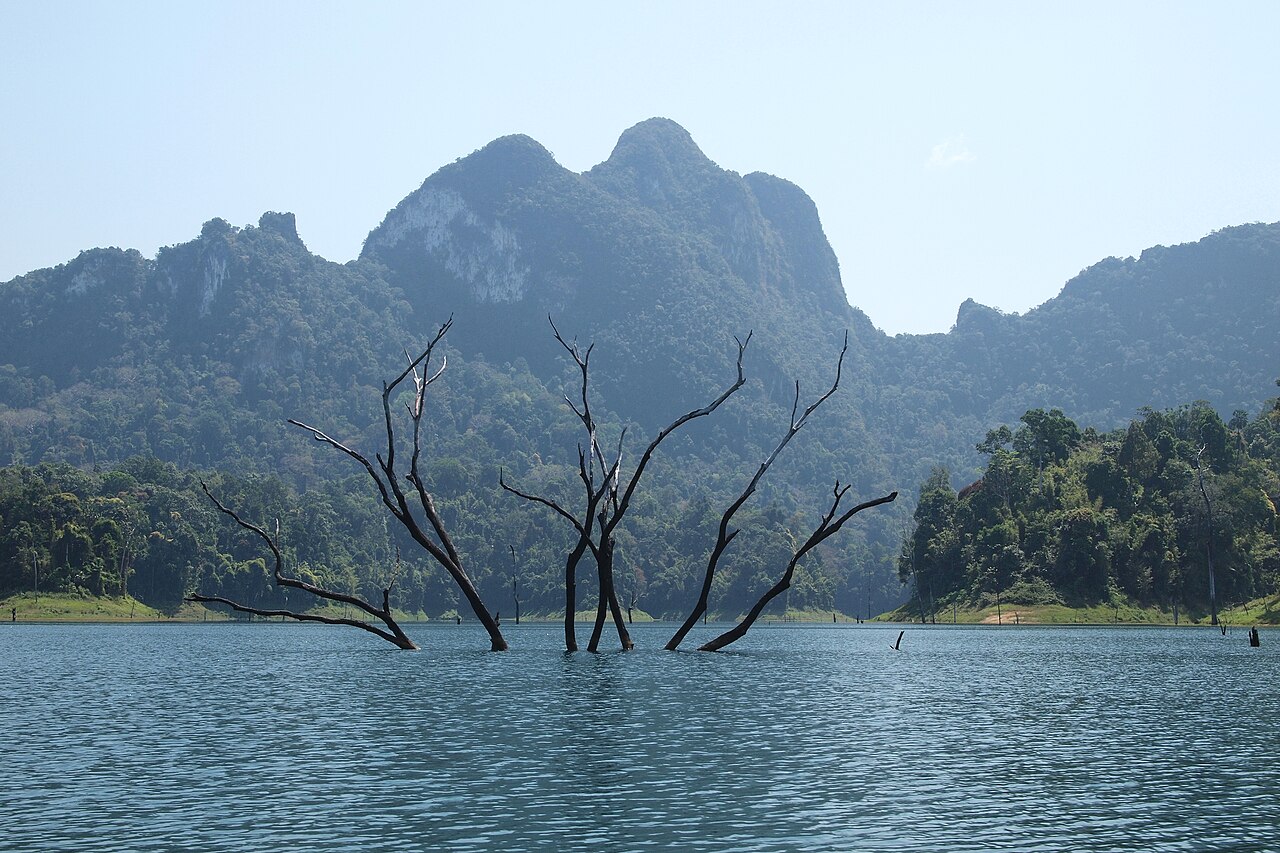
An inland rainforest between the Andaman Sea and the Gulf, one of the oldest in the world and a national park since 1980. At its heart is Cheow Lan, a reservoir with limestone towers rising out of the water, where you sleep in floating bungalows, go canoeing in the morning and hear gibbons in the evening. With a bit of luck you may also see a rafflesia, the largest flower in the world. Park entry costs 300 THB (about £7) for an adult foreigner and 150 THB for a child (tourismthailand.org).
Give Khao Sok two or three days, with one night on the lake. We think it is the best break between beaches, and it also works as a way to cross from the Andaman side to the Gulf. Some lists include it among the UNESCO sites, but it is not on the World Heritage List.
The Gulf of Thailand and the south
The east side of the peninsula runs on a different weather pattern. Most of the rain falls roughly from October to December, but in summer, when the monsoon is blowing on Phuket, Samui and the nearby islands are usually lovely. If you are travelling to Thailand in July or August, this is the side to head for.
43. Ko Samui
Thailand’s second-largest island and the most comfortable one in the Gulf, with its own airport served by Bangkok Airways. Chaweng and Lamai beaches are lively, while Maenam and Bophut in the north are quieter. Worth seeing are the Big Buddha temple on a small island linked by a causeway, the colourful Wat Plai Laem, the Na Muang waterfalls and the Hin Ta and Hin Yai rocks, which locals call Grandfather and Grandmother with a knowing smile. Samui is one of the more expensive places in Thailand, for both flights and hotels. For families with children, though, the ring road round the island and the short transfers make it one of the best choices in our view.
44. Ang Thong National Marine Park
An archipelago of forty-two islands west of Samui, with limestone cliffs, lagoons and a beach where boats can anchor. The best-known sights are the viewpoint on Ko Wua Talap, which looks out over the whole archipelago, and Thale Nai, a saltwater lake enclosed by rock on Ko Mae Ko. People come on a full-day trip from Samui or Pha Ngan, often with kayaking. During the heaviest rain at the end of the year, boats may not sail because of the sea.
45. Ko Pha Ngan
The world knows it for the Full Moon Party, a night on Haad Rin beach at full moon that draws thousands of people. But the party takes place on just one tip of the island and has almost nothing to do with the rest of it. The hilly interior is quiet and full of yoga and meditation retreats, and the best beaches are in the north and east, such as Bottle Beach or Haad Salad, some of them reachable only by boat. If you are not here for the party, avoid Haad Rin. And never leave your drink unattended: foreign ministries, including the UK Foreign Office, warn about drinks being spiked here.
46. Ko Tao and Ko Nang Yuan
A small island in the Gulf that is one of the cheapest places in the world to learn to dive. There are dozens of dive schools, and the best-known sites include Chumphon Pinnacle and Japanese Gardens. Just off the coast lies Ko Nang Yuan, three islets joined by sandbars, with the viewpoint that gives you the famous photo of Ko Tao. Three or four days are enough for snorkelling and relaxing. For a beginner’s diving course, allow about a week.
47. Nakhon Si Thammarat
Thailand’s newest UNESCO site: Wat Phra Mahathat Woramahawihan in Nakhon Si Thammarat was inscribed on the World Heritage List in 2026. Its white chedi, built in the style of a Sri Lankan stupa, is one of the most sacred in the south and draws pilgrims from all over the country. The town itself is lively, not geared up for tourists and excellent for food, with a southern cuisine that is among the spiciest in the country. It lies on the mainland south of Samui and makes a good stop on the way from the Gulf to the far south.
48. Thale Noi Lake in Phatthalung
A wetland in the south that, when in bloom, turns into a lake full of pink water lilies and lotuses, which you visit by boat at dawn. They flower roughly between late winter and early spring, and the best time is early morning, when the flowers open and mist still hangs over the water. It is also a bird reserve with dozens of species of waterbirds. A place you travel to for a single morning and remember for years.
The east: islands near the Cambodian border
The east coast has a similar season to the Andaman side (best from December to March), but fewer people and a shorter overland journey from Bangkok.
49. Ko Chang
Thailand’s third-largest island, largely covered in jungle and protected as a national park. The west coast has sandy beaches, the interior has waterfalls such as Khlong Plu, and in the south is the fishing village of Bang Bao, with houses on stilts and a pier lined with restaurants. Ferries leave from the mainland near Trat, and from Bangkok the whole journey takes around five to six hours including the ferry. September and October are the wettest months, and many places close. The monkeys by the roadside will grab your snacks, so do not hold them in your hand.
50. Ko Kut and Ko Mak
If Ko Chang leaves you wanting even more peace, carry on south. Ko Kut has clearer water than the rest of the east, the Khlong Chao waterfall, which you can walk to, and the fishing village of Ao Salad on stilts over the water. Ko Mak is smaller and flat, covered in coconut and rubber plantations and perfect for cycling. There are no big resorts and no nightlife, and that is exactly their charm. Out of season fewer boats run and some accommodation closes.
How to combine the places into a Thailand itinerary
Thailand is big and moving between regions takes time. The most common mistake we see is trying to fit Bangkok, the north, Phuket and Samui into two weeks. Below are six combinations that we think work, each built from the numbered places above.
| Route | Places from the list | Days | When | Getting around |
|---|---|---|---|---|
| The first-timer classic | Bangkok (1), Ayutthaya (2), Chiang Mai (18–20), Krabi (31) or Lanta (38) | 14 | November to March | domestic flight or overnight train to the north, flight to the south |
| History and mountains | Ayutthaya (2), Sukhothai (13–14), Chiang Mai (18–21), Chiang Rai (25–28), Pai (23) | 12–16 | November to January | train and buses, flight back to Bangkok from Chiang Rai |
| Summer by the sea | Bangkok (1), Ko Samui (43), Ang Thong (44), Ko Pha Ngan (45), Ko Tao (46) | 12–14 | June to August, February to April | flight to Samui, ferries between the islands |
| Andaman island hopping | Phuket (30), Phi Phi (32), Lanta (38), Ko Muk and Kradan (39), Ko Lipe (40), optionally Langkawi | 14–21 | December to March | ferries and speedboats, island-to-island mainly in season |
| Kanchanaburi and Khao Sok | River Kwai and Hellfire Pass (5–6), Erawan (7), Khao Sok (42), Phang Nga (33) | 10–12 | November to April | train, minibuses, flight or overnight bus to the south |
| East from Bangkok | Bangkok (1), Sanctuary of Truth (10), Ko Samet (9), Ko Chang (49), Ko Kut and Ko Mak (50) | 10–14 | December to March | buses and ferries, no flights |
💡 On your first trip, three regions, not five. Expect the time difference to hit you on the first day after landing (Thailand is seven hours ahead of the UK in winter and six in summer), and every move between regions takes half a day. Our tips for coping are in the article Jet lag: 21 tips on how to handle it.
What we would do differently
If we were planning Thailand again from scratch, we would cross off half of this list. Not because those places are not worth it, but because the best things in Thailand are not on any list. A bowl of khao soi, the curry noodle soup of the north, at a plastic table on a street corner in Chiang Mai. A morning market in a small town where the bus only stops for a moment. A beach on Lanta reached by a dirt track through the rubber trees that nobody has written about. You cannot plan those things. All you can do is leave room for them.
You do not have to see every temple. After the third day in Ayutthaya and Sukhothai they start to blur together, and that is the moment to sit down in the shade with an iced coffee and watch the monks sweeping the courtyard. Try things you do not recognise, even if the menu has no picture. Ask what the cook is eating. And on the islands, keep at least one day free of boat trips, snorkelling and your phone. Thailand can be wonderfully slow if you let it.
Frequently asked questions
What are the best places to visit in Thailand for first timers?
For a first trip, three regions are enough in our view: Bangkok with a day trip to Ayutthaya, the north around Chiang Mai (Doi Suthep, the old city, an ethical elephant sanctuary) and one coast, depending on the month. From November to April go to the Andaman Sea (Krabi, Ko Lanta, Phi Phi), in summer to the Gulf of Thailand (Ko Samui, Ko Pha Ngan, Ko Tao). Allow two weeks for a route like this.
What is there to see in northern Thailand?
Chiang Mai Old City with Wat Chedi Luang and Wat Phra Singh, Doi Suthep temple above the city, Doi Inthanon, the country’s highest mountain (2,565 m), the White Temple, the Blue Temple and the Black House in Chiang Rai, the Golden Triangle, the mountain town of Pai and the Mae Hong Son loop with Tham Lod cave. The best time to go north is November to January. From February to April the fields are burned and the air is often smoky.
What are the best places to visit in southern Thailand?
On the west side: Phang Nga Bay with James Bond Island, the Railay peninsula near Krabi, Phi Phi, Ko Lanta, the Similan and Surin Islands, Ko Muk with the Emerald Cave and Ko Lipe. Inland, the Khao Sok rainforest with Cheow Lan Lake. On the Gulf side: Ko Samui, Ang Thong, Ko Pha Ngan and Ko Tao, and on the mainland Wat Phra Mahathat in Nakhon Si Thammarat, added to the UNESCO list in 2026.
How much are the entrance fees for temples and national parks in Thailand?
According to official sources: the Grand Palace in Bangkok is 500 THB for foreigners, the White Temple in Chiang Rai 100 THB, Erawan and Khao Sok national parks 300 THB, Khao Yai 400 THB, and the Similan and Surin Islands 500 THB for an adult foreigner. As a rough guide, 100 THB is about £2.20. Children pay less in national parks.
When are the Similan Islands open?
For the 2026/2027 season, Similan Islands National Park is open from 15 October 2026 to 15 May 2027. After that it closes every year so that nature can recover. The fee for an adult foreign visitor is 500 THB (about £11), and daily visitor numbers are capped, so in high season book your trip in advance.
Is it ethical to visit elephants in Thailand?
Yes, as long as you choose a sanctuary where the elephants are only observed. Avoid anything that offers elephant rides, shows, painting or bathing on command, because all of that involves harsh training. The best-known sanctuary for rescued elephants is Elephant Nature Park near Chiang Mai, which is worth booking well in advance.
How many days do you need in Thailand?
At least ten days for Bangkok and one beach area, ideally two weeks for three regions. With three weeks you can add Sukhothai, Khao Sok or southern islands such as Ko Muk and Ko Lipe. How long you can stay without a visa depends on your passport and the rules have changed in recent years, so British travellers should check GOV.UK Foreign travel advice before they go.
What are the UNESCO World Heritage Sites in Thailand?
Thailand has nine entries: the historic towns of Ayutthaya and Sukhothai (with the associated towns of Si Satchanalai and Kamphaeng Phet), the Ban Chiang archaeological site, the ancient town of Si Thep, Phu Phrabat, Wat Phra Mahathat in Nakhon Si Thammarat (2026) and three natural sites: the Dong Phayayen–Khao Yai forest complex, the Kaeng Krachan forest complex and the Thungyai–Huai Kha Khaeng wildlife sanctuaries.
Where to next
- Thailand holiday guide: when to go, entry rules, flights, budget and routes for two or three weeks.
- Bangkok guide: the palace, temples, Chinatown, markets, neighbourhoods to stay in and a plan for one to three days.
- Phuket guide: beaches around the coast, Old Phuket Town, day trips and where to stay.
- Krabi guide: Ao Nang, Railay, the Tiger Cave Temple and island trips.
- Ko Phi Phi guide: Maya Bay, ferries, fees and whether to stay the night.
- Malaysia holiday: if you want to carry on across the border from southern Thailand.
Potřebujete pomoct s cestováním?
-
Ubytování 🏨
Vyberte si to nejlepší ubytování, ať už jste kdekoliv, přes Booking.com. -
Půjčení auta 🚗
Auto si snadno najdete přes Booking.com, kde máte často slevu díky ubytování, nebo Rentalcars.com, kde porovnáte nabídky většiny půjčoven. -
Zážitky 🎟️
Přes GetYourGuide.com si vyberete z nejrůznějších výletů i zážitků po celém světě, navíc se zrušením zdarma do 24 h předem.