Last updated 10.11.2026
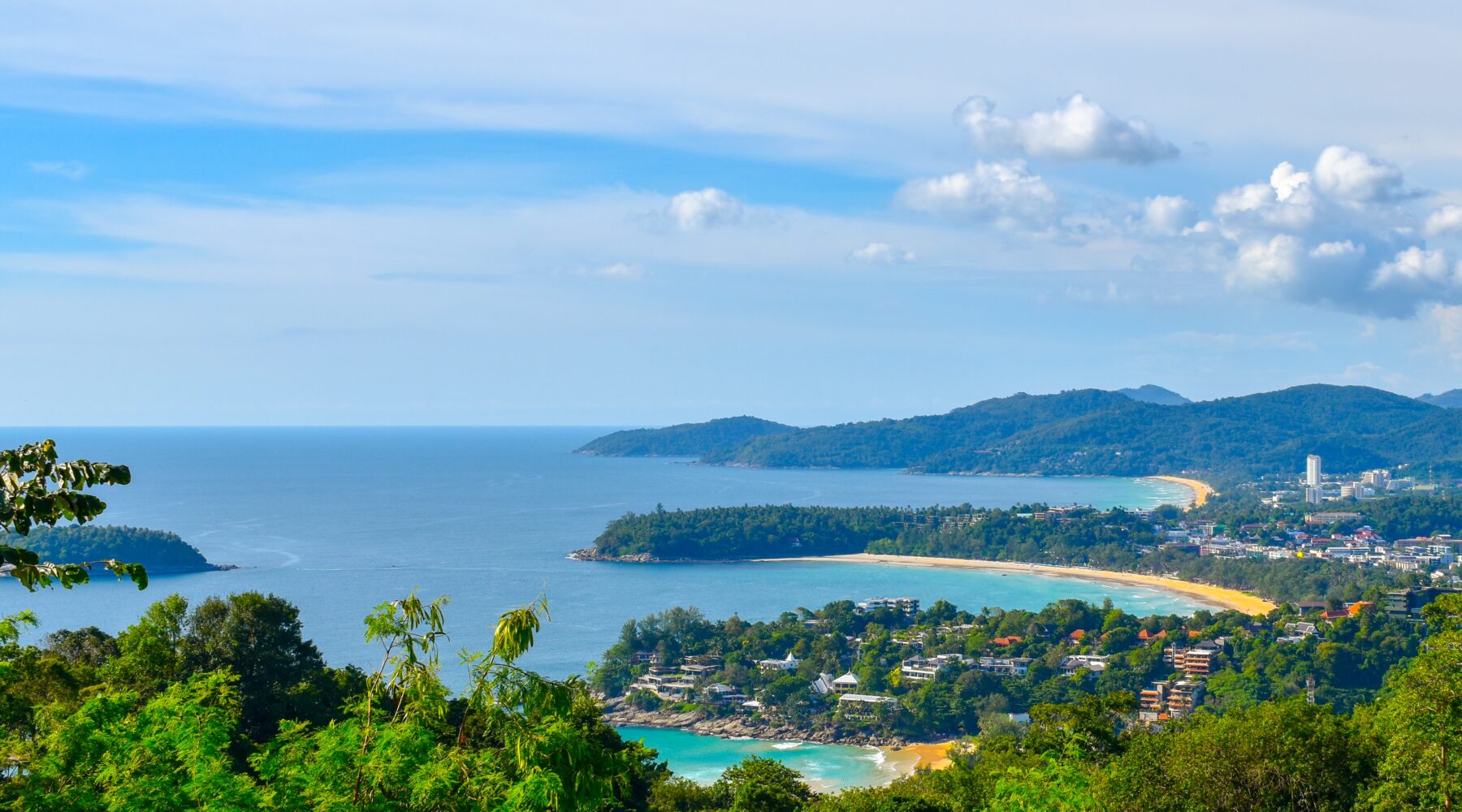
Mention Phuket and most people think of Patong and the neon of Bangla Road at two in the morning. That Phuket is real, and it is every bit as loud as its reputation. But it is a small part of the island. A few kilometres from Patong there are bays where the only thing you hear in the evening is the sea, and in Old Phuket Town you can spend a whole day without going near a sunbed. For many travellers from the UK, Phuket, Thailand is also their first sight of the Andaman Sea: Thailand’s largest island, with an international airport linked to half the world, around ten big beaches on the west coast, an old town built on tin money and piers for boat trips to Phang Nga Bay, Phi Phi and the Similan Islands.
We have picked 25 things to do in Phuket that we think are worth your time, from beaches and viewpoints to temples, markets and boat trips. Around them you will find the practical side: how to get from the airport to your hotel, whether to rent a scooter, when the sea is calm and when red flags go up on the beaches, what to watch out for and which part of the island to stay in. Some of these places will fill a whole day, others are worth an hour on the way to dinner.
Things to do in Phuket: the short version
- Phuket is both an island and a province. It is about 45 km long and joined to the mainland by two parallel bridges. Nearly all the beaches are on the west coast; the east side is muddier and mostly piers and harbours.
- Choose your beach by how you want to spend your evenings. Patong is loud and lives at night, Kata and Karon are the middle ground for families and couples, Kata Noi, Nai Harn, Surin and Bang Tao are quieter, and Mai Khao by the airport is almost empty.
- The Phuket Smart Bus runs from the airport via Patong, Karon and Kata to Rawai for a flat 100 THB (about £2.20). The orange 8411 bus goes to Phuket Town. Grab and Bolt both work here.
- High season runs from December to March. From May to October the southwest monsoon brings rain, big waves and strong currents. A red flag on the beach means no swimming, and even strong swimmers drown here.
- The Big Buddha reopened on 3 March 2026. It had been closed since August 2024, when a landslide came down below Nakkerd Hill near Kata.
- To ride a scooter you need a helmet and the right licence. GOV.UK warns that riding without a valid licence for the vehicle can invalidate your travel insurance.
- Smoking on the beach and e-cigarettes are banned in Thailand. A cigarette on the beach can cost you a fine of up to 100,000 THB; with an e-cigarette you risk detention as well.
- Boat trips: Phang Nga Bay with James Bond Island (national park fee 300 THB), Phi Phi and the Similan Islands (open from 15 October 2026 to 15 May 2027, 500 THB).
Phuket, Thailand: how the island fits together
On the map Phuket looks small. It covers a little over 500 square kilometres, roughly a third of the size of Greater London. In practice the roads climb over hills between the bays, traffic backs up in high season and the drive from the airport to the southern tip takes an hour or more. So pick your base by what you want to do, not by wherever the cheapest room happens to be.
The west coast is one beach after another, separated by rocky headlands. From north to south: Mai Khao and Nai Yang by the airport, Bang Tao with the Laguna resorts, Surin, Kamala, Patong, Karon, Kata, Kata Noi and, in the south, Nai Harn. This is where almost everyone who comes for the sea ends up staying.
Phuket Town sits on the east side of the island, and there is no beach to speak of. What it has instead is an old town of Sino-Portuguese shophouses, markets, cafés and the cheapest beds on the island. If you plan to go on trips most days, it makes a good base.
The south, around Rawai and Chalong, is harbour country. Boats for the southern islands leave from Chalong Pier, Rawai has a seafood market, and plenty of foreigners have settled here long term.
The north and the interior are the greenest part. Here you will find Sirinat National Park with the beaches by the airport, the Khao Phra Thaeo rainforest reserve with its waterfalls, and the rubber plantations that made Phuket rich, along with tin.
| Area | Best for | What to expect |
|---|---|---|
| Patong | nightlife, shopping, first trip to Asia | long beach, Bangla Road, noise until morning, the most services |
| Karon and Kata | families, couples, anyone after a compromise | big beaches, restaurants, quieter evenings, surfing in the monsoon |
| Kata Noi, Nai Harn | peace, swimming, shorter stays | smaller bays, fewer bars, locals and expats at Nai Harn |
| Kamala, Surin | couples, longer stays | mid-sized beaches, smaller resorts, closer to the airport |
| Bang Tao, Mai Khao, Nai Yang | resorts, families, quiet | long beaches, big hotels, not much going on outside the resorts |
| Phuket Town | day trips, food, tight budgets | no beach, old town, markets, buses to every resort |
For a first visit we would split the stay between two bases: a few nights in the Old Town for the food and the atmosphere, then the rest by the sea in the south, in Kata or near Nai Harn. Patong we would save for one evening, not a week.
How to get to Phuket from the UK
Entry rules for Thailand have changed several times in recent years, including how long you can stay without a visa, so check the current rules for British passport holders on GOV.UK Foreign travel advice and, if you need a visa, on the official Thai e-Visa site. A few things apply whatever your passport: you fill in the free online arrival card TDAC no earlier than three days before you land, your passport must be valid for more than six months, and you may be asked to show 20,000 THB per person (about £440) in cash, in baht or another currency. A tourist entry fee has been talked about in Thailand for several years, but it does not yet appear among the official entry requirements.
By air. Phuket International Airport (HKT) is in the north of the island, right behind Mai Khao Beach. From London, Manchester and other UK airports you will usually fly with one stop, typically in the Gulf, in Istanbul or in Bangkok, and the whole journey tends to take around 13 to 16 hours. From Bangkok the flight down to Phuket takes about an hour and twenty minutes. Schedules change from season to season, so compare current options before you book rather than relying on last year’s routes.
By road and by sea. The island is connected to the mainland by the Sarasin and Thao Thep Krasattri bridges. Bangkok is more than 860 km away by road and long-distance buses take around twelve hours. Ferries and speedboats run to Phuket from Krabi and Phi Phi, mostly to Rassada Pier on the east coast. We cover the connections from Krabi in our Krabi guide and from Phi Phi in the Koh Phi Phi guide.
Phuket airport to your hotel
| Transport | Where it goes | Price | Good to know |
|---|---|---|---|
| Phuket Smart Bus | airport, Surin, Kamala, Patong, Karon, Kata, Rawai | 100 THB (about £2.20) | flat fare, pay by card, phone, QR code or cash |
| Airport Bus 8411 (orange) | airport, Phuket Town | by distance, up to 100 THB | public service, stop by exit 3 of the main terminal |
| Grab, Bolt | anywhere | fixed price in the app | pick-up at the marked point, not at the taxi rank |
| Official taxi and limousine | anywhere | fixed price by zone | counters in the arrivals hall, confirm the price before you set off |
| Shared minibus | beach resorts | depends on the beach | leaves when full, drops off hotel by hotel |
The Smart Bus does not run all night, so if you land late in the evening you are left with a taxi or Grab. Airport taxi fares are steep by Thai standards and the figures quoted online vary wildly, which is why we do not give one here. The easiest reality check is to open Grab while you are still in the arrivals hall and compare.
Getting around Phuket
Phuket does have public transport, but it is built mainly around getting from Phuket Town to the beach resorts, not from one beach to the next. Patong to Kata by bus is doable; Kata to Kamala is a lot harder.
The Phuket Smart Bus is the most comfortable option. Besides the airport to Rawai route, there is a line from the Phuket Town bus station to Patong for 50 THB and a free Dragon Line loop around the Old Town. Children under six ride free, and you can pay by contactless card, Apple Pay, Google Pay, Thai QR code or cash (phuketsmartbus.com).
Songthaews are blue open-sided buses with benches down each side. They run from the market in Phuket Town to the individual resorts. They are cheap and slow, and they stop running early in the evening.
Grab and Bolt are the simplest way to get from anywhere to anywhere without haggling. One catch: Grab also offers motorbike taxis, so if you do not fancy riding pillion, choose GrabCar. Local taxis and tuk-tuks in the resorts have a reputation as the most expensive in Thailand, and you need to agree the fare before you get in.
Scooters are what almost everyone rents here, and also the most common reason people fly home in bandages. Thailand drives on the left, as in the UK, but the hill roads between the beaches are steep and slippery in the rain. GOV.UK points out that many travel insurance policies only cover you for a vehicle you are licensed to ride in the UK, so without a full motorcycle licence your insurer may refuse to pay for treatment or getting you home. You also need the 1968 International Driving Permit together with your UK licence, and you cannot buy the permit once you are outside the UK. A helmet is compulsory by law, and riding after drinking is asking for trouble with the police and with your insurer. Never leave your passport as a deposit, and film the scooter from every side when you pick it up.
💡 When to rent a scooter and when not to. If you do not ride a motorbike at home, Phuket is not the place to learn. Grab will take you to the viewpoints and beaches in the south, and boat trips come with hotel pick-up. If you do ride and hold a motorcycle licence plus an IDP, rent a scooter for a day or two and head out in the morning, when the roads are emptier and the sun is not in your eyes.
A car makes sense for families and for anyone who wants to drive round the island in a day. You need the International Driving Permit here too, and parking in the resorts can be hard work.
Best time to visit Phuket
Phuket is on Thailand’s Andaman coast, and its year is shaped by the southwest monsoon. Put simply: from December to March it is dry, the sea is calm and the hotels are full; from May to October it rains, the wind blows in off the sea and the waves are high. April and November are the shoulder months, and September and October are usually the wettest. That does not mean it rains all day in the monsoon. More often a heavy shower comes through and an hour later the sun is out again.
| Months | Weather | Sea | Best for |
|---|---|---|---|
| December to March | dry, least rain | calm, clear | swimming, boat trips, highest prices and biggest crowds |
| April | hottest, more thunderstorms | mostly calm | a last taste of the season at lower prices, Songkran 13 to 15 April |
| May to October | monsoon, showers, humid | waves, strong currents, red flags | surfers, cheap hotels, trips inland and to Phang Nga Bay |
| November | rain easing off | settling down | start of the season, the Similans reopen |
You can still have a good holiday in Phuket during the monsoon, you just plan it differently. Phang Nga Bay is sheltered and boats run there all year, the Similan Islands close from mid-May, and Phi Phi trips get cancelled when the waves are high. Kata and Kalim beaches turn into surf spots at this time of year. Only swim where there is no red flag, though; more on that in the safety section below.
We would go in January or February, or in November or April if you hate crowds. Over Christmas and New Year Phuket’s hotels are at their most expensive, and you need to book months ahead.
Where to stay in Phuket
Choose the area first and the hotel second. Going by the table above: Patong for nightlife, Kata and Karon as the all-rounders, Kata Noi, Nai Harn and Surin for peace and quiet, Bang Tao and the north for resorts, and Phuket Town for food, day trips and a low budget. Room rates can easily halve between high season and the monsoon, so if you are coming between December and February, book as early as you can. Here are five hotels in different areas and price bands:
- Book a Bed Poshtel (Phuket Town): a modern hostel with a pool and breakfast, within walking distance of the Old Town. Good for solo travellers and anyone planning lots of day trips.
- Sugar Ohana Poshtel (Kata): budget-friendly rooms a short walk from Kata Beach, including family rooms. A sensible base for families watching what they spend.
- Andaman Embrace Patong (Patong): a mid-range hotel within walking distance of both the beach and Bangla Road. For people who want to be near the nightlife without sleeping right on top of it.
- The Nai Harn (Nai Harn): a luxury hotel on the hillside above Nai Harn Beach, with views across the bay. For couples and a quiet holiday in the south.
- The Slate (Nai Yang): a design resort by Nai Yang Beach in the north, a few minutes from the airport, with a kids’ club. For families, and for your first or last night.
You can find more places to stay across the whole island here. If your hotel is up on a hill, check whether there is a footpath down to the beach or whether you will be taking a taxi every day. On Phuket that happens more often than you would expect.
25 things to do in Phuket, Thailand
We have ordered them roughly by location: first the beaches from Patong southwards, then the beaches to the north, then the Old Town and the interior, and finally the boat trips. Beaches in Phuket are public and hotels are not allowed to fence off a stretch of sand for their own guests, so you can lie down in front of the most expensive resort on the island. Sunbeds and umbrellas are rented by the day.
1. Patong Beach
Patong is the island’s biggest resort, and its beach runs for more than two kilometres. By day it is an ordinary wide stretch of sand with jet skis, parasailing behind speedboats and vendors selling just about everything; in the evening the action moves one street back into town. Patong has more hotels and restaurants than anywhere else on Phuket, from cheap hostels to big resorts.
Patong works if you want everything within walking distance and do not mind the noise. Do not come here for peace or the clearest water. We liked Patong best in the morning, when the beach is almost empty and the clean-up after the night is still going on. Roads climb over the hills from Patong to Karon in one direction and to Kamala in the other; both are steep and unpleasant in the rain.
2. Bangla Road
This street of roughly four hundred metres, running inland from Patong Beach, is pedestrianised from evening until morning. Bars, clubs, neon signs, music pouring out of every doorway and people trying to wave you inside. It is exactly as loud as it looks in the photos. If you want to see the whole of Phuket, walk down Bangla Road at least once, say after dinner, and then decide whether you are coming back.
A few things worth knowing: ask to see the price before you order in a bar, keep an eye on your drink and your phone, and remember that alcohol in Thailand can officially only be sold between 11am and midnight. Licensed venues in entertainment zones are an exception, and Bangla Road is one of those zones.
3. Freedom Beach
A small bay south of Patong with no road access. You get there by boat from Patong Beach, or on foot down a steep path from the hill between Patong and Karon. Walking in means crossing private land, for which there is a fee, and the path is slippery after rain, so proper shoes beat flip-flops. The reward is white sand, clear water and better snorkelling than on the big beaches.
Freedom Beach stopped being a secret a long time ago, and in high season boats full of day-trippers arrive around midday. If you want the beach to yourself for a while, come in the morning.
4. Karon Beach
At more than three kilometres, Karon is one of the longest beaches on the island. The sand is so fine it squeaks underfoot, a road with a pavement runs alongside it and the hotels sit behind that. Think of it as a calmer version of Patong: plenty of restaurants, a few bars, but you can actually sleep at night. The northern end by the lagoon is quieter; the southern end runs into Kata.
In the monsoon Karon gets big waves and strong rip currents, and the lifeguards put up red flags here a lot. Outside the dry season we would only swim here with care and near the lifeguards.
5. Kata (Kata Yai)
For us, Kata is the best all-round choice on Phuket. The beach is just the right size and framed by green hills, the swimming is good in high season and there is snorkelling off the rocks at both ends. Behind the beach is a small town with restaurants, cafés and shops that is lively without being wild. For families with children it is probably the easiest choice of all.
From May to October Kata becomes one of Phuket’s surf centres, with board hire and lessons for beginners right on the beach. Just offshore sits the small island of Ko Pu.
6. Kata Noi
Little Kata is one bay further south, about a fifteen-minute walk over the hill from Kata. It is smaller, quieter and, many would say, more photogenic. One large hotel lines most of the beach, but the beach itself is public like everywhere else. There are sunbeds, a few stalls and restaurants, and hardly any bars.
If we wanted to stay by the sea in peace and still have Kata ten minutes away by taxi for the evenings, Kata Noi is where we would book.
7. Karon Viewpoint
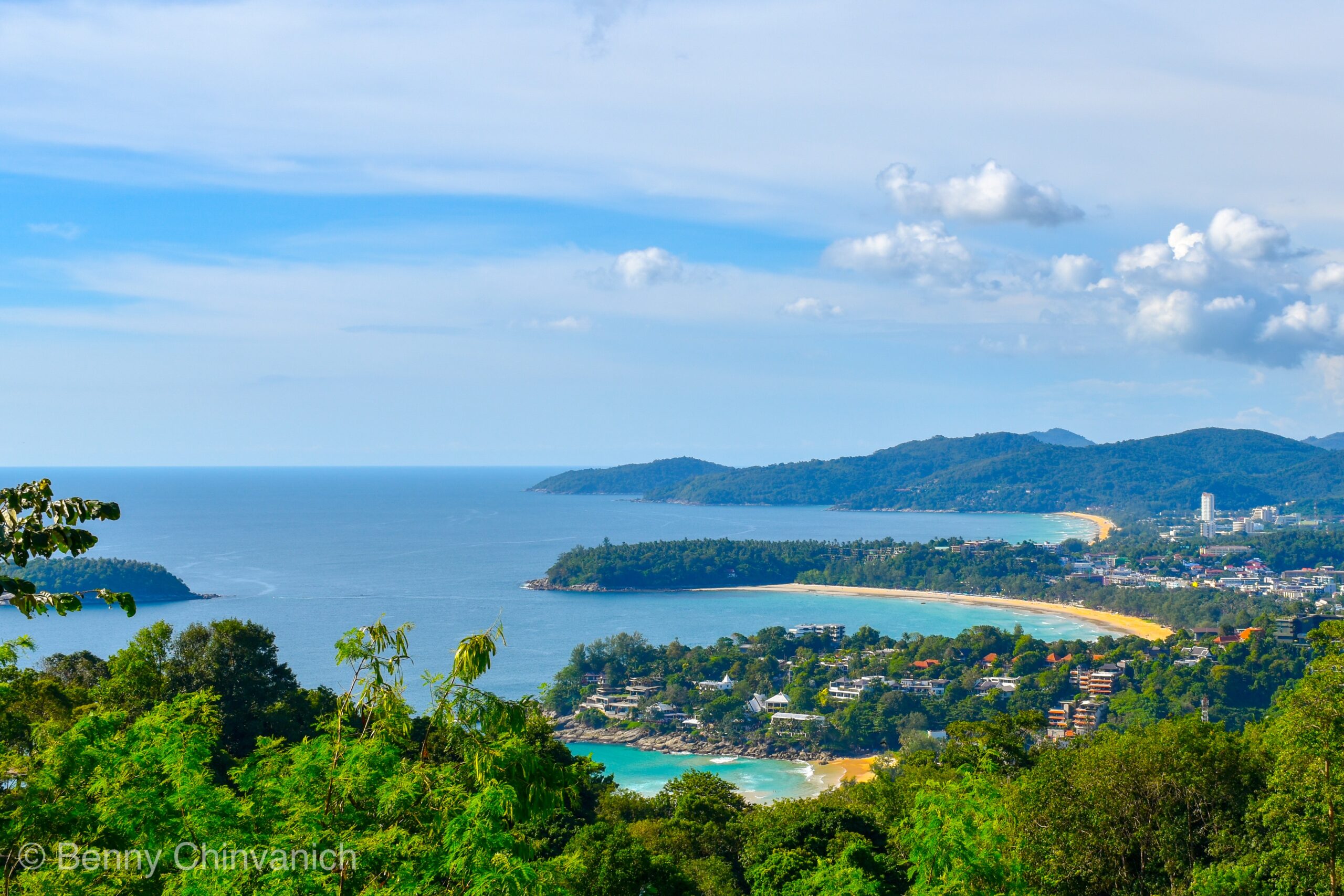
A viewpoint on the road between Kata Noi and Nai Harn, also called Kata Viewpoint or the Three Beaches Hill. From the wooden platform you see the bays of Kata Noi, Kata and Karon lined up one behind the other, the view you know from every Phuket postcard. It is right on the main road, so you can stop on the way south by Grab, car or scooter. A few minutes is enough, and the light is best in the afternoon.
8. Nai Harn Beach
Nai Harn, in the south of the island near Rawai, is a bay beneath green hills with just under a kilometre of sand. Behind the beach lies Nai Harn Lake, ringed by a paved path where locals and long-term foreign residents go running in the morning and evening. There are hardly any bars, the sea is calm and good for swimming in high season, and in the monsoon the surfers move in.
Together with Kata Noi, we think Nai Harn has the best beaches you can reach by car. If you want even more peace, take a look at the small neighbouring beach of Ya Nui, towards Promthep Cape.
9. Promthep Cape (Laem Phromthep)
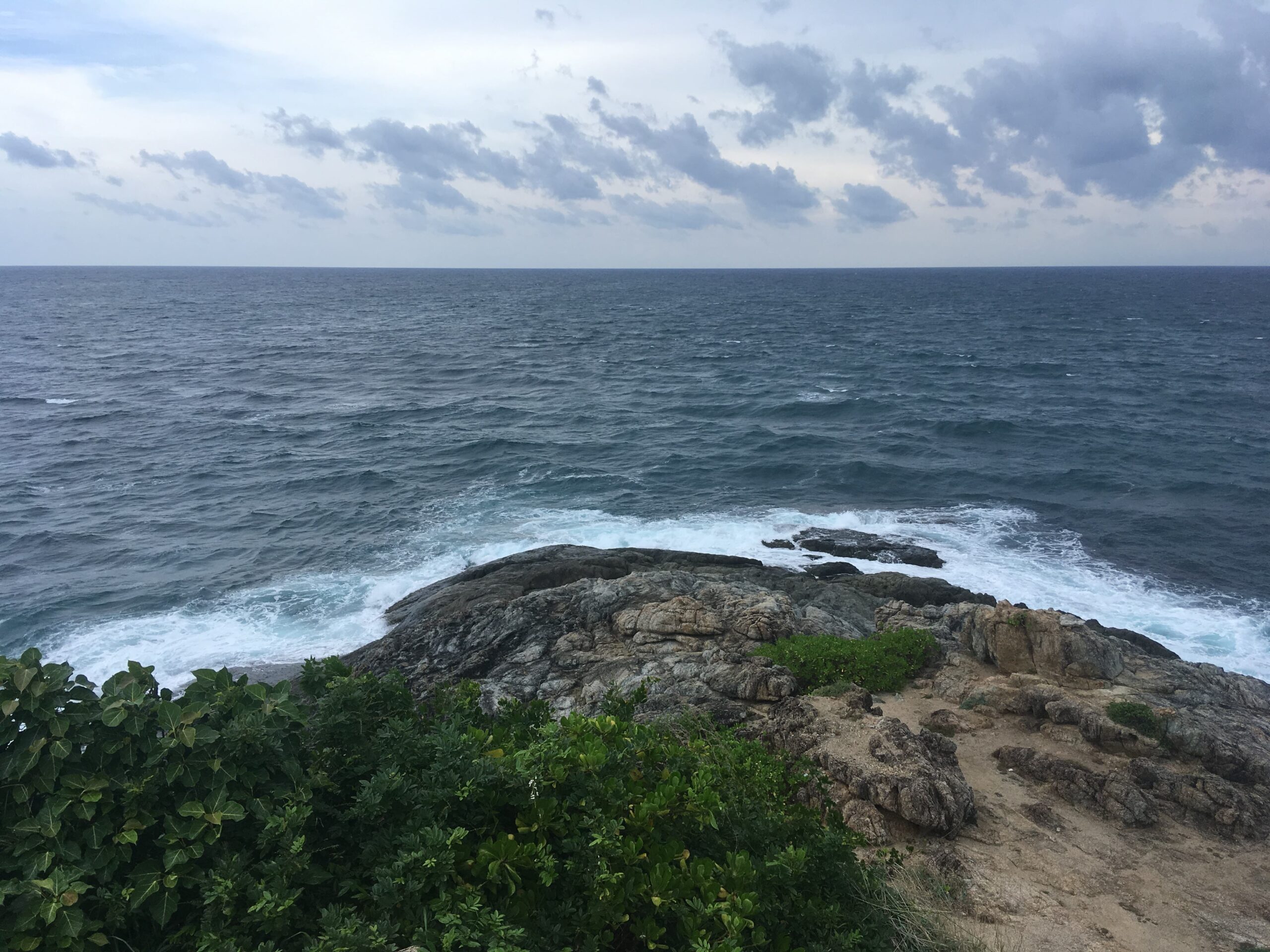
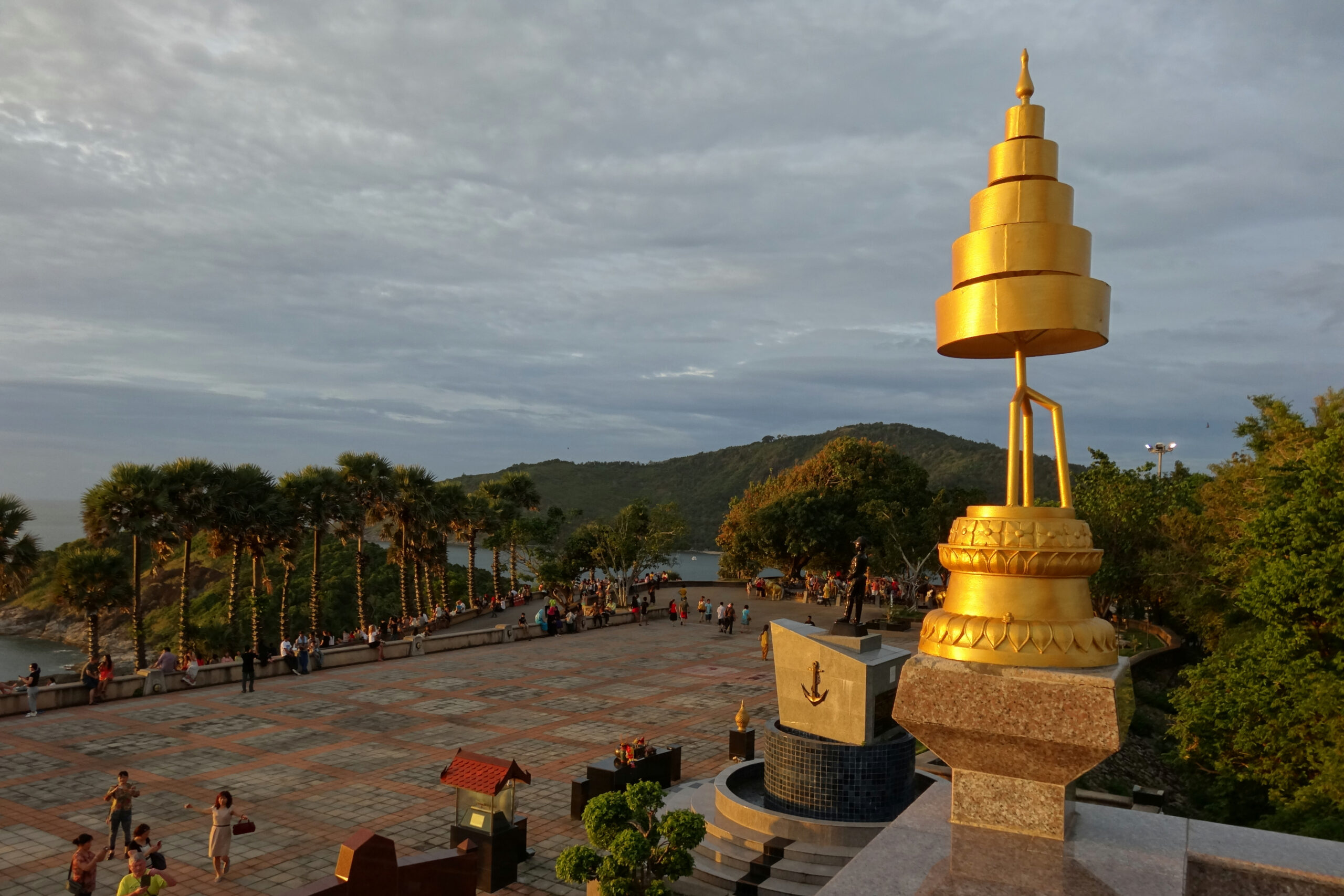
The southernmost point of Phuket and the island’s classic sunset spot. On the cape there is a lighthouse with a small maritime museum, a shrine where people leave elephant figurines, and a large terrace looking out over the sea and the islets. A steep path leads from the car park down to the end of the rocky headland; only go down in sturdy shoes and when it is dry.
At sunset the place fills up and the coaches roll in, so arrive at least an hour early. We would turn it around: get there early, walk out on the rocks, and then watch the actual sunset somewhere nearby, from the viewpoint above Nai Harn or on the beach.
10. Kamala Beach
Kamala lies north of Patong, and one hill and a single bend in the road later you are in a different world. The beach is about a kilometre long, and the town behind it is smaller and more family-oriented, with restaurants on the beach and shops along the main road. Kamala was one of the places hit hardest by the 2004 tsunami, and today there is a memorial to the victims by the beach.
At the southern end of Kamala, luxury villas and beach clubs sit above the sea. If you are looking for something between Patong and the big resorts in the north, this is it.
11. Surin and Laem Singh
Surin Beach, between Kamala and Bang Tao, is smaller and in our view one of the prettiest in the north. It has plenty of shade under the trees and a few hundred metres of sand, a calm sea in high season and powerful waves in the monsoon. Just to the south is the little cove of Laem Singh, which you reach on foot from a viewpoint by the road. Surrounded by rocks and jungle, it is one of the most photographed spots on the island in high season.
12. Bang Tao
At around six kilometres, Bang Tao is the longest beach on Phuket. The middle section is taken up by the Laguna complex, with several large hotels, golf and lagoons, while the southern and northern ends have more local restaurants and beach clubs. It is a good choice for families who want a resort, a pool and lots of room on the sand. Without a car or Grab, though, you will not get very far from here.
13. Nai Yang, Mai Khao and Sirinat National Park
Right up in the north, by the airport, Sirinat National Park protects a stretch of coast with Nai Yang and Mai Khao beaches, plus a slice of sea. Nai Yang is a quiet beach under the trees with a few hotels and food stalls; Mai Khao is long, wild and almost empty. At its southern end, right by the end of the runway, planes come in low over the heads of people on the beach, which draws photographers and plane spotters. Do not swim here in the monsoon, the currents are strong.
For your last night before flying home, or your first night after a long-haul flight, the north of the island is ideal. The airport is a few minutes away, and you do not have to slog an hour across the island on day one.
14. Old Phuket Town
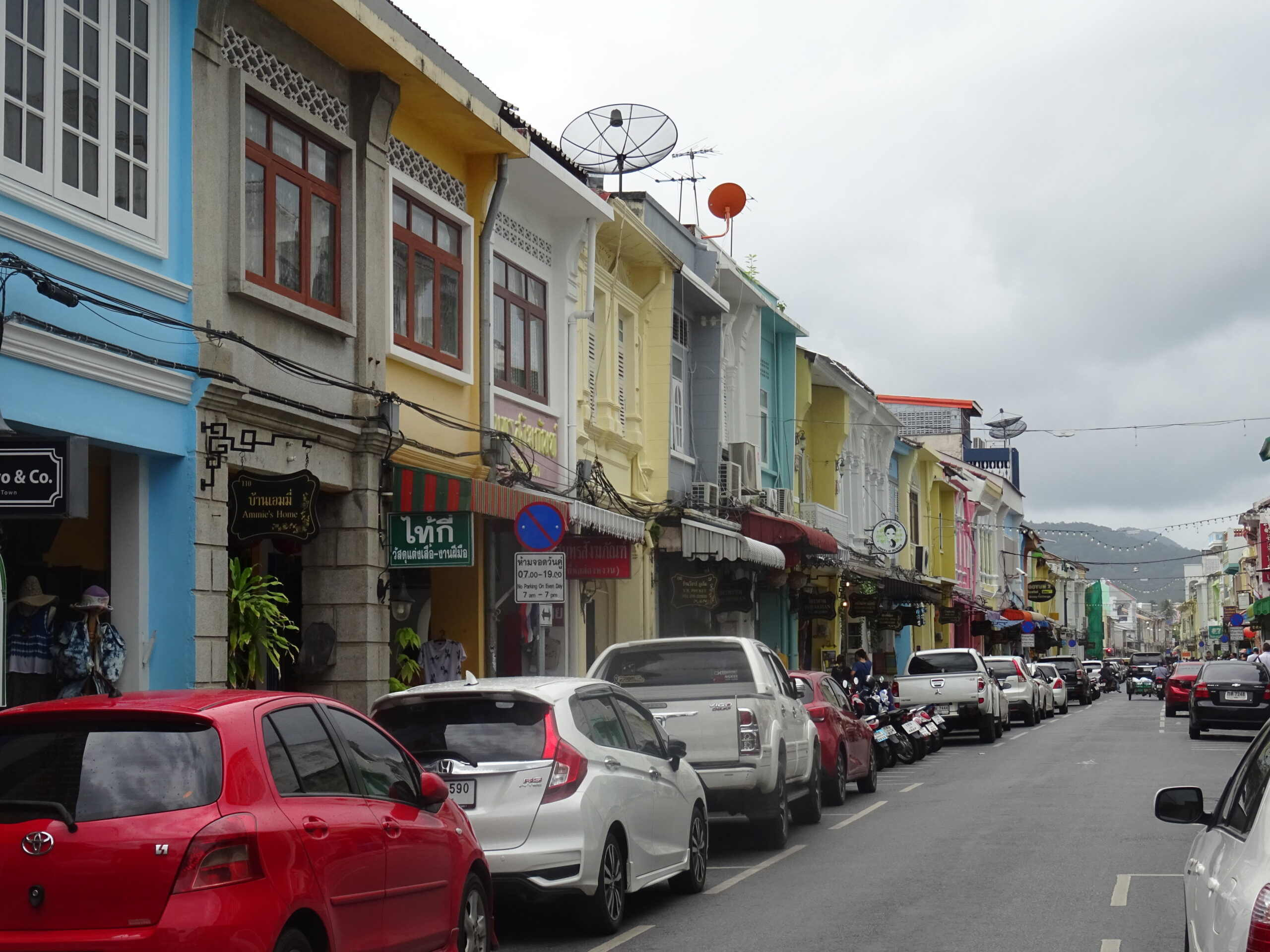
For us, the old quarter of Phuket Town is the best reason to leave the beach for at least a day. Thalang, Dibuk, Krabi, Phang Nga and Romanee roads are lined with two-storey Sino-Portuguese shophouses: a shop downstairs, living quarters upstairs, a covered walkway in front, stucco and brightly painted shutters. They were built by Chinese merchants and tin-mine owners in the 19th and early 20th centuries. Today they house cafés, galleries, small shops, boutique hotels and, still, ordinary family homes.
Two hours is enough for a walk, but add coffee, lunch and a museum and the whole morning is gone. Soi Romanee was once the red-light street; today it is probably the most photographed lane on the island. The Phuket Thai Hua Museum, in a former Chinese school, tells the story of the Chinese immigrants and the tin trade. Between the houses you will find Chinese shrines thick with incense and street art on the walls.
The Old Town is best in the late afternoon, when it is cooler and the shops are still open. The Smart Bus, songthaews and Grab all come here from the resorts, and the ride from Patong takes about half an hour.
15. Lard Yai Sunday market on Thalang Road
Every Sunday from the afternoon into the evening, Thalang Road closes to cars and turns into a walking market known as Lard Yai or the Phuket Walking Street. Stalls with street food, fruit, sweets and souvenirs, local musicians and big crowds. Come hungry and bring cash, since most stalls only take baht. If you are staying at the beach, you can plan your Old Town day for a Sunday and do both.
16. Naka and Chillva night markets
The big Naka weekend night market (Phuket Weekend Market) sits on the southern edge of Phuket Town, not far from the road to Chalong. It is a maze of stalls selling food, clothes, electronics and everything else, and it only opens at weekends, in the afternoon and evening. Chillva Market, on the northern edge of town, is smaller and more modern, built from shipping containers, with food, a bar and live music, and it runs several nights a week.
For us, the markets are the best place to try Phuket’s food for a few dozen baht. If you only have time for one, choose by the day: Lard Yai on Sunday, Naka on Saturday.
17. Big Buddha
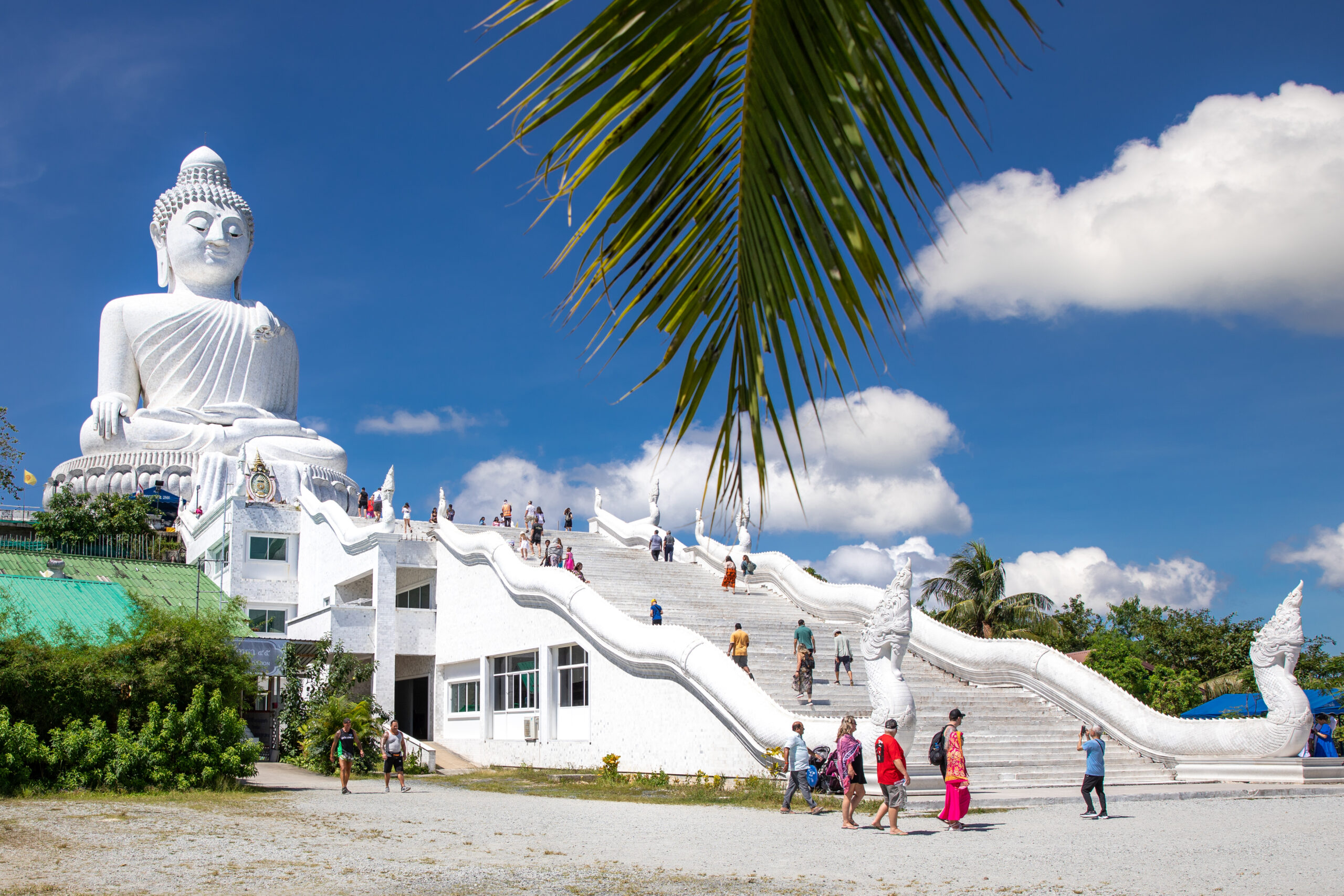
This 45-metre seated Buddha in white Burmese marble stands on top of Nakkerd Hill between Kata and Chalong and can be seen from much of the south of the island. Its official name is Phra Phuttha Ming Mongkhon Eknakhiri, and construction began in 2004, funded entirely by donations. The terrace below the statue looks out over Chalong Bay, Kata and Karon.
The site was closed from August 2024. After torrential rain, a landslide came down below the hill and killed thirteen people in Karon, and the authorities then looked into the permits for some of the buildings on the site. It reopened on 3 March 2026, on the Buddhist holiday of Makha Bucha, and is now managed by Wat Kittisangkharam (Wat Kata). It is open daily from 9am to 6pm, entry is free and a voluntary donation is expected (The Phuket Express).
This is a sacred site, so cover your shoulders and knees; sarongs are lent at the entrance. The road up is steep and not one we would recommend to beginners on a scooter. Grab or a taxi is the safer bet.
18. Wat Chalong
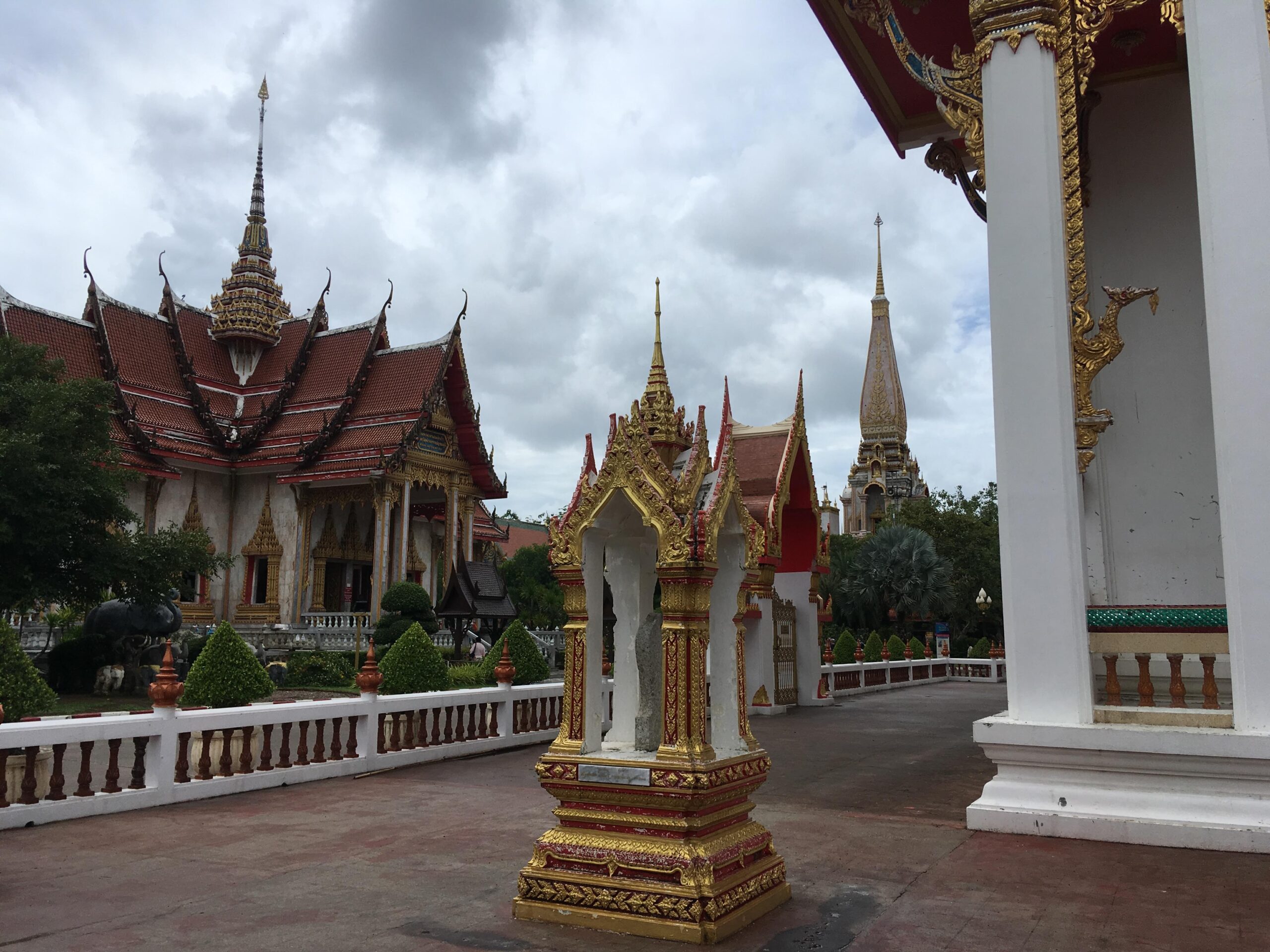
Wat Chalong, or Wat Chaiyathararam to give it its full name, is the most important Buddhist temple on the island. It is dedicated to the monks Luang Pho Chaem and Luang Pho Chuang, who according to tradition tended the wounded and helped broker peace during the Chinese miners’ uprising of 1876. The temple grounds are dominated by a chedi about sixty metres tall, which the temple says holds a fragment of the Buddha’s bone. You can climb up inside to the upper floors, and the walls are painted with scenes from the Buddha’s life.
Now and then you will hear what sounds like gunfire. Those are firecrackers, set off by worshippers in a brick kiln as thanks for answered prayers. Entry is free, and the temple is open during the day until around 5pm. Cover your shoulders and knees, and take your shoes off before going into the buildings. We would come in the morning and combine it with the Big Buddha, as they are close to each other.
19. Rawai and Chalong Pier
Rawai, in the southeast of the island, is not a beach resort in the usual sense. The beach is narrow, muddy at low tide and not much good for swimming. What it does have is a seafood market where you buy fresh fish and shellfish and the restaurants next door cook them for a fee. Rawai is also home to a community of Chao Le sea nomads, who were fishing around Phuket long before the first tourists arrived. Boats for the southern islands leave from Rawai Beach and from nearby Chalong Pier.
Rawai and the area around it are popular with foreigners who live here long term, so there are lots of cafés, Muay Thai gyms and small restaurants. This is Phuket without a nightclub round the corner.
20. Khao Phra Thaeo and Bang Pae Waterfall
In the northeast of the island a patch of original rainforest survives, protected as Khao Phra Thaeo. Trails run through it, and there are two waterfalls, Ton Sai and Bang Pae. Neither is huge; in the rainy season they carry a decent amount of water, while in the dry season they shrink to little more than streams. By Bang Pae Waterfall there is a station of a project that returns gibbons rescued from the tourist trade to the wild.
For half a day it makes a pleasant change from the beach, especially in the monsoon, when the waterfalls are at their best. In the damp, expect mosquitoes and leeches, so bring repellent.
21. Phuket Elephant Sanctuary
The only place with elephants on Phuket that we would recommend. The sanctuary was set up for old and injured elephants that used to work in logging or tourism, and there is no riding or bathing with visitors. You watch them from a distance as they feed, bathe and wander through the forest. The half-day programme costs from 3,000 THB (about £65), and the canopy walkway above the enclosure from 1,900 THB (about £40) (phuketelephantsanctuary.org). Places sell out, so book ahead.
Watch the names. Half the operators on Phuket put “sanctuary” or “camp” in their name. If a place offers elephant rides, bathing with elephants or shows, it is not an ethical place, whatever the sign says. GOV.UK also warns that elephant rides can be dangerous and that British visitors have been seriously injured on them.
22. Phang Nga Bay and James Bond Island
The most famous trip from Phuket. Phang Nga Bay, northeast of the island, is full of limestone towers rising out of a shallow green sea, mangroves and caves. The main stop is usually Khao Phing Kan, where the 1974 Bond film The Man with the Golden Gun was shot, along with the rock needle of Ko Tapu right next to it, just over twenty metres tall. Other stops tend to include canoeing into the hongs, lagoons hidden inside the islands that you paddle into through caves at low tide, and Ko Panyi, a village built on stilts over the water.
The bay is the Ao Phang Nga National Park and the entry fee is 300 THB (about £6.50) per person. It is often included in tour prices, but not always, so ask. Trips go by longtail boat, big boat or speedboat, with hotel pick-up. We think it is worth choosing a smaller boat that reaches James Bond Island in the morning or afternoon, outside the main rush. At midday the few dozen metres of beach there are packed shoulder to shoulder. The bay is sheltered from the monsoon, so tours run in the rainy season too.
23. Ko Phi Phi
Phi Phi is within sight of Phuket and you can visit on a day trip or stay a few nights. Ferries and speedboats leave mainly from Rassada Pier on the east coast, and tours with hotel pick-up go from Chalong Pier and other harbours. Maya Bay, the viewpoint above Tonsai and the national park rules are covered in our separate Koh Phi Phi guide. We would rather spend at least one night there: in the evening and early morning Phi Phi is a completely different place from what you see at midday, when the tour boats arrive.
24. Similan Islands
The Similans lie northwest of Phuket in the Andaman Sea and are among the best places in Thailand for snorkelling and diving. White beaches, granite boulders and clear water. The islands are a national park and only open in season; for 2026/27 that means from 15 October 2026 to 15 May 2027. The entry fee is 500 THB (about £11) and the number of visitors per day is capped. Boats leave from Thap Lamu Pier in Phang Nga province, about an hour’s drive north of the airport, and trips from Phuket include a hotel transfer.
It is a long day with an early start, but for us it is the best trip from Phuket. Divers can also choose liveaboard boats and spend several nights at sea. Further north still lie the Surin Islands, another national park that only opens seasonally.
25. Racha Yai, Coral Island and the Ko Yao islands
Shorter trips to the islands south and east of Phuket. Racha Yai is about half an hour by speedboat from Chalong Pier and has white-sand bays and good snorkelling. Coral Island (Ko Hae) is even closer and is usually full of day-trippers and jet skis. The islands of Ko Yao Noi and Ko Yao Yai, in Phang Nga Bay between Phuket and Krabi, are the complete opposite: quiet, rice paddies, Muslim villages and few tourists. Boats leave from Bang Rong Pier in the northeast of Phuket.
If you have a week on Phuket and have already done Phang Nga and Phi Phi, try a day on Racha or a night on Ko Yao Noi. For us, Ko Yao Noi is the best escape from Phuket for anyone who wants to see what southern Thailand looks like without the big resorts.
Food and evenings in Phuket
Since 2015 Phuket has been a UNESCO Creative City of Gastronomy, mainly thanks to a local cuisine that grew out of Thai, Chinese and Malay cooking. Beyond the classics such as pad thai and green curry, try the local dishes: mee hokkien (fried yellow noodles with seafood), moo hong (pork braised with black pepper and soy sauce), oh tao (an oyster and taro omelette) and the morning dim sum that people in Phuket Town eat for breakfast with tea. You will find the best versions in the Old Town and at the markets, not in the beachfront restaurants.
Prices on Phuket are high by Thai standards, especially in Patong and in restaurants right on the beach. Street food and small restaurants on the main road a few hundred metres back from the sea are cheaper.
Evenings: in Patong, Bangla Road and the clubs; in Kata and Karon, bars and restaurants; in Kamala and Bang Tao, beach clubs with the sunset; in Phuket Town, markets and small bars in the old quarter. If you are here at the turn of September and October, you may catch the Vegetarian Festival, when Phuket Town’s Chinese community gives up meat for nine days, holds processions and some participants pierce their cheeks while in a trance. It is not for the squeamish, but it is one of the strangest festivals in Thailand.
Is Phuket safe? Rules worth knowing
Phuket is a safe island, but it has its typical traps. Most of the trouble tourists bring home with them has to do with the sea, scooters and rental shops.
Red flags and rip currents. During the monsoon, from May to October, strong rip currents form along the west coast and can drag you away from the shore. People drown on Phuket every year because of them, including good swimmers. A red flag means no swimming, and it applies even when the sea looks calm. A yellow flag means take care. Swim near the lifeguard stations, and if a current catches you, do not swim against it towards the shore; swim sideways, parallel to the beach.
Jet skis and rental shops. In tourist areas, Phuket included, scooter and jet-ski rental shops are known for demanding large sums for alleged damage when you return the vehicle. Photograph and film everything together with the person renting it to you, including the payment and the return of your deposit, and never hand over your passport as a guarantee; GOV.UK warns that some companies keep passports against claimed damage (GOV.UK). If you can live without a jet ski, you will save yourself a lot of stress.
Taxis and tuk-tuks. Taxis and tuk-tuks in the resorts do not use meters and charge fixed fares, which are high. Agree the price before you set off, or use Grab or Bolt.
Smoking, e-cigarettes, alcohol. Smoking and littering on beaches are banned, with a fine of up to 100,000 THB (about £2,200) or a year in prison, and cases always go to court. Bringing in, owning or using e-cigarettes and shisha pipes is illegal in Thailand, and police do check in tourist areas. Alcohol may be sold from 11am to midnight and must not be drunk in temples or public parks.
Cannabis and drugs. Cannabis is now limited to medical use with a Thai prescription and recreational use is illegal; for other drugs the penalties are very severe. Rules have changed several times, so check the current position on GOV.UK before you go. On Bangla Road and in the clubs, keep an eye on your drink.
Tsunami. After 2004, Phuket’s beaches were fitted with warning towers and sirens and marked evacuation routes, and you will see “Tsunami hazard zone” signs and evacuation arrows everywhere. It is worth knowing which way the route uphill leads from your beach.
How many days in Phuket is enough?
For us, a week is ideal for Phuket. You have time for two or three trips, the Old Town and the south of the island with its viewpoints, and still plenty of beach days. Five days is the minimum; anything shorter only makes sense as a stopover on the way to Krabi or Phi Phi. With two weeks, we would combine Phuket with Krabi and Phi Phi. For ideas across the rest of the country, see our guide to places to visit in Thailand.
| Day | One-week plan |
|---|---|
| 1 | arrival, rest on the beach by your hotel, evening walk around the resort |
| 2 | the south of the island: Wat Chalong and the Big Buddha in the morning, then Nai Harn, Karon Viewpoint and sunset at Promthep Cape |
| 3 | full-day trip to Phang Nga Bay and James Bond Island |
| 4 | beach, then Old Phuket Town in the afternoon, Lard Yai market on a Sunday or Naka on a Saturday |
| 5 | Similan Islands (in season), otherwise Phi Phi |
| 6 | free day: Freedom Beach, the Elephant Sanctuary or the Khao Phra Thaeo rainforest |
| 7 | a last swim, then one evening on Bangla Road or a night near the airport at Nai Yang |
Do not book boat trips on two days in a row. Early starts, sun on the water and hours in a boat are more tiring than the brochure makes them look.
A little history
Phuket used to be called Thalang, and Portuguese navigators marked it on their maps as Junk Ceylon. It lay on the sea route between India and China, and ships called here for water, supplies and above all tin, which the island’s soil held in large quantities. In the 17th century the Dutch, the English and the French all competed for the tin trade, but Phuket, like the rest of Thailand, was never a colony.
The island’s most famous story dates from 1785. A Burmese army besieged Thalang just after the local governor had died. The defence was led by his widow, Chan, and her sister, Muk, and after a month the Burmese withdrew. The king ennobled the two women as Thao Thep Krasattri and Thao Si Sunthon. A monument to the sisters stands on a roundabout near Thalang, and one of the bridges to the mainland is named after the elder of the two.
In the 19th century tin mining took off, and tens of thousands of Chinese miners and merchants arrived, mostly from Fujian via Penang in Malaya. The mine owners who struck it rich built houses and mansions like those they knew from Penang and Singapore, and these became today’s Old Town with its Sino-Portuguese architecture. Phuket also owes the Vegetarian Festival and much of its cooking to the Chinese community. Alongside tin, the island grew rich on rubber, and the plantations are still there in the interior.
Tin mining ended in the 20th century, just as tourism began. Within a few decades Phuket went from a backpacker stop to one of the most visited islands in Asia. On 26 December 2004 a tsunami triggered by an earthquake off Sumatra hit Thailand’s west coast. On Phuket it caused the worst damage in Patong and Kamala, and thousands of people died across Thailand, many of them tourists. The beaches were rebuilt quickly, the island got a warning system with sirens and evacuation routes, and within a few years the visitors were back.
What we would do differently
Phuket tempts you to buy a different tour every day. Every resort has a stall on every street selling Phi Phi, Phang Nga, the Similans, islands, elephants, cabaret and rafting, and after a few days you start to feel the holiday does not count without one more trip. We would pick two, three at most, and give the rest of the time to the island itself.
The best places on Phuket, in our view, are not on the posters at those stalls. They are a dim sum breakfast in Phuket Town where locals go on a weekday, a lane in the Old Town that leads nowhere, a little roadside restaurant in Rawai without an English menu, or an empty stretch of Mai Khao where all you hear is the sea and the occasional plane. Try a dish you have never heard of, and if you do not like it, at least you will have a story.
And you do not need to see all twenty-five places. Better three beaches where you sit down and watch the colour of the water change than eight viewpoints reached in traffic jams across the island. At sunset on Promthep there will be a hundred phones around you. Try keeping yours in your pocket. The sunset is not going anywhere, and you will remember it better.
Phuket FAQ
When is the best time to visit Phuket, Thailand?
From December to March, when Thailand’s Andaman coast is dry and the sea is calm. The biggest crowds and highest prices come over Christmas and New Year. November and April are a good compromise. From May to October it is monsoon season, with showers, waves and strong currents, but accommodation is much cheaper.
What is the weather like in Phuket in November?
November is the changeover from the rainy season to the dry season. Early in the month it still rains often; towards the end the weather settles and the sea calms down. It is warm, around thirty degrees, and so is the water. The Similan Islands have been open since mid-October.
What are the best beaches in Phuket?
We would pick Kata Noi and Nai Harn in the south and Surin with Laem Singh in the north. Kata is the best all-rounder, with restaurants and shops, and Freedom Beach has the clearest water, but you can only get there by boat or on foot. For peace and space, go to Bang Tao or Mai Khao. Patong is the liveliest, not the prettiest.
How do I get from Phuket airport to Patong and the other beaches?
The cheapest option is the Phuket Smart Bus for a flat 100 THB (about £2.20), which runs from the airport via Surin, Kamala, Patong, Karon and Kata to Rawai, plus the orange 8411 bus to Phuket Town. Then there are Grab and Bolt with a fixed price in the app, official taxis and limousines from the counters in the arrivals hall, and shared minibuses. At night you are left with a taxi or Grab.
Phuket or Krabi: which is better?
Phuket is bigger, with more beaches, flights, hotels and nightlife. Krabi is quieter and its limestone scenery is more dramatic. If you want choice and evenings out, go for Phuket; if you are mainly after nature and island-hopping by boat, go for Krabi. You can easily do both: ferries run between the island and Krabi, and by road it takes about three hours.
How many days in Phuket is enough?
Five days is a sensible minimum and a week is ideal. That gives you time for the main things to do in Phuket: the south of the island with the Big Buddha and Wat Chalong, the Old Town, a trip to Phang Nga Bay, Phi Phi or the Similans, and still some days on the beach.
Is the Big Buddha in Phuket open?
Yes. It was closed after the landslide in August 2024 and reopened on 3 March 2026. It is open daily from 9am to 6pm, and entry is free with a voluntary donation. Covered shoulders and knees are required.
What is the time difference between Phuket and the UK?
Thailand is on the same time all year round, UTC+7. During UK winter time (GMT) Phuket is seven hours ahead of London; while British Summer Time is in force it is six hours ahead.
Where next
- Thailand holiday guide: when to go, entry rules, flights, budget and routes for two or three weeks.
- Places to visit in Thailand: an overview of the whole country, from Bangkok to the islands in the Gulf of Thailand.
- Krabi: Railay, Ao Nang, the Four Islands and Hong Islands tours, just across the bay from Phuket.
- Koh Phi Phi: Maya Bay, the viewpoint, ferries from Phuket and where to stay on the island.
- Bangkok: where most flights from the UK land, and worth a few days before or after the beach.
Potřebujete pomoct s cestováním?
-
Ubytování 🏨
Vyberte si to nejlepší ubytování, ať už jste kdekoliv, přes Booking.com. -
Půjčení auta 🚗
Auto si snadno najdete přes Booking.com, kde máte často slevu díky ubytování, nebo Rentalcars.com, kde porovnáte nabídky většiny půjčoven. -
Zážitky 🎟️
Přes GetYourGuide.com si vyberete z nejrůznějších výletů i zážitků po celém světě, navíc se zrušením zdarma do 24 h předem.