Last updated 10.11.2026
For most people flying to Thailand from the UK, Bangkok is where the plane lands, and too often it is just a night in an airport hotel before the onward flight to the beach. That is a shame. Mention Bangkok and people picture gridlock, heat and smog, and yes, you will get all three. But a few hundred metres from the eight-lane roads stand gilded temples, boats work the river like buses, Chinatown cooks on every corner after dark and from the top of the towers you finally see how enormous the city is. Once you start listing things to do in Bangkok, a couple of days quickly stops feeling like enough.
We have picked 30 places in Bangkok that we think are worth your time, from the Grand Palace to the railway market where the stallholders fold back their awnings for the train. Around them you will find the practical side: getting in from the airport, using the Skytrain, the metro and the river boats, not falling for the tuk-tuk drivers, choosing a neighbourhood to stay in and planning one to three days. You will not fit all thirty into one trip, and you do not need to.
Things to do in Bangkok at a glance
- Thais call their capital Krung Thep, the “city of angels”. Its full ceremonial name is the longest place name in the world. Bangkok has been the capital since 1782, when it was founded by the first king of the Chakri dynasty, which still reigns today.
- The Grand Palace with the Temple of the Emerald Buddha costs 500 THB (around £11), Wat Pho 300 THB and Wat Arun 200 THB. All three require covered shoulders and knees.
- From Suvarnabhumi Airport (BKK), the Airport Rail Link train takes about half an hour to its terminus at Phaya Thai. From Don Mueang (DMK), the suburban Red Line runs to Krung Thep Aphiwat station for 33 THB.
- The quickest way around is the BTS Skytrain and the MRT metro, and for the temples in the old town, the boats on the Chao Phraya river. Grab and Bolt work well, and taxis are supposed to use the meter.
- “The palace is closed today” is a scam. Whoever tells you this outside a sight and offers a tuk-tuk will take you to gem shops. Check at the official ticket office.
- Stay near the river, a BTS station or an MRT station. Riverside and Banglamphu are close to the temples, Sukhumvit and Silom to the modern districts and the nightlife.
- Chatuchak is a weekend market: the whole market is open only on Saturdays and Sundays from 9am to 6pm.
- Money and entry: 1 Thai baht is roughly £0.022, so 100 THB is a little over £2; conversions are rounded. Entry rules for British passport holders are on GOV.UK Foreign travel advice, and if you need a visa you apply through the official Thai e-Visa site.
Bangkok neighbourhoods: how the city fits together
Bangkok is huge. The city proper covers more than 1,500 square kilometres, roughly the size of Greater London, and the wider metropolitan area is home to over fourteen million people. The good news is that almost everything a visitor wants to see sits in a handful of districts along the river and along the Skytrain lines. It helps to think of the city in three parts.
The old town (Rattanakosin and Banglamphu). An island of land between the river and the old canals, home to the Grand Palace, Wat Pho, museums and government buildings. Just to the north is Banglamphu and Khao San Road. Only one metro line reaches this area and the Skytrain does not come here at all, so the boat is the easiest way in. On the opposite bank lies Thonburi, with Wat Arun and the canals.
Chinatown (Yaowarat) and Riverside. South of the old town, Chinatown begins and runs along the river towards the luxury hotels on the waterfront and the ICONSIAM shopping centre on the far bank. Charoen Krung, the oldest road in the city, runs through the whole of this area.
The modern centre (Siam, Silom, Sathorn, Sukhumvit). Shopping malls, skyscrapers, Lumphini Park, rooftop bars and most of the hotels. This is where the BTS Skytrain and the MRT metro run and where Bangkok moves fastest. Between the old town and the modern centre a taxi in traffic can easily take an hour; by boat and Skytrain it is often half that.
💡 Keep one rhythm in mind and you will save a lot of time: temples in the old town in the morning, air-conditioned malls or a museum in the afternoon heat, and Chinatown or a skyscraper rooftop in the evening.
Getting to Bangkok from the UK
Most flights from the UK to Bangkok go with one stop, typically in the Gulf or in Istanbul, and take somewhere around 13 to 16 hours door to door. Some airlines have run non-stop services from London, so compare current schedules before you book; from Manchester, Birmingham, Edinburgh and other regional airports you will almost always change planes. Thailand’s entry rules have changed several times in recent years, including the visa-exempt stay and the digital TDAC arrival card, so check the current rules on GOV.UK and the official Thai e-Visa site shortly before you travel.
Bangkok has two airports and it is worth knowing which one you are flying into. Suvarnabhumi (BKK), on the eastern edge of the city, handles almost all long-haul flights from Europe. Don Mueang (DMK), in the north, is the older budget airport, typically AirAsia, with flights to Phuket, Krabi and Chiang Mai. If you are changing between the two, allow one to two hours for the transfer by road.
Suvarnabhumi Airport (BKK) to the city centre
- Airport Rail Link. The train leaves from beneath the terminal and runs via Makkasan (change for the MRT at Phetchaburi) to its terminus at Phaya Thai, where you change to the BTS Skytrain. The whole journey takes about half an hour, trains run from roughly 5.30am to midnight and the fare depends on distance, a few dozen baht into town. For most people it is the quickest and cheapest option, though at rush hour it can get cramped with a big suitcase.
- Taxi. The official rank is on the ground floor of the arrivals hall, where a machine gives you a ticket with your bay number. Taxis run on the meter, plus an airport surcharge and the expressway tolls, which you pay to the driver at the toll booths. Depending on traffic, the ride into the centre takes from 40 minutes to an hour and a half.
- Grab and Bolt. You know the price in advance, usually 350 to 600 THB (about £8 to £13) from the airport into the centre. The pick-up point is signposted in the terminal and the app guides you there.
Don Mueang Airport (DMK) to the city centre
- Red Line. The suburban rail station is linked to the terminal by a footbridge. A ticket to Krung Thep Aphiwat station costs 33 THB (around 70p), and there you change to the MRT. At peak times trains run every ten minutes, otherwise every fifteen.
- Airport buses. The A1 goes to BTS Chatuchak and the Mo Chit 2 bus terminal, the A2 via BTS Chatuchak to Victory Monument (both 30 THB), the A3 via Pratunam to Lumphini Park and the A4 past Democracy Monument to Khao San Road and Sanam Luang (both 50 THB). If you are staying in Banglamphu, the A4 is the simplest way in.
- Taxi and Grab work the same way as at Suvarnabhumi. The old town is closer to Don Mueang than to BKK.
Most long-distance trains, including the night trains north to Chiang Mai, now leave from the main station Krung Thep Aphiwat (formerly Bang Sue). The old Hua Lamphong station on the edge of Chinatown now handles only some regional services, so check on your ticket which station your train leaves from.
Getting around Bangkok
Bangkok’s traffic jams are legendary, and the legend is not exaggerated. So the rule is simple: anything that runs on rails or on water beats anything on the road.
BTS Skytrain. Two main lines, Sukhumvit and Silom, cross at Siam station. Together they cover the modern centre, the shopping districts, Silom and the whole of Sukhumvit, reaching north to Chatuchak market (Mo Chit station) and south to Saphan Taksin by the river, where the boats start. Tickets come from machines in the stations and fares depend on distance. If you are staying longer, get a top-up Rabbit card.
MRT metro. The Blue Line runs in a loop, and for visitors its big advantage is that it is the only line under the old town and Chinatown: Wat Mangkon (Chinatown), Sam Yot and Sanam Chai (for Wat Pho and the Grand Palace). You can change to the BTS at, for example, Asok/Sukhumvit, Sala Daeng/Si Lom and Mo Chit/Chatuchak Park. The BTS and MRT are run by different operators, so you buy a new ticket when you change.
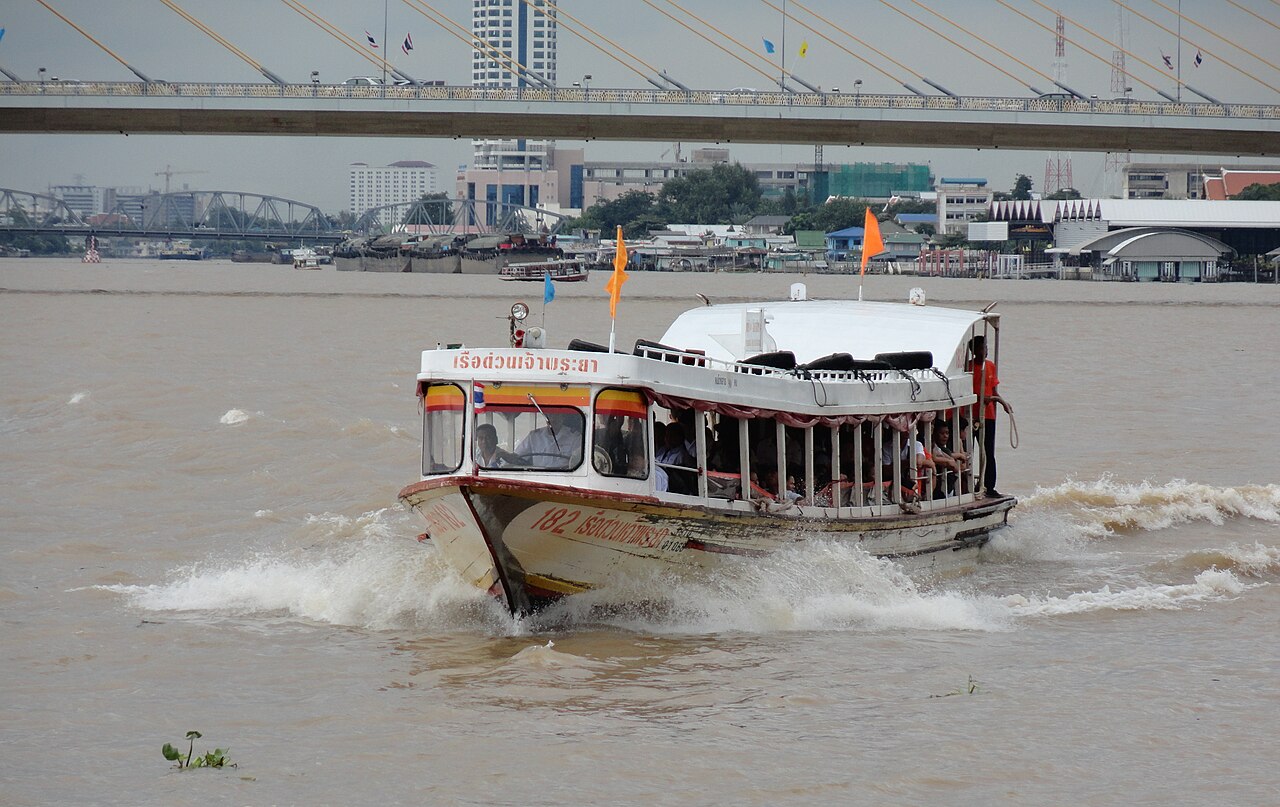
Chao Phraya river boats. The most enjoyable transport in the city and also the most practical way to reach the sights. Chao Phraya Express boats are told apart by the colour of the flag at the stern. The orange flag stops at most piers and costs a flat 19 THB (about 40p); the yellow and green-yellow flags are faster and skip piers, so check where the boat stops before you get on. The key piers are Sathorn (by BTS Saphan Taksin), Ratchawong (Chinatown), Tha Tien (Wat Pho, cross-river ferry to Wat Arun), Tha Chang (Grand Palace) and Phra Arthit (Khao San Road). There is also a blue-flag hop-on hop-off tourist boat every 30 minutes between eleven piers from Sathorn to Phra Arthit, and in the evening as far as Asiatique. It costs more and is more comfortable, with commentary along the way.
Saen Saep canal boats. This canal “bus” links the Golden Mount (Panfa Leelard pier) with Siam and Sukhumvit. It is fast, cheap and noisy, and you have to jump on and off. For us it is one of the best ways to see Bangkok the way locals live it.
Grab, Bolt and taxis. The most comfortable option for short trips away from the Skytrain lines. By law, taxis must use the meter. If the driver refuses to switch it on and quotes a fixed price, get out and flag down another one; it happens a lot around the tourist sights. Grab also offers motorbike taxis (GrabBike), which weave through the traffic, but it is quite a ride.
Tuk-tuk. An experience rather than transport. You agree the fare in advance and it tends to be higher than a taxi. Even the official Grand Palace website warns that a tuk-tuk over a short distance will probably cost you more than a taxi.
Best time to visit Bangkok
Bangkok is at its most pleasant from November to February, when it is dry and the nights cool down a little. March to May brings heat you can only cope with thanks to air conditioning and by doing your sightseeing early and late in the day. May to October is the rainy season, but the rain usually comes in afternoon storms and the rest of the day is perfectly usable, hotel prices drop and the sights are less crowded. Unlike the beaches, where the month matters a great deal, Bangkok works all year round. When the UK is in winter, Bangkok is 7 hours ahead; during British Summer Time the gap is 6 hours.
Where to stay in Bangkok
The golden rule: stay as close as you can to a BTS or MRT station or a river pier. A hotel that looks cheap and “just a little way” from the centre can cost you an hour a day in traffic. Choose the neighbourhood according to what you want to do.
Riverside (the Chao Phraya waterfront). The loveliest place to stay, with river views, hotel shuttle boats and easy access to both the temples and Chinatown. Bangkok’s most famous luxury hotels are here. A good choice for a first visit if you are more about sights than nightlife.
Banglamphu and Khao San. The cheapest accommodation close to the Grand Palace: hostels, guesthouses and boutique hotels. The downside is that neither the Skytrain nor the metro comes here, so you reach the modern centre by boat or taxi. Khao San Road is noisy until the early hours, so look a few streets away, around Phra Arthit or Samsen for example.
Silom and Sathorn. The business district, with Lumphini Park, the Skytrain and the metro, and the river close by. A compromise between the sights and modern Bangkok, with night markets and bars around Patpong.
Sukhumvit. A long avenue with numbered side streets (soi), where the expats live and where you find the most restaurants, cafés and nightlife. The areas around Asok, Phrom Phong and Thong Lo stations are modern and comfortable. The temples are a long way off, so it suits a second visit, or anyone who comes to Bangkok mainly to eat and shop.
Siam and Pratunam. The heart of the shopping malls and the hub of all the BTS lines. Practical for families and for shopping.
- Mandarin Oriental, Bangkok is the legendary 19th-century riverside hotel where Joseph Conrad and Somerset Maugham stayed. A boat runs from the hotel pier to the opposite bank. One for a special occasion.
- Chatrium Bangkok Riverside is a large riverside hotel with spacious rooms looking out over the water and its own shuttle boat to Sathorn pier and BTS Saphan Taksin. Good value for the view.
- Eastin Grand Hotel Sathorn is a modern hotel in Sathorn connected by a walkway to BTS Surasak, with a high-level pool. The river is one stop away and the modern centre a few minutes.
- Hotel Clover Asoke is a mid-range hotel on Sukhumvit, a few minutes’ walk from the BTS Asok and MRT Sukhumvit interchange, with easy connections to the centre and the airport.
- Lamphu Tree House Boutique Hotel is a small Thai-style hotel by a canal in Banglamphu, with a pool, close to Khao San Road but on a quiet lane. An affordable, pleasant base for the old town.
We have checked all these hotels on Booking.com. Prices change with the season and are highest from December to February. For more options, see our hotels in Bangkok search.
30 things to do in Bangkok, Thailand
We have grouped the places by neighbourhood so you can build your days straight from the list. Entry fees come from the official websites of the sights and from the Tourism Authority of Thailand (TAT); where we could not find an official price, we leave it out.
The old town and the river
1. The Grand Palace and the Temple of the Emerald Buddha (Wat Phra Kaew)
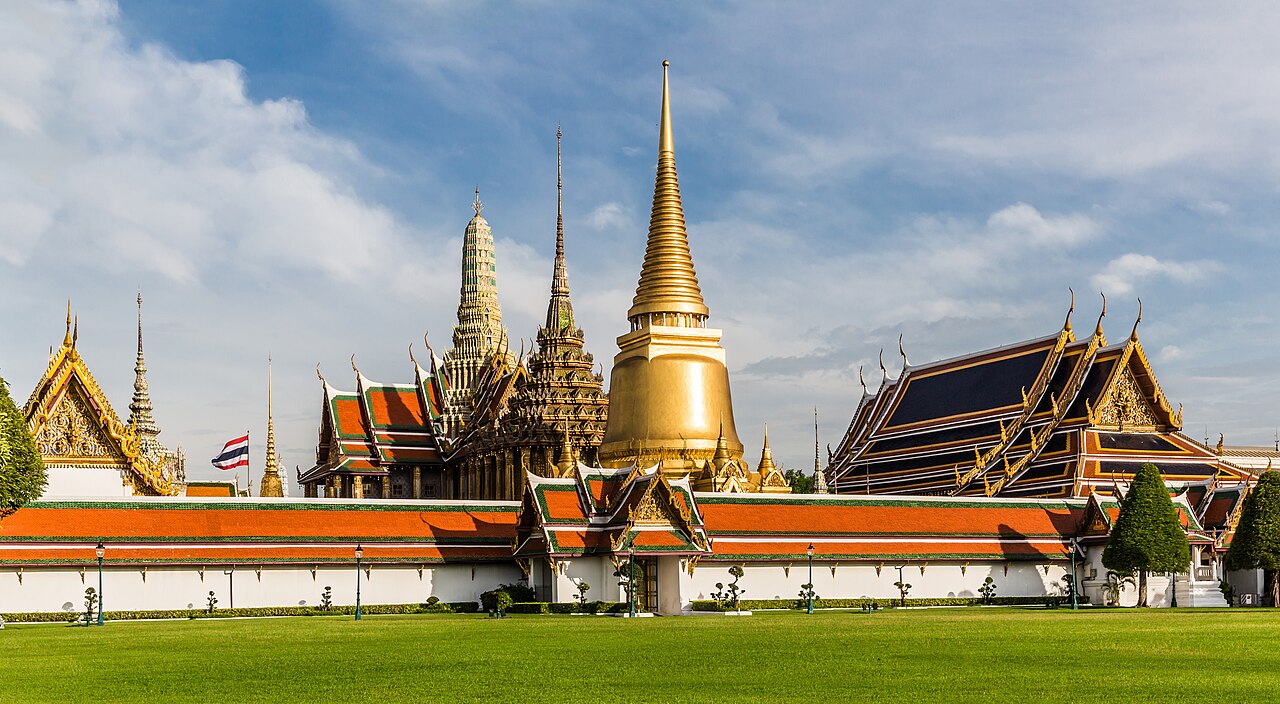
The residence of the kings of Siam since 1782 and the most sacred place in Thailand. Inside the palace walls stands Wat Phra Kaew with the Emerald Buddha, which is actually carved from jade and is around 66 centimetres tall. It is small, sits high up on its altar and photography inside is not allowed, so plenty of people are surprised by how little of it they actually see. What stays with you is the outer courtyard: golden chedis, roofs of coloured tiles, giant yaksha guardians and long galleries painted with scenes from the Ramakien epic.
Entry for foreigners is 500 THB (around £11) and includes Wat Phra Kaew and the Queen Sirikit Museum of Textiles. Tickets are sold daily from 8.30am to 3.30pm (royalgrandpalace.th). The dress code is strict and checked at the gate: no vests, short or see-through tops, shorts, ripped, tight or cycling trousers, miniskirts or culottes. Men need long trousers, women covered shoulders and knees. Drones are not allowed.
Go as soon as it opens: the tour coaches arrive around ten and the courtyards fill up. The easiest way to get here is by boat to Tha Chang pier (N9), or Tha Tien (N8), or by metro to Sanam Chai. Allow two hours for your visit.
2. Wat Pho and the Reclining Buddha
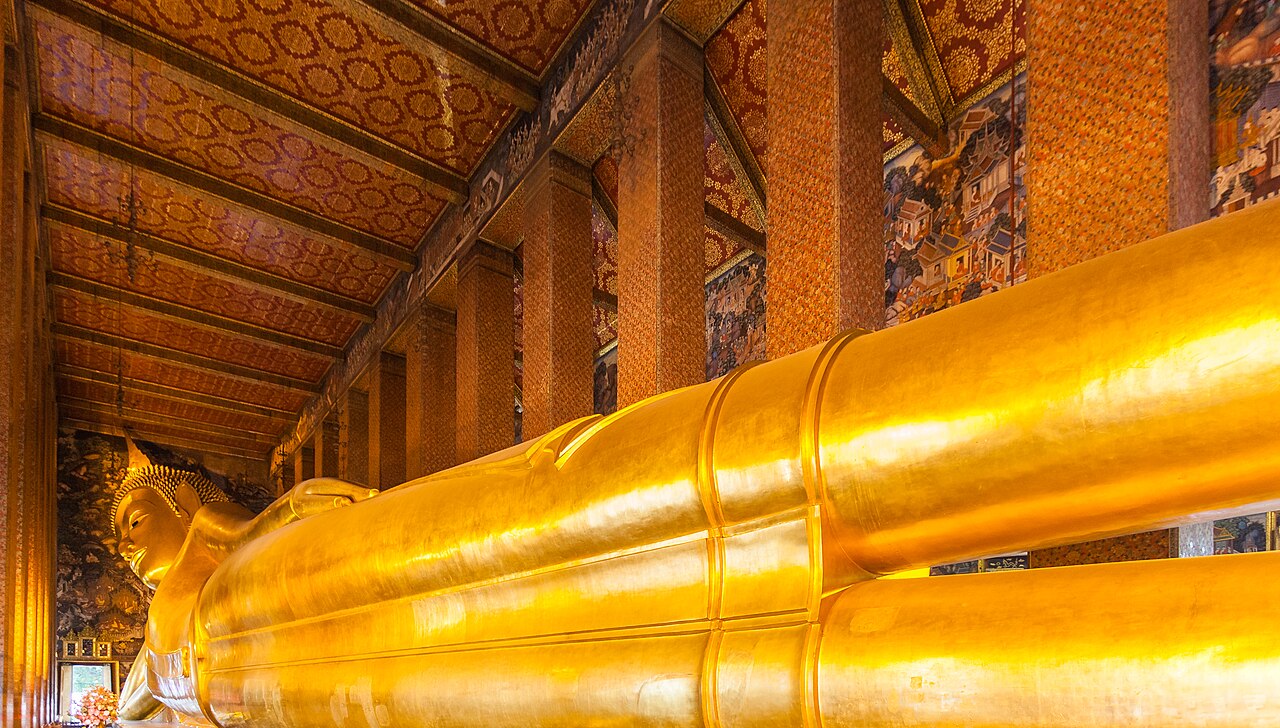
A few minutes’ walk from the palace is the temple we like best in Bangkok. The gilded Reclining Buddha is 46 metres long, and the soles of its feet are inlaid with mother-of-pearl showing 108 auspicious symbols. The hall is almost too small for it, so you cannot fit the whole statue into one photo, which only makes it more impressive. The grounds around it are vast, with more than ninety chedis and hundreds of Buddha images in the galleries, and although the crowds come here too, you can find quiet in the back courtyards.
Wat Pho is also the birthplace of traditional Thai massage. The massage school works right inside the temple grounds, and a half-hour or one-hour massage after your visit is, in our view, the best way to round off a hot morning. Entry for foreigners is 300 THB (around £7), and it is open from 8.30am to 7.30pm (watpho.com). Older guidebooks give 100 or 200 THB, which no longer applies. Shoulders must be covered here too, and women should not wear shorts above the knee.
3. Wat Arun, the Temple of Dawn
On the other bank of the river, directly opposite Wat Pho. The temple dates from the Ayutthaya period and was originally called Wat Chaeng; under King Taksin it briefly housed the Emerald Buddha. The main tower (prang) is 82 metres high and covered in thousands of pieces of Chinese porcelain that glitter in the sun. You can climb to the first terrace up very steep steps, and coming down you are almost on all fours.
Entry is 200 THB (around £4), open daily from 8am to 6pm (TAT). A cross-river ferry shuttles over from Tha Tien pier in a few minutes. The best view of Wat Arun, though, is from the opposite bank at sunset, when the tower lights up, and there are several bars and restaurants with terraces on the waterfront by Tha Tien. We would visit the temple in the morning and come back in the evening just to look at it across the river.
4. A trip along the Chao Phraya river
Not a single sight, but an experience that ties all the others together. Board an orange-flag boat at Sathorn pier by BTS Saphan Taksin and ride upstream past luxury hotels, Chinese warehouses, temples and wooden houses on stilts all the way to Phra Arthit. At 19 THB, it is the cheapest sightseeing cruise in the world. At rush hour it is packed; in the afternoon and at weekends it is calm. In the evening there are dinner cruises on the river too, but the illuminated temples look beautiful from the water even without one.
5. The amulet market and Tha Maharaj waterfront
In the lanes by Tha Chang pier, between the Grand Palace and Thammasat University, traders sell amulets, Buddha figurines and talismans. Locals examine them through magnifying glasses like stamp collectors and haggle over prices with total seriousness. Right next door is the Tha Maharaj waterfront, with restaurants and cafés over the water where you can hide from the midday heat. In our view, it is the best place for lunch after the palace.
6. Museum Siam
An interactive museum in a former ministry building close to Wat Pho (Sanam Chai MRT station is even decorated in the style of old Thai architecture). It explains what it actually means to be Thai, from Ayutthaya to the present day, with games and videos that keep children entertained too. Ideal for the hottest part of the day, when walking around outside is out of the question.
7. The Golden Mount (Wat Saket)
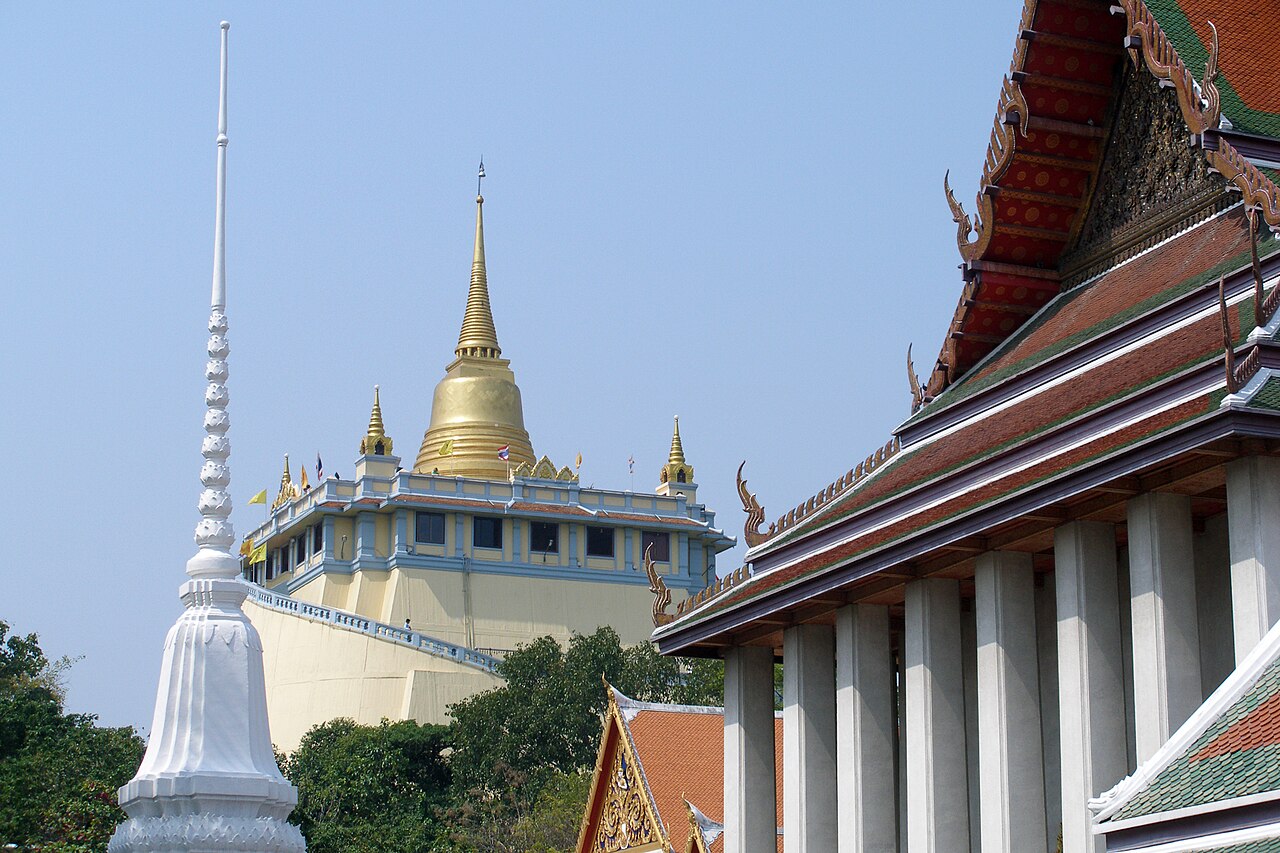
The only hill in Bangkok, and an artificial one at that. A spiral staircase of around 320 steps (according to TAT; other sources count 318 or 344) winds up to the golden chedi on top, past bells, waterfalls and statues. From the top you look out over the whole old town, with the skyscrapers in the distance. Entry is 100 THB (around £2), open from 7am to 7pm. Every November, during the Loy Krathong festival, the temple holds a seven-day fair. We like to come up towards evening, when it is cooler and the sun sets behind the palace.
8. The Giant Swing and Wat Suthat
A red wooden frame more than 21 metres high in the middle of a road junction: Sao Ching Cha. Until the 1930s, men swung on it during a Brahmin ceremony, trying to catch a bag of money hung high on a pole with their teeth, until several fatal falls led to it being banned. Behind the swing stands Wat Suthat, one of the oldest and most beautiful royal temples, which sees far fewer visitors than Wat Pho. The surrounding streets sell monks’ robes and giant Buddha statues; the whole district is one big shop for religious supplies.
9. Khao San Road and Banglamphu
The most famous backpacker street in the world. By day it is a market of T-shirts, travel agents and pad thai stalls; by night it is one big bar with music pouring out of every door and fried scorpions for the brave. You will either love it or run away after ten minutes; there is nothing in between. We prefer the surroundings: tree-lined Soi Rambuttri running parallel, and the Phra Arthit riverside with the white Phra Sumen Fort and Santi Chai Prakan Park, where locals do aerobics in the evening. If you want to stay cheaply and close to the sights, this is where you will end up, but pick somewhere a few streets from Khao San if you want to sleep.
10. Wat Benchamabophit, the Marble Temple
A temple of white Italian marble with red roofs, built under King Rama V at the end of the 19th century in the Dusit district. It is smaller and quieter than the temples by the river, and the gallery around the courtyard holds dozens of Buddha images from all over Asia. Early in the morning, monks come here to receive alms. Half an hour is enough; combine it with the Golden Mount, for instance.
Chinatown
11. Yaowarat by night
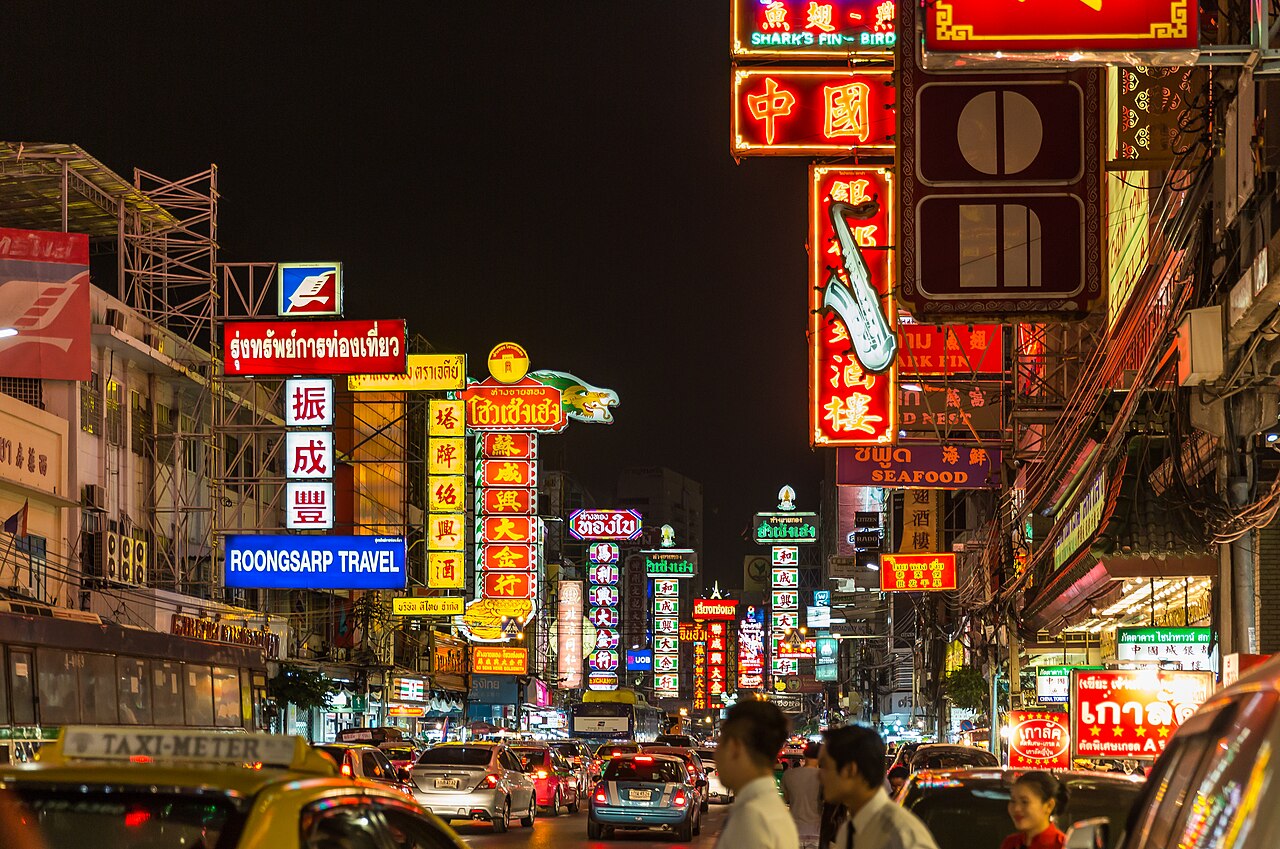
By day, Chinatown’s main street is lined with gold shops and stores selling herbs, dried seafood and birds’ nests. After dark the neon signs with Chinese characters light up and food carts roll out onto the pavements: noodles, roast duck, grilled seafood, roasted chestnuts, mango with sticky rice. An evening in Yaowarat is, for us, one of the best experiences in all of Bangkok. Do not eat only on the main street; the best stalls are often in the side lanes, wherever you see a queue of locals. Wat Mangkon MRT station drops you right in the middle of the district.
12. Wat Traimit and the Golden Buddha
On the edge of Chinatown, close to the old Hua Lamphong station, sits a Buddha statue of solid gold weighing more than five tonnes. For centuries it was covered in plaster, most likely to hide it from Burmese soldiers, and nobody knew what lay underneath. Only in 1955, when it was being moved, did it fall, the plaster cracked and gold gleamed through. Today it sits in a white marble pavilion at the top of the temple. TAT gives the entry fee as 40 THB (around £1) for the statue; with the exhibition on the history of Chinatown on the lower floors, the ticket costs more. Open daily from 8am to 5pm.
13. Wat Mangkon Kamalawat
The largest Chinese Buddhist temple in Bangkok, a few steps from Wat Mangkon metro station. It is a completely different world from the Thai temples: red lanterns, incense smoke, golden deities and people bringing offerings and shaking fortune sticks to ask about the future. Entry is free. It is at its liveliest at Chinese New Year and during the vegetarian festival in autumn, when the whole district hangs out yellow flags.
14. Talat Noi
The oldest part of Chinatown, by the river, where the draw is not sights but atmosphere. Narrow lanes, workshops full of rusty engines, old Chinese houses, small shrines, street art and cafés in old warehouses. The best-known spot is the So Heng Tai mansion, with a courtyard and a pool where people now learn to dive. For us, Talat Noi is the best place in the city to wander aimlessly with a camera. Take the boat to Si Phraya pier or walk over from Yaowarat.
15. Pak Khlong Talat flower market
A wholesale flower market by the river just below Wat Pho, open practically around the clock. It is liveliest at night and early in the morning, when orchids, lotuses and mountains of yellow marigolds arrive from the countryside to be woven into offering garlands. A glimpse of the Bangkok that does not exist for tourists, and one of the most colourful places in the city.
Thonburi and the far bank
16. Thonburi’s canals by longtail boat
Bangkok was once called the Venice of the East, and on the west bank of the river some of that survives. The network of canals (khlongs) is lined with wooden houses on stilts, small temples and gardens where people do their washing and feed giant catfish. Rides in a narrow boat with a long propeller shaft (a longtail) are offered at the piers by Tha Chang and Tha Tien; agree the price per boat and per hour in advance. We prefer the more distant canals around Bang Luang, where it is quiet and there is hardly any traffic.
17. Wat Paknam and the giant Buddha
A temple on the western edge of Thonburi, off the main tourist trail, with two reasons to visit. The first is a tall white stupa whose top floor has a ceiling painted with a green cosmos and a glass stupa in the middle (that is the photo you know from Instagram). The second is a giant bronze statue of a seated Buddha, completed in 2021, visible from far away. Take the metro to Bang Phai station, then walk a few minutes.
18. ICONSIAM
A huge shopping centre on the riverbank, opened in 2018. Most people do not come for the designer shops but for SookSiam on the ground floor, an indoor “floating market” with stalls from every Thai province. If you do not have time for a floating market outside the city, it makes a good taster, with air conditioning thrown in. The riverside terrace looks out over the opposite bank. Get here on the free shuttle boat from Sathorn pier or on the elevated Gold Line from Krung Thon Buri station.
The modern centre
19. Jim Thompson House
Jim Thompson, an American architect and former intelligence officer, revived the Thai silk industry after the war, and in the 1950s he built a house in Bangkok out of six old traditional teak houses that he had brought in from the countryside. In 1967 he vanished without trace while out walking in the Malaysian highlands and was never found. The house, with its collection of Asian art and its tropical garden, is now a museum. The main house can only be visited with a guide, tours run in five languages and you take your shoes off at the door.
Open daily from 10am to 5pm; entry is 250 THB for adults (around £5.50), 150 THB for visitors aged 10 to 21, and free for children up to 9 (jimthompsonhouse.org). The nearest station is BTS National Stadium, exit 1. Photography is allowed inside, but no flash and no selfies.
20. Siam and the shopping malls
Around BTS Siam the shopping centres stand shoulder to shoulder, linked by walkways: Siam Paragon with its aquarium and enormous food hall, Siam Center, Siam Discovery, CentralWorld and MBK, where you haggle over electronics and knock-offs. What is really typical of Bangkok are the food courts on the top or bottom floors, where a few dozen baht gets you a better meal than in many restaurants. Right next to MBK is the Bangkok Art and Culture Centre (BACC), with contemporary art and exhibitions that are usually free.
21. Erawan Shrine
A small Hindu shrine with a golden statue of the four-faced Brahma on the corner of the busy Ratchaprasong junction, between the malls and the Skytrain. Worshippers bring garlands and elephant figurines, and when a wish comes true they pay for dancers in traditional costume to perform right next to the shrine. A five-minute stop between shops that shows how faith in Bangkok is woven into everyday life.
22. Lumphini Park
The largest green space in the centre: more than 50 hectares of lawns, trees and lakes beneath the Silom skyscrapers. In the morning locals jog and practise tai chi here, and at six in the evening everyone freezes for a moment when the national anthem plays from the loudspeakers. The lakes and lawns are also home to monitor lizards, some of them more than a metre and a half long, which wander calmly between the benches. Entry is free; the nearest stations are MRT Lumphini and Si Lom and BTS Sala Daeng.
23. Mahanakhon SkyWalk
The highest viewpoint in Thailand, 314 metres above the city on the roof of the King Power Mahanakhon tower, which looks as if someone has knocked chunks out of it. At the top there is an open-air terrace and a glass floor that lets you look straight down. Tickets cost 500 to 1,200 THB (around £11 to £26) depending on the time of day, the most expensive being at sunset. Open from 10am to midnight, last entry at 11pm (kingpowermahanakhon.co.th). The nearest station is BTS Chong Nonsi, exit 3. If you are torn between the SkyWalk and a rooftop bar: the SkyWalk is for the view, a bar is for the atmosphere.
24. Rooftop bars
Bangkok is a city of rooftop bars, and a drink above the lights of the city is one of its rituals. The best known is Sky Bar on top of Lebua at State Tower, where The Hangover Part II was filmed, followed by Vertigo & Moon Bar at the Banyan Tree. Drinks are expensive by Thai standards, but you are paying for the view. Almost everywhere has a dress code: no flip-flops, vests or shorts, and men are often expected to wear long trousers. In the rainy season the terraces close during storms, so do not plan a rooftop for one specific evening as the only thing that day.
25. Thai boxing (Muay Thai)
Muay Thai is the national sport, and a fight night at one of Bangkok’s big stadiums is an experience even if you never watch boxing. Before every bout the fighters perform the ritual wai khru dance to live music, while the gamblers in the stands shout and signal their bets. The best-known venues are Rajadamnern, the oldest stadium in the country, not far from Khao San, and Lumpinee in the north of the city. You will find the programme and tickets on their websites; the cheapest seats are up top among the locals.
Markets
26. Chatuchak Weekend Market
One of the largest weekend markets in the world: more than 15,000 stalls over 14 hectares and over 200,000 visitors every weekend. Clothes, ceramics, furniture, plants, antiques, food, coconut ice cream. You can lose a whole day here; the clock tower in the middle is your landmark. The full market is only open on Saturdays and Sundays from 9am to 6pm; on Friday evenings only the wholesale section trades, and on Wednesdays and Thursdays only the plant section (chatuchakmarket.org). Come first thing in the morning, as the afternoon is hot and crowded. Stations: BTS Mo Chit, MRT Chatuchak Park and Kamphaeng Phet.
27. Or Tor Kor Market
Directly opposite Chatuchak is a covered food market regularly ranked among the best fresh markets in the world. Fruit stacked neatly into pyramids, durian in every variety, curry pastes, dried fish and ready-made dishes. It is pricier than ordinary markets, but clean and with air-conditioned sections. For tasting Thai fruit you will never see at home, it is, in our view, the best place in the city.
Day trips from Bangkok
28. Floating markets: Damnoen Saduak, Amphawa and Taling Chan
Everyone knows the picture of little boats piled high with fruit, but the markets are very different from one another. Damnoen Saduak, about a hundred kilometres south-west of the city, is the biggest and the most touristy; you go early in the morning and it sells mainly to visitors. Amphawa is smaller, comes alive on weekend afternoons and evenings and its shoppers are mostly Thai. Taling Chan is right in Bangkok on the Thonburi side, open at weekends, small but easy to reach. If you do not want to lose a whole day to a market, Taling Chan fits into a morning. We compare the two big markets in more detail in our guide to the best places to visit in Thailand.
29. Maeklong Railway Market
In the small town of Samut Songkhram, about an hour and a half from Bangkok, the market is held right on the railway tracks. When a train approaches, the vendors pull back their awnings and shift their baskets of vegetables and fish a few centimetres, the train rolls past within touching distance and a minute later the market is back. Thais call it Talat Rom Hup, the “umbrella pulldown market”. The market is open from 6am to 6pm, but the train only passes a few times a day. According to TAT, it arrives at Maeklong station at 8.30am, 11.10am, 2.30pm and 5.40pm and departs at 6.20am, 9am, 11.30am and 3.30pm. The timetable changes, so check the times with the railway or your hotel before you go, otherwise you will just see an ordinary market. Maeklong combines easily with Amphawa into a single day trip.
30. Ayutthaya
The former capital of Siam, about 80 kilometres north, which was burned by the Burmese army in 1767. Its temple ruins have been a UNESCO World Heritage Site since 1991, and the most famous sight is the Buddha head entwined in the roots of a tree at Wat Mahathat. Trains run from Bangkok several times a day; once there, rent a bicycle or hire a tuk-tuk for a loop of the ruins. One day is enough, but if you want the ruins without the crowds, stay the night. We write more about Ayutthaya, Kanchanaburi with the Bridge on the River Kwai and other trips in our guide to the places to visit in Thailand.
Bangkok entry fees at a glance
| Sight | Entry for foreigners | Approx. in £ | Opening hours |
|---|---|---|---|
| Grand Palace and Wat Phra Kaew | 500 THB | £11 | tickets daily 8.30am–3.30pm |
| Wat Pho | 300 THB | £7 | daily 8.30am–7.30pm |
| Wat Arun | 200 THB | £4 | daily 8am–6pm |
| Golden Mount (Wat Saket) | 100 THB | £2 | daily 7am–7pm |
| Wat Traimit (Golden Buddha) | from 40 THB | from £1 | daily 8am–5pm |
| Jim Thompson House | 250 THB (ages 10–21: 150 THB) | £5.50 | daily 10am–5pm |
| Mahanakhon SkyWalk | 500–1,200 THB depending on time | £11–26 | 10am–midnight |
| Wat Mangkon, Lumphini, Chatuchak, ICONSIAM | free | free | Chatuchak only Sat–Sun 9am–6pm |
Prices are taken from the official websites of the sights and from the Tourism Authority of Thailand (TAT); the sterling conversions are approximate. Thais usually get into temples for free, and the dual pricing is not up for discussion.
Bangkok street food and what to eat
For us, Bangkok is one of the best food cities in the world, and the best food here often costs no more than a few dozen baht. Food stalls are everywhere: by the Skytrain stations, on street corners, outside office blocks at lunchtime. Eat where the locals queue, and if you do not know what to order, point at your neighbour’s plate.
What to try: pad thai (stir-fried rice noodles, in Bangkok often with prawns and tamarind sauce), tom yum goong (hot and sour prawn soup), som tam (green papaya salad), khao man gai (chicken with rice cooked in stock), boat noodles (small bowls of rich noodle soup, eaten several at a time), moo ping (grilled pork skewers for breakfast) and mango sticky rice. You can control the heat: say “mai phet” (not spicy) or “phet nit noi” (a little spicy).
The best areas for food are Yaowarat (in the evening), Banglamphu and the streets around Khao San, old Charoen Krung and the lanes around Victory Monument with their noodle soups. For a meal with air conditioning, the mall food courts and Or Tor Kor market are ideal.
Jay Fai is the most famous street food cook in the world. In her small restaurant on Maha Chai Road in the old town, she cooks crab omelettes over a charcoal fire wearing ski goggles, which earned her a Michelin star that, according to the Michelin Guide, she still holds. It is open Wednesday to Saturday, the queue is long and the prices are high (a crab omelette here costs more than dinner for a whole family at the stall next door). Cash only. We would only go if you have the time and want to tick off a legend; you can find good crab dishes elsewhere too.
Do not drink tap water. Buy bottled water or refill from the filtered water machines you see on the streets. Ice in drinks usually comes from ice factories, and Thais use it as a matter of course in restaurants.
How many days in Bangkok, and a 1 to 3 day itinerary
Two days are enough for the main sights; three or four if you want Bangkok with its markets, Chinatown and one day trip. We would give it three days at the start of the trip, while you get over the jet lag, or two at the start and one at the end before you fly home.
Day 2: modern Bangkok. Jim Thompson House in the morning, then the malls around Siam and lunch in a food court. In the afternoon, the Erawan Shrine and Lumphini Park with its monitor lizards; in the evening, Mahanakhon SkyWalk or a rooftop bar and Sukhumvit by night.
Day 3: markets or a day trip. At the weekend, Chatuchak and Or Tor Kor in the morning, then Talat Noi and the Thonburi canals in the afternoon. On a weekday, a trip to Maeklong and Amphawa, or to Ayutthaya.
If you only have one day, spend the morning by the river (the palace, Wat Pho, Wat Arun) and the evening in Chinatown. If you just have a layover of a few hours, skip the sights and have some street food and a boat ride instead; from Suvarnabhumi you can get into town and back by train.
Is Bangkok safe? Safety and etiquette
For a big city, Bangkok is safe, and violent crime against tourists is rare. The problems tend to be small ones: tuk-tuk and “closed sight” scams, taxi drivers who will not use the meter, pickpockets in the crowds at markets and thieves on motorbikes who snatch bags. Carry your bag on the side away from the road. The GOV.UK safety advice for Thailand gives the same warnings about pickpockets and bag-snatchers on motorbikes.
A few rules that matter to Thais:
- The King and the royal family. Insulting the monarchy is a criminal offence in Thailand, with heavy sentences. Do not speak about the King disrespectfully, do not step on banknotes bearing his portrait, and stand for the royal anthem at the cinema.
- Temples. Cover your shoulders and knees, take your shoes off before entering the shrine, and do not point the soles of your feet towards the Buddha. Women must not touch monks.
- Head and feet. The head is sacred, so do not pat anyone on the head, not even children. Do not point at anything with your foot.
- The anthem. At 8am and 6pm the national anthem plays from loudspeakers in parks and stations. People stop for a moment; do the same.
For practical matters that apply to the whole of Thailand (health, vaccinations, insurance, SIM cards, money and ATM fees), start with the GOV.UK Foreign travel advice for Thailand. The tourist police emergency number is 1155.
A little history
Until the late 18th century, Bangkok was just a small port and customs post on the river, on the way upstream to Ayutthaya, the capital of Siam. In 1767 Ayutthaya was captured and burned by the Burmese army. General Taksin then reunited the country and founded a new capital on the west bank of the river at Thonburi, today a district of Bangkok.
In 1782 General Chao Phraya Chakri took the throne as Rama I and founded the Chakri dynasty, which still reigns today. He moved the capital to the east bank, which was easier to defend, had defensive canals dug and built the Grand Palace and the Temple of the Emerald Buddha, completed in 1785. The Chinese merchants who lived on the site of the palace were moved a little way south, and their settlement became today’s Chinatown. The new city was given a ceremonial name that, in full, is listed by Guinness World Records as the longest place name in the world, and Thais still shorten it to Krung Thep. The name Bangkok comes from the original village and is used mainly by foreigners.
In the 19th century most people lived on the water, in houses along the canals, and Europeans began to call Bangkok the Venice of the East. Kings Mongkut (Rama IV) and Chulalongkorn (Rama V) modernised the country, building roads and railways, and through skilful diplomacy between the British and the French kept Siam the only country in Southeast Asia never to become a colony. Absolute monarchy ended in 1932, and in 1939 Siam became Thailand.
From the 1960s Bangkok grew rapidly, its canals were filled in and turned into roads, and today the city pays the price: it stands on soft marine clay, it is slowly sinking, and in the major floods of 1995 and 2011 much of the surrounding area was under water. Even so, the quickest way into old Bangkok is still along the river, the same route the ships once took to Ayutthaya.
What we would do differently
Bangkok tempts you to rush through twenty temples in three days. After the third one, though, they start to blur together, and in the heat you get nothing out of them. We would pick two or three of the big ones and then step into the first small temple you pass, where nobody sells tickets and a monk is sweeping the courtyard.
The best moments in Bangkok are not on any list. They are a ride on the orange boat with no destination, getting off at whichever pier catches your eye, or a bowl of soup at a stall in a Talat Noi lane that you know nothing about except that taxi drivers eat there. Try dishes whose names you cannot pronounce, and ask what they are. You do not have to queue for Jay Fai; the woman two blocks away might make you an omelette just as good.
You do not need to see all 30 places, and you do not need to go to a floating market just because it is on every postcard. And when you are sitting on a riverside terrace in the evening looking at Wat Arun lit up, leave your phone in your pocket for a moment. The photo will turn out just as well a minute later; the moment when a boat glides past and dusk falls over the city, you will only remember without a screen.
Frequently asked questions
How many days in Bangkok is enough?
Two days cover the main sights; three or four give you Bangkok with its markets, Chinatown and a day trip. Day one for the old town and the river (Grand Palace, Wat Pho, Wat Arun), day two for the modern centre and a viewpoint, day three for Chatuchak weekend market or a trip to Maeklong or Ayutthaya. That is enough for the essential things to do in Bangkok without rushing.
How much is the Grand Palace entrance fee in Bangkok?
500 THB for foreigners, around £11; Thais get in free. The ticket covers Wat Phra Kaew, the Temple of the Emerald Buddha, and the Queen Sirikit Museum of Textiles. Tickets are sold daily from 8.30am to 3.30pm, and you will only be let in with your shoulders and knees covered.
How do I get from Bangkok airport to the city centre?
From Suvarnabhumi (BKK), the quickest way is the Airport Rail Link train to Phaya Thai, where you change to the BTS Skytrain; the journey takes about half an hour. Otherwise take a metered taxi (plus the airport surcharge and tolls) or Grab or Bolt for 350 to 600 THB (about £8 to £13). From Don Mueang (DMK), the Red Line costs 33 THB and the A1 to A4 airport buses 30 to 50 THB.
Where should I stay in Bangkok for the first time?
For a first visit we would choose Riverside on the Chao Phraya, where the boats take you to the temples, or Silom near the BTS Skytrain. Banglamphu by Khao San Road is cheaper and closest to the palace, but has no Skytrain. Sukhumvit is modern and full of restaurants, but a long way from the temples.
Is Bangkok safe for tourists?
Yes. For a big city it is safe, and violent crime against tourists is rare. The main things to watch out for are scams: people outside sights who tell you it is closed and send you off by tuk-tuk to a shop, taxi drivers who will not use the meter, and pickpockets in crowds. The tourist police number is 1155.
When is the best time to visit Bangkok?
From November to February, when it is dry and least hot. March to May is very hot; May to October is the rainy season, with afternoon storms but lower prices. Bangkok works as a destination all year round.
What are Chatuchak Market’s opening hours?
The full Chatuchak Weekend Market is open on Saturdays and Sundays from 9am to 6pm. On Friday evenings only the wholesale section trades, and on Wednesdays and Thursdays only the plant section. Get there on the BTS Skytrain to Mo Chit or the MRT metro to Chatuchak Park.
Why is Bangkok called Krung Thep?
Krung Thep and Bangkok are the same city. Visitors search for Bangkok, Thailand, but Thais rarely call their capital that. Krung Thep (Krung Thep Maha Nakhon, the city of angels) is the Thai name used by locals; Bangkok is the name of the original village, which caught on abroad. According to Guinness World Records, the full ceremonial name is the longest place name in the world.
Where next
- Thailand holiday guide: when to go, entry rules, flights, budget and routes for two or three weeks.
- Places to visit in Thailand: the whole country region by region, from Ayutthaya and Kanchanaburi to the north and the islands.
- Krabi: Railay, Ao Nang, the islands and the Tiger Cave Temple.
- Phuket: beaches all along the coast, Old Phuket Town and trips to Phang Nga Bay.
- Ko Phi Phi: Maya Bay, the viewpoint, ferries and where to stay on the island.
- Jet lag: how to adjust to the time difference faster after the long flight to Bangkok.
Potřebujete pomoct s cestováním?
-
Ubytování 🏨
Vyberte si to nejlepší ubytování, ať už jste kdekoliv, přes Booking.com. -
Půjčení auta 🚗
Auto si snadno najdete přes Booking.com, kde máte často slevu díky ubytování, nebo Rentalcars.com, kde porovnáte nabídky většiny půjčoven. -
Zážitky 🎟️
Přes GetYourGuide.com si vyberete z nejrůznějších výletů i zážitků po celém světě, navíc se zrušením zdarma do 24 h předem.