Last updated 10.11.2026
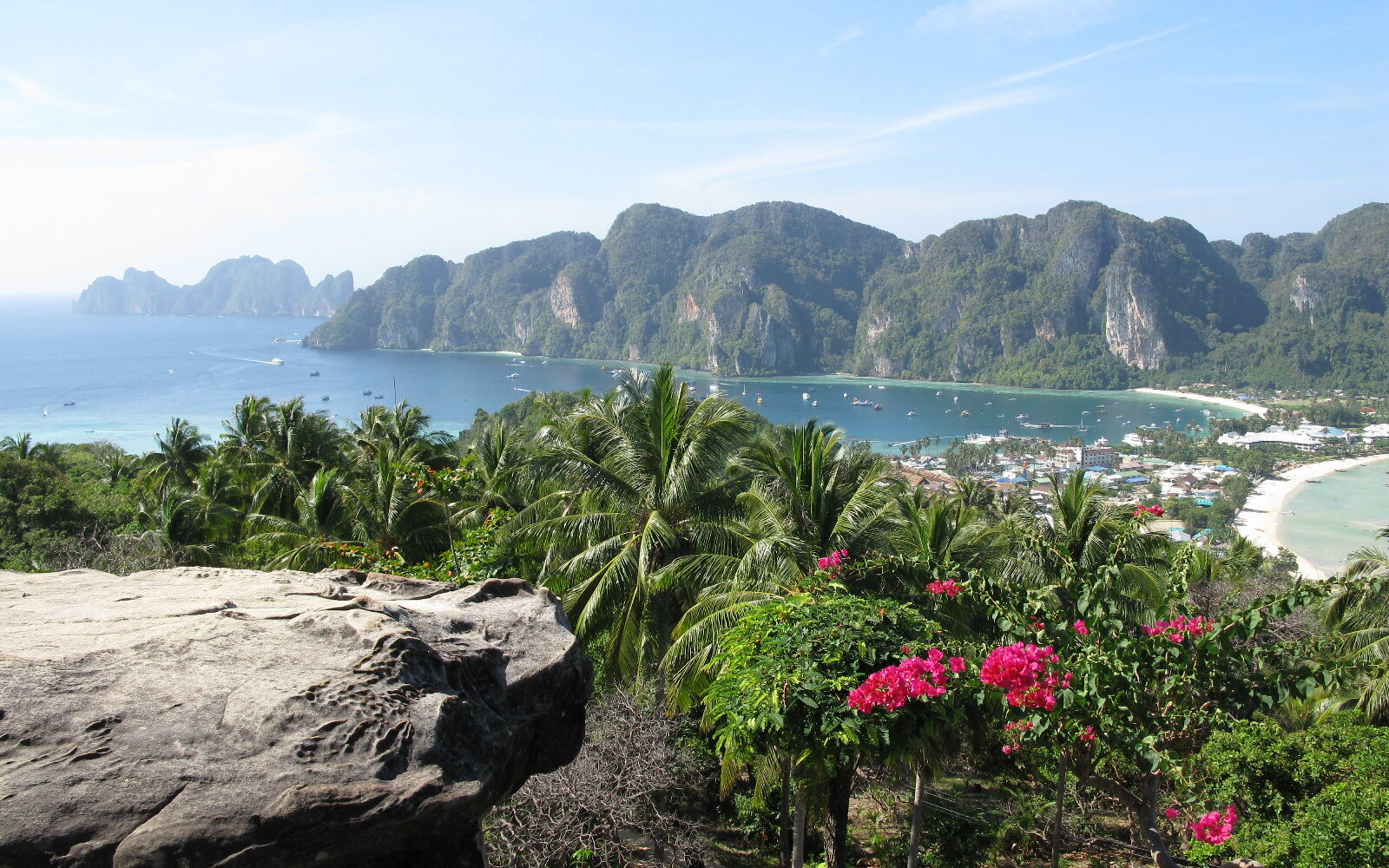
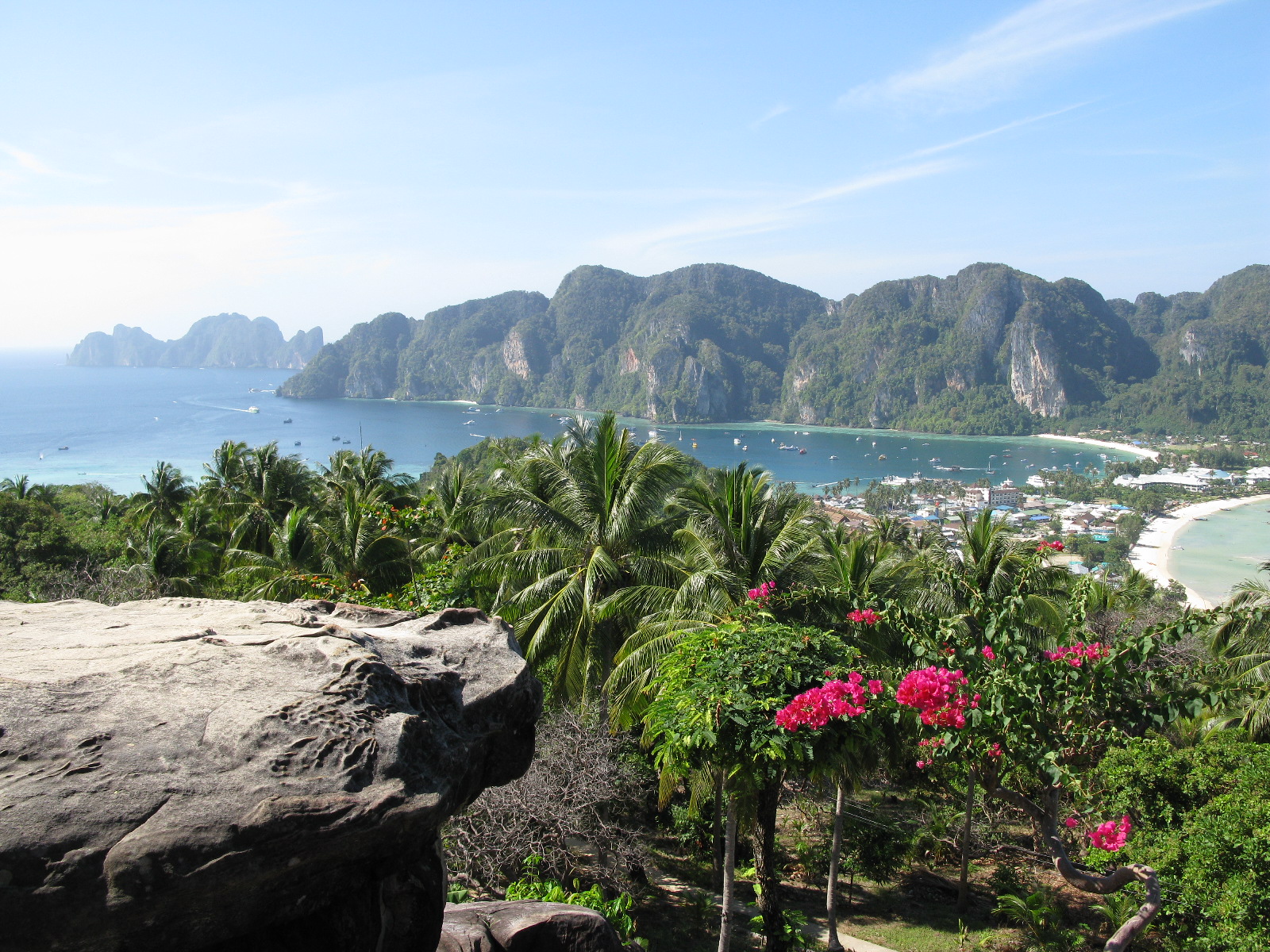
From the viewpoint it looks exactly like the photos: two curved bays almost touching, a thin strip of sand between them, a village squeezed onto that strip and jungle-covered limestone walls rising on both sides. Not a single car anywhere. Up close, though, Koh Phi Phi has two faces. During the day dozens of boats unload day-trippers from Phuket and Krabi. In the evening fire dancers spin on Loh Dalum beach and the music goes on long past midnight. And at seven in the morning you can stand on Maya Bay with hardly anyone else around. Which of those faces you catch decides whether you fall for the place or go home wondering what all the fuss was about.
This guide covers 17 things to do in Koh Phi Phi, spread across Phi Phi Don, Phi Phi Leh and the small islands around them. Before we get to the list, we deal with the questions that shape your whole stay: which ferry or speedboat to take from Phuket, Krabi or Koh Lanta and what the operators charge, what the national park fees are, how Maya Bay works since it reopened, when to go and, above all, where to sleep if you actually want to sleep. We also look at the big one: day trip or overnight stay? On Phi Phi, the answer matters more than almost anywhere else.
Things to do in Koh Phi Phi: the short version
- Koh Phi Phi is a group of six islands in Krabi province, about 46 km southeast of Phuket. You can only stay on the largest one, Phi Phi Don. Phi Phi Leh, home to Maya Bay, is uninhabited.
- There is no airport and there are no roads. You reach Phi Phi Don by ferry or speedboat from Phuket (about 2 hours), Krabi (about 2 hours) or Koh Lanta (about an hour). On the island you walk or take a long-tail boat.
- You pay 20 THB (under 50p) when you step off at Tonsai pier. It goes towards cleaning the island and shipping the rubbish back to the mainland.
- National park entry is 400 THB (about £9) for an adult foreigner and 200 THB for a child, in cash. It covers Maya Bay, Pileh Lagoon and Bamboo Island and is valid for the whole day.
- Maya Bay closes every year from 1 August to 30 September. The rest of the year boats may not enter the bay. You land at Loh Samah on the other side, get roughly an hour on the beach and are not allowed to swim in the bay.
- The best time to visit is November to April. From May to October the Andaman Sea is in its rainy season, the sea is often rough and some boats stop running.
- Where you sleep shapes everything. Tonsai and Loh Dalum are cheap and loud until late. Long Beach and the north of the island are quiet, but you will need a boat to get anywhere.
- The island costs more than the mainland because everything arrives by boat. Fresh water is scarce in the dry season, and you should not drink the tap water.
Koh Phi Phi Don, Phi Phi Leh and the rest: getting your bearings
When people say Koh Phi Phi, they usually mean Phi Phi Don, the only inhabited island in the group. It covers around ten square kilometres and is about 8 km long, and from above it looks like two islands tied together by a narrow neck of sand. That neck is where you find the main village, Tonsai (also written Ton Sai), with the pier, hotels, bars, dive shops and little stores. Tonsai Bay and the harbour lie on one side of it; on the other is the shallow bay of Loh Dalum.
Roughly two kilometres south sits Phi Phi Leh (also spelt Phi Phi Le or Ley), a smaller, uninhabited island with Maya Bay, Pileh Lagoon and Viking Cave. The group is completed by Bida Nok and Bida Nai, two rocky islets that are mostly of interest to divers, and, to the north, Koh Mai Phai (Bamboo Island) and Koh Yung (Mosquito Island). Almost all of this lies within Hat Noppharat Thara–Mu Ko Phi Phi Marine National Park, which covers more than 38,000 hectares of sea and coastline.
When it comes to choosing a place to stay, it helps to think of Phi Phi Don in four parts:
Tonsai and Loh Dalum are the centre. Narrow lanes where pedestrians, bicycles and luggage trolleys all squeeze past each other, cheap hostels, restaurants, tour desks and beach parties at night. Every boat leaves from here.
Long Beach (Hat Yao) lies southeast of the village: fine sand, a view across to Phi Phi Leh and a handful of resorts. You can walk there along the coast or take a boat.
The north and northeast are the beaches of Laem Tong, Loh Bakao and Pak Nam, with pricier resorts that you can only reach by boat. This is the brochure version of the island, but having dinner anywhere other than your hotel turns into an outing.
The surrounding islands are uninhabited and you visit them on boat trips.
Our favourite approach, which we come back to later in this guide: sleep outside Tonsai, go into the village for dinner and set off for Phi Phi Leh in the morning before the boats from Phuket arrive.
How to get to Koh Phi Phi from Phuket, Krabi and Koh Lanta
There is no direct way to Phi Phi from the UK. You fly to Phuket or Krabi, usually with one stop (typically in the Gulf, Istanbul or Bangkok, around 13 to 16 hours in total), and finish the journey by boat. Entry rules for Thailand depend on your passport and have changed several times since 2024, so check the current position for British nationals on GOV.UK and, if you need a visa, on the official Thai e-Visa site. Whatever your nationality, you need to fill in the online arrival card TDAC before you land.
The nearest airports are Phuket (HKT) and Krabi (KBV). From either one you take a taxi or transfer to the pier and then a boat. If your flight lands in the afternoon, you will often miss the last sailing, so it is easier to spend a night near the pier and cross in the morning.
From Phuket, ferries leave from Rassada pier near Phuket Town, roughly 40 to 55 minutes by car from the airport. The ferry takes around two hours; speedboats do it in about one. Several companies run the route, including Chaokoh, Andaman Wave Master (with its Royal Jet Cruiser) and Phi Phi Cruisers. You can also visit Phi Phi on a day trip from Phuket, but more on that below.
From Krabi, ferries sail from Klong Jilad pier near Krabi Town, about half an hour from the airport. In high season boats also leave from Nopparat Thara pier near Ao Nang. The ferry takes about two hours, a speedboat around one. For more on the province, see our guide to things to do in Krabi.
From Koh Lanta, it is about an hour from Saladan pier. Some boats only run in the season from November to April, while speedboats (Bundhaya, for example) also run outside it when the sea allows, according to travel guides.
Phi Phi sits right between Phuket and Krabi, so it works well as a stop along the way: Krabi to Phi Phi, a few nights on the island, then on to Phuket by ferry without doubling back.
| Route | Operator and boat | Crossing time | Adult fare, one way |
|---|---|---|---|
| Phuket (Rassada) → Phi Phi | Chaokoh, departs 11:00 and 15:00 | 2 hours | 599 THB (about £13) |
| Phuket (Rassada) → Phi Phi | Andaman Wave Master, Royal Jet Cruiser | 2 to 3 hours | from 700 THB (about £15) |
| Phi Phi → Phuket | Phi Phi Cruisers | 2 hours | from 500 THB (about £11) |
| Krabi (Klong Jilad) → Phi Phi | Andaman Wave Master, Nautica Express | 2 hours | from 450 THB (about £10) |
| Koh Lanta (Saladan) → Phi Phi | Chaokoh, departs 9:00 and 12:30 | 1 hour | 600 THB (about £13) |
| Phi Phi → Koh Lanta | Chaokoh, departs 11:00 and 14:00 | 1 hour | 500 and 400 THB (about £11 and £9) |
Fares come from the operators’ own websites, and children pay less. Timetables change with the season and boats are cancelled in big monsoon swells, so confirm your sailing with the operator or your accommodation the day before. Many tickets are also sold as a package with a hotel-to-pier transfer, which saves you sorting out a taxi.
Arriving at Tonsai pier and getting around the island
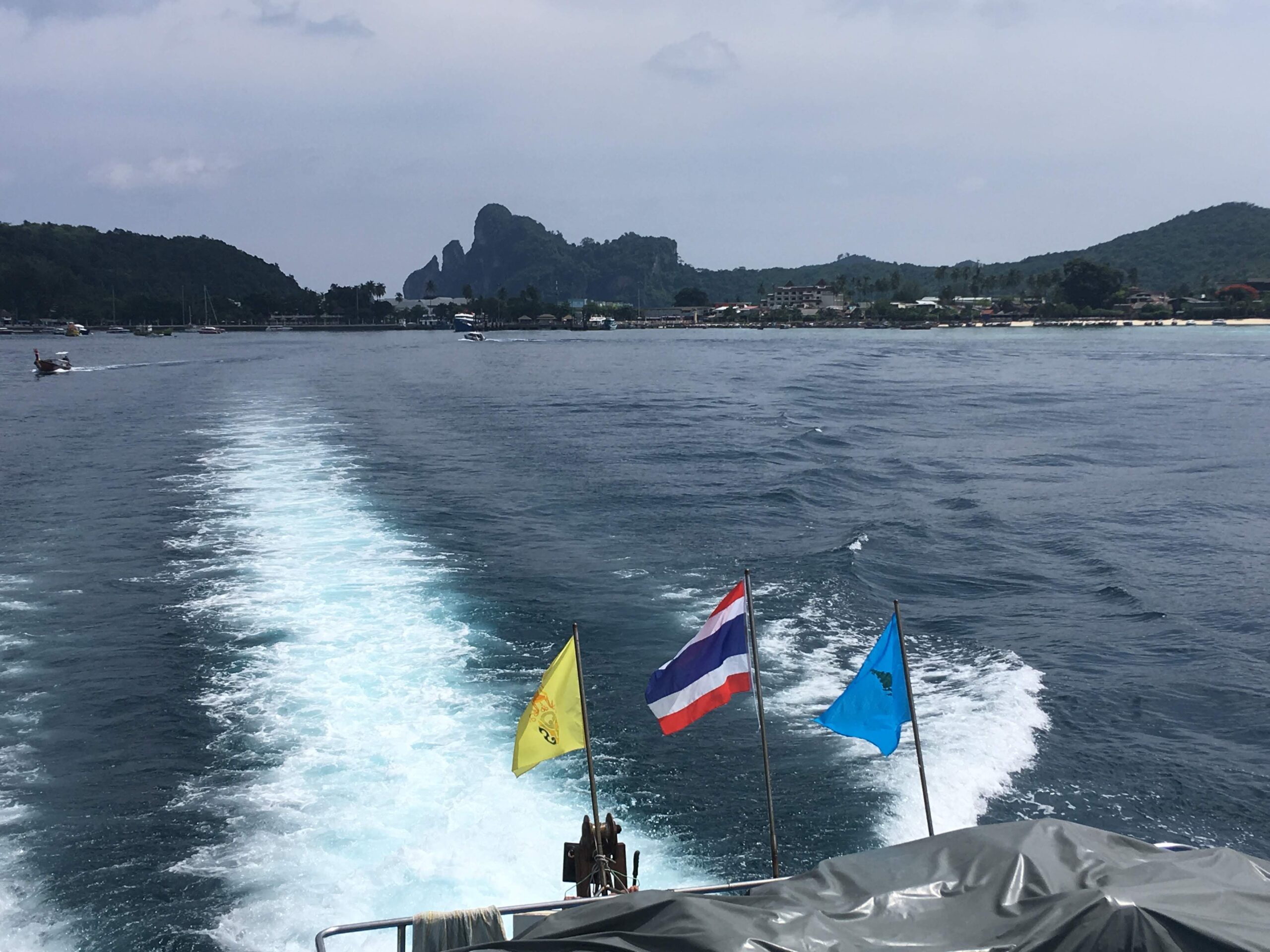
All scheduled boats dock at Tonsai pier in the middle of Tonsai Bay. Right on the pier you pay the 20 THB fee (under 50p), which funds cleaning and shipping waste back to the mainland. Past the pier, a row of people holds up signs for hotels and tours. Mornings and midday are the busiest; after about half past two the pier quietens down. There is a left-luggage office on the pier, handy if you arrive in the morning and cannot check in until the afternoon.
There are no cars or scooters on Phi Phi Don. Between the village, Loh Dalum and the nearest hotels you walk along narrow paved paths. Locals wheel your luggage to the hotel on hand carts for a small fee. A backpack is far more practical here than a big wheeled suitcase: some paths are sandy, and anything uphill means steps.
Long-tail boats act as taxis to the more distant beaches: Long Beach, Laem Tong, Loh Bakao and Monkey Beach. Agree the price before you get in; in a small group it works out cheaper per person. Resorts in the north of the island usually run their own boat transfer from Tonsai pier, so check when you book whether it is included. Andaman Wave Master also runs a scheduled boat, the Phi Phi Island Shuttle, between Tonsai pier and Laem Tong, for which it quotes 200 THB (about £4.40).
You can also walk from the village to Long Beach along the coast and over the rocks, which takes about half an hour. It is easier at low tide, and we would not do it after dark.
Best time to visit Koh Phi Phi
Phi Phi lies in the Andaman Sea, which has a different weather pattern from the islands in the Gulf of Thailand (Koh Samui, Koh Pha Ngan, Koh Tao). Here is what matters for Phi Phi itself.
November to April is the dry season. The sea is calm, boats run to timetable and trips to Phi Phi Leh are rarely cancelled. The crowds and the highest room rates come from December to February. Around Christmas and New Year the island is often fully booked, so reserve your room two to three months ahead. April is hot and brings the first storms. Bear in mind that the dry season is also when the island has the most visitors and the least fresh water (more on that below).
May to October is the rainy season of the southwest monsoon. It rarely rains all day; you get heavy downpours instead. But the sea is often rough, some boats are cancelled and trips to Phi Phi Leh get postponed. According to travel guides, September and October are the wettest months. Rooms are much cheaper and there are fewer people.
Maya Bay is closed every year from 1 August to 30 September. The national park shuts it so the beach and coral can recover, and for safety, because in monsoon swells boats cannot land safely at the pier in Loh Samah. The closure includes Loh Samah as well. In 2026 Maya Bay reopened on 1 October. Boat trips around Phi Phi Leh carry on in August and September, just without the landing at Maya Bay. The park announces the exact dates every year, so check them before you go.
If it were up to us, we would go between mid-November and early December, or in March. The sea is calm, Maya Bay is open, and the Christmas crush has either not yet started or is already over.
Koh Phi Phi day trip or stay overnight?
Every day crowds of people visit Phi Phi on a day trip from Phuket, Krabi, Ao Nang, Koh Lanta and Khao Lak. It is convenient, cheaper than two nights on the island, and the price usually includes a hotel pick-up, lunch and snorkelling gear. The catch is timing. Tour boats reach Maya Bay and Pileh Lagoon from roughly ten in the morning until the afternoon, which is exactly when both are at their busiest and the light is at its harshest. From Phuket you also spend several hours on the boat.
Stay on Phi Phi and you can set off for Phi Phi Leh at seven in the morning on a private long-tail from Tonsai, arriving at Maya Bay among the first visitors of the day. In the evening you catch the sunset from the viewpoint and see the island once the day-trippers have gone. In our view two nights is ideal: day one for arriving, Long Beach and the viewpoint at sunset; day two for Phi Phi Leh in the morning and snorkelling or kayaking in the afternoon; day three for leaving in the late morning. One night works too, but leaves you nothing in reserve if the weather turns.
A day trip makes sense if you have a fixed base on Phuket or in Krabi and do not want to move, if you are travelling with small children, or if what draws you is the snorkelling and the boat ride rather than the island itself. In that case, choose a small group and an early departure. Before you book, check whether the national park fee is included. Often it is not, and you then pay it in cash on the spot.
Where to stay in Koh Phi Phi
On Phi Phi, more than almost anywhere else, where you sleep decides how your stay goes. The island is small but has no roads, so what looks close on the map can be a long way at night with a backpack, or a boat ride. Rooms cost more than on the mainland, and the same money buys you something simpler, because everything comes in by boat and space is tight. Hotel reviews on Phi Phi tend to be harsher than elsewhere in Thailand, and we think that is mostly because people expect the luxury they saw in the photos. Where water and power come from island supplies, something is bound to stop working now and then. For December to February, book well in advance.
Tonsai and Loh Dalum suit people who want everything within walking distance and do not mind noise. The cheapest rooms are in the village lanes and at the foot of the hill towards the viewpoint, which is also a little quieter. In the village and around Loh Dalum the bars play music until late at night, and earplugs come in handy even in a hostel two streets back.
- Phi Phi Villa Resort is on the quieter end of Tonsai beach, about ten minutes’ walk from the village. For us it is the most sensible compromise between convenience and a good night’s sleep, although you will hear the call to prayer from the mosque in the morning.
- PP Princess Resort sits right on Loh Dalum bay, a few minutes’ walk from the pier. A good pick if you want to be in the centre but not above a bar.
Long Beach is, in our view, the best choice for couples and for anyone who wants peace without being cut off. It has the island’s nicest beach, a view of Phi Phi Leh and snorkelling at Shark Point, and the village is a few minutes away by boat or half an hour on foot.
- Phi Phi The Beach Resort is right on Long Beach, and the rooms look across the strait to Phi Phi Leh.
- Viking Nature Resort has wooden bungalows in the greenery above its own little beach between Tonsai and Long Beach. More for people who want nature than air-conditioned standard rooms.
The north and northeast of the island (Laem Tong, Loh Bakao, Pak Nam) are for those who want white sand outside the bungalow and silence. The resorts have their own restaurants and boat transfers from Tonsai pier, but getting to the village means taking a boat. Food and drink cost more here than in Tonsai.
- SAii Phi Phi Island Village is a large resort on Loh Bakao beach in the northeast of the island, about 20 to 30 minutes by boat from Tonsai. For stays of five nights or more it offers a free shared speedboat transfer.
- Phi Phi Relax Beach Resort has bungalows above its own quiet beach on the east coast. Pricier than the centre, cheaper than the big resorts in the north.
For more places to stay, try this search for Phi Phi Don, or for the northern tip, this search for Laem Tong.
17 things to do in Koh Phi Phi
We have grouped them by island: first Phi Phi Don, where you will be staying, then Phi Phi Leh, which you reach by boat, and finally the smaller islands nearby and what to do on and under the water.
1. Phi Phi Viewpoint
The most famous view of Koh Phi Phi, the two half-moon bays of Tonsai and Loh Dalum with the village on the sandy isthmus between them, is from the viewpoint on the hill above the village. From the village you climb steep steps and paths. It takes 15 to 30 minutes and is hard work in the heat and humidity. There is a gentler but longer route that loops round.
There are three viewpoints. The first is just above the steps and full of signs and photo props. The best-known view is from the second (Viewpoint 2), a bit higher up, and only a few people make it to the third, where there is a café. The viewpoints are on private land and the owners charge a small fee in cash at the entrance for upkeep. There are toilets and a drinks stall at the top.
Sunset draws the biggest crowds; we prefer the morning, when it is cooler and the light comes from the right direction. The water looks its best at high tide, when there is more of it in Loh Dalum bay. From the viewpoint a path continues over the hill to the remote beaches in the northeast (Loh Bakao, Pak Nam, Loh Lana), but expect jungle, heat and next to no signposting.
2. Tonsai village
Tonsai is the only sizeable village on the island and nearly everything you need is here: the pier, cash machines, pharmacies, a 7-Eleven, tour desks, dive shops, laundries and dozens of restaurants. It is a maze of narrow lanes where you dodge luggage carts and bicycles. Do not expect a fishing village: right by the pier there is fast food and souvenir shops.
The village also has a market with fruit, vegetables, seafood and cheap food, used mostly by locals. You will find a mosque in Tonsai too, because most of the island’s permanent residents are Muslim. The call to prayer rings out in the morning, which makes a good alarm clock for an early boat trip.
3. Loh Dalum and the tsunami memorial
The other side of the isthmus: a shallow bay with fine sand and limestone cliffs around it. During the day it is calm, and you can rent kayaks and paddleboards. At low tide the water retreats a long way and swimming is barely possible, so check when high tide is. In the evening the beach turns into a row of bars with fire shows, music and buckets of mixed drinks, which are sold here instead of cocktails. According to visitors, the music plays until one or two in the morning.
Loh Dalum took the worst of the tsunami wave in December 2004 (more in the history section below). There is a memorial to the victims on the beach, and every year on 26 December a quiet remembrance is held here.
4. Long Beach (Hat Yao) and Shark Point
In our view the nicest beach on Phi Phi Don that you can reach on foot. Fine white sand, clear water and a direct view of Phi Phi Leh across the strait. Only a few resorts and bars line the beach, so it stays calm even in high season. From Tonsai it is a few minutes by long-tail, or about half an hour’s walk along the coast.
Just off the beach is a rocky reef called Shark Point, where snorkellers can see blacktip reef sharks. They are small and shy and do not harm people; your best chance is early in the morning. Bring your own mask, as the beach is ideal for snorkelling.
5. Loh Moo Dee
Beyond Long Beach, on the southeastern tip of the island, lies the small bay of Loh Moo Dee, with a strip of beach around 250 metres long enclosed by rocks. At most there is a drinks stall, no hotels or bars. You can walk here from Long Beach on a path or arrive by boat. If you want the feeling of a deserted beach on Phi Phi, this is the easiest place to find it.
6. Laem Tong and the sea gypsy village
A beach on the northern tip of Phi Phi Don with turquoise water and a coral reef close to the shore. There are a few upmarket resorts and a small village of the Urak Lawoi, sea nomads known in Thailand as Chao Leh. They lived on these islands long before tourists arrived and still make a living mainly from fishing. From Tonsai it takes about half an hour by boat. Laem Tong has a calm you will not find in the centre, and it is the closest point to Bamboo Island.
7. Nui Beach and Camel Rock
A small sandy cove in the north of the island with good snorkelling by the rocks on the right-hand side and a view of a rock formation known as Camel Rock. You get here by boat or by kayak from Loh Dalum, and it is a regular stop on snorkelling trips around Phi Phi Don.
8. Monkey Beach
A small beach on the coast not far from Tonsai Bay, home to a troop of macaques. It is on almost every boat trip’s itinerary and gets packed at midday. The monkeys are cheeky and used to people. They steal from bags and boats, and if someone feeds or teases them they can bite. A bite means a trip to the doctor and rabies jabs. We would stay on the boat or in the water and leave the monkeys alone; the water here is crystal clear and good for snorkelling.
9. Wang Long Bay and a sunset kayak
A quiet bay on the west coast that is the destination of sunset kayak tours. You can rent a kayak on Loh Dalum and on other beaches, and the coast around Phi Phi Don is perfect for paddling: rock walls drop straight into the sea and behind every headland there is another cove. If you want to go on your own, set off in the morning when the sea is calmest, and take a snorkel.
10. Maya Bay
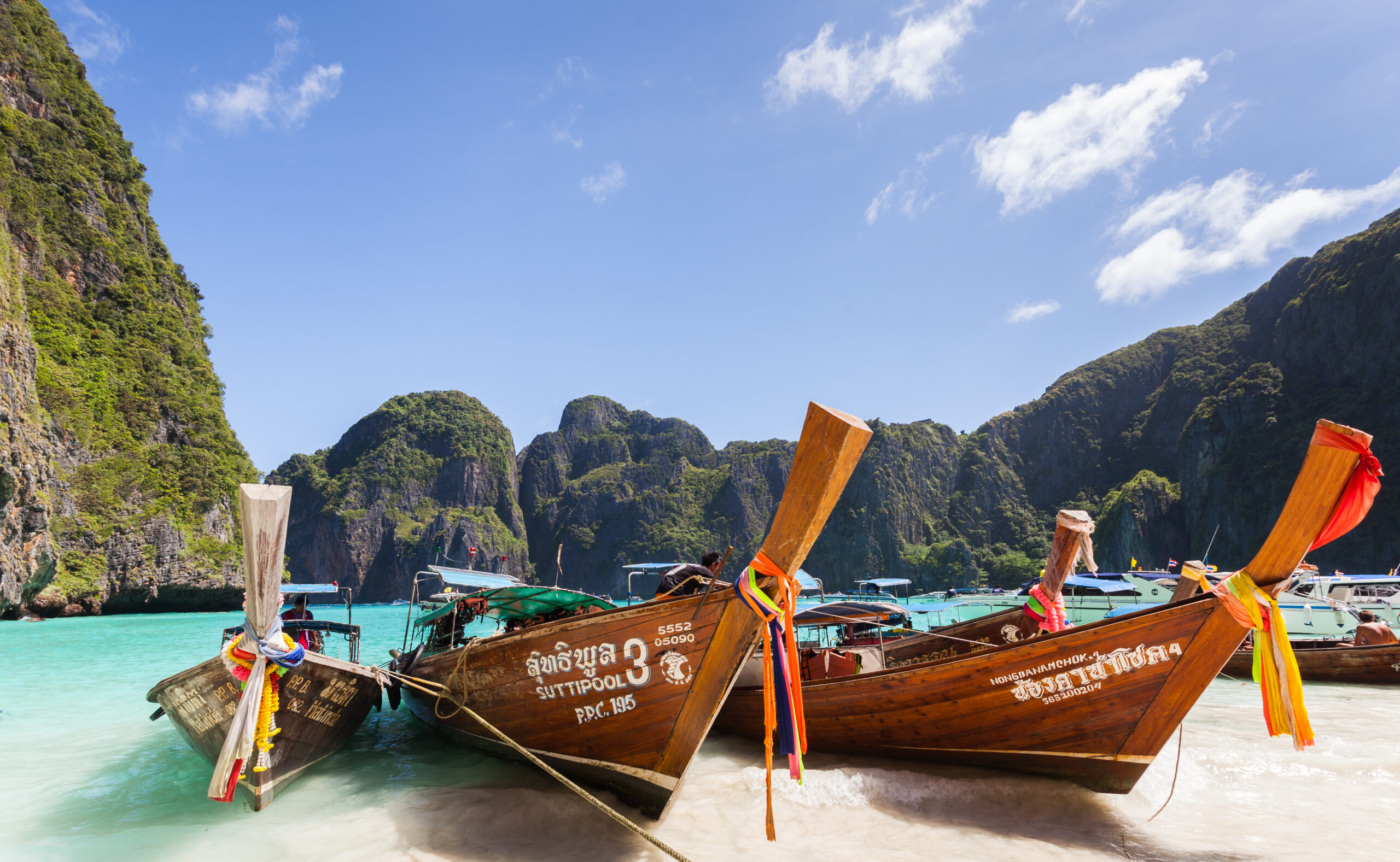
A bay on the west side of Phi Phi Leh, enclosed on three sides by limestone walls about a hundred metres high, with an arc of white sand. It shot to fame with the film The Beach (2000) starring Leonardo DiCaprio, and a quiet cove became one of the most visited places in Thailand. Before 2018, according to local guides, thousands of people arrived every day, boats anchored right in the bay and much of the coral beneath them died. So in June 2018 the national park closed Maya Bay, at first for a few months, in the end for almost four years. During that time coral was replanted and blacktip reef sharks returned to the shallows.
Maya Bay reopened on 1 January 2022, but with new rules:
- Boats may not enter the bay. They drop you at a floating pier in Loh Samah, the bay behind it, and you walk to the beach in a few minutes along a wooden boardwalk.
- Swimming in the bay is not allowed; you may only wade near the shore. Some tour companies mention a marked swimming zone by the beach, but the park rangers set the rules on the day, so follow them. For snorkelling, boats go to Loh Samah and Pileh Lagoon.
- Time on the beach is limited to roughly an hour, and so is the number of people at any one time. When it is full, boats wait outside.
- Feeding or chasing the sharks, drones, smoking, alcohol, picnics and litter are all banned.
- You pay the national park entry fee of 400 THB (about £9) for an adult foreigner, 200 THB for a child, in cash. Bring small notes, as the rangers do not take cards.
- The bay is closed every year from 1 August to 30 September.
It sounds strict, but it works. The beach is clean, the water is clear and you can often see sharks straight from the sand. It is busiest between ten in the morning and one in the afternoon, when the tour boats from Phuket and Krabi arrive. The park opens at seven, and if you stay on Phi Phi Don and set off early on a private long-tail from Tonsai, you will have the bay almost to yourself. If you are going to pay for one extra on Phi Phi, make it this.
11. Loh Samah Bay
A small bay at the back of Phi Phi Leh where boats with Maya Bay visitors now land. According to the Tourism Authority of Thailand (TAT), it is one of the best dive spots around Phi Phi. The water is calmer than in the open sea and, unlike in Maya Bay, you can snorkel here, so trips usually stop here for a swim.
12. Pileh Lagoon
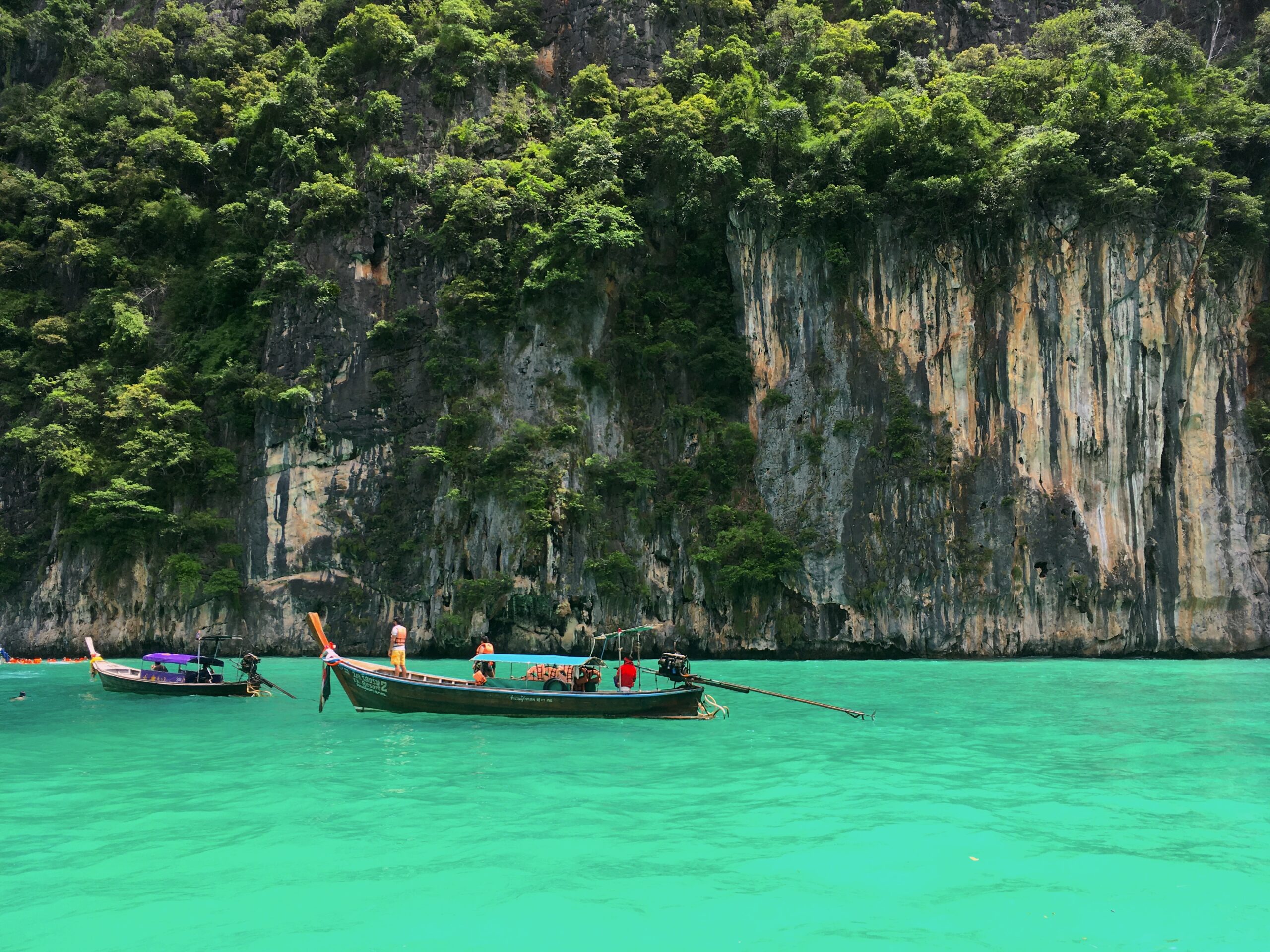
Pileh (Pi Leh) is a bay on the east side of Phi Phi Leh that you enter through a narrow gap in the rock. Inside is an almost enclosed lagoon of emerald-green water ringed by sheer limestone walls. Boats stop here and people jump off the deck to swim and snorkel; you can see the fish even from above. For us it is the most beautiful spot in the whole archipelago, lovelier than Maya Bay, and at midday also the most crowded with boats. It looks its best around noon, when the sun is overhead and the water is at its greenest, but it is calmest in the morning.
13. Viking Cave
This cave on the northeast coast of Phi Phi Leh got its name from old paintings of ships on its walls, which reminded someone of Viking longships. In reality it is where edible swiftlet nests are collected for expensive bird’s nest soup. The collectors climb bamboo ladders all the way up to the roof. You are not allowed inside: boats just slow down and you see the cave from the water. It is a short stop, but you will pass it on almost every trip around Phi Phi Leh.
14. Bamboo Island and Mosquito Island
Koh Mai Phai, known as Bamboo Island, lies roughly 5 km north of Phi Phi Don. It has white sand all the way round, shallow water and a coral reef that is good for snorkelling, and only basic facilities. It is part of the national park, so the same 400 THB entry applies, but if you have already been to Maya Bay or Pileh Lagoon that day, you show your ticket and do not pay again. Right next to it is Koh Yung, or Mosquito Island, with rocky shores and coral that you snorkel from the boat. No need to worry about mosquitoes: boats rarely land on the island.
Full-day trips usually stop at Bamboo Island for lunch. It is closest to Laem Tong, and if you stay there you can hire a long-tail for the early morning, before anyone else arrives.
15. Diving: Bida Nok, Bida Nai and the King Cruiser wreck
Phi Phi is one of the best places to dive in Thailand, and Tonsai has dozens of dive centres. Beginners can try an introductory dive without a certificate or take the basic Open Water course. Experienced divers head for the rocky islets of Bida Nok and Bida Nai south of Phi Phi Leh, with reefs full of blacktip reef sharks, turtles and shoals of fish. Further out lies the wreck of the King Cruiser ferry, which sank in 1997 after hitting Anemone Reef. It rests at a depth of around 30 metres, so it is for experienced divers only. Hin Muang is another famous site, a rocky ridge with an underwater wall about 60 metres deep.
On top of the park entry fee, divers pay a surcharge of 200 THB (about £4.40) per day of diving. If you dive several days in a row, you pay in three-day cycles: 600 THB (about £13) for the first day, then 200 THB for each of the next two. You buy the ticket from the rangers at Tonsai pier.
16. Bioluminescent plankton
In some spots around Phi Phi the plankton lights up in the dark. Move your hand through the water and it leaves a trail of blue sparks. Evening boat trips include it in their programme, usually combined with the sunset and snorkelling. You will see it best on a moonless night, away from the lights of the village. Nobody can guarantee it, though; plankton does what it likes.
17. Rock climbing
The limestone cliffs on Phi Phi Don are well known among climbers, even though the more famous climbing spot is Railay near Krabi. The best known is Tonsai Tower, a wall at the western end of Tonsai Bay with about twenty routes of varying difficulty; others include Drinking Wall, Ao Ling Wall and Hua Ling Wall. Climbing schools in the village run half-day courses with all the gear, even for complete beginners. Climb in the morning or late afternoon, when the wall is in the shade.
Food, evenings and what to do in Koh Phi Phi at night
You can eat well everywhere on Phi Phi Don, just at higher prices than on the mainland. The cheapest options are the stalls and small Thai canteens in the lanes of Tonsai and the village market, where the cooking is aimed at locals. In the evening, restaurants set up seafood grills out front: you pick your fish and pay by weight. Ask for the price first. On the beaches outside the village, at Long Beach and Laem Tong, food and drink cost more, because everything has to come in by boat.
If you want to learn to cook, Tonsai has Thai cookery classes ranging from short lessons to sessions lasting several hours with a trip to the market. For us that is one of the best souvenirs you can bring home from Thailand.
In the evening the action moves to Loh Dalum beach: fire shows, music, beach bars and buckets of spirits mixed with an energy drink and fizzy pop. At Reggae Bar in the village there is muay thai boxing every night, and brave guests can climb into the ring themselves. Parties on Phi Phi are loud and go on and on, with no official finish. If that is why you are coming, you will be happy. If not, stay on Long Beach or in the north and only come to Tonsai for dinner.
Practical information: water, money and safety
Water. Phi Phi Don has very little fresh water. The mains supply is fed by two freshwater reservoirs, and in the dry season from November to April, when the island is at its busiest, it does not rain and water runs short. Do not drink the tap water, and in some places the shower water is salty or just a trickle. Buy bottled drinking water, and if your accommodation offers refills, use them so the island does not end up with even more plastic. Rubbish is a big problem on Phi Phi. According to figures from 2014, the island produced around 40 tonnes of waste a day in high season, and all of it has to be shipped to the mainland.
Money. The only cash machines are in Tonsai, and Thai ATMs charge a fee for withdrawals on foreign cards. The national park entry, boats, the pier fee and smaller restaurants are all paid in cash, so take out a larger amount at once rather than paying the fee several times. You will not find a cash machine on Long Beach or in the north of the island.
Safety. Phi Phi is a safe island; the most common problems are petty theft on the beach and at parties. Do not leave your things unattended on the beach, and take only as much money to a party as you plan to spend. Keep an eye on your drink. Drugs carry heavy penalties in Thailand, and e-cigarettes and vapes are illegal. According to GOV.UK, there is no exception for tourists, and you risk confiscation, a fine of typically 5,000 to 30,000 THB and detention. Smoking is banned on many Thai beaches.
The sea. In the monsoon there are strong currents and waves, and a red flag means no swimming. Do not touch or stand on coral: damaging it is an offence in the national park. When snorkelling, use reef-safe sun cream, or better still a UV-protective rash vest.
Health. There are pharmacies on the island, but anything more serious means a boat to the mainland. Do not come without travel insurance that also covers medical evacuation. If a monkey bites you, see a doctor straight away. Ask your GP or a travel clinic about vaccinations well before you leave.
How many days in Koh Phi Phi and how to plan them
A day trip is enough if you want to see Maya Bay, Pileh Lagoon and Bamboo Island and you are based on Phuket or in Krabi. You will see the main sights from the boat, but not the island itself.
Two nights is ideal in our view:
- Day 1: morning ferry from Krabi or Phuket, check in, Long Beach in the afternoon, the viewpoint at sunset, dinner in Tonsai.
- Day 2: at seven in the morning, a private long-tail to Phi Phi Leh: Maya Bay, Loh Samah, Pileh Lagoon, Viking Cave. Rest in the afternoon, a kayak or snorkelling at Shark Point, then the fire shows on Loh Dalum or the plankton in the evening.
- Day 3: the viewpoint without the crowds or Bamboo Island early in the morning, then an afternoon ferry onwards.
Three to five nights makes sense for divers who want to do a course, and for anyone staying in the north of the island who has come mainly to rest.
Phi Phi works well as a stop between Krabi and Phuket (see our guide to things to do in Phuket) or on the way to Koh Lanta. For how it fits into two or three weeks in Thailand, see our overview of places to visit in Thailand.
A little history
As late as the mid-20th century, Phi Phi Don was almost deserted. In the late 1940s Muslim fishermen from the Thai-Malay coast settled here and the island became a coconut plantation. The Urak Lawoi sea nomads lived in the north. Muslims still make up most of the permanent population today, although many people from elsewhere work here in the season. There are about 2,500 permanent residents. Meanwhile, the caves on Phi Phi Leh served the collectors of edible birds’ nests.
In the 1980s the first backpackers began to arrive and bamboo huts sprang up on the beaches. Then came 2000 and Danny Boyle’s film The Beach with Leonardo DiCaprio, shot in Maya Bay. The filming itself drew criticism that the crew had reshaped the beach with bulldozers and planted palm trees for the shots, which the producers denied. The film made Phi Phi world famous and visitor numbers rose quickly.
On the morning of 26 December 2004, a tsunami triggered by an earthquake off Sumatra struck the island. Shortly after ten the water drew back from both bays, and at 10:37 it returned from both sides at once. The waves collided in the middle of the isthmus where Tonsai village stands, less than two metres above sea level. The wave from the Tonsai side was around three metres high, the one from Loh Dalum 6.5 metres. More than a thousand people died on Phi Phi Don and most of the village was destroyed. The island was rebuilt quickly and more densely than before, because tourism was the only livelihood.
Mass tourism then nearly broke the island. In 2018 the national park closed Maya Bay and only reopened it in January 2022, with limits and rules. Since then it closes again every August and September. For Phi Phi, it was the first time a famous spot was closed to let it recover, and by all accounts it is working.
What we would do differently
On Phi Phi it is easy to get swept along with what everyone else is doing: the viewpoint at sunset, the midday boat to Maya Bay, a bucket on Loh Dalum. It is all fine, but the best moments here tend to come at other places and other times. Long Beach in the morning, before the boats start up. A kayak into a cove that has no name on any map. A fish curry in a canteen where the menu is only in Thai and nobody invited you in.
Do not try to tick off all seventeen places. If you spend two days on Phi Phi and see Maya Bay, Pileh Lagoon and one sunset, you have not missed anything. Better to keep one afternoon for nothing at all: a hammock, a book, a snorkel and the view across the strait to Phi Phi Leh.
And leave your phone in your bag, at least for a while. At Maya Bay half the people stand with their backs to the bay taking selfies, and the hour you get there goes fast. You will remember the sharks in the shallows better if you watch them rather than film them.
Koh Phi Phi FAQ
How do you get to Koh Phi Phi from Phuket or Krabi?
Only by boat; there is no airport or bridge. Ferries run from Rassada pier on Phuket (about 2 hours), from Klong Jilad pier near Krabi Town (about 2 hours) and from Saladan on Koh Lanta (about an hour), and in high season also from Ao Nang. A ferry ticket costs roughly 450 to 700 THB (about £10 to £15) depending on the operator; speedboats cost more. All boats dock at Tonsai pier on Phi Phi Don.
What is the difference between Koh Phi Phi Don and Koh Phi Phi Leh?
Phi Phi Don is the larger island and the only inhabited one in the group. It has Tonsai village, the hotels, the restaurants and the pier. Phi Phi Leh lies about two kilometres to the south, is uninhabited and is home to Maya Bay, Pileh Lagoon and Viking Cave. You can only visit Phi Phi Leh on a boat trip; there is nowhere to stay.
How much is the Phi Phi Islands national park fee for Maya Bay?
Maya Bay lies in Hat Noppharat Thara–Mu Ko Phi Phi National Park, and entry costs 400 THB (about £9) for an adult foreigner and 200 THB for a child, in cash. The same ticket is valid all day for Pileh Lagoon and Bamboo Island too. On top of that, you pay 20 THB at the pier on Phi Phi Don towards cleaning the island. Boat trips often do not include the park fee.
Can you swim in Maya Bay?
No. Since it reopened in January 2022, swimming and snorkelling in the bay are not allowed; you may only wade near the shore. Boats cannot enter the bay. You land at Loh Samah behind it and get roughly an hour on the beach. For a swim, boats go to Loh Samah and Pileh Lagoon. Maya Bay is closed every year from 1 August to 30 September.
When is the best time to visit Koh Phi Phi?
From November to April, the dry season on the Andaman Sea, when the sea is calm. The crowds and the highest prices come from December to February. From May to October is the rainy season, boats are sometimes cancelled and Maya Bay is closed in August and September. Our own favourites are the second half of November and March.
Is Koh Phi Phi worth staying on, or is a day trip enough?
We think it is worth staying at least one night, ideally two. Tour boats from Phuket and Krabi reach Maya Bay and Pileh Lagoon at the busiest time of day. If you stay on Phi Phi Don, you can head out on a private long-tail at seven in the morning, when most things to do in Koh Phi Phi are at their best and you have the places almost to yourself. A day trip makes sense if you have a fixed base elsewhere.
What is the best place to stay in Koh Phi Phi?
It depends on whether you want to sleep. Tonsai and Loh Dalum are the cheapest and everything is within walking distance, but the bars play music late into the night. Long Beach is quiet, has the nicest beach and the village is a few minutes away by boat. In the north of the island (Laem Tong, Loh Bakao) there are expensive, peaceful resorts, but you need a boat to get to the village.
What happened on Koh Phi Phi in the 2004 tsunami?
On 26 December 2004 the wave hit the island from both sides at once and the two fronts collided in the middle of the low isthmus with Tonsai village. The wave from Loh Dalum bay was 6.5 metres high. More than a thousand people died on Phi Phi Don and most of the village was destroyed. Today there is a memorial to the victims on Loh Dalum beach.
Where next
- Thailand holiday guide: when to go, entry rules, flights, budget and routes for two or three weeks.
- Things to do in Krabi: Railay, Ao Nang, Tiger Cave Temple and the islands, plus the piers where the Phi Phi ferries leave.
- Things to do in Phuket: beaches all along the coast, Old Phuket Town and trips to Phang Nga Bay.
- Places to visit in Thailand: an overview of the whole country, from Bangkok to the islands in the Gulf of Thailand.
- Things to do in Bangkok: temples, markets and canals in the city where most trips to Thailand begin or end.
Potřebujete pomoct s cestováním?
-
Ubytování 🏨
Vyberte si to nejlepší ubytování, ať už jste kdekoliv, přes Booking.com. -
Půjčení auta 🚗
Auto si snadno najdete přes Booking.com, kde máte často slevu díky ubytování, nebo Rentalcars.com, kde porovnáte nabídky většiny půjčoven. -
Zážitky 🎟️
Přes GetYourGuide.com si vyberete z nejrůznějších výletů i zážitků po celém světě, navíc se zrušením zdarma do 24 h předem.