What to See in Portugal: 28 Best Places to Visit (2026)
Last updated 30.8.2026
Portugal is one of those countries you don’t know much about until you arrive — and then you fall for it completely. The beaches, the endless ocean and the little sun-bleached towns are so lovely that you’ll want to stay far longer than you planned. Best of all, there’s a wonderful sense of calm here. You can learn to surf, practise yoga, walk long-distance trails, or simply do nothing at all. We’ve gathered the best of what to see in Portugal — from the famous icons to the quiet corners the crowds never reach — so you can start dreaming up your own trip.
What to see in Portugal at a glance
The must-see four: Lisbon, Sintra, Porto and the Algarve — the backbone of any first trip.
When to go: May–June and September are best (warm, fewer crowds, lower prices). High summer is hot and packed.
How long: ideally 10–14 days for the mainland; Madeira or the Azores each deserve a week of their own.
Getting around: train or bus between the cities; a car is best for the Algarve and the Douro Valley.
Budget: from around €50/day as a backpacker, a comfortable €80–100/day.
Don’t leave without tasting: pastéis de nata, bacalhau and a glass of port in Vila Nova de Gaia.
When to go and how to get around Portugal
Portugal has one of the longest seasons in Europe — the sun shines here from roughly April to October. The sweet spot is May, June and September. It’s warm enough to swim (over 25 °C on the Algarve), but the crowds have either not arrived or already gone, and accommodation costs far less than in July and August. The height of summer is hot and, especially in the south, very busy; spring and autumn are also ideal for cities and hiking, because trudging up Lisbon’s hills in 35 °C heat is no fun at all.
Between cities: train and bus
You can cover the spine of the country without a car. Trains run by CP link Lisbon and Porto on the Alfa Pendular express in about 2 hours 50 minutes (fares from roughly €25–30, cheaper if you book early). Rede Expressos and FlixBus coaches are cheaper still and reach places the trains don’t. Within Lisbon and Porto you’ll get around by metro, tram and local trains.
The Algarve, the Douro and the countryside: a car
As soon as you want the beaches of the Algarve, the vineyards above the Douro or the mountain villages, a car is a huge advantage — some beaches and viewpoints are all but impossible to reach otherwise. Hire starts at around €20–30 a day out of season. Expect motorway tolls (some stretches are electronic-only, tied to a registered number plate), and in city centres it’s best to use park-and-ride car parks.
💡 Tip: If you’re flying into Lisbon and only want the big cities, skip the car — you’ll save on parking and stress. Hire one just for 3–4 days on the Algarve or for a loop through the Douro Valley. Flights and connections to Lisbon →
What to see in Portugal: 28 places, region by region
We’ve roughly ordered them by region, running from Lisbon through the centre and north to the islands out in the Atlantic. Feel free to build your own route from them — the first four (Lisbon, Sintra, Porto, the Algarve) form the backbone, and the rest are the icing on the cake.
1. Lisbon — Alfama, Belém and Tram 28
The capital sits on seven hills above the River Tagus and makes the perfect starting point. Begin in Alfama — the oldest and most picturesque part of the city, a maze of narrow cobbled lanes where washing hangs from the windows and fado drifts out of the little taverns come evening. Climb up to São Jorge Castle and the Miradouro de Santa Luzia viewpoint. The second must is the Belém district, with the Jerónimos Monastery and the Belém Tower (both UNESCO) and the Monument to the Discoveries. And in between, ride the legendary yellow Tram 28, which rattles through the steepest streets.Entry to both the Jerónimos Monastery and the Belém Tower is around €8–10, and a ticket on Tram 28 costs about €3 on board (cheaper on a 24-hour travel card). Give Lisbon itself at least 2–3 days.
💡 Tip: Board Tram 28 first thing in the morning at the Martim Moniz terminus, otherwise you won’t squeeze on later in the day. And watch out for pickpockets — this is one of their favourite routes. Accommodation in Lisbon →
2. Sintra — Pena, Quinta da Regaleira and the Moorish Castle
Half an hour by train from Lisbon lies Sintra — wooded hills scattered with fairy-tale palaces. The star is the Pena Palace, a red-and-yellow Romantic confection straight out of a children’s book, along with the mysterious Quinta da Regaleira, with its gardens, grottoes and initiation well, down whose spiral staircase you descend underground. Add the ruined Moorish Castle, with views over the whole area. Sintra is the most popular day trip from Lisbon — and deservedly so.Entry to the Pena Palace is around €14–20, and Quinta da Regaleira about €12. Buy your tickets online in advance.
💡 Tip: Catch the very first morning train to Sintra and start with Pena, before the coaches arrive. The 434 shuttle minibus links the sights — walking uphill in the heat is hard going.
3. Cabo da Roca — the westernmost point of Europe
Just beyond Sintra, the cliffs plunge into the Atlantic at the spot where “land ends and the sea begins”, as the poet Camões put it. Cabo da Roca is the westernmost tip of continental Europe — rugged rocks, a lighthouse and a wind that nearly blows you off your feet. Entry is free, and on a clear day it’s a phenomenal stop on the way between Sintra and the coast.
4. Cascais — an elegant seaside town
A former fishing village and now a favourite resort of well-heeled Lisboetas. Cascais has a pleasant pedestrianised centre, small beaches right in town, and just outside it the natural spectacle of Boca do Inferno (Hell’s Mouth), where the sea roars through a rocky chasm. You can get here on the suburban train from Lisbon along the coast — one of the loveliest rail journeys in the country.
5. Porto — Ribeira, the Douro and port wine cellars
The second-largest city and our own favourite. The historic Ribeira quarter, with its colourful houses, tumbles down to the River Douro, spanned above by the two-tier Dom Luís I bridge. Cross its upper walkway to the far bank at Vila Nova de Gaia, home to the famous port wine cellars — Sandeman, Graham’s, Taylor’s and more offer tours with a tasting. Don’t miss the fairy-tale Livraria Lello bookshop or the azulejo-tiled São Bento station.A tasting in a port cellar starts at around €15–25 depending on how many samples you try. Give Porto 2 days.
💡 Tip: The finest view of Ribeira is from the upper walkway of the Dom Luís I bridge at sunset — and it’s free. Buy your ticket for Livraria Lello (around €8) in advance, or you’ll queue for ages. Tours and tastings via GetYourGuide →
6. The Douro Valley — vineyards and viewpoints
From Porto the Douro winds inland between terraced vineyards, where port wine is born. The Douro Valley is a UNESCO World Heritage Site and one of the most beautiful corners of the country. You can drive its winding roads to viewpoints like the Miradouro de Casal de Loivos, ride the historic train along the river, or take to the water by boat. The little town of Pinhão makes a good base, as does the pilgrimage town of Lamego, with its monumental staircase up to the basilica.
💡 Tip: The cheapest and most laid-back way to experience the valley is the regional train from Porto to Pinhão — the final stretch runs right above the river and costs just a few euros.
7. Guimarães — the birthplace of Portugal
“Aqui nasceu Portugal” — Portugal was born here, proclaims the sign on the walls. Guimarães is a medieval town in the north with a beautifully preserved historic centre (UNESCO), a majestic castle and the Palace of the Dukes of Braganza. Cobbled squares, arcades and calm — the ideal half-day trip from Porto.
8. Braga — baroque city and Bom Jesus do Monte
The country’s religious heart, with churches beyond counting. The main draw is Bom Jesus do Monte above the city — a baroque pilgrimage staircase with symmetrical fountains, which you can also reach on the oldest water-powered funicular in the world. From the top there’s a view over the whole of Braga. It pairs beautifully with Guimarães on a single day out from the north.
9. Coimbra — a university city above the Mondego
Between Lisbon and Porto lies Coimbra, home to one of the oldest universities in Europe (UNESCO). Don’t miss the baroque Biblioteca Joanina — a gilded hall where a colony of bats protects the books from insects. Coimbra has its own, more melancholy version of fado, and the lanes of the old quarter are best explored in the evening.
10. Aveiro and Costa Nova — the “Portuguese Venice”
Aveiro is threaded with canals plied by brightly painted moliceiro boats, and the centre is dominated by art nouveau houses. A few kilometres away on the coast stands Costa Nova — a row of fishermen’s cottages in candy-striped facades, one of the most photogenic corners of Portugal. A great stop on the Lisbon–Porto route.
11. Nazaré — town of giant waves
The fishing town of Nazaré is famous for the giant waves that form in winter by its lighthouse at Praia do Norte, thanks to an underwater canyon — surfers have conquered waves of over 20 metres here and hold world records. Ride the funicular up to the upper Sítio district for the viewpoint by the São Miguel Arcanjo fort, the spot from which the waves are watched. In summer, down below, there’s a classic wide sandy beach and the scent of drying fish.
💡 Tip: The giant waves roll in mainly from October to March. If you want to see them, watch the forecast — the biggest Atlantic storms are best, though plenty of people come just for the atmosphere.
12. Óbidos — a fairy-tale town behind the walls
One of the prettiest little towns in the country. Óbidos is tucked entirely behind fully preserved medieval walls, which you can walk right around. Inside are whitewashed houses trimmed in blue and yellow, flowers in the windows and lanes full of cafés. Do try the local speciality, ginjinha — a sour-cherry liqueur served in an edible chocolate cup.
13. Évora — bone chapel and Roman temple in the Alentejo
The capital of the rural Alentejo region, the whole historic core of Évora is a UNESCO site. Here stand a preserved Roman temple, a Gothic cathedral and, above all, the chilling Capela dos Ossos — the chapel of bones, its walls decorated with the skulls and bones of thousands of people, above an inscription that reads “We bones that are here await yours.” Just outside town lies the prehistoric Almendres cromlech, a European “Stonehenge”.
14. Monsaraz — a fortified town above the Alentejo
In the heart of the Alentejo, above the vast Alqueva reservoir, stands Monsaraz, a white fortified town of cobbled lanes and a castle from which you can see far across the plains. Alqueva is the largest artificial lake in Europe, and the whole area is a certified dark-sky reserve, making it one of the best places in Portugal for stargazing after dark. Calm, wine and sun-baked plains by day; a sky full of stars by night.
15. Tomar — the Templar convent
Tomar hides the Convento de Cristo (UNESCO), the former seat of the Order of the Templars. Its circular Charola rotunda and the celebrated window in the Manueline style rank among the high points of Portuguese architecture. For lovers of history and Templar mysteries, an essential stop between Lisbon and the centre of the country.
16. The Batalha and Alcobaça monasteries — Gothic gems
Two monumental monasteries on the UNESCO list, both close together in the centre of the country. Batalha Monastery is the pinnacle of Portuguese Gothic, with its unfinished chapels open to the sky. Alcobaça Monastery is the largest church in the country and holds the tragic love story of Pedro and Inês on ornate tombs. They can be combined with Tomar and the pilgrimage town of Fátima in a single day by car.
17. Fátima — a famous pilgrimage site
Fátima is one of the most important Catholic pilgrimage sites in the world, where, according to tradition, the Virgin Mary appeared in 1917. Millions of pilgrims now flow here to the huge basilica and its vast square. Even if you’re not religious, the sheer scale of the place makes it worth a stop on a route through central Portugal.
18. Lagos — gateway to the Algarve
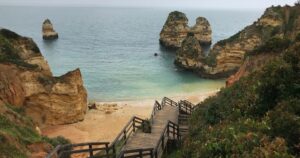
In the south we start in Lagos — a lively little walled town that makes the ideal base for the finest beaches of the Algarve. Just outside town lie the rock formations of Ponta da Piedade, with golden cliffs, caves and turquoise water, well worth exploring by sightseeing boat or kayak. The beaches of Praia Dona Ana and Praia do Camilo are among the most photogenic in the country.
💡 Tip: Boats to the Benagil cave and to Ponta da Piedade leave from the harbour in Lagos. Take a morning departure — by afternoon the sea gets choppier and entry to the caves can be cancelled. Accommodation in Lagos →
19. The Benagil Cave — icon of the Algarve
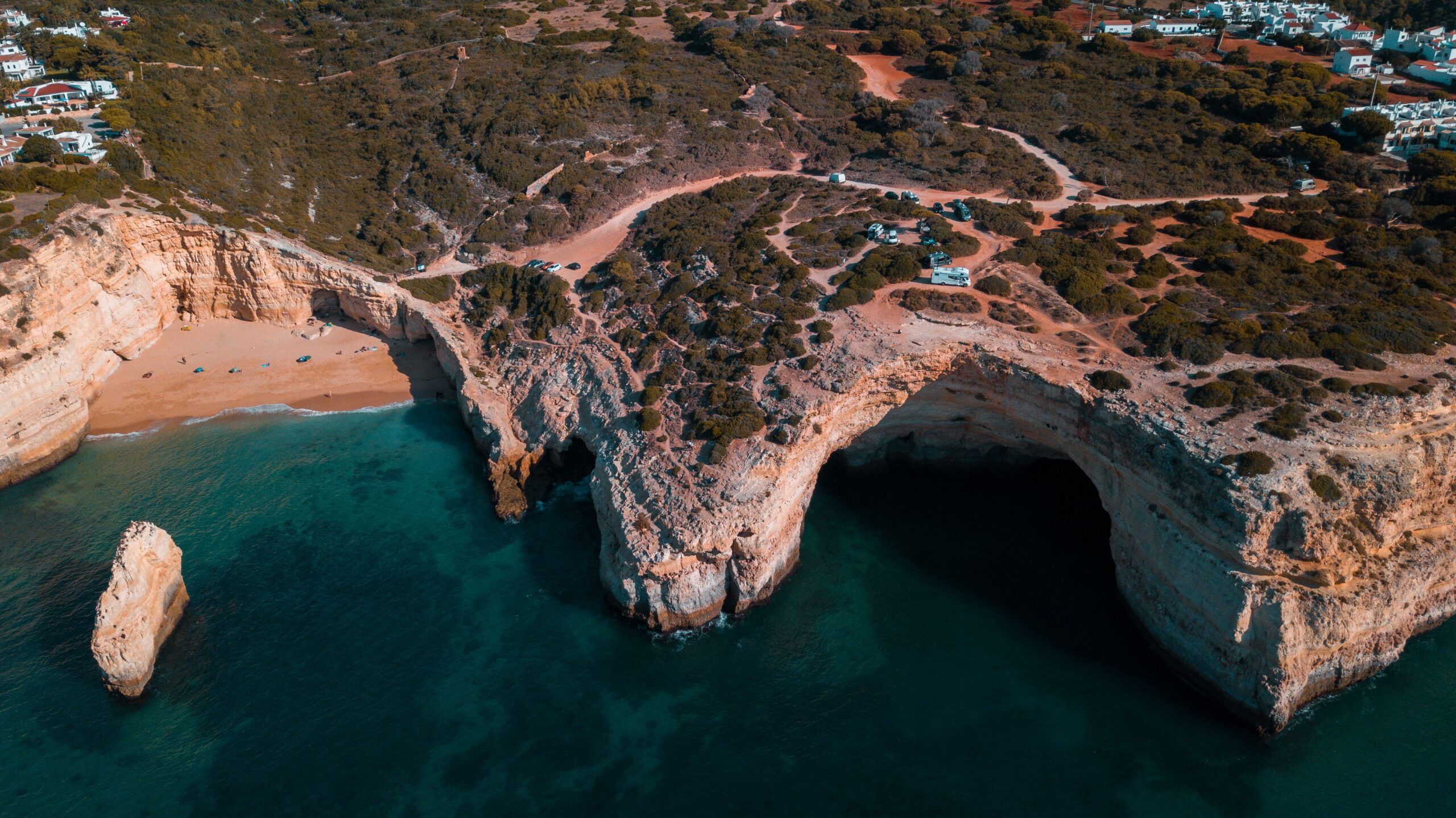
Probably the most photographed spot in the whole south. The Benagil Cave is a huge sea cave with a golden dome and an opening in its roof, through which sunlight pours onto a small beach inside. You reach it by boat, kayak or SUP from Praia de Benagil. You’re no longer allowed to set foot on the sand inside, but gliding through it on the water is an experience in itself.Photo: Mo Eid / Pexels
20. Carvoeiro and the Sete Vales Suspensos trail
Not far from Benagil lies Carvoeiro, a cosy seaside town with a small beach hemmed in by cliffs and wooden boardwalks over the Algar Seco rock formation. From here runs one of the loveliest coastal walks in the country, the Percurso dos Sete Vales Suspensos (Seven Hanging Valleys Trail), roughly 5.7 km along the cliffs all the way to Praia da Marinha. Along the way you pass hidden coves, sinkholes and viewpoints you’d never reach from a boat.
💡 Tip: Do the walk early in the morning or towards evening: there’s no shade on the cliffs during the day and it gets hot in summer. Leave the car in Carvoeiro and walk to Marinha on foot — the beach car park fills up during the day.
21. Silves — the Moorish capital of the Algarve
Inland on the Algarve, just a short hop from the beaches, hides Silves, once the capital of the Moorish south. It’s crowned by a red sandstone castle, the best-preserved Moorish fortress in the region, with views over the surrounding orange groves. Below the castle stand a Gothic cathedral and the tangled lanes of the old town. A calm counterweight to the crowded coast and a pleasant half-day trip from the sea.
22. Sagres and Cabo de São Vicente — the end of the world in the south
The most south-westerly tip of Europe, which the Portuguese once believed to be the end of the world. In Sagres stands a mighty fortress on the cliffs, and a little further on Cabo de São Vicente with its lighthouse, where at dusk crowds gaze out into the endless ocean. Rugged, windswept, raw beauty — the opposite of the manicured beaches of the eastern Algarve.
23. Faro and Ria Formosa — lagoons and islands
The capital of the Algarve, where most holidaymakers fly in, yet it’s often overlooked itself. Faro has a pretty walled old town and, above all, sits beside the Ria Formosa nature park — a lagoon dotted with islands such as Ilha Deserta, Ilha da Culatra and Ilha do Farol, reached by boat, where you’ll find calmer, wilder beaches than in the tourist centres.
24. Tavira — the most charming town in the eastern Algarve
On the quieter eastern Algarve lies Tavira, a town spread across both banks of the River Gilão, spanned by an old stone bridge. You’ll find dozens of churches, the remains of a castle with a garden, and above all the gateway to Ilha de Tavira, a long sandy island with one of the warmest and calmest beaches in the country, reached by boat or footbridge. Ideal when you want the Algarve without the concrete resorts.
💡 Tip: Boats to Ilha de Tavira leave from the town centre and from nearby Quatro Águas. In summer they run frequently; out of season, check the timetable in advance.
25. Costa Vicentina — wild beaches for surfers
The west coast of the Algarve and the Alentejo is the protected Costa Vicentina — kilometres of wild beaches fringed by cliffs, with no big resorts. Praia do Amado, Praia da Bordeira near Carrapateira and Praia de Odeceixe draw surfers and nature lovers. The water is colder here and the waves bigger than on the south coast, but you’ll have the beach almost to yourself.
26. Peneda-Gerês National Park — the wilderness of the north
The country’s only national park lies in the north, on the Spanish border. Peneda-Gerês is a land of granite peaks, waterfalls, mountain villages and wild horses. You’ll find hikes of every length, stone hamlets where time has stood still, and crystal-clear pools for a swim. For lovers of nature and quiet, the opposite of the crowded Algarve.
27. Madeira — island of eternal spring
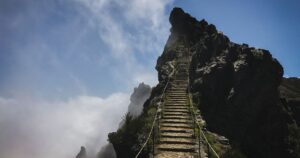
A volcanic island in the Atlantic that deserves a week of its own. Madeira is a paradise for walkers — famous for the trails along the levadas (irrigation channels), the climb to the highest peaks of Pico Ruivo and Pico do Arieiro above the clouds, the Cabo Girão viewpoint on its glass skywalk above the sea, and the colourful market in the capital, Funchal. The climate is mild all year round — hence “the island of eternal spring”.
💡 Tip: Set off in the dark on the walk from Pico do Arieiro to Pico Ruivo and reach the summit for sunrise above a sea of clouds — it’s one of the most powerful experiences Portugal has to offer.
28. The Azores — a green archipelago in the mid-Atlantic
Nine volcanic islands in the middle of the ocean, still relatively off the crowds’ radar. The star is the island of São Miguel in the Azores, with the crater lakes of Sete Cidades (one blue, one green), the thermal springs of Furnas and the hot stream of Caldeira Velha, where you can bathe in a natural forest setting. From the islands you set out to watch whales and dolphins. Green, misty, raw nature straight out of another world.
Beaches and the Algarve
Say “a Portuguese beach” and most people picture the Algarve — the southern coast of golden cliffs, hidden coves and turquoise water. And rightly so: it’s among the loveliest in Europe. But there are beaches all along the coast.
Praia da Marinha — regularly rated among the finest beaches in the world, with golden rocks and crystal-clear water.
Praia Dona Ana and Praia do Camilo (Lagos) — postcard coves between the cliffs; 200 steps lead down to Camilo.
Praia da Rocha (Portimão) — a long, lively beach with a promenade, ideal for families.
Costa Vicentina (Amado, Bordeira, Odeceixe) — wild beaches for surfers in the west.
Comporta — endless empty beaches south of Lisbon, a popular alternative to the Algarve.
A word of warning: the Atlantic is cold even in summer (around 18–22 °C), and the west coast has strong waves and currents — swim only on patrolled stretches. The water is warmest on the eastern Algarve near Tavira and Faro.
💡 Tip: Arrive at the finest Algarve beaches (Marinha, Benagil) before ten or after four — the car parks fill up around midday and a crowd-free photo becomes impossible.
Food (pastéis de nata, bacalhau)
Portuguese cooking is honest, cheap and built on fish and the sea. A few things you simply have to try:
Pastéis de nata — the famous creamy custard tarts in flaky pastry, best eaten warm with a dusting of cinnamon. Buy the original at Pastéis de Belém in Lisbon (around €1.30 each).
Bacalhau — dried, salted cod, said to be prepared “365 ways”. The classic is bacalhau à brás (with egg and potato) or baked.
Grilled sardines — a symbol of summer, especially during the St Anthony’s festivities in June.
Francesinha — Porto’s calorie bomb: a meat sandwich smothered in cheese and a spicy sauce, often with an egg and chips.
Caldo verde — a green soup of kale and potato with chouriço sausage.
Wine — port from Vila Nova de Gaia, the light, slightly sparkling vinho verde from the north, and quality reds from the Alentejo and the Douro.
💡 Tip: Order the prato do dia (dish of the day) at a local tasca between noon and two — usually soup, a main and a drink for €8–12. Beware the “couvert” (bread, olives and pâté on the table) — it isn’t free, so feel free to send it back.
How much it costs (budget)
Portugal is one of the cheapest countries in Western Europe. A rough daily budget per person (outside the summer peak):
Item
Backpacker / day
Comfortable / day
Accommodation (hostel bed vs. guesthouse/double)
€15–25
€40–60
Food (set menu, café, self-catered breakfast)
€15–20
€30–45
Transport (train/bus, public transport)
€5–12
€15–30 (car + fuel)
Entry fees and activities
€5–15
€15–30
Total
around €40–70
around €100–165
You’ll save the most by avoiding July and August, staying in hostels and apartments with a kitchen, and travelling by bus. The big cities (Lisbon, Porto) are pricier for accommodation than the countryside, and the Algarve drops by almost half out of season.
💡 Tip: For a summer trip, book accommodation in Lisbon and Porto a good 2–3 months ahead — the best hostels and central apartments go first. Accommodation in Porto →
Where to stay in Portugal
Portugal is long, so one base is not enough. Three hubs cover most of the country: Lisbon for the centre and Sintra, Porto for the north and the Douro valley, and Lagos or Faro for the Algarve.
Budget: a hostel bed in Lisbon or Porto roughly €25 to €45 per person per night.
Mid-range: a double room in a guesthouse or an apartment €80 to €130.
On the Algarve: summer prices double; June and September are far cheaper.
If you drive: parking in the old centres of Lisbon and Porto is expensive and awkward, so look for private parking.
Prices and ratings are indicative (source: GetYourGuide); you’ll see the latest once you click through.
What should I see in Portugal on a first visit?
The classic backbone of a first trip is Lisbon, a day trip to Sintra, Porto and a few days on the beaches of the Algarve. With 10–14 days, add Aveiro, Coimbra, Nazaré and the Douro Valley. Madeira and the Azores are separate destinations, each worth a week of its own.When is the best time to travel to Portugal?
The best months are May, June and September — warm enough to swim, but before the crowds arrive and with lower prices than in high summer. July and August are the hottest, but the priciest and busiest. April and October are also ideal for cities and hiking.How many days do you need in Portugal?
For the main mainland highlights (Lisbon, Sintra, Porto, part of the Algarve), allow at least 7 days, ideally 10–14. If you also want the Douro Valley, the north or more beaches, two weeks is easily justified. Madeira or the Azores each call for a week of their own.Is it worth hiring a car in Portugal?
Between the big cities, no — the train and bus are cheap and comfortable. A car pays off on the Algarve, in the Douro Valley and in the countryside, where you can barely get otherwise. A common approach is the big cities by train and a car hired just for 3–4 days.Is Portugal expensive?
It’s one of the cheapest countries in Western Europe. A backpacker can get by on around €40–70 a day, while a comfortable trip runs €100–165. The priciest elements are accommodation in Lisbon and Porto and the Algarve in summer.What is the sea like in Portugal — can you swim?
The coast is washed by the Atlantic, so the water is cool even in summer (around 18–22 °C), and the west has strong waves and currents. It’s warmest and calmest on the eastern Algarve near Tavira and Faro. Swim only on patrolled stretches.What should I eat in Portugal?
The essentials are pastéis de nata (custard tarts), bacalhau (salt cod in many guises), grilled sardines, port from Vila Nova de Gaia and, in Porto, the calorific francesinha. Add a light vinho verde and the dish of the day at a local tasca for a few euros.Is Sintra worth it as a day trip from Lisbon?
Absolutely — it’s the most popular day trip from Lisbon. You get there by train in half an hour and see the Pena Palace, Quinta da Regaleira and the Moorish Castle. Take a morning train, as it gets packed in the afternoon.Lisbon or Porto — which is better?
Both are worth seeing. Lisbon is bigger, sunnier and has more sights and day trips nearby (Sintra, beaches). Porto is smaller, cosier, cheaper and offers the port cellars and the Douro Valley. If you have time, link them by train in under three hours.Is it worth visiting Madeira or the Azores?
Yes, if you love nature and hiking — but treat them as a trip in their own right, not a day out from the mainland. Madeira draws you in with its levadas and mountains, the Azores with crater lakes, thermal springs and whales. Allow at least a week for each island and count on a flight.How do you get from Lisbon to Porto?
The fastest is the Alfa Pendular express in about 2 hours 50 minutes (from roughly €25–30, cheaper if you book early). The bus with Rede Expressos or FlixBus is cheaper. Buy train tickets online in advance to save.Is Portugal safe?
It’s one of the safest countries in Europe. The main risks are pickpockets in the tourist centres of Lisbon (especially Tram 28) and Porto, and thefts from cars at remote beach car parks — don’t leave valuables on show.
Potřebujete pomoct s cestováním?
Ubytování 🏨
Vyberte si to nejlepší ubytování, ať už jste kdekoliv, přes Booking.com.
Půjčení auta 🚗
Auto si snadno najdete přes Booking.com, kde máte často slevu díky ubytování, nebo Rentalcars.com, kde porovnáte nabídky většiny půjčoven.
Zážitky 🎟️
Přes GetYourGuide.com si vyberete z nejrůznějších výletů i zážitků po celém světě, navíc se zrušením zdarma do 24 h předem.
Abychom poskytli co nejlepší služby, používáme k ukládání a/nebo přístupu k informacím o zařízení, technologie jako jsou soubory cookies. Souhlas s těmito technologiemi nám umožní zpracovávat údaje, jako je chování při procházení nebo jedinečná ID na tomto webu. Nesouhlas nebo odvolání souhlasu může nepříznivě ovlivnit určité vlastnosti a funkce.
Funkční
Always active
Technické uložení nebo přístup je nezbytně nutný pro legitimní účel umožnění použití konkrétní služby, kterou si odběratel nebo uživatel výslovně vyžádal, nebo pouze za účelem provedení přenosu sdělení prostřednictvím sítě elektronických komunikací.
Předvolby
Technické uložení nebo přístup je nezbytný pro legitimní účel ukládání preferencí, které nejsou požadovány odběratelem nebo uživatelem.
Statistiky
Technické uložení nebo přístup, který se používá výhradně pro statistické účely.Technické uložení nebo přístup, který se používá výhradně pro anonymní statistické účely. Bez předvolání, dobrovolného plnění ze strany vašeho Poskytovatele internetových služeb nebo dalších záznamů od třetí strany nelze informace, uložené nebo získané pouze pro tento účel, obvykle použít k vaší identifikaci.
Marketing
Technické uložení nebo přístup je nutný k vytvoření uživatelských profilů za účelem zasílání reklamy nebo sledování uživatele na webových stránkách nebo několika webových stránkách pro podobné marketingové účely.