Last updated 29.8.2026
Borneo — the third-largest island on the planet, where a single week can hand you more than a whole month somewhere else. We can barely remember what first put Borneo on our list, but it turned into one of the finest adventures we have ever had. It also stays wonderfully off the mass-tourism radar, which we count as a bonus. This guide is about things to do in Borneo and what a Borneo holiday actually looks like when you plan it well. We have pulled together the 11 strongest experiences, from orangutans to the climb up Mount Kinabalu and diving off Sipadan.
Borneo holidays in a nutshell
- The standout experiences: orangutans at Sepilok, the climb up Mount Kinabalu (4,095 m), diving off Sipadan and a river safari on the Kinabatangan.
- Ideal length: 10–14 days for Sabah (the north), 2–3 weeks if you also want the caves of Sarawak.
- When to go: the driest stretch runs roughly March to September; November to February is the wettest (and Sipadan is closed for the whole of November 2026).
- Budget: backpackers can travel on around £30–£70 a day; Kinabalu and Sipadan are pricey one-off splurges on top.
- Book ahead: the Mount Kinabalu permit (2–3 months in advance) and your Sipadan diving permit.
- Currency: the Malaysian ringgit (MYR); 1 MYR ≈ £0.18 (a rough guide — check the live rate before you travel).
When to visit Borneo and for how long
Borneo sits almost bang on the equator, so it stays warm and humid all year (usually 26–33 °C) and a downpour can arrive at any moment. There are still clear seasons, though: the driest and most comfortable window is roughly March to September, while November to February brings the main monsoon and the heaviest rain, both in the north (Sabah) and in the west (Sarawak). For diving, trekking and the Kinabalu climb, the drier half of the year is by far the safer bet.
How many days? To tick off the big hitters in the Malaysian north — orangutans, Kinabalu and the Kinabatangan River — allow 10 to 14 days. Add diving around Semporna and the caves of Sarawak and you are easily looking at two to three weeks. Borneo is not a place you can “do over a long weekend” — the distances are huge and getting around eats up time (an awful lot of it, if you drive it yourselves as we did).
💡 Tip: Borneo is split between three countries — the Malaysian states of Sabah and Sarawak, the sultanate of Brunei and Indonesian Kalimantan. Most of the experiences in this guide are in the Malaysian part, which is easiest to reach by flying via Kuala Lumpur into Kota Kinabalu. We cover the details in our article Getting to Borneo.
11 things to do on a Borneo holiday
We have ordered them from what we loved most through to the experiences for those with more time on their hands. Each one comes with a rough price and time. What does Borneo have in store? And how do you get the most out of a Borneo holiday while sidestepping the things worth watching out for?
1. Orangutans at Sepilok — the encounter you never forget
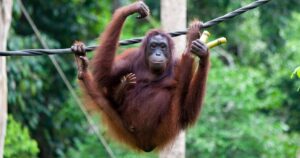
If there is one reason to fly to Borneo, it is the orangutans — and the surest place to see them is the Sepilok Orangutan Rehabilitation Centre near Sandakan in the north-east. Orphaned and injured animals are cared for here and taught how to fend for themselves back in the wild.
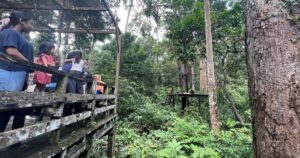
From wooden platforms you watch the feedings at 10:00 and 15:00, when the semi-wild orangutans swing down from the canopy to the feeding station. Admission for overseas visitors is 30 MYR (≈ £5), plus a camera fee of 10 MYR (≈ £2) and a compulsory locker for your backpack costing a couple of ringgit.
Right next door is the Bornean Sun Bear Conservation Centre, home to the world’s smallest bears, and a short walk further on lies the Rainforest Discovery Centre with its canopy walkway — the three link up nicely into a single day. We go into much more detail on meeting these great apes in our article Orangutans in Borneo.
💡 Tip: Come for the morning feeding and get to the ticket desk early — there are fewer crowds than in the afternoon. And bear in mind that orangutans do not appear on cue: the more fruit there is in the surrounding forest, the fewer of them turn up at the platform. That only makes the encounter more authentic.
You can stay right in Sepilok at lodges tucked into the rainforest — compare the options through the places to stay in Sepilok →.
2. Proboscis monkeys at Labuk Bay — the island’s most curious creature
A short hop from Sepilok, in the mangroves of Labuk Bay, lives another Borneo icon: the proboscis monkey. The males sport an enormous drooping nose and a round belly, so they look like caricatures of themselves — and you will not spot them in the wild anywhere but Borneo. At the Labuk Bay Proboscis Monkey Sanctuary the monkeys naturally gather at the feeding platforms, bringing them within easy reach. Admission for overseas visitors is 60 MYR (≈ £11) plus a 10 MYR (≈ £2) camera fee.
Feeding happens twice a day at each of the two platforms: at platform A roughly at 9:30 and 14:30, at platform B at 11:30 and 16:30 (double-check the times before you go). Alongside the proboscis monkeys you will spot silver langurs flitting about and flocks of birds, so there is plenty to watch between feedings.
💡 Tip: Labuk Bay is only a few kilometres from Sepilok and Sandakan, so it pairs perfectly with the orangutans into one day: great apes in the morning, proboscis monkeys in the afternoon. You reach the platforms along wooden boardwalks over the wetland, so comfortable shoes are worth having.
3. Climbing Mount Kinabalu — Malaysia’s highest peak
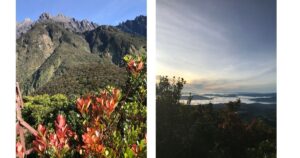
Mount Kinabalu (4,095 m) is the highest mountain in Malaysia and one of the most accessible “4,000-metre” peaks in the world — you need no mountaineering kit, just decent fitness and two days. The classic route is a 2-day / 1-night climb: on day one you hike up to the Panalaban base (around 3,300 m), sleep over, and set off in the dark at about two in the morning for the summit at Low’s Peak to catch sunrise above a sea of cloud.
The catch is the price and the system — only 163 people a day are allowed on the mountain, and the climb is only possible as a package with a licensed guide. A 2D1N package for overseas visitors (accommodation at Panalaban, meals, guide, permit) works out at roughly 2,890 MYR and up per person (≈ £520) depending on group size — not cheap, but a genuine once-in-a-lifetime experience.
💡 Tip: Permits vanish months ahead — in high season (roughly March to September) book 2–3 months in advance. Pack layers and a head torch: it hovers around freezing at the top and you climb in the dark. If you would rather not tackle the summit, you can at least hike into the foothills of Kinabalu Park and enjoy the rainforest and botanical garden without a permit.
4. Poring Hot Springs and the Rafflesia — a reward after Kinabalu
Under an hour’s drive from the Kinabalu massif lie the Poring Hot Springs, part of Kinabalu National Park. After a demanding climb (or instead of one), this is where you sink weary legs into hot sulphur pools deep in the rainforest.
The grounds hold a botanical garden, a butterfly farm and a garden where, with a bit of luck, the Rafflesia blooms — the world’s largest flower, which can measure over 80 cm across and opens for just a few days. Admission is usually covered by the same park ticket as Kinabalu Park (roughly 50 MYR for overseas visitors), and the outdoor bathing pool costs around 10 MYR.
💡 Tip: The famous canopy walkway at Poring has been temporarily closed for repairs since the summer of 2025 — check the current situation before you go. The Rafflesia blooms unpredictably: if you want to see one, ask locally around Poring, Ranau or Tambunan where a flower has just “popped”.
5. Diving off Sipadan — one of the world’s best reefs
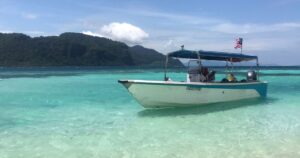
The tiny island of Sipadan off the town of Semporna turns up again and again in rankings of the planet’s best dive sites. The wall drops hundreds of metres into the deep and you will meet shoals of barracuda and jacks, turtles on every dive and sharks. Sipadan is protected, so a daily quota of 254 permits is shared between the local dive centres — you can only dive with a permit, which you arrange through a dive centre in advance.
Budget for the fees: the diving permit for overseas visitors is 350 MYR/day (≈ £63) plus a 100 MYR/day (≈ £18) conservation fee; a regular day’s diving around Semporna (Mabul, Kapalai) costs roughly 350–450 MYR (≈ £63–£80). Your base is usually the island of Mabul or Semporna itself. There is more on the area and the boat departures in our article Semporna and around.
💡 Tip: Sipadan is closed for the whole of November 2026 to give the reef a rest — plan your visit around that month. And even if you are not a diver, the snorkelling off Mabul and Kapalai is superb. You can book experiences through GetYourGuide →.
6. A safari on the Kinabatangan River — wildlife from a boat
The Kinabatangan is the best place in Malaysia to see wild animals with no fences. From a slow-moving boat at dawn and dusk you watch proboscis monkeys, macaques, wild orangutans if you are lucky, pygmy elephants and clouds of birds, then crocodiles by torchlight in the evening. It is the kind of experience you will fall for even without a telephoto lens.
The easiest option is to buy a package from a lodge near the village of Sukau or Bilit. A budget 3-day / 2-night trip starting in Sandakan (accommodation, 4 cruises, treks, meals, transfers) starts from roughly 600 MYR (≈ £108); luxury lodges cost several times that. A standalone cruise runs around 55 MYR (≈ £10).
💡 Tip: Both the Kinabatangan and Sepilok are near Sandakan, so it makes sense to combine them into one trip to eastern Sabah. In high season (June to September) packages often carry a surcharge — book ahead and ask whether the 8% tax is included.
7. The Mulu and Niah caves — Sarawak’s underground cathedrals
Head west into the state of Sarawak and some of the most astonishing caves on earth await. Gunung Mulu National Park (UNESCO) hides Deer Cave — one of the largest cave passages in the world — and, above all, the famous bat exodus, when millions of bats stream out of the cave at dusk in snaking spirals. Park admission for overseas visitors is 30 MYR for 5 days (≈ £5) plus a small conservation fee. You reach Mulu by light aircraft from Miri or Kota Kinabalu.
More modest but historically fascinating is Niah National Park — the oldest human remains in South-East Asia were found in its vast caves, and prehistoric paintings decorate the walls. Admission for overseas visitors is around 20 MYR (≈ £4).
8. Kuching, Bako and Semenggoh — the gateway to Sarawak
Western Borneo revolves around Kuching, perhaps the island’s most likeable city, with a laid-back riverfront, cat statues and excellent street food. From here you can easily reach two brilliant reserves. At Semenggoh Nature Reserve there are feedings of semi-wild orangutans (mornings 9:00 to 10:00 and afternoons 15:00 to 16:00, admission for overseas visitors roughly 15 MYR / ≈ £3) and your chances of spotting them tend to be high.
Bako National Park, meanwhile, is the best place in Sarawak to meet proboscis monkeys, bearded pigs and macaques right on the coastal trails; admission for overseas visitors is roughly 20 MYR (≈ £4).
💡 Tip: You reach Bako by car to the village of Bako and then a short boat, which only runs when the tide is high enough — factor that into your timing. From November to March the orangutans at Semenggoh often skip the feedings because fruit is ripening in the forest, so the drier half of the year is the safer bet.
9. Rainforest treks in a primeval jungle
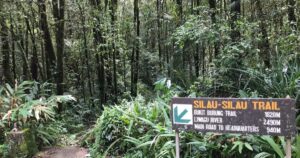
Borneo’s rainforest is among the oldest on the planet, and there is proper trekking to be had in it. The best known is Danum Valley — a primary-rainforest reserve with a canopy walkway, night safaris and the chance to spot wild orangutans in their natural habitat. For real adventurers there is Maliau Basin, nicknamed the “Lost World” — a remote bowl of waterfalls that is far from easy to reach.
💡 Tip: Both Danum Valley and Maliau Basin can only be entered on an organised programme through a lodge or an agency — you cannot just “drive in”. Prepare for the damp, the leeches (bring leech socks) and some honest mud. The reward is a rainforest like nowhere else.
10. Beaches and islands — downtime between adventures
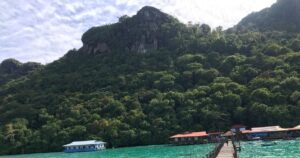
After the Kinabalu climb or a trek you will appreciate a day by the sea. Boats leave right from Kota Kinabalu for the Tunku Abdul Rahman marine park — five islands (Manukan, Sapi, Gaya, Mamutik and Sulug) with white sand and snorkelling a stone’s throw from the city. In the east there is Mabul, mentioned already, and off the northern tip the remote Mantanani. We dig into the city itself and the trips you can make from it in our article Kota Kinabalu.
Compare where to lay your head in Kota Kinabalu through the accommodation options →.
11. Culture and tribal life — Borneo beyond the forest
Borneo is about far more than nature. The indigenous Dusun, Kadazan, Iban and Murut peoples have lived here for centuries. Close to Kota Kinabalu is the Mari Mari Cultural Village, where you walk through replicas of traditional dwellings and taste the local cooking. In Sarawak you can spend a night in a longhouse — a long communal home where an entire village lives under one roof.
💡 Tip: Treat a longhouse visit with respect — these are real homes, not an open-air museum. It is best to go through a local community project, where the money stays in the village, and always ask before you photograph anyone.
How to piece the experiences together (and how many days it takes)
Borneo is big and the transfers eat time, so it pays to keep the regions grouped. A few tried-and-tested skeletons:
- 10 days, classic Sabah: Kota Kinabalu + the islands → Mount Kinabalu → Sandakan (Sepilok) → the Kinabatangan.
- 14 days, Sabah in full: the same plus diving off Semporna / Sipadan and a day in Danum Valley.
- 2–3 weeks, all of Borneo: Sabah plus a flight over to Sarawak for Kuching with Bako and the Mulu and Niah caves, with Brunei an optional add-on.
How much a Borneo holiday costs (the budget)
Borneo can be travelled on a budget — food and basic accommodation are cheap, and a Malaysian meal in a kedai kopi costs next to nothing. What is expensive are the big one-off experiences (Kinabalu, Sipadan) and the domestic flights. A rough daily budget per person:
| Item | Roughly per day (1 person) |
|---|---|
| Accommodation (hostel / guesthouse) | 60–140 MYR (£11–£25) |
| Food (local eateries, markets) | 30–60 MYR (£5–£11) |
| Transport (buses, shared cars) | 15–40 MYR (£3–£7) |
| Activities and admissions | 50–150 MYR (£9–£27) |
| Typical day total | about 155–390 MYR (£28–£70) |
On top of that, add the big-ticket items outside the daily budget: the Mount Kinabalu climb from ~2,890 MYR (≈ £520) and a day’s diving off Sipadan, with permits, easily 800–1,000 MYR (≈ £145–£180). You will save most on food (eat where the locals eat) and by planning your transfers ahead. Compare flights from the UK to Kota Kinabalu (with a stopover) through Kayak →.
Where to stay in Borneo
Borneo is huge, so there is no single base. It works best to split the trip into three hubs: Kota Kinabalu in Sabah for the mountains and islands, Sandakan and Sepilok for orangutans and the Kinabatangan river, and Kuching in Sarawak for the national parks and caves.
- Backpackers: a hostel bed in Kota Kinabalu or Kuching roughly MYR 40 to 60 per person per night.
- Mid-range: a three-star hotel with a pool MYR 150 to 250 for a double room.
- Jungle lodges: along the Kinabatangan and in Danum Valley you pay for a package with full board and guided trips. This is the most expensive part of the trip and also the reason people come.
- By the sea: island resorts off Semporna and in Tunku Abdul Rahman park just outside Kota Kinabalu.
Compare current prices and availability through accommodation in Borneo.
Where to next
- The island of Borneo: an overview and what to know
- Getting to Borneo: how to get there
- Orangutans in Borneo
- Semporna and diving off Sipadan
- Kota Kinabalu: the gateway to Sabah
Frequently asked questions: Borneo holidays
Experiences and tickets in and around Kota Kinabalu
traveller-approved · GetYourGuide

Tunku Abdul Rahman: Snorkelling off Sapi and Manukan Islands
★ 4.8 · 243 reviews
from £47


Prices and ratings are indicative (source: GetYourGuide); you will see the current ones after clicking through.
What should you absolutely not miss in Borneo?
If you had to pick just a handful of things, they would be the orangutans at Sepilok, a safari on the Kinabatangan River and — if you have the fitness and the budget — the climb up Mount Kinabalu. Divers will add Sipadan off Semporna. Those four make up the core of a classic Borneo holiday.
How many days should you set aside for Borneo?
For the Malaysian north (Sabah) with the orangutans, Kinabalu and the Kinabatangan, allow 10–14 days. If you want to add diving and the caves of Sarawak, you are looking at 2–3 weeks. You will not do the island in a weekend — the distances are huge.
When is the best time for a Borneo holiday?
The driest and most comfortable stretch is roughly March to September. November to February is the main monsoon season with the heaviest rain. Remember that Sipadan is usually closed for the whole of November while the reef recovers (in 2026 from 1 to 30 November).
Is a Borneo holiday expensive?
The basics are cheap — food and simple accommodation cost little, and backpackers can comfortably keep to around £30–£70 a day. The big experiences are the pricey bit: the Mount Kinabalu climb starts from about £520, and a day’s diving off Sipadan, permits included, runs to well over £100.
Where can I see orangutans in Borneo?
The surest spot is the Sepilok Orangutan Rehabilitation Centre near Sandakan, where feedings take place at 10:00 and 15:00 (admission for overseas visitors 30 MYR / ≈ £5). You also stand a chance of spotting wild orangutans on a Kinabatangan safari or in the Danum Valley rainforest. In Sarawak, Semenggoh Nature Reserve near Kuching is a reliable bet.
Where can I see proboscis monkeys?
The surest spot is the Labuk Bay Proboscis Monkey Sanctuary just outside Sepilok, where the monkeys gather at the feeding platforms (admission for overseas visitors 60 MYR / ≈ £11). You will also often glimpse wild proboscis monkeys on a Kinabatangan river safari and on the coastal trails of Bako National Park in Sarawak.
Do I have to book Mount Kinabalu in advance?
Yes. Only 163 people a day are allowed on the mountain, and the climb is only possible as a package with a licensed guide. In high season, book the permit and the base accommodation 2–3 months ahead, or you risk not getting on.
Do I need a permit to dive off Sipadan?
Yes. The daily quota is just 254 permits, shared between the local dive centres, so you arrange your permit through a dive centre well ahead. The fees for overseas visitors are 350 MYR/day for the permit plus a 100 MYR/day conservation fee.
Is Borneo safe for independent travel?
The Malaysian part of Borneo is calm and easy to handle for independent travellers. Along the east coast of Sabah (the Semporna area), keep an eye on your government’s current advice and travel with reputable dive centres. Otherwise the usual caution applies, as it does anywhere in South-East Asia.
Potřebujete pomoct s cestováním?
-
Ubytování 🏨
Vyberte si to nejlepší ubytování, ať už jste kdekoliv, přes Booking.com. -
Půjčení auta 🚗
Auto si snadno najdete přes Booking.com, kde máte často slevu díky ubytování, nebo Rentalcars.com, kde porovnáte nabídky většiny půjčoven. -
Zážitky 🎟️
Přes GetYourGuide.com si vyberete z nejrůznějších výletů i zážitků po celém světě, navíc se zrušením zdarma do 24 h předem.