Last updated 1.9.2026
Castles in Slovakia come in a quantity that stops making sense once you look at the map. The official tourist board, slovakia.travel, counts more than a hundred castles and chateaux and at least twice as many manor houses, in a country of roughly 5.4 million people. That is somewhere around one castle for every 50,000 Slovaks, which is why Slovakia is so regularly described as the country with the most castles per head of population in the world. Drive forty minutes along the D1 motorway and you can pass three separate medieval ruins on the ridges above you.
The difference between them matters far more than the count. Some are open walls on a hilltop that you wander at your own pace for the price of a coffee. Others will not let you past the gate without a booked guided tour that starts on the hour.
This guide covers 18 castles and chateaux grouped by region, and for each one gives you the same things: where exactly it stands, whether it is a ruin or a full tour, the admission price, the opening hours, the season, whether you can get there without a car, and how long to allow. Slovakia is in the eurozone, so every price here is in euros, with an approximate pound figure in brackets at a rate of 0.84 GBP to the euro.
Castles in Slovakia at a glance
- Largest: Spis Castle (Spišský hrad), over 4 hectares, one of the largest castle complexes in Central Europe and a UNESCO site since 1993.
- Most visited: Bojnice Castle, a romantic fairy-tale rebuild with a cave underneath the courtyard.
- Best-preserved interiors: Cerveny Kamen and Bojnice, both guided tour only.
- Best known abroad: Orava Castle, a filming location for the silent Nosferatu (1922).
- Admission: ruins 2.50 to 8 € (about £2 to £7), castles with a tour 7 to 16 € (about £6 to £13.50).
- Season: the main season runs May to September. From November to March many castles close completely or open at weekends only.
- Time needed: 2 to 3 hours for a ruin with a climb, 1.5 to 2 hours for a castle with a guided tour.
- Closed: Krasna Horka is still shut for restoration after the fire.
How many castles does Slovakia have?
The honest answer is that nobody agrees, because it depends on what you are willing to call a castle. The official figure from slovakia.travel is more than a hundred castles and chateaux, plus at least double that number of manor houses. Count every overgrown wall fragment on a hill with no caretaker and no ticket office and the number climbs well past that. Count only the places that are properly opened to visitors, with an entrance, a price and someone to sell you a ticket, and you are down to several dozen.
Either way, the density is the point. This is a country you can drive across in about five hours, and it carries a hundred-plus fortified sites, most of them medieval, most of them on hilltops, and a surprising number of them still standing well enough to walk into. This is a place where the castle is not the day trip you build a holiday around. It is the thing you keep bumping into.
Three Slovak words worth knowing, because Slovaks separate them sharply and English blurs them all into “castle”:
- hrad = castle. Defensive, usually medieval, usually on a rock or a hill. Spišský hrad, Oravský hrad, Devín.
- zámok = chateau or palace. Built or rebuilt for comfort rather than defence, often on flat ground. Bojnice, Zvolen, Smolenice.
- kaštieľ = manor house. Smaller aristocratic country seat, usually with a park. Betliar is the famous one.
So when you see “over a hundred castles and twice as many manor houses”, the second number is a different kind of building entirely, and most of those manor houses are not open to the public at all.
Three kinds of Slovak castle, and how to group them on a map
Slovak castles fall into three practical categories, and which one you pick decides the shape of your whole day:
- Ruins you roam freely (Beckov, Cachtice, Saris, Devin). Turn up any time during opening hours, walk where you like, pay very little. The catch is that you often walk uphill for half an hour to reach the gate.
- Castles with a fixed guided tour (Cerveny Kamen, Strecno, Smolenice, Orava Castle). Tour times are set, capacity is limited, and in high season you may not get in without booking.
- Museum castles you walk through at your own pace (Bratislava Castle, Trencin, Budatin, Zvolen). Enter when you like, just respect the last admission time.
If you are plotting castles in Slovakia on a map, work in regional clusters rather than picking favourites at random. Around Žilina, Strečno and Budatín are half an hour apart. In the Spiš region, Spis Castle, Kežmarok and Stará Ľubovňa all sit within a 60 km radius. In the Little Carpathians you can pair Cerveny Kamen with Smolenice in a single afternoon. Orava Castle, Trencin and Bojnice, by contrast, are each a full day on their own.
💡 Tip: Castles with guided tours usually stop selling tickets an hour before closing time, and several of them close the ticket office over lunch as well. At Bojnice nothing is sold between 12:00 and 12:30. Do not plan to arrive at the last minute.
The superlatives: largest, oldest, most visited
These are the questions people actually type into a search box before a trip, so here they are in one place rather than buried in prose.
| Superlative | Castle | The detail |
|---|---|---|
| Largest castle in Slovakia | Spis Castle (Spišský hrad) | Over 4 hectares, among the largest castle complexes in Central Europe, UNESCO listed since 1993 |
| Third largest | Trencin Castle | And one of the very few open daily, all year round |
| Most visited and most photographed | Bojnice | Romantic rebuild on French models, with a cave under the courtyard |
| Best-preserved interiors | Cerveny Kamen | Furnished rooms and monumental cellars, guided tour only |
| Most dramatic setting | Orava Castle | Stuck to a rock above the river Orava, and the location of the silent Nosferatu |
| Most steps | Orava Castle | 155 rooms and 754 steps across the lower, middle and upper castle |
| Cheapest ticket | Cachtice Castle | 2.50 € for an adult (about £2) |
| Most expensive ticket | Bojnice | 16 € (about £13.50) for the castle and cave combined |
| Newest in this selection | Smolenice | Now a conference centre of the Slovak Academy of Sciences, open on set dates only |
| Oldest castle in Slovakia | Genuinely contested | Depends whether you date the first fortification or the surviving stonework. Cachtice goes back to the first half of the 13th century, Zvolen was built in the 1370s, Kezmarok dates from 1463 |
| Currently closed | Krasna Horka | Shut to the public since the 2012 fire, no reopening date announced |
Castles near Bratislava
Most visitors land at Bratislava (BTS) or at Vienna-Schwechat, which is only about 60 km away and is the main gateway for anyone flying long haul. That makes the western corner of Slovakia the obvious starting point, and it happens to hold four very different castles within an easy radius of the capital.
1. Bratislava Castle
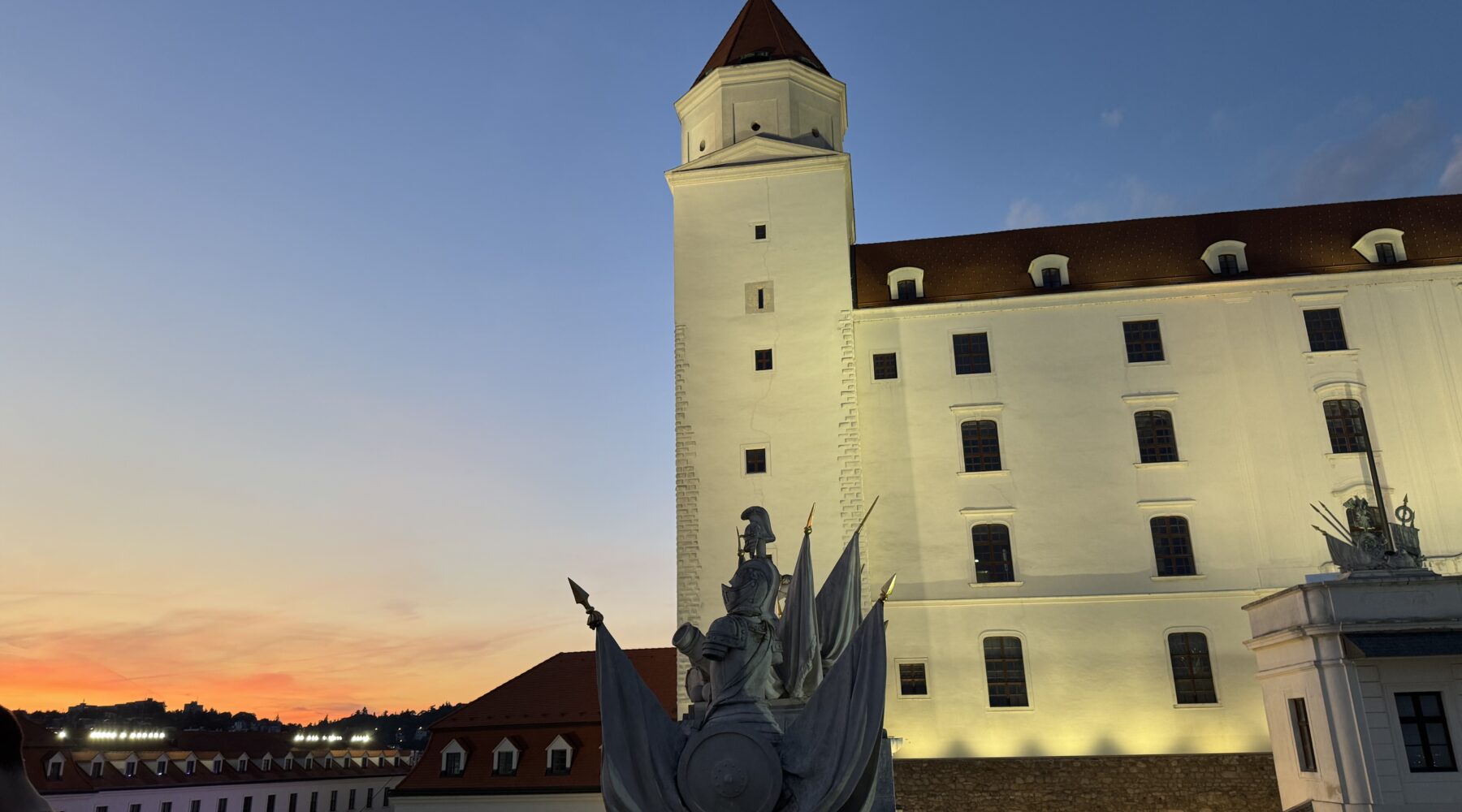
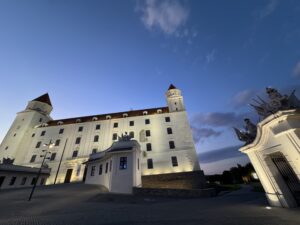
The white four-towered landmark above the Danube, today the seat of the Slovak National Museum’s history collection. The practical part is this: the castle grounds and the baroque garden are free and open daily from 8:00 to 22:00, so the view over the city and over Petržalka is yours even outside museum hours. The exhibitions are open daily except Tuesday, 10:00 to 18:00, with last admission at 17:00. Admission is 14 € (about £12), concessions 7 €, seniors aged 65 to 69 pay 8 €, and over-70s go free. An hour is enough for the grounds alone, two with the museum. It is a walk uphill from the old town, so no transport question arises.
2. Devin Castle
A ruin on a crag above the confluence of the Danube and the Morava, about 10 km from central Bratislava. You move freely around the ramparts and courtyards, with one exception: the upper castle has been closed on safety grounds since 2008. Open Tuesday to Sunday, closed Mondays all year: June to August 10:00 to 19:00, April, May and September until 18:00, March and October until 17:00, November to February until 16:00. Last admission 45 minutes before closing. Admission April to October 8 € (about £7), concessions 4 €, family 18 €, dropping to 6 € and 3 € in the winter season. Allow 1.5 to 2 hours. Reachable without a car: a city bus from Bratislava runs to the foot of the castle.
💡 Tip: The bus gets you to Devin, but the better arrival is the boat from Bratislava to the Devín landing stage, then about 15 minutes on foot. Come back by bus rather than boat, so you are not tied to the last departure.
3. Cerveny Kamen Castle
Near the village of Častá in the Little Carpathians stands one of the best-preserved castles in the country, with furnished interiors and vast cellars. Entry is by guided tour only and tours leave on the hour. The long tour takes 75 minutes and costs 12 € (about £10), family 29 €. The short tour takes 60 minutes and costs 10 €, family 25 €. Children aged 7 to 18, students and over-62s pay 6 € and 5 € respectively. Open June to September daily 9:00 to 17:00, October to April Tuesday to Sunday 9:30 to 15:30. It sits out in the vineyard country about an hour’s drive from Bratislava, and public transport is patchy enough that a car makes life much easier here.
4. Smolenice Castle
The youngest chateau in this selection and the smallest time commitment. It belongs to the Slovak Academy of Sciences and works as a conference centre, so it opens to the public only on set dates. Tours run on the hour with a cap of 50 people. Admission is a very reasonable 5 € for an adult (about £4), 4 € concessions, 15 € family, and 6 € for a tour in English. In July and August it opens daily except Monday, last admission 18:00. From March to June and in September and October it opens at weekends and on public holidays only, until 17:00, and until 16:00 in winter. Check before you set off, because the castle closes for events. Like Cerveny Kamen, it is a car destination in practice.
Along the D1 motorway: Trencin, Beckov and Cachtice
The D1 running north-east out of Bratislava towards the mountains is the busiest road in the country, and it threads past three castles in the space of an hour. If you are driving from the capital to the Tatras, this is where you break the journey.
5. Trencin Castle
The third largest castle complex in Slovakia and one of the very few you can visit all year round, daily from 9:00 to 18:30. The grounds close at 19:00 and last admission to the short circuit is 17:30. The short circuit is self-guided and costs 10 € (about £8.50), 8 € for students aged 19 to 26 and pensioners, 4 € for children aged 7 to 18, free under 6. The long circuit with a guide costs 12 €, with commentated tours on weekdays at 11:00, 12:00, 14:00, 15:00 and 16:00, and from 10:00 at weekends. After 17:30 you can also buy exterior-only access for 3 €. Reachable without a car: the castle rises directly above the town centre, and Trenčín sits on the main line between Bratislava and eastern Slovakia, so arriving by train is straightforward.
6. Beckov Castle
A ruin on a sheer limestone crag about 60 metres above the village of Beckov, roofless since the fire of 1728. Part of it has been restored, the chapel has a roof again and there is an exhibition in the western palace. It is a five-minute walk from the car park in the village, which makes Beckov the perfect quick stop on a D1 drive when nobody in the car wants another hill. Adult admission runs from 5 to 8 € (about £4 to £7) depending on the circuit and whether an event is on. The season runs roughly from February to mid-November, with the main period April to September, daily 9:00 to 18:00, and October Tuesday to Sunday until 17:00. Without a car it is awkward, since Beckov is a small village off the rail line.
7. Cachtice Castle
A picturesque ruin made famous by the legend of Elizabeth Báthory. The castle dates from the first half of the 13th century and was burned down by the troops of Ferenc Rákóczi in 1708. Admission is the lowest on this entire list: 2.50 € for an adult (about £2), concessions from 1.50 €. Open Tuesday to Sunday, 10:00 to 17:30, closed Mondays. Be aware that reaching the castle means about 45 minutes on foot, either on the yellow trail from Čachtice village or up the steep green trail from Višňové. With the climb up and back it is a half-day. Reachable without a car: yes, the green trail starts near the railway station at Višňové, which is why this ruin is popular with people travelling without wheels.
Central Slovakia: Bojnice, Orava and the Vah valley
This is where Slovakia keeps its two headline castles, the pretty one and the terrifying one, plus three more that are worth the detour if you are already in the region.
8. Bojnice Castle
The most photographed and most visited castle in Slovakia, rebuilt in the romantic style on French models, and a fairy-tale film set for generations of central European cinema. There are several different tours at different prices. Castle plus cave costs 16 € (about £13.50), 10 € for over-62s and students, 8 € for children aged 6 to 15 and 4 € for children aged 3 to 6. The castle chambers tour costs 14 €, an evening tour of the courtyard 7 €, and the children’s tour O bojnickom baziliškovi 13 € for an adult and 9 € for a child. Opening hours: June to August daily 9:00 to 17:00, the same in May and September but closed Mondays, April and October 10:00 to 16:00 and until 15:00 respectively, and from November to March Wednesday to Sunday only, 10:00 to 15:00. Reachable without a car: yes, the castle stands in the middle of the town of Bojnice, next door to Prievidza, so buses drop you within walking distance.
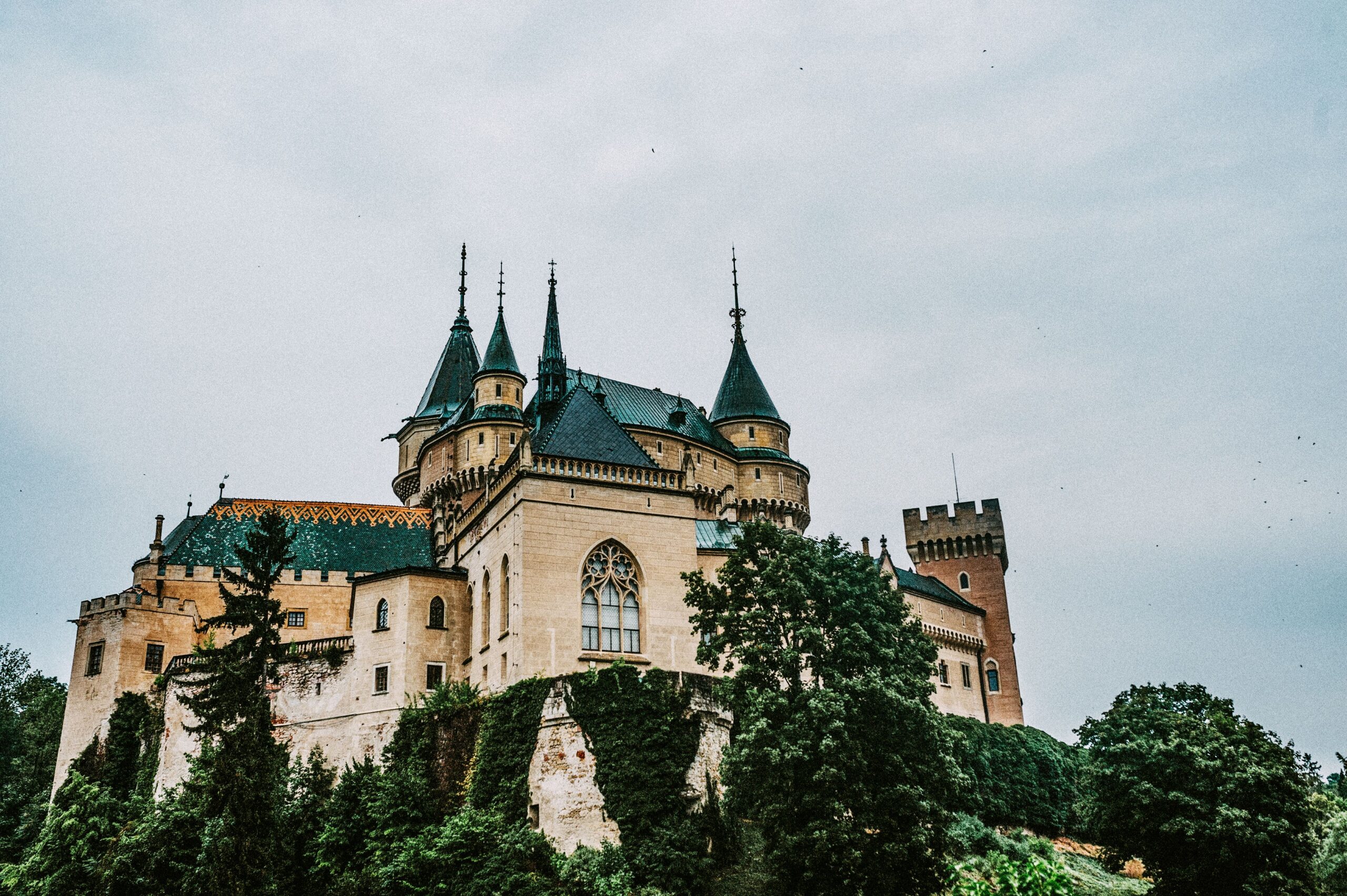
Bojnice is also the one place on this list where it is worth planning an overnight stay. The castle, the zoo and the thermal baths sit in one small town and will comfortably fill two days. Find places to stay in Bojnice →
9. Orava Castle
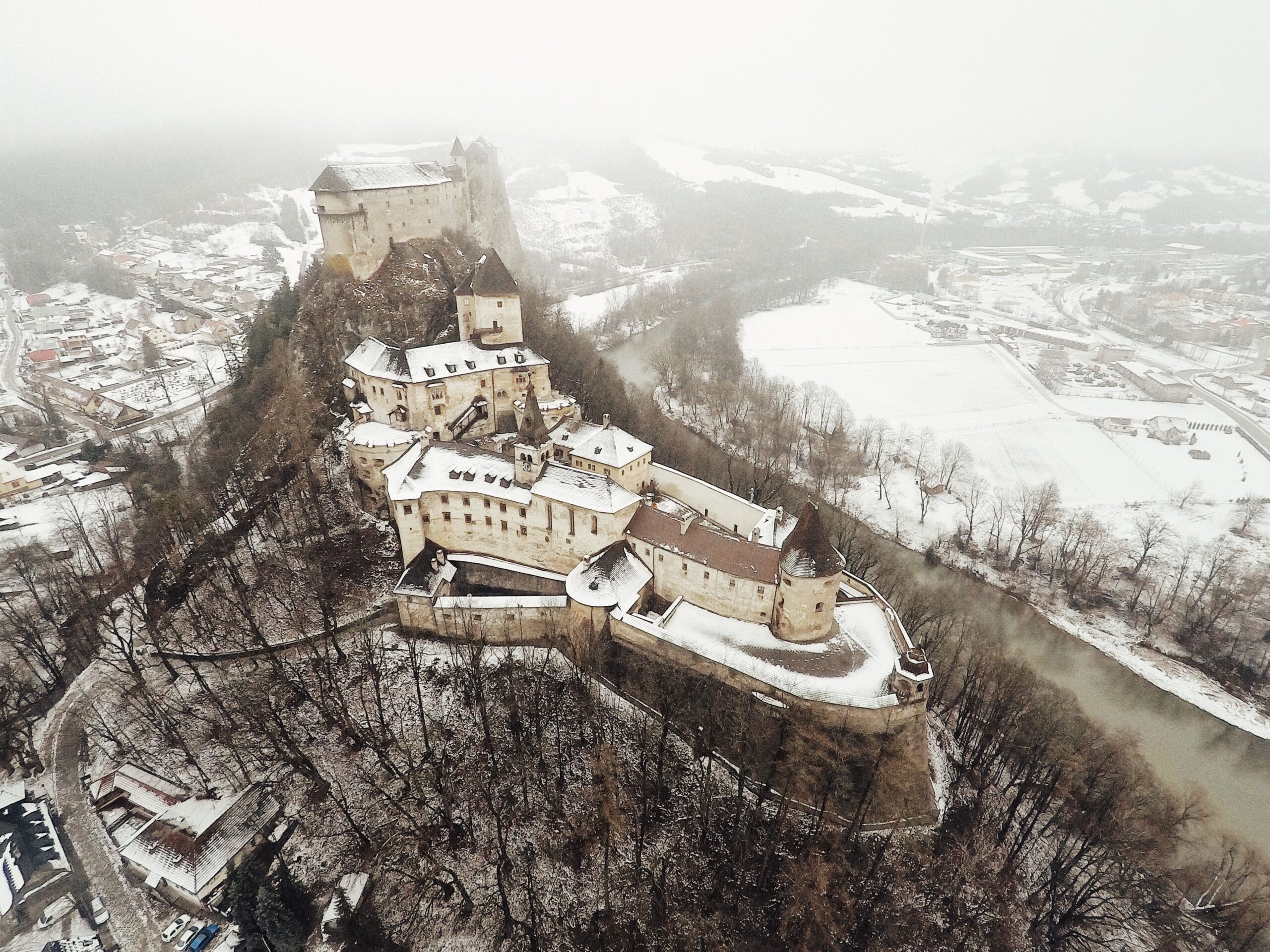
The castle glued to a rock above the river Orava at Oravský Podzámok is probably the most dramatic building in Slovakia, and the reason a lot of English speakers know it at all: the silent Nosferatu was filmed here. Murnau’s 1922 vampire film used Orava as Count Orlok’s lair, and if the silhouette above the river looks unnervingly familiar, that is why. Very little about the exterior has changed since the camera crew left.
The castle splits into a lower, middle and upper section, with 155 rooms and 754 steps in total, so come prepared to climb. There are three circuits: the standard circuit A at 9 € (about £7.50, children under 15 and seniors 4.50 €, family 22.50 €), the short circuit B at 7 € and the long circuit C at 13 €. Students under 26 pay half price. The ticket office is open all year: July and August 8:30 to 17:00, in the main season usually 9:00 to 16:00 or 17:00, and in winter 9:00 to 15:00. Reachable without a car: the castle sits directly above the village of Oravský Podzámok, so a bus into the village puts you at the entrance, though services thin out considerably at weekends.
10. Strecno Castle
A castle above a bend in the river Váh just outside Žilina, tied to the story of Žofia Bosniaková. Entry is by guided tour only and the tour lasts about an hour. The season is short: 1 April to 30 September, tours daily 9:00 to 12:15 and 12:45 to 17:00. The medieval settlement of Paseka below the castle opens earlier, at 8:45. Admission is 7 € standard (about £6), 3.50 € for children aged 7 to 15, students and over-60s, family 17.50 €, free under 6. It is about 20 minutes on foot from the car park and 30 minutes from the village. Reachable without a car: yes, buses from Žilina serve the village of Strečno, and from there it is the 30-minute climb.
11. Budatin Castle
Right inside Žilina, above the point where the Kysuca joins the Váh. A good call for a wet day, or as a second stop after Strečno. The park and the chapel are free and open daily from 6:00 to 22:00. The castle circuit, with exhibitions on the history of Žilina and period interiors, costs 10 € (about £8.50), 5 € concessions, 25 € family. The separate wire-craft exhibition, a genuinely Slovak speciality, costs 4 €, 2 € concessions, 10 € family. Open daily 9:00 to 12:15 and 12:45 to 17:00. Reachable without a car: easily, it is a walk from Žilina city centre and the main station, and Žilina is a major rail junction.
12. Zvolen Castle
A Gothic chateau built in the 1370s as a hunting seat for Louis I, now managed by the Slovak National Gallery. Inside there is a collection of old European art and, above all, the coffered wooden ceiling in the King’s Hall with 78 portraits of Roman and German emperors. Open Wednesday to Sunday, 10:00 to 17:30, with admission starting at 2.70 € (about £2.30) and concessions from 1 €. It is one of the cheapest major monuments in the country and an hour covers it. Reachable without a car: yes, the chateau stands in the middle of Zvolen, one of the main railway junctions of central Slovakia.
Eastern Slovakia: Spis, Saris and Gemer
The east is the long way from Bratislava, but it holds the biggest castle in the country and the densest concentration of them. Getting there is not difficult even without a car: the train from Bratislava to Poprad-Tatry takes about four hours and to Košice about five, and Košice (KSC) has seasonal flights of its own. If you have three days or more in Slovakia, this is where they should go.
13. Spis Castle
The largest castle in Slovakia and the one unmissable stop in the east. It spreads over more than 4 hectares, ranks among the biggest castle complexes in Central Europe, and has been on the UNESCO list since 1993 together with Levoča and the surrounding monuments. It has been a ruin since the fire of 1780, restoration has been running since the 1970s, and the upper courtyard is currently closed for works, which is reflected in the price. Admission is 12 € for an adult (about £10), 8 € for students aged 19 to 26 and over-60s, 6 € for children aged 6 to 18, and 25 € for a family of up to four. A night tour costs 15 €. From May to September it is open daily 9:00 to 19:00 with last admission at 18:00, until 18:00 in October and until 17:00 from 26 October. In November and through the winter the castle closes depending on the weather. Reachable without a car: yes, but with effort. Buses from Poprad and Levoča serve Spišské Podhradie below the hill, and from there it is an uphill walk to the gate.
💡 Tip: There is no shade at Spis Castle and no shelter from the wind, and the path up from the car park crosses an open hillside. In July and August go straight after opening or after five in the afternoon, and take more water than feels sensible.
Spiš works nicely as a whole weekend: the castle, Levoča, Spišská Kapitula and the Slovak Paradise national park a short drive away. Find places to stay in Levoca and around →
14. Lubovna Castle
The castle above Stará Ľubovňa has an advantage you will not find anywhere else on this list: an open-air museum of folk architecture sits directly below it, so you get two attractions from one car park. Admission to the castle is 10 € (about £8.50), the open-air museum alone 5 €, and the combined ticket 13 €. Children aged 6 to 19 pay 5 €, university students and over-60s 7 €, family 20 € or 24 € combined. The castle tour takes an hour and a half and the open-air museum about an hour on top. Open May to September daily 9:00 to 19:00, October Wednesday to Sunday 10:00 to 16:00, and in winter Friday to Sunday only. The open-air museum is closed from January to March. Reachable without a car: yes, the castle overlooks the town of Stará Ľubovňa and is a walk from the centre.
15. Kezmarok Castle
A town castle from 1463 in the middle of Kežmarok, largely Renaissance after the rebuilding of 1572 to 1624, with arcades and a baroque chapel. The regional museum has been based here since 1931. Admission starts from 3 € (about £2.50) and concessions from 1.50 €, making it the cheapest stop under the Tatras. Open May to September daily 9:00 to 16:00, and from October to April Monday to Friday only, 8:00 to 15:00. In summer there are evening tours with live theatre. An hour is plenty. Reachable without a car: very easily, the castle is in the town centre and Kežmarok is a short hop from Poprad, the main gateway to the High Tatras.
16. Krasna Horka
This is the most common disappointment in eastern Slovakia, so do not let it catch you out on the spot. Krasna Horka Castle has been closed to the public since the fire of 2012 and remains closed for reconstruction, as its custodian, the Slovak National Museum, confirms. It does not appear in the museum’s online ticket system either. The restoration continues as a separate project and no opening date has been made public. You can photograph it from the road and from the village below, but you cannot get inside. Rather than driving out here on the off chance, go straight to nearby Betliar.
17. Betliar Manor House
The fallback for Krasna Horka, and one of the loveliest properties in the country in its own right. The Andrássy family seat still holds its original furnishings and library, with an extensive English landscape park, again under Slovak National Museum management. Standard admission is 12 € (about £10) and children aged 6 to 15 pay 6 €. Tickets can be bought online. Allow two to three hours with the park; the interior tour alone takes about an hour. Reachable without a car: yes, Betliar is a short bus ride from Rožňava, the local hub.
18. Saris Castle
A sprawling ruin above Veľký Šariš a few minutes from Prešov, with a strikingly rebuilt donjon tower. Prices are low: the courtyard costs 3 € for an adult (about £2.50), children aged 6 to 18 and over-60s 2 €, the donjon tower another 2 €, and a family ticket for the courtyard 6 €. Open May to October, Tuesday to Sunday 10:00 to 18:00, with last admission to the courtyard at 17:30 and to the tower at 17:00. From November to April it opens at weekends only, 10:00 to 16:00. A footpath leads up from the village below, so expect a climb. Reachable without a car: yes, Veľký Šariš is a short train or bus ride from Prešov and the trail starts in the village.
Castles in Slovakia: admission, season and time needed
Prices are standard adult admission in the 2026 main season. Pound figures elsewhere in this guide use an approximate rate of 0.84 GBP to the euro.
| Castle | Region | Type | Adult admission | Season | Time |
|---|---|---|---|---|---|
| Bratislava Castle | west | museum, self-guided | 14 € (grounds free) | all year, closed Tue | 1 to 2 h |
| Devin | west | ruin | 6 to 8 € by season | all year, closed Mon | 1.5 to 2 h |
| Cerveny Kamen | west | guided tour | 12 € / 10 € | all year | 1.5 to 2 h |
| Smolenice | west | guided tour | 5 € | daily in summer, otherwise weekends | 1 h |
| Trencin Castle | west | circuit with or without guide | 10 € / 12 € | all year, daily | 2 h |
| Beckov | west | ruin with exhibition | 5 to 8 € | February to mid-November | 1.5 h |
| Cachtice Castle | west | ruin | 2.50 € | closed Mondays | 3 h with the climb |
| Bojnice | centre | chateau with tour | 14 to 16 € | all year, Wed to Sun in winter | 2 h |
| Orava Castle | centre | circuits A, B, C | 7 / 9 / 13 € | all year | 2 to 3 h |
| Strecno | centre | guided tour | 7 € | 1 April to 30 September | 2 h with the climb |
| Budatin Castle | centre | museum | 10 € (park free) | all year, daily | 1.5 h |
| Zvolen Castle | centre | gallery | from 2.70 € | Wed to Sun | 1 h |
| Spis Castle | east | ruin, UNESCO | 12 € | April to October | 2 to 3 h |
| Lubovna Castle | east | castle plus open-air museum | 10 € / 13 € combined | all year, Fri to Sun in winter | 2.5 h |
| Kezmarok Castle | east | museum | from 3 € | all year | 1 h |
| Krasna Horka | east | closed, under reconstruction | cannot be visited | closed | exterior only |
| Betliar Manor House | east | manor house with park | 12 € | all year | 2 to 3 h |
| Saris Castle | east | ruin | 3 € plus 2 € for the tower | all year, weekends in winter | 2 h with the climb |
If you are travelling without a car, the straightforward ones are Bratislava Castle, Devin, Trencin, Budatin, Zvolen, Bojnice, Kezmarok and Lubovna, all of them either in a town or on a city bus route. Cachtice, Saris, Strecno and Spis Castle are reachable by public transport but finish with a climb of 20 to 45 minutes. Cerveny Kamen, Smolenice and Beckov are the three where a car genuinely makes the difference.
The best castles in Slovakia if you only have time for three
On a long weekend there is no point chasing the whole list. These three cover three completely different experiences, and together they make the obvious castle tour across the country:
- Spis Castle for sheer scale and the feeling of open space. There is nothing of comparable size anywhere in this part of Europe.
- Bojnice for the perfect fairy-tale silhouette and interiors that still work in the rain.
- Orava Castle for the drama of the setting. The photograph taken from the river below is more famous than most castles are.
If you are driving the length of Slovakia anyway, add Trencin in the west to the three. It sits right beside the D1 motorway and it is open daily, all year, which makes it the easiest of the lot to slot into a schedule. West to east, the run Trencin to Bojnice to Orava Castle to Spis Castle is the classic four-day medieval castles itinerary, and every leg of it can be done by train and bus if you would rather not drive.
Which castles in Slovakia work with children
Not every castle works with kids. What decides it is the length of the climb, whether you have to stay quiet in a group for an hour, and whether there is anywhere to let off steam.
- Bojnice. The safest bet by far. There is a dedicated children’s tour, O bojnickom baziliškovi, at 13 € for an adult and 9 € for a child, a zoo next to the castle, and a cave right underneath the courtyard.
- Lubovna Castle with the open-air museum. Two very different things in one place, child tickets from 5 € and a combined family ticket at 24 €.
- Strecno with the Paseka settlement. The tour is only an hour, and the medieval settlement below the castle opens as early as 8:45.
- Budatin Castle. The park with its chapel is free and open from 6:00 to 22:00, and the wire-craft exhibition costs 4 € with children at 2 €.
- Beckov. Five minutes from the car park, no long ascent, and still a proper ruin.
Cachtice Castle and Saris Castle, on the other hand, both mean roughly a 45-minute uphill walk, which with pre-school children tends to be a battle. And at Spis Castle keep an eye on the forecast, because there is no shade at all up on that hill.
💡 Tip: A lot of Slovak castles sell a family ticket that comes in well below the sum of the individual ones. At Cerveny Kamen the long tour saves you around 5 €, and at Spis Castle the 25 € family ticket covers four people. Ask at the ticket window, because it will not be offered to you.
Practical planning: money, driving and getting there
Slovakia uses the euro. It is a eurozone member, which surprises a lot of first-time visitors who expect a separate national currency the way you find in Czechia, Poland or Hungary. Every price in this guide is the real euro price at the ticket window, with an approximate pound figure at 0.84 GBP to the euro.
Flying in. Bratislava (BTS) is the obvious airport for the west of the country, but Vienna-Schwechat is only about 60 km away and is the main gateway for most long-haul and many European routes. From the east or the north, Budapest, Kraków and Katowice all work as entry points, and Košice (KSC) has its own seasonal flights, which is the shortcut if the Spiš castles are your priority.
Trains and buses. The rail spine runs west to east and it is genuinely usable: Bratislava to Poprad-Tatry takes about four hours and Bratislava to Košice about five. Most of the castles in this guide sit in or above a town, so they are reachable on public transport, but the last few kilometres are often a bus into a village followed by a climb. Check the notes on each castle above before you commit to a car-free itinerary.
Driving and the motorway vignette. If you do hire a car, this is the trap that catches foreign visitors more than anything else. Slovak motorways require a vignette, 10 days costs 10.80 € (about £9), and it is electronic only, bought online at eznamka.sk and tied to the number plate. There is no sticker to put in the windscreen and nothing to buy at the border. Hire cars usually do not include it, whatever the desk tells you, so check the registration is covered before you join the D1. It takes two minutes online and the fines are considerably more than 10.80 €.
When to go
The main season is May to September, and it is the only period when every site in this guide is open. Strečno is accessible only from 1 April to 30 September, and Spis Castle shuts entirely in November depending on the weather.
The best combination of weather and quiet is usually the second half of May and September. July and August mean full car parks, longer waits for a tour slot and real heat on the open courtyards.
Through the winter the ones that stay open are mainly Bojnice, Trencin, Bratislava Castle, Budatin, Zvolen, Orava Castle and Betliar, with several others down to weekends only. Orava Castle in winter has a particular atmosphere, but bear in mind that 754 steps can be iced over.
If you want to combine castles with other sightseeing, tours and tickets in the capital are easy to arrange through GetYourGuide in Bratislava →.
More on Slovakia
- What to see in Slovakia: highlights across the regions
- Thermal baths in Slovakia: prices and season
- Camping in Slovakia: campsites and wild camping rules
- Where to stay in Slovakia: the most beautiful places to sleep
- Slovakia by train: a holiday without a car
- Lakes in Slovakia: glacial lakes, reservoirs and swimming
- Súľovské skaly: the circuit and the practicalities
Castles in Slovakia: frequently asked questions
How many castles are in Slovakia?
The official tourist portal slovakia.travel gives more than a hundred castles and chateaux, plus at least twice that number of manor houses. The exact figure depends on whether you count small ruins with no caretaker and no ticket office. The number of properly opened, visitable sites is several dozen.
Does Slovakia really have the most castles per capita in the world?
It is the claim Slovakia is best known for, and the arithmetic behind it is sound enough: more than a hundred castles and chateaux for a population of roughly 5.4 million works out at about one castle for every 50,000 people. No official body publishes a global per capita ranking, so treat it as a very well founded boast rather than a certified record. What is beyond dispute is the density on the ground, especially in the Spiš region and along the Váh valley.
What is the largest castle in Slovakia?
Spis Castle. It covers more than 4 hectares and is one of the largest castle complexes in Central Europe. Since 1993 it has been on the UNESCO list together with Levoča and the surrounding monuments. Adult admission is 12 €, currently a reduced rate because the upper courtyard is closed for restoration.
What is the oldest castle in Slovakia?
There is no clean answer, because it depends on whether you date the first fortification on the site or the stonework that still stands. Several of the big Slovak castles have medieval cores: Cachtice Castle goes back to the first half of the 13th century, Zvolen Castle was built in the 1370s and Kezmarok Castle dates from 1463. If you want the oldest fortified place rather than the oldest castle, Devin above the Danube has been a strategic site far longer than any of them.
Which castles can you visit near Bratislava?
Bratislava Castle stands in the city itself, with free access to the grounds and the baroque garden daily from 8:00 to 22:00. Devin, a ruin above the confluence of the Danube and the Morava, is about 10 km from the centre and reachable by city bus or by boat. Cerveny Kamen and Smolenice in the Little Carpathians are both roughly an hour’s drive away, and both are guided tour only.
Was Nosferatu filmed at Orava Castle?
Yes. Murnau’s silent Nosferatu of 1922 used Orava Castle, above the river at Oravský Podzámok, as Count Orlok’s lair, and the exterior is still instantly recognisable from the film. The castle is open all year, with three separate circuits priced at 7, 9 and 13 €, and it has 155 rooms and 754 steps.
How much does it cost to visit castles in Slovakia?
Ruins are the cheapest: Cachtice Castle costs 2.50 €, the courtyard at Saris Castle 3 €, Devin roughly 6 to 8 € depending on the season. Castles with a tour usually cost 7 to 14 €, and the most expensive ticket in this guide is Bojnice with the castle and cave at 16 €. Children, students and seniors pay around half, and most sites offer a family ticket.
Which castles in Slovakia are free to visit?
The grounds of Bratislava Castle, including the baroque garden, are free and open daily from 8:00 to 22:00, and the park with the chapel at Budatin Castle in Žilina is free from 6:00 to 22:00. Everywhere else in this guide charges for the exhibitions and for the courtyards, ruins included.
Is Krasna Horka open after the fire?
No. The Slovak National Museum, which manages the castle, states that it is closed to the public for reconstruction, and it does not appear among the sites with online tickets. Restoration after the 2012 fire continues as a separate project. The nearest open alternative is Betliar Manor House.
Which castles in Slovakia are open in winter?
Trencin Castle, Bratislava Castle, Budatin Castle, Zvolen Castle, Orava Castle, Betliar and Bojnice run all year, although Bojnice is Wednesday to Sunday only in winter. Lubovna Castle and Saris Castle switch to a weekend timetable. Strecno is closed from October and Spis Castle shuts in November depending on the weather.
Can you visit Slovak castles without a car?
Yes, for most of them. Bratislava Castle, Devin, Trencin, Budatin, Zvolen, Bojnice, Kezmarok and Lubovna are all in a town or on a city bus route. Cachtice, Saris, Strecno and Spis Castle can be reached by public transport but end with a climb of 20 to 45 minutes on foot. Cerveny Kamen, Smolenice and Beckov are the three where hiring a car makes a real difference.
Read next
Potřebujete pomoct s cestováním?
-
Ubytování 🏨
Vyberte si to nejlepší ubytování, ať už jste kdekoliv, přes Booking.com. -
Půjčení auta 🚗
Auto si snadno najdete přes Booking.com, kde máte často slevu díky ubytování, nebo Rentalcars.com, kde porovnáte nabídky většiny půjčoven. -
Zážitky 🎟️
Přes GetYourGuide.com si vyberete z nejrůznějších výletů i zážitků po celém světě, navíc se zrušením zdarma do 24 h předem.