Last updated 1.9.2026
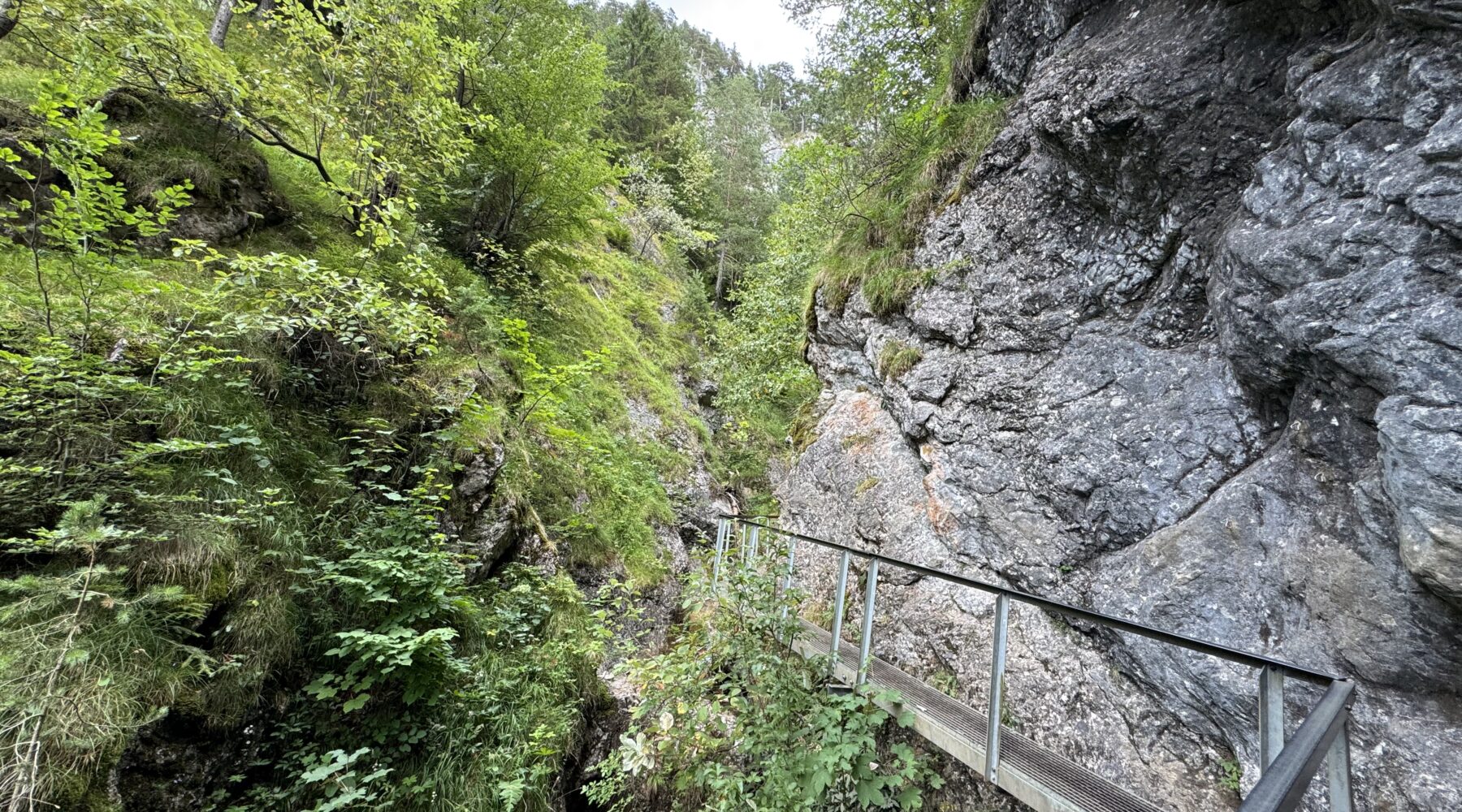
Slovakia has a style of walking that barely exists anywhere else in Europe, and the Jánošíkove diery — usually typed Janosikove diery once the accents fall off — are the best known example of it. This is a chain of narrow rock gorges above the village of Terchová in the Malá Fatra mountains, and the footpath does not go around them or above them. It goes straight up the stream bed, over wooden walkways bolted to the rock, up metal staircases and, in the upper sections, up near-vertical ladders that run to twelve or fifteen metres. It is a public waymarked trail, free to walk, and on a summer Saturday several thousand people do exactly that.
The question every visitor ends up asking is not whether to come, but which loop to walk. There are three sensible answers and two ambitious ones, ranging from a two-hour family outing to a full day with a 1,610 m summit tacked on. Choose badly and you either drive four hours for a walk that is over before lunch, or you find yourself halfway up a fifteen-metre ladder with a child on your back, wondering how to reverse.
Below you will find what the gorges actually are, how the small and the big loop differ, how the one-way system works and why it exists, what the ladders are really like, what parking costs, and — since almost nobody arrives here on a whim — how to reach Terchová from the nearest airports with or without a car.
Janosikove diery at a glance: routes, times and parking
- Where: above Terchová in the Krivánska Malá Fatra, northern Slovakia, roughly 25 km (16 miles) from Žilina.
- Small loop: Dolné and Nové diery, 5–6 km, 210–290 m of ascent, 2–3 hours. Fine for children from around five.
- Big loop: adds Horné diery and the Medzirozsutce saddle (1,200 m), 8–12 km, 560–625 m of ascent, 4–5 hours.
- With a summit: the big loop plus Malý Rozsutec (1,343 m), roughly 12 km, 900 m of ascent, 6–7 hours.
- There is no entrance fee. You pay only for parking: at Hotel Diery the first 90 minutes are free, then €5 for 3 hours, €8 for 6 hours, €10 for 12 hours and €15 for 24 hours (about £4 to £13). Štefanová is roughly €3 a day (about £2.50).
- One-way sections: Nové diery may only be walked Ostrvné → Podžiar, and the Horné diery section from Podžiar up to Pálenica is uphill only.
- Best timing: a weekday outside the school holidays, on the trail by 8.30 am.
- Open all year, and the spring trail closure from 1 March to 15 June does not apply here — it shuts the route over Veľký Rozsutec and two other paths, not the gorges.
What are the Jánošíkove diery, exactly?
If you have walked a via ferrata in the Alps, forget the comparison. If you have done a guided canyoning trip in a wetsuit, forget that too. A Slovak tiesňava — a gorge walk of this kind — is something in between and rather more relaxed than either: an ordinary waymarked public footpath that happens to run inside a ravine so narrow that there is nowhere to put a path except the stream itself. Where the water drops over a ledge, the trail climbs the ledge on a ladder. Where the gorge pinches shut, a metal walkway is bolted to the wall a metre above the water. No harness, no helmet, no guide, no ticket. Just boots, free hands and a head that copes with exposure.
The name is worth a moment too, because it tells you nothing in English. Diery means “holes” in Slovak, and Jánošík was Juraj Jánošík, the eighteenth-century outlaw born in Terchová who has been Slovakia’s Robin Hood ever since. “Jánošík’s holes”, then — a folk name for a place that used to be a hiding hole rather than a tourist attraction.
Geologically the system sits inside the Rozsutec national nature reserve, the strictest category of protection in the Slovak system. The gorges were cut by the Hlboký potok stream, known locally as the Dierový, and its course carries more than twenty waterfalls, protected in their own right as a natural monument. None of them is enormous — the tallest are around four metres — but you pass them at arm’s length, which is the whole point.
Two practical consequences of that reserve status: stay on the marked path, and expect the infrastructure to be maintained rather than expanded. Nothing here has been widened for the convenience of crowds, which is precisely why the crowds are managed by rules instead.
The three sections: Dolné, Nové and Horné diery
Every route in the area is built from the same three components, so it pays to learn the names before you look at a map.
- Dolné diery (“the lower holes”) are the easiest and the busiest. An interpretive nature trail runs through them, there are two small waterfalls of 1 m and 3.5 m, and the stretch from Biely Potok up to Podžiar measures 2.4 km — around 50 minutes of walking. This is the section people mean when they say the gorges are suitable for families.
- Nové diery (“the new holes”) were the last part to be opened up, hence the name. They branch off the Dolné diery and follow a smaller tributary upstream, with four waterfalls of one to two metres and noticeably more ladders. They are the reason the small loop is a loop rather than a there-and-back.
- Horné diery (“the upper holes”) are the most beautiful and the most demanding. They lie between the massifs of Veľký and Malý Rozsutec, the stream drops over nine waterfalls of two to four metres, and the only way through is on ladders, chains and walkways. In heavy rain the section becomes impassable, and in winter it is generally described as closed.
One thing to clear up, because English-language sources repeat it: you will sometimes read that Kúr and Sokolie are part of the Jánošíkove diery. They are not. Kúr is a valley on the northern side of the Malá Fatra, and Sokolie (1,171 m) is a rocky ridge above Štefanová with its own chain-secured route — a separate half-day outing, and one for dry weather only.
The five Janosikove diery routes, from easiest to hardest
The hub of the whole system is the Podžiar junction at 715 m, where you will find a salaš — a traditional sheep farm turned snack bar — and the only refreshments on the route. Two parallel paths climb to it from Biely Potok, the Dolné and the Nové diery, and the Horné diery continue above it. Which loop you end up walking is simply a question of how many of those pieces you string together.
1. The small loop: Dolné and Nové diery (2–3 hours)
The classic, and the one most visitors walk: Biely Potok, Ostrvné, Nové diery, Podžiar, Dolné diery, Biely Potok. Sources put it at 5 to 6 km with 210 to 290 metres of ascent, so allow two to three hours. You climb through the Nové diery, which are the more entertaining of the two, and come back down the gentler Dolné diery.
Who it suits: families with children from about five, older walkers who are sure-footed, and anyone with only a morning to spare. It is also, inevitably, the most crowded thing in the valley.
2. The big loop: Horné diery and the Medzirozsutce saddle (4–5 hours)
From Podžiar the route carries on upwards through the Horné diery to the Pod Pálenicou junction (900 m), then into the Tesná rizňa valley and up to the Medzirozsutce saddle (1,200 m), the notch between the two Rozsutec peaks. You come back down on the green waymarks past Pod Tanečnicou to the Vrchpodžiar saddle (745 m), then on yellow to Podžiar and down through the Dolné diery. Sources give 8 to 12 km and 560 to 625 metres of ascent.
Who it suits: reasonably fit walkers with no fear of heights. The Horné diery have both the most waterfalls and the tallest ladders, and this is the version of the day people remember.
3. The big loop starting from Štefanová
The same circuit approached from the other side. From Štefanová (around 650 m) you follow the yellow waymarks over the Vrchpodžiar saddle to Podžiar, walk up through the Horné diery and return on green. The advantages are a cheaper car park and a much quieter first hour; the drawback is that you miss the Nové diery entirely.
💡 Tip: The best compromise is to start at Štefanová, walk the gorges, then descend the Nové and Dolné diery to Biely Potok and return on the yellow path over Vrchpodžiar. You save on parking and cover the whole system in one go.
4. The gorges plus Malý Rozsutec (6–7 hours)
From the Medzirozsutce saddle it is a short but steep pull to the summit of Malý Rozsutec (1,343 m), adding roughly an hour and a half. The full day works out at around 12 km, some 900 metres of ascent and six to seven hours. This is by far the most popular way to add a proper summit to the gorges, and the view down onto Terchová from the top is the payoff for the ladders.
5. The gorges plus Veľký Rozsutec or the ridge (a full day)
The most ambitious combination heads from Medzirozsutce up Veľký Rozsutec (1,610 m), the pointed peak that appears on every postcard of the range, or continues along the main ridge. Be warned on two counts: the terrain is harder, and the Medziholie – Veľký Rozsutec – Medzirozsutce route on the red waymarks is closed from 1 March to 15 June every year. Outside that window it is a long, satisfying day; inside it, the summit is simply off the table.
| Route | Distance | Ascent | Time | Difficulty |
|---|---|---|---|---|
| Small loop (Dolné and Nové diery) | 5–6 km | 210–290 m | 2–3 hrs | easy, but with ladders |
| Big loop (Horné diery, Medzirozsutce) | 8–12 km | 560–625 m | 4–5 hrs | moderate |
| Big loop from Štefanová | about 10 km | about 550 m | 4–5 hrs | moderate |
| Gorges plus Malý Rozsutec | about 12 km | 900–930 m | 6–7 hrs | harder, a full day |
| Gorges plus Veľký Rozsutec | 13 km and up | over 1,000 m | 7–8 hrs | demanding, closed in spring |
How long the Janosikove diery really take
The times above assume steady walking with short stops, no lunch break and no queues. In practice, add two things. The first is photography: in the gorges you stop every fifty metres, and that alone can stretch the small loop to a full three hours. The second is traffic. On a July Saturday a queue forms below every taller ladder, and 30 to 45 minutes disappear into waiting. If you are coming for the day from Vienna or Kraków, budget from the moment you leave the car: the small loop is half a day, the big loop plus the drive both ways is a dawn-to-dusk affair.
The one-way system: which way you may walk, and why
The gorges are narrow, two people cannot pass on a ladder, and in season thousands of walkers a day come through. The one-way sections are therefore not a matter of etiquette but a safety measure, and they are signposted on the ground.
- The Nové diery have been one-way since 2013, in the direction Ostrvné → Podžiar, which is upstream and uphill. You do not come back down this way.
- The Horné diery have a one-way section from the Podžiar junction up to Pálenica, again uphill only. The way back is the green path over Vrchpodžiar, not the stream bed.
- The Dolné diery are not one-way. They are walked in both directions, which is exactly why they make the natural return leg.
So the rule for planning is simple: upstream on the way up, a different path on the way down. Walk the loop backwards and you will spend the day squeezing past oncoming traffic on ladders, which is both slower and considerably less pleasant than the detour you were trying to avoid.
Ladders, walkways and chains: how hard is it really?
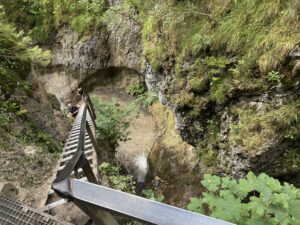
Nobody keeps an official count of the fixed aids, but there are dozens of them across the system: metal and wooden walkways, footbridges, steps, chains and ladders. The tallest ladders run to 12 to 15 metres. They are in good condition — a complete replacement of the steel components began back in 2009 — and they feel solid underfoot.
Technically this is not climbing, and unlike a Slovak via ferrata you need no equipment at all. The ladders stand close to vertical but the rungs are broad and firmly fixed, and anyone without a serious fear of heights will manage. What matters is having both hands free: rucksack on your back rather than over one shoulder, camera and phone stowed, poles collapsed and strapped down. And the ladders are not actually the hazard — wet wood and polished stone are, and that is where the slips happen.
💡 Tip: One person on a ladder at a time. Crowding and hurrying while trying to pass account for most of the avoidable injuries here.
Entrance fee and parking: Biely Potok, Štefanová, Podžiar
There is no entrance fee for the Jánošíkove diery. There is no ticket office and no turnstile, in high season or in winter, so the question of admission prices simply does not arise. Your only cost is parking, and that is charged by the car park operators, not by the national park.
| Car park | Price | Notes |
|---|---|---|
| Hotel Diery car park, Biely Potok | first 90 minutes free, then €5 for 3 hrs, €8 for 6 hrs, €10 for 12 hrs, €15 for 24 hrs (roughly £4–13) | Around 200 spaces, payment at the barrier, €10 per 24 hrs for a campervan. |
| Štefanová car park | roughly €3 a day (about £2.50), around €5 for a campervan | Start of the yellow waymarks over Vrchpodžiar. |
| Podžiar | no parking | The junction in the middle of the system — reachable on foot only. |
| Along the road in Biely Potok | free where it is not prohibited | Five to ten minutes’ extra walking; full early in season. |
The free 90 minutes at Hotel Diery sound generous and are a trap: they will not even cover the Dolné diery there and back at a gentle pace. Buy three hours for the small loop, six for the big one and twelve if you are adding a summit. Bring euros in cash as well as a card — the machine at the barrier is often the quicker option, and at peak times the queue for it is shorter than the queue of cars behind you.
Getting to the Janosikove diery: airports, trains and buses
Terchová is not on anyone’s main tourist route, which is half its appeal and all of its logistical problem. There is no railway station in the village and no airport within an hour. The good news is that Žilina, the regional capital 25 km away, is a genuine transport hub on the main Bratislava–Košice line, so getting here without a car is more realistic than in most Central European ranges.
Nearest airports
Žilina has an airport of its own at Dolný Hričov, but it handles no scheduled passenger flights, so ignore it when you plan. In practice you fly into one of five:
- Ostrava (OSR) — about 110 km, the closest of the lot, though with a thin route network.
- Katowice (KTW) — about 185 km, well served by budget airlines from the UK.
- Bratislava (BTS) — about 200 km, roughly two hours by car, or a little over two hours by train to Žilina.
- Kraków (KRK) — about 200 km, the best choice if you are combining the trip with the Tatras.
- Vienna (VIE) — about 250 km, the widest choice of flights and easy onward connections.
By train and bus, without a car
Take a train to Žilina, where services from Bratislava run roughly hourly and are frequent, comfortable and cheap; the national operator is ZSSK. From Žilina bus station, the suburban bus through Terchová (route 050178) carries on to the stop Terchová, Biely Potok hotel Diery, which is literally at the start of the trail. There is no walking-in from a distant station and no taxi required.
The catch is frequency. In season the buses run reliably through the day, but on Sundays and outside the school holidays the timetable thins out considerably, and the last bus back is earlier than you would like. Check both directions on cp.sk the evening before, and note your return departure before you set off up the gorge — mobile signal in the ravine is patchy at best.
By car and hire car
Hire cars are available in Žilina and at all five airports above. From Žilina it is around half an hour on road 583 through Krasňany to Terchová, then a couple of minutes more to Biely Potok. Coming from Poland, the Zwardoń–Skalité crossing and the D3 motorway through Čadca is the fastest line; coming from Vienna or Bratislava you follow the D1 the whole way.
One thing to sort out before you cross the border: Slovak motorways use an electronic vignette, bought online at eznamka.sk against your number plate. There is nothing to stick on the windscreen, but there is also no toll booth to buy one at, and hire cars are not always covered. Check with the rental desk, and if in doubt buy it yourself — it costs a fraction of the fine.
When to go to avoid the crowds
The Jánošíkove diery are among the most visited natural attractions in Slovakia, and in summer you will notice within five minutes. The rule here is unusual but consistent: the day of the week and the hour matter far more than the month.
- Worst: holiday weekends and public holidays between 10 am and 2 pm, when the car parks fill before noon.
- Best: a weekday outside the school holidays, starting between 7 and 8.30 am. For the first two hours you will have the gorges more or less to yourself.
- Prettiest: late May and June, when the stream is running high, and the second half of September.
- Quietest: October and early November, when the paths are still dry and there is a fraction of the summer traffic.
There is one date to avoid unless you are coming for it deliberately: the Jánošíkove dni folklore festival takes over Terchová in late July, and the village is booked solid.
Because that early start is the single most effective thing you can do, it is worth sleeping nearby rather than driving in at dawn. Terchová itself has the widest choice, while Biely Potok and Štefanová put you within minutes of the trailhead. Compare places to stay in Terchová →.
The Janosikove diery with children, pushchairs and dogs
- With children, the small loop is realistic from around five, provided the child walks uphill unaided and is not frightened of heights. The Dolné diery on their own work for younger ones. Expect to take a third longer than the guidebook time and leave room for a stop at Podžiar. Do not take small children into the Horné diery.
- With a pushchair it is impossible, even on the easiest section. The path runs over walkways, metal steps and uneven rock, and there is no version of the route a buggy will get through. With toddlers, bring a child carrier — and even then, stick to the Dolné diery.
- With a dog the gorges are not recommended. A dog cannot climb a ladder unaided, and carrying one up a near-vertical ladder is unsafe for both of you. A small dog will travel in a rucksack; a large dog has no business here. You are also inside a national nature reserve, where dogs must be kept on a lead. With a dog, take the ridge paths instead — and read up on bear behaviour in the Malá Fatra before you do, because the range has a healthy population.
The Janosikove diery in the rain and in winter
Rain changes the place fundamentally. Wood and stone both turn slippery, and when the stream is running high the Horné diery become impassable because the water simply covers the path. After sustained rainfall, plan on the small loop and nothing more.
In winter no section is officially closed. In practice the Horné diery are generally described as closed and are walked only by people with winter experience and the kit to match. The sensible winter outing is the Dolné diery from Biely Potok up to Podžiar and back, ideally between 7 am and 2 pm, before the light goes. In the depths of the gorge, dusk arrives noticeably earlier than it does in the valley.
💡 Tip: In winter take microspikes or adjustable crampons — you can also hire them at the Hotel Diery reception. Without them, a single iced-over metal step is worse than the whole summer route put together.
And one piece of good news for anyone planning a spring trip: the seasonal closure from 1 March to 15 June does not affect the gorges. It applies to three other routes — Medziholie to Medzirozsutce over Veľký Rozsutec on the red waymarks, Obšívanka to Malé nocľahy on blue, and Vendovka to Malý Kriváň on blue. The Jánošíkove diery stay open without restriction; you simply cannot add Veľký Rozsutec to them during those months.
What to wear and what to pack
- Footwear: sturdy walking boots with a good tread, ideally waterproof. This is the one item that genuinely decides how the day goes.
- A rucksack with two shoulder straps, never a shoulder bag. You need both hands.
- Layers and a waterproof. The gorges are cold and damp even in August, and you are in shade for most of the walk.
- Water and food. The only refreshments on the route are at Podžiar and by the car park.
- An offline map. Signal is weak in the ravine, so download the route before you set off.
- Gloves for the chains and cold rungs, particularly outside high summer.
- Cash in euros for the car park barrier and the snack bar.
The mistakes people actually make
Trainers on wet wood. Walking the loop the wrong way round and queueing at every ladder. Starting at eleven on a Saturday. Underestimating the big loop with children in tow. And trying to bolt Veľký Rozsutec on late in the afternoon, which is how people end up descending in the dark. The Jánošíkove diery are not a dangerous place, but they are unforgiving of haste.
Where to go next
If the gorges leave you wanting more of this corner of Slovakia, everything worth doing is within an hour. Malý Rozsutec is the natural pairing with the diery and the easiest summit to add to the same day; Veľký Rozsutec is the harder, pointier one with the spring closure attached. The full Malá Fatra ridge traverse from Chleb to Rozsutec is a two-day undertaking and one of the finest ridge walks in Central Europe. For a rest day, the Súľovské skaly rock town near Žilina offers similar ladders and rock gates on a much shorter loop. And whichever you choose, it is worth reading up on where to stay in the Malá Fatra and on how to behave in bear country before you set out.
If you are staying for a few days, you can also book tours and activities around Terchová →.
Janosikove diery FAQ
What are the Jánošíkove diery?
They are a system of narrow rock gorges and canyons above Terchová in the Malá Fatra mountains of northern Slovakia, cut by the Hlboký potok stream and containing more than twenty waterfalls. The waymarked footpath runs inside the gorge itself, on wooden walkways, metal steps, chains and near-vertical ladders up to 12 to 15 metres tall. No harness, helmet or guide is needed — it is a public hiking trail, not a via ferrata.
Which Janosikove diery route should I choose?
There are two main options. The small loop goes through the Dolné and Nové diery from Biely Potok via Podžiar and back, covering 5 to 6 km in two to three hours. The big loop adds the Horné diery and the Medzirozsutce saddle for a total of 8 to 12 km and four to five hours. Either can be extended over Malý Rozsutec or Veľký Rozsutec.
How much does it cost to enter the Jánošíkove diery?
Nothing. There is no entrance fee and the trails are freely accessible all year. You pay only for parking: at Hotel Diery in Biely Potok the first 90 minutes are free, then €5 for three hours, €8 for six hours, €10 for twelve hours and €15 for 24 hours (roughly £4 to £13). Štefanová is about €3 a day.
Can I visit the Janosikove diery without a car?
Yes. Take a train to Žilina on the main Bratislava–Košice line, then the suburban bus through Terchová (route 050178) to the stop Terchová, Biely Potok hotel Diery, which is right at the trailhead. Buses run regularly in season but thin out on Sundays and outside the school holidays, so check the timetable on cp.sk and note your return departure before you start walking.
Why are the Jánošíkove diery one-way?
For safety, because two people cannot pass each other on a ladder. The Nové diery have been one-way since 2013, in the direction Ostrvné to Podžiar, and the Horné diery section from Podžiar up to Pálenica is also uphill only. The Dolné diery are not one-way and are used for the descent.
Are the Janosikove diery suitable for children?
The small loop is, from around five years old, provided the child walks unaided and is not afraid of heights. The Dolné diery are the easiest part. Do not take small children into the Horné diery. A pushchair will not get through any section of the gorges, so with toddlers a child carrier is essential.
Can I take a dog into the Jánošíkove diery?
It is not recommended. A dog cannot climb the ladders unaided, and carrying one up a vertical ladder is dangerous. A small dog can be carried in a rucksack, but a large dog is better left out of it. The area is a national nature reserve, so dogs must be kept on a lead throughout.
Are the Jánošíkove diery open in winter, and does the spring closure affect them?
No section is officially closed in winter, although the Horné diery are commonly described as closed and should only be attempted with proper kit and experience; the sensible winter option is the Dolné diery from Biely Potok to Podžiar and back, with microspikes and a start before 2 pm. The spring closure from 1 March to 15 June does not affect the gorges at all — it applies to the Medziholie–Medzirozsutce route over Veľký Rozsutec, Obšívanka–Malé nocľahy and Vendovka–Malý Kriváň.
Read next
Potřebujete pomoct s cestováním?
-
Ubytování 🏨
Vyberte si to nejlepší ubytování, ať už jste kdekoliv, přes Booking.com. -
Půjčení auta 🚗
Auto si snadno najdete přes Booking.com, kde máte často slevu díky ubytování, nebo Rentalcars.com, kde porovnáte nabídky většiny půjčoven. -
Zážitky 🎟️
Přes GetYourGuide.com si vyberete z nejrůznějších výletů i zážitků po celém světě, navíc se zrušením zdarma do 24 h předem.