
Last updated 1.9.2026
The Mala Fatra hiking trails pack an improbable amount of mountain into a range you can cross in three days. In a single morning you can climb a stream bed on wooden ladders and chains, and by lunchtime be standing on a grassy summit ridge with the High Tatras on the skyline. This is northern Slovakia, an hour from the Polish border, and the whole area around Terchová and the Vrátna valley sits inside Malá Fatra National Park — protected since 1988, and still almost unknown to British walkers.
Below are 20 walks and routes across the range, from the famous gorges to grassy ridges where you will meet nobody all day. Each one comes with distance, height gain, timing and a starting point, plus the practical things that trip up first-time visitors: the spring trail closure that shuts the best summit until mid-June, cable car and parking prices, and how to get here without a car. We also calibrate the hard sections against routes you probably know — Striding Edge, Crib Goch — so you know what you are signing up for.
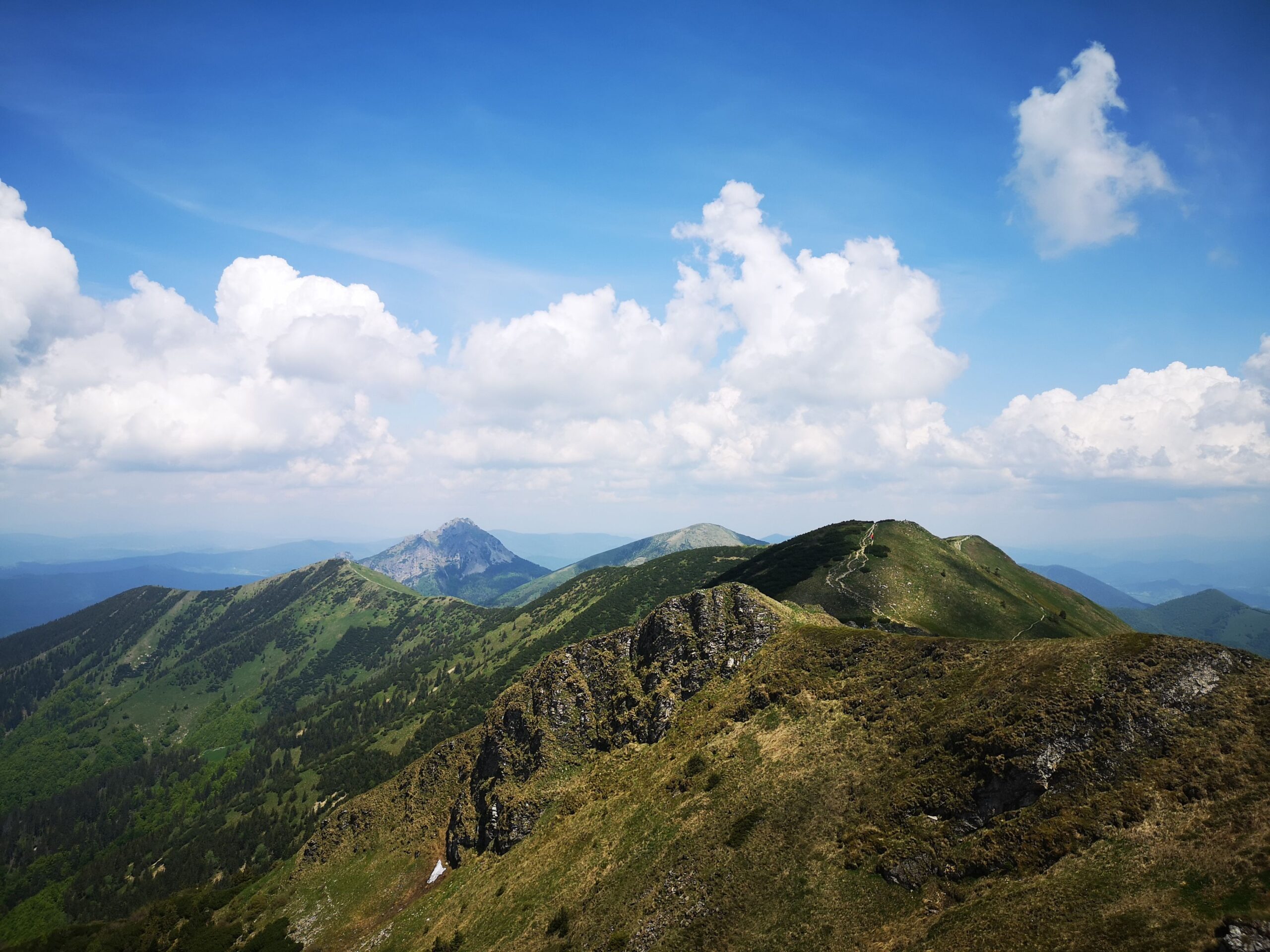
Mala Fatra hiking trails at a glance
- Where it is: north-west Slovakia, just above the city of Žilina. Trailhead villages are Terchová, Štefanová, the Vrátna valley, Šútovo and Martin.
- Highest summit: Veľký Kriváň (full name Veľký Fatranský Kriváň), 1,709 m.
- The classic first visit: the Jánošíkove diery gorges, Veľký Rozsutec, and the main ridge between Veľký Kriváň and Chleb.
- Check before you book: from 1 March to 15 June three trails are closed, including the ascent of Veľký Rozsutec from Medziholie. The gorges and Malý Rozsutec stay open.
- Cable car to the ridge: €25 return at the ticket office, €24 online (about £21), running 8.30 a.m. to 6 p.m.
- Parking: Štefanová around €3 a day; Biely Potok at Hotel Diery charged by the hour (first 90 minutes free, 3 hrs €5, 6 hrs €8, 12 hrs €10, 24 hrs €15); €10 a day at the cable car; free at Paseky.
- There is no entrance fee for the Jánošíkove diery gorges — only a voluntary contribution towards maintaining the ladders and walkways.
- Best time: mid-June to late October. Winter is for people with crampons, an ice axe and the judgement to use them.
Read this first: the spring trail closure, 1 March to 15 June
Slovak national parks shut selected waymarked paths every spring so that wildlife can breed undisturbed and the ground can recover after the snowmelt. In the Malá Fatra the closure runs from 1 March to 15 June and it takes out the single most sought-after summit in the range. Three sections are affected:
- Medziholie – Veľký Rozsutec – Medzirozsutce (red waymarks) — the normal ascent of the range’s signature peak
- Obšívanka – Malé nocľahy (blue waymarks)
- Vendovka – Malý Kriváň (blue waymarks)
The practical consequence is simple: if you arrive before 15 June, Veľký Rozsutec is off the table. Everything else on this page still works. The Jánošíkove diery gorges are open all year and so is Malý Rozsutec, which is the mistake most people make when they read about the closure second-hand and cancel the trip. The main red ridge trail is unaffected too, so the Kriváň–Chleb–Stoh section is walkable throughout spring.
The park’s visitor regulations also fix the hours you may be on the paths at all: 6 a.m. to 9 p.m. from 16 April to 31 October, and 7 a.m. to 6 p.m. from 1 November to 15 April. In winter that 7 a.m. start matters, because it rules out the pre-dawn beginnings you might plan for a long ridge day. Dogs must be on a lead everywhere in the park, and bikes belong on roads and marked cycle routes, not on the footpaths.
💡 Tip: Planning Veľký Rozsutec in May? Check the waymark colour on your map. The closure applies to the red route from Medziholie, and the current status is always published by the Malá Fatra National Park administration before the season starts.
Getting to Malá Fatra National Park
There are no flights to Žilina, so every route in starts somewhere else. The nearest usable airport is Ostrava in the Czech Republic, about 110 km away, followed by Katowice (185 km), Bratislava and Kraków (both around 200 km) and Vienna (250 km). Vienna and Kraków have the widest choice of UK flights; Ostrava and Katowice are the shortest drives.
The train works well. Žilina sits on the main Bratislava–Košice line, so it is a straightforward connection from Bratislava (about 2 hrs 30 mins), from Vienna via Bratislava, or from Kraków and Katowice via the Czech border. From Žilina, buses run to Terchová and on up the Vrátna valley — roughly 45 minutes, about €2 (£1.70). The stops Terchová Biely potok, Vrátna Štefanová, Vrátna Starý dvor and Vrátna Výťah cover every trailhead you are likely to want, which means a car is genuinely optional here.
If you do drive, Slovak motorways need an electronic vignette: the 10-day sticker costs €10.80 (about £9) and you buy it online before you cross the border. Roads inside the range are narrow and the valley car parks fill early on summer weekends. Fuel and shopping are easiest in Žilina; Terchová has small supermarkets but no large stores.
One number worth saving in your phone before you set off: mountain rescue is 18 300, and 112 works as everywhere in the EU. Slovak mountain rescue is free for the call-out itself, but treatment and transport are not, so bring a European Health Insurance Card or its UK equivalent (GHIC) plus travel insurance that covers hiking.
Parking, cable car and where to base yourself
Parking is charged differently at almost every trailhead, and one price in particular gets misquoted online. At Hotel Diery in Biely Potok, the main entrance to the Jánošíkove diery gorges, you pay by the length of stay: the first 90 minutes are free, 3 hours cost €5, 6 hours €8, 12 hours €10 and 24 hours €15. Plan the gorges as a half-day and you are in the €5 to €8 band. At Štefanová it is around €3 a day, at the lower cable car station in Vrátna €10 a day, at Paseky parking is free, and in the Šútovská valley you pay about €4. Carry coins — cards are not accepted everywhere.
The cable car from Vrátna up to Snilovské sedlo (1,492 m) is the single best shortcut in the range. A return adult ticket is €25 at the ticket office or €24 online (about £21), children aged 7 to 12 pay €20 and a family ticket for two adults and two children is €65 (about £55). It runs daily from 8.30 a.m. to 6 p.m., weather permitting, and it lifts you straight onto the main ridge — no forest slog, no 1,000 m of ascent before the view starts.
Most visitors stay in Terchová or one of the hamlets around it, which puts the majority of the trailheads within walking or bus distance. We cover the bases, price ranges and mountain huts separately; if you want to see what is available now, you can compare places to stay in Terchová and the surrounding valleys.
How hard are the Mala Fatra hiking trails really?
Slovak grading is not British grading, and the range’s two showpiece routes both involve fixed metal — so it is worth translating.
The Jánošíkove diery gorges are graded as ordinary waymarked paths, yet you climb wet wooden ladders, cross plank walkways bolted above a stream and hold onto chains for perhaps two hours. Technically it is easier than Striding Edge: the exposure is small, you are rarely more than a few metres above water, and there is no scrambling on rock. What it demands is a head for ladders and dry-ish weather. Think of it as a beginner’s via ferrata rather than a ridge scramble — but note that when the timber is wet or frozen it becomes genuinely slippery, and the one-way sections mean you cannot easily turn back once a queue has formed behind you.
Veľký Rozsutec is the serious one. The upper section is a chain-protected climb up steep, sometimes greasy limestone with real exposure below you, and it comes at the end of roughly 1,000 m of ascent. In feel it sits between Striding Edge and Crib Goch: shorter and better protected than Crib Goch, but with a longer approach and no easy escape once you commit to the chains. If Crib Goch is at your comfort limit, do Rozsutec in dry weather, early in the day, and not on a summer Saturday.
The main ridge — Veľký Kriváň, Chleb, Hromové, Steny, Stoh — is different again: grassy, wide and gentle underfoot, closer to the Carneddau than to Crib Goch, with a couple of short chained steps around Steny. The catch is weather rather than terrain. There is no shelter and no water on the crest, and the wind funnels along it hard enough to make a summer afternoon feel like a Scottish spring.
💡 Tip: Look up Mala Fatra weather for the summit ridge, not for Žilina in the valley. There is typically a 6 to 8 °C difference between the town and Snilovské sedlo, and the cable car stops running in high wind — which can leave you walking 1,000 m down at the end of a long day.
20 of the best Mala Fatra hiking trails and walks
The list runs roughly from the famous to the forgotten. Times assume a steady walking pace with a couple of stops, not a race, and they cover the Krivánska Malá Fatra — the national park half of the range — as well as the larger but far quieter Lúčanská part in the south, which most visitors never see.
1. Jánošíkove diery: gorges on ladders and chains
Three linked gorges — Dolné, Nové and Horné diery (“lower”, “new” and “upper”) — follow the stream bed itself on walkways, chains and ladders. The small circuit is about 4 km with 270 m of ascent and takes roughly 2.5 hours; the big circuit takes in all three and runs to some 8 km, 560 m of climbing and 4 to 5 hours. The gorges are open year-round, including during the spring closure, and there is no entrance fee.
2. Veľký Rozsutec (1,610 m): the peak on the park’s logo
The rocky tooth that the national park uses as its emblem, and the hardest waymarked walk in the range. Chains and ladders guard the top section; from Štefanová allow a full day and close to 1,000 m of ascent. This is the summit affected by the spring closure of the Medziholie route between 1 March and 15 June.
3. Malý Rozsutec (1,344 m): the little brother, the big view
Lower, and nothing like as tame as the name suggests — a chain-protected section leads to a summit that looks straight across at the walls of its bigger neighbour. It combines neatly with the Horné diery gorge into a circuit of around 6 hours from Biely Potok, and unlike Veľký Rozsutec it stays open in spring.
4. Veľký Kriváň (1,709 m): the highest summit, the easy way
On a clear day the view runs from the High Tatras to Moravia. Take the cable car to Snilovské sedlo (1,492 m) and you have about 380 m of ascent and an hour of ridge walking left. On foot from the Vrátna valley it is a full day. The top is grassy, completely open and reliably windy — carry a jacket even in August.
5. Chleb (1,646 m) and the Snilovské sedlo saddle
The second summit within reach of the top cable car station, under two hours there and back. The trick is to walk the ridge in both directions — Veľký Kriváň one way, Chleb the other — before riding down: about 3 hours in total, and the best view-to-effort ratio anywhere in the range.
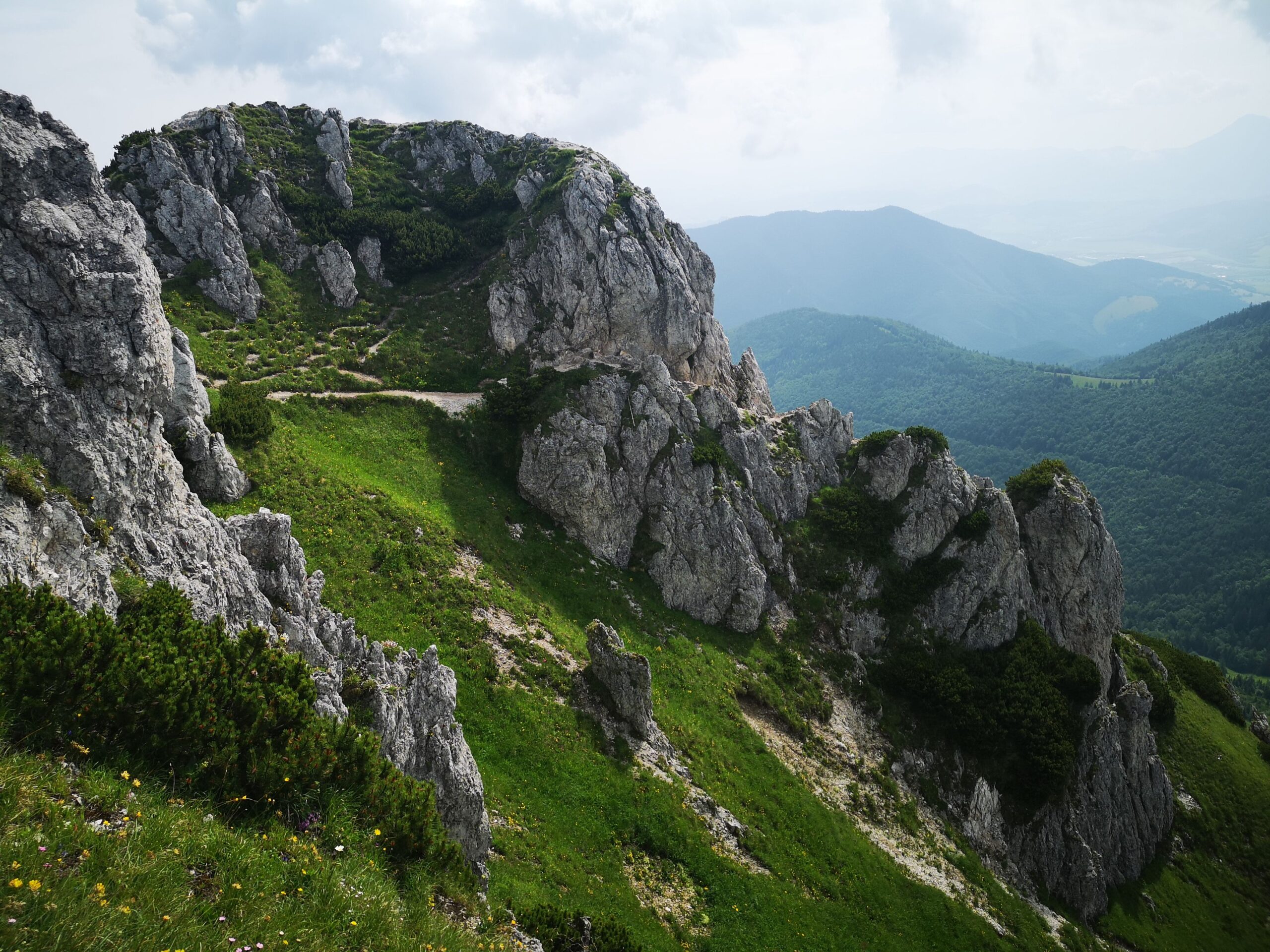
6. Stoh (1,608 m): the cone above Vrátna
A near-perfect grassy pyramid visible from the whole valley. From Štefanová it is a demanding full-day climb of around 1,200 m and over 5 hours, rewarded by what is arguably the finest view of both Rozsutec peaks. No shade and no water on the way up.
7. Poludňový grúň (1,460 m) and Chata na Grúni
A broad meadow ridge that children can manage. The path from Vrátna up to Chata na Grúni (1,260 m) takes 45 minutes to an hour and a quarter depending on where you start, and the hut has a playground and food. From there the ridge continues to Poludňový grúň, which hosts a well-known mountain race each year.
8. Steny and Hromové: the rocky stretch of the ridge
The section between Chleb and Poludňový grúň, over Hromové (1,636 m) and Steny (south summit 1,572 m), is the most photogenic part of the crest. Rock towers alternate with grass, a few steps are chain-protected, and the limestone is slick when wet.
9. The Krivánska Malá Fatra traverse
The full ridge walk from Strečno over Suchý, both Kriváň summits, Chleb, Poludňový grúň and Stoh to Zázrivá. It is usually split across three days with nights at Chata pod Suchým (1,075 m) and Chata pod Chlebom; both need booking well ahead in season. We break the stages down in a separate guide to the Mala Fatra ridge hike.
10. Sokolie (1,171 m): chains, and nobody there
Short but spicy — a chain-protected climb from Starý dvor with a grandstand view over the Vrátna valley. About 2 hours 45 minutes there and back with 575 m of ascent. Avoid it in rain or winter. You will meet a fraction of the crowds who are queueing in the gorges below.
11. Osnica (1,363 m): the photographer’s summit
A little-visited ridge above Štefanová, roughly 2.5 hours up with 750 m of ascent, and the best profile view of both Rozsutec peaks anywhere. Keep it as your plan B for the days when the gorge car parks are full by nine in the morning.
12. Baraniarky and Kraviarske: a ridge without queues
A circuit from Starý dvor over open grassy tops, about 860 m of ascent and 3 hours 40 minutes. The route crosses meadows with the whole Vrátna valley below and sees a tiny fraction of the traffic on the main crest. Parking at Starý dvor is usually free.
13. Šútovský vodopád: 38 metres of falling water
Slovakia’s fourth-highest waterfall drops 38 m in a narrow gorge at an altitude of 830 m. From the car park by the Fatranka snack bar it is about 3.7 km along an interpretive trail, 2.5 to 3 hours there and back, with parking around €4 a day. The gradient is gentle enough for a pre-schooler.
💡 Tip: Walk to the waterfall early or late in the day. The canyon is narrow, direct sun reaches it for only a few hours, and around midday the wooden viewing platform is at its most crowded.
14. The Vrátna valley and Tiesňavy
The entrance to the valley is guarded by Tiesňavy, a rock gate with towers such as Kozol, and you can walk through it on an interpretive trail from Terchová. Higher up the valley you will find Starý dvor with its traditional koliba restaurants, Paseky with its chairlift (usually running 11 a.m. to 6 p.m.), and the starting points for most of the ridge routes.
15. Terchová: Jánošík, the museum and the Terchovské srdce tower
The village below the mountains is the obvious wet-afternoon plan. It has a stainless steel statue of Juraj Jánošík — Slovakia’s Robin Hood, born here — the Považské múzeum devoted to him, and above the village the Terchovské srdce (“Terchová heart”) lookout tower, reached by a short interpretive trail in about 15 minutes. In August the village hosts Jánošíkove dni, the biggest folk festival in the region.
16. Zázrivá: the Rozsutec peaks from the other side
A village on the Orava side of the range, with an alternative ascent of both Rozsutec summits and the prettiest valley-level view of them. Zázrivá is also the home of korbáčiky, plaited smoked sheep’s cheese, worth the drive on its own. Scattered timber cottages and gentle ridges make for easy afternoon wandering.
17. Strečno Castle and the Domašínsky meander
The castle on its crag above the river Váh is the gateway to the range. In 2026 it is open roughly from late April to the end of September, usually 9 a.m. to 5 p.m., though since June the exhibition has been undergoing a refurbishment scheduled to run to 2028 and admission is temporarily adjusted — check the current position with the Považské múzeum. Below the castle the Váh loops into a giant U known as the Domašínsky meander.
18. Starhrad: a ruin above the river
Strečno’s older, wilder neighbour, a ruin at 475 m above the hamlet of Nezbudská Lúčka. The walk through woods and meadows is about 3.5 km and takes two hours including time to poke around the walls. The spur gives the best view of the meander.
19. Martinské hole and Veľká lúka (1,476 m)
The best-known destination in the Lúčanská half of the range. A made-up track from the hut at Martinské hole reaches Veľká lúka in about an hour and a half, with views over the Turiec basin and across to the Veľká Fatra; a spur leads to the transmitter on Krížava. Gradients are gentle and younger children cope well.
20. Kľak (1,352 m), plus Súľovské skaly as a bonus
The southernmost distinctive summit on the main ridge, usually climbed from the Fačkovské sedlo pass. The route is around 9 km, takes roughly 3.5 hours, needs no technical skill and gives a full 360-degree panorama. A short drive west lie the Súľovské skaly rock formations with their natural gate and castle ruin — an ideal half-day add-on.
Malá Fatra with children
With a pre-schooler, stick to the Šútovský vodopád waterfall, the walk up to Chata na Grúni, the Terchovské srdce lookout tower or the interpretive trail through the Tiesňavy rock gate. From roughly six years old you can add the small circuit of the Jánošíkove diery, bearing in mind that the ladders need patience more than strength. With school-age children the cable car plus the ridge walk from Snilovské sedlo works beautifully, because the cabin does all the hard work.
💡 Tip: Do the gorges before 9 a.m. or after 4 p.m. Between ten and two, queues build at the ladders, and standing still on a narrow walkway with small children is the least enjoyable thing the Malá Fatra can offer you.
Winter on the Mala Fatra hiking trails
The winter season runs from roughly December to April. Vrátna has about 14 km of downhill pistes across the Paseky, Poludňový grúň, Chleb and Príslop sectors, and above Martin the Winter Park Martinky offers 5 km of easy and 3 km of intermediate runs. Around 30 km of cross-country trails are groomed across the region.
The main ridge between the Kriváň summits and Chleb is a different proposition altogether: it ices up, it holds wind slab, and mountaineering crampons, an ice axe and the ability to judge avalanche risk are not optional extras. The gorges stay passable in winter, but the ladders and walkways freeze and micro-spikes earn their place in the rucksack. Remember too that from 1 November to 15 April you may only be on the trails from 7 a.m., which shortens the usable day considerably.
Bears in the Malá Fatra
The question British visitors ask most often. Brown bears do live here, and the rules around them have changed a great deal in the last few years — the state intervention team killed 28 animals in 2026, against 213 in 2025. In practice, encounters on busy trails are rare, noise is your friend on quiet ones, and food should never go into a tent. We deal with behaviour on the trail and what to do in an actual encounter in a separate article on bears in the Malá Fatra.
What a trip to the Malá Fatra costs
| Item | Price 2026 | Approx. in GBP |
|---|---|---|
| Chleb cable car, adult return | €25 ticket office / €24 online | about £21 |
| Chleb cable car, child 7 to 12, return | €20 / €19 | about £17 |
| Family ticket, 2 adults and 2 children | €65 | about £55 |
| Round-trip ticket, Chleb and Paseky | €23 | about £19 |
| Parking, Biely Potok (Hotel Diery) | 90 min free, 3 hrs €5, 6 hrs €8, 12 hrs €10, 24 hrs €15 | about £4 to £13 |
| Parking, Štefanová | around €3 a day | about £2.50 |
| Parking at the Chleb cable car | €10 a day | about £8.40 |
| Parking, Šútovská dolina | around €4 a day | about £3.40 |
| Entry to the Jánošíkove diery gorges | free, voluntary contribution | £0 |
| Bus, Žilina to Terchová | around €2 | about £1.70 |
| Motorway vignette, 10 days | €10.80 | about £9 |
Conversions use a rate of roughly €1 = £0.84 and prices shift during the season, so treat them as a guide rather than a quotation. Guided trips and experiences around Žilina can be booked in advance through GetYourGuide.
Where to go next
- The Jánošíkove diery gorges: which circuit to choose, how the ladders work and when to stay away.
- Veľký Rozsutec and Malý Rozsutec: detailed route descriptions for both summits.
- The Mala Fatra ridge hike: the three-day traverse from Strečno to Zázrivá.
- Where to stay in the Malá Fatra: Terchová, Štefanová and the Vrátna valley compared.
- Bears in the Malá Fatra: how to behave on the trail and what not to take into a hut.
- Súľovské skaly: a rock town and castle ruin half an hour from Žilina.
- The Veľká Fatra next door, and the Polish Tatras a couple of hours north, if you have a second week.
Frequently asked questions
Which are the best Mala Fatra hiking trails for a single day?
Either the small circuit of the Jánošíkove diery gorges (about 4 km, 2.5 hours), or the cable car to Snilovské sedlo followed by the ridge walk to Veľký Kriváň and Chleb (around 3 hours of walking). Between them they show you the two things the range does best: a gorge on ladders and an open grassy ridge.
Which trails in Malá Fatra National Park are closed, and when?
From 1 March to 15 June three sections are closed for the spring wildlife period: Medziholie – Veľký Rozsutec – Medzirozsutce (red waymarks), Obšívanka – Malé nocľahy (blue) and Vendovka – Malý Kriváň (blue). The Jánošíkove diery gorges and Malý Rozsutec are not affected and stay open all year, and so does the main ridge trail.
Do you have to pay to enter the Jánošíkove diery?
No. There is no entrance fee and the gorges are freely accessible; only a voluntary contribution towards maintaining the ladders and walkways is collected. What you do pay for is parking. At Hotel Diery in Biely Potok the charge depends on how long you stay: the first 90 minutes are free, 3 hours cost €5, 6 hours €8, 12 hours €10 and 24 hours €15. At Štefanová it is around €3 a day.
How much does the cable car in the Vrátna valley cost?
An adult return to Snilovské sedlo (1,492 m) costs €25 at the ticket office or €24 online, about £21. Children aged 7 to 12 pay €20 and a family ticket for two adults and two children is €65. It runs daily from 8.30 a.m. to 6 p.m., weather permitting.
How hard is Veľký Rozsutec compared with Striding Edge or Crib Goch?
It sits between the two. The upper section is a chain-protected climb on steep limestone with genuine exposure, but it is shorter and better protected than Crib Goch, while the approach from Štefanová is much longer — close to 1,000 m of ascent. The Jánošíkove diery gorges are easier than any of them technically, more like a beginner’s via ferrata, though wet ladders demand care.
Can you visit the Malá Fatra without a car?
Yes, easily. There are no flights to Žilina, so most visitors fly to Vienna, Kraków, Katowice, Bratislava or Ostrava and continue by train to Žilina. From there buses run to Terchová and up the Vrátna valley in about 45 minutes for roughly €2. The stops Biely potok, Štefanová, Starý dvor and Vrátna Výťah cover almost every trailhead.
When is the best time to hike, and what is the Mala Fatra weather like?
Mid-June to late October is the reliable window, once the spring closure has lifted. Expect the summit ridge to be 6 to 8 °C colder than Žilina in the valley and considerably windier, with no shelter and no water on the crest. Afternoon thunderstorms are common in July and August, so start early.
Can you hike in the Malá Fatra in winter?
The main ridge only if you are experienced: it ices over and holds wind slab, so mountaineering crampons, an ice axe and avalanche judgement are essential. The gorges stay passable year-round, though the ladders freeze and micro-spikes help. From 1 November to 15 April you may only use the trails from 7 a.m., which cuts the daylight you can legally walk in.
Potřebujete pomoct s cestováním?
-
Ubytování 🏨
Vyberte si to nejlepší ubytování, ať už jste kdekoliv, přes Booking.com. -
Půjčení auta 🚗
Auto si snadno najdete přes Booking.com, kde máte často slevu díky ubytování, nebo Rentalcars.com, kde porovnáte nabídky většiny půjčoven. -
Zážitky 🎟️
Přes GetYourGuide.com si vyberete z nejrůznějších výletů i zážitků po celém světě, navíc se zrušením zdarma do 24 h předem.