
Last updated 5.11.2026
There are a handful of mountains you would recognise even without a caption — and the Matterhorn is one of them (quite possibly from a bar of chocolate). That sharp, slightly hooked tooth of rock, rising 4,478 metres on the border between Switzerland and Italy, has become perhaps the most photographed mountain on earth. The first time you catch it peeking out over the rooftops of Zermatt, it simply stops you in your tracks.
This guide is all about the mountain itself — what the Matterhorn actually is, where the best viewpoints are, when it shows its face without the clouds, what the climb to the summit involves and where to take the photograph you came for. It is not a general Zermatt guide or a weather forecast — we have separate articles for those, and we will link to them along the way. Here it is just the mountain.
The Matterhorn, Zermatt in a nutshell
- What it is: a pyramid-shaped peak of 4,478 m on the Swiss-Italian border (Monte Cervino in Italian).
- Best views: Gornergrat (3,089 m), the mirror lakes Stellisee and Riffelsee, Matterhorn Glacier Paradise and Sunnegga.
- When you will see it: earliest in the morning is the surest bet — clouds often gather around the summit after ten o’clock.
- The climb: for experienced mountaineers with a guide only; the standard route follows the Hörnli ridge.
- First ascent: 14 July 1865 by Edward Whymper — a triumph overshadowed by tragedy on the way down.
- Base: the car-free town of Zermatt; lifts run from around 26 to 132 CHF return.
What Exactly Is the Matterhorn?
The Matterhorn is a high-alpine peak on the border between Switzerland and Italy, in the Swiss canton of Valais above the town of Zermatt. It stands 4,478 metres tall, which makes it neither the highest mountain in the Alps nor in Switzerland — that honour belongs to its neighbour, Monte Rosa (Dufourspitze, 4,634 m, and a name almost nobody knows). What makes the Matterhorn an icon is not its height but its shape: a lone pyramid of rock with four steep faces pointing roughly towards the compass points, jutting out of the surrounding terrain like a carved spike.
The mountain has two names, depending on which side you are looking from. In Switzerland it is the Matterhorn; on the Italian side it is Monte Cervino (and Le Cervin in French). The ridge traces the national border exactly, so the summit is quite literally half Swiss and half Italian.
💡 Tip: Do not confuse the Matterhorn with Klein Matterhorn (“Little Matterhorn”). That is a neighbouring, much lower peak that a cable car serves and that any visitor can reach without climbing gear. There is no cable car up the real Matterhorn — only mountaineers get there.
How the Matterhorn Was Formed
That sharply cut shape is neither an accident nor the work of a single process. The Alps, the Matterhorn included, began to rise roughly 50 to 60 million years ago, when the African and Eurasian plates collided and squeezed the rocks of an ancient sea between them. Here is a detail that even non-geologists tend to enjoy: the summit of the mountain is made of “African” rock (gneiss), thrust up and over the rocks of the European plate during the collision. Put simply, you are standing beneath a tip that once belonged to the African continent.
But it was ice that carved out the distinctive four-sided pyramid. During the ice ages, glaciers ground away at the ridges from several directions at once, gradually chiselling the steep faces into today’s solitary spike. The Matterhorn is a textbook example of a so-called glacial horn, a peak sculpted from three or four sides by glacial cirques.

Best Matterhorn Viewpoints in Zermatt
Good news for anyone who has no intention of scrambling up rock faces: you do not need to climb the mountain to have an unforgettable experience of it. A web of cable cars and cogwheel trains around Zermatt whisks you up to viewpoints looking straight at the Matterhorn’s north face. Here are the best of them, ordered roughly from most popular downwards.
1. Gornergrat — the classic postcard
If you only have time for one viewpoint, come here. The historic Gornergrat cogwheel railway has run from the centre of Zermatt since 1898 (it is the oldest electric rack railway in Switzerland) and carries you up to 3,089 metres in about half an hour. At the top a jaw-dropping panorama opens up: the Matterhorn on one side, the Monte Rosa massif with Switzerland’s highest summit, and the vast Gorner Glacier below your feet. From the ridge you can see 29 four-thousand-metre peaks. A return ticket in high season costs around 132 CHF (roughly £120).
2. Matterhorn Glacier Paradise (Klein Matterhorn) — Europe’s highest cable car
The Matterhorn Glacier Ride cable car takes you up to the highest mountain station in Europe — 3,883 metres. From the viewing platform you can see 38 four-thousanders and 14 glaciers across three countries (Switzerland, Italy and France). Cut into the mountain is the Glacier Palace, 15 metres deep in the ice, with ice sculptures and a slide. Pack warm clothing even in summer — you are almost four thousand metres up. A return ticket comes to roughly 99–132 CHF (about £90–120) depending on the season.
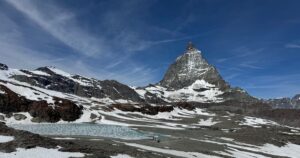
3. Lake Stellisee — the perfect reflection
This is the Matterhorn’s other iconic photograph — the mountain mirrored in the surface of an alpine lake. Stellisee lies just a few hundred metres from the Blauherd lift station (you get there via Sunnegga). On a still, early morning a flawless reflection of the peak appears on the calm water. It is the most famous of a string of little lakes on the so-called Five Lakes Walk (5-Seenweg), which we come to below.
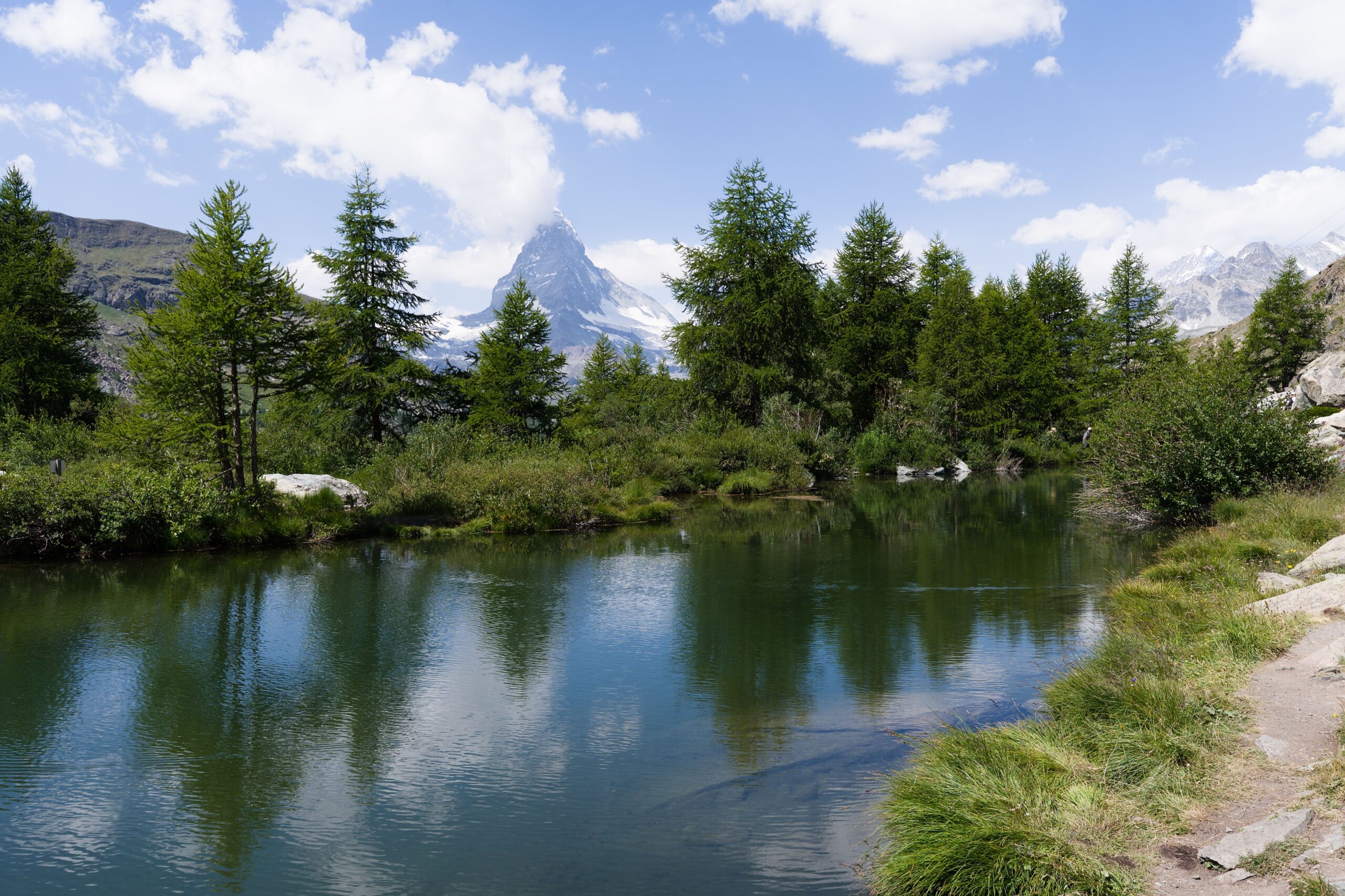
4. Riffelsee — a reflection on the way down from Gornergrat
The second “mirror” lake is Riffelsee, just below Gornergrat and a short walk from the Rotenboden stop on the cogwheel railway. Get off one stop before the summit, walk down a few minutes to the lake, and you have the Matterhorn complete with its reflection — often with fewer people than at the main viewpoint. Our favourite combination: ride all the way up to Gornergrat, then walk back down past Riffelsee.
5. The Five Lakes Walk (5-Seenweg)
An easygoing circular route above Sunnegga that links five mountain lakes — Stellisee, Grindjisee, Grünsee, Moosjisee and Leisee. Several of them frame the Matterhorn, and in two you can even swim on warm days. Grindjisee, tucked between rock and a little wood, tends to be a quieter alternative to the crowded Stellisee. The walk is undemanding and ranks among the loveliest half-day strolls in the area.
6. Sunnegga — quick and easy
The fastest view of all. The underground Sunnegga Express funicular carries you from the centre up to 2,288 metres in just a few minutes. It is an ideal choice with children, or when time is short — right by the station you will find the little Leisee lake, a playground, and the Matterhorn standing directly opposite. At around 26 CHF return (about £24), it is the friendliest fare here too.
7. Rothorn and Schwarzsee — a different angle
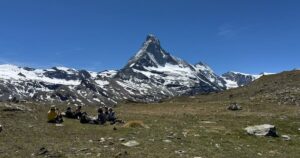
Rothorn (3,103 m) offers a view of the whole mountain from a greater distance, so the Matterhorn fits into the frame alongside the surrounding peaks. Schwarzsee (2,552 m), by contrast, is the closest you can get to the foot of the mountain — there is a little chapel here, and this is where climbers set off for the summit. Both spots are wonderful when you want to escape the crowds from Gornergrat.
💡 Tip: The lifts and excursions around Zermatt are well worth booking ahead, especially in season. You will find the experiences and tickets gathered together here: trips and cable cars in Zermatt →
When You Can Actually See the Matterhorn (Weather)
This is the one thing most visitors underestimate — and then find themselves standing at a viewpoint in front of a grey wall of cloud. A simple rule applies: clear in the morning, cloudy in the afternoon. The Matterhorn’s summit likes to “sew” its own cloud cover. Damp air rises up the faces through the morning, cools, and mist starts to form around the tip — often as early as ten o’clock.
That is why our advice is unequivocal: head up to the viewpoints first thing, ideally on the first cable car or train. Not only do you stand the best chance of a clear summit, there are fewer people about and the morning light flatters the mountain. And if you are after that perfect mirror reflection at Stellisee or Riffelsee, early morning also brings the still air and calm water you need.
💡 Tip: Before you set off, check one of the Zermatt webcams (Gornergrat, Klein Matterhorn) — you will see live whether the summit is clear. And for when to visit Zermatt month by month, we go into detail in our article Zermatt weather: when to go and what to expect month by month.
Climbing the Matterhorn
Let us be completely honest: climbing the Matterhorn is not hiking, it is serious high-alpine mountaineering. This is not a mountain you simply “walk up”. If you do not have alpine experience, glacier skills and the fitness for a full day at altitude, this mountain is not for you — and that is perfectly fine, most people admire it from below.
The usual route is the Hörnli ridge (Hörnligrat), the so-called Swiss standard line. It runs from the Hörnli Hut (3,260 m) straight up the north-east ridge to the summit — more than 1,200 metres of ascent, secured in places with fixed ropes, but with crumbling rock and a real risk of rockfall. From the Italian side, the Lion Ridge (Cresta del Leone) climbs from the Carrel Hut. Both routes are graded at roughly AD (fairly difficult), with climbing sections around UIAA III, and they demand roping up and route-finding on exposed terrain. The climb from the hut usually takes 4 to 6 hours, and the descent about the same, so it is a full-day undertaking.
The Matterhorn has, in total, four distinct faces and four ridges: besides the Hörnli and Lion ridges, there are also the longer and more demanding Zmutt and Furggen ridges, which only experienced alpinists attempt. The north face has a reputation all of its own, ranked by climbers among the “six great north faces of the Alps”. It was first conquered only in 1931, by the brothers Franz and Toni Schmid from Munich, who cycled to the foot of the wall and back.
💡 Tip: About halfway up the Hörnli ridge, at 4,003 m, stands the Solvay Hut, the highest hut of the Swiss Alpine Club. It is not for overnight stays or refreshments, though: it is intended solely for emergencies, when a storm or an injury catches climbers out.
The overwhelming majority of those who climb the Matterhorn go with a mountain guide — and we strongly recommend it. In season a guide looks after a single client, knows the conditions and greatly improves your chances of coming back. The cost runs into the region of a thousand pounds and more for the ascent. The Hörnli Hut is usually open from around mid-June to mid-September, and in high season you need to book well in advance.
An honest warning, plainly put: the Matterhorn is among the deadliest mountains in the Alps. Around two thousand people reach the summit each year and, sadly, someone dies here every year — most often because of a sudden change in the weather, a fall or exhaustion. When the weather turns, even the experienced turn back. The mountain will still be there.
The Story of the First Ascent
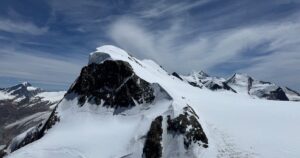
The Matterhorn was one of the last great alpine mountains to hold out. The summit was first reached on 14 July 1865 by an expedition led by the English mountaineer Edward Whymper — they set off from Zermatt up the Hörnli ridge and beat an Italian team, climbing from the other side, by a matter of hours. It was a triumph that closed the “golden age” of alpine conquest.
The glory lasted only a few hours. Tragedy struck on the descent: one of the less experienced members, Douglas Hadow, slipped, dragging three more men with him, and all four — Hadow, the Reverend Charles Hudson, the young Lord Francis Douglas and the guide Michel Croz — fell down the north face into the depths. Whymper and the two Taugwalder guides were saved only because the rope broke between them. That broken rope is on display today in the Matterhorn Museum in Zermatt and is one of the most affecting exhibits you will see in any mountain setting.
The mountain soon added other “firsts”. As early as 1871, the Briton Lucy Walker became the first woman to reach the summit, reputedly in a long skirt in keeping with the fashion of the day. Today thousands of people climb to the top every summer, yet the respect the Matterhorn earned back in 1865 has never left it.
Tips for Photographing the Matterhorn
Everyone photographs the Matterhorn, but a genuinely good shot takes a little planning. Here is what works for us and for others:
- Go early in the morning. A clear summit, still lake water for reflections and warm light — everything plays in your favour. After ten o’clock you are gambling with cloud.
- For a reflection, aim for Stellisee or Riffelsee. Still air and calm water are the key. Even a small puddle after rain gives a surprisingly good mirror effect.
- The golden hour and the “alpenglow”. At sunrise the summit turns pink — from Gornergrat or Riffelsee it is unforgettable. That alone is a good reason to stay overnight in Zermatt.
- Look for foreground. A larch tree, the chapel at Schwarzsee, the wooden chalets of the Hinterdorf quarter — a foreground gives the photo depth, otherwise the mountain is just a “tooth against the sky”.
- The Kirchbrücke bridge in Zermatt. The classic shot of the Matterhorn over the town’s rooftops, and you can reach it without a lift.
How to Get to the Matterhorn
The base for everything Matterhorn-related is the town of Zermatt (1,620 m). It is a car-free (autofrei) zone — by car you can only get as far as the village of Täsch, a few kilometres lower down, where you leave the car in the car park (around 17 CHF a day) and cover the last few minutes into Zermatt by shuttle train. The easiest way in is to fly into Zurich or Geneva and continue on the excellent Swiss trains; you usually change at Brig or Visp.
From Zermatt, a network of cogwheel trains and cable cars runs up to the viewpoints (Gornergratbahn, Sunnegga, Matterhorn Express, Glacier Paradise), or you can go on foot, which we would wholeheartedly recommend — it is well worth it, few people walk, and the lifts really are expensive. Around the town itself you get about on foot or in small electric vehicles.
For a full practical guide to the town — where to stay, how to save money, what else to see — read our article Zermatt, Switzerland: 12 things to see and do.
💡 Tip: Want to sleep with a view of the mountain and ideally catch it at dawn? Accommodation in Zermatt fills up early in season — take a look at places to stay in Zermatt → and book well ahead.
What the Lifts and Trips Cost
Zermatt is not cheap — it is one of the most expensive alpine resorts of all. Here is a rough overview of return prices for the main lifts and cogwheel trains in the summer season. Prices change with the season and the exchange rate, so treat them as a guide rather than gospel (converted at roughly 1 CHF ≈ £0.90):
| Trip / lift | Top station | Return price (approx.) |
|---|---|---|
| Gornergrat (cogwheel railway) | 3,089 m | ~132 CHF (≈ £120) |
| Matterhorn Glacier Paradise | 3,883 m | ~99–132 CHF (≈ £90–120) |
| Rothorn (via Sunnegga) | 3,103 m | ~89 CHF (≈ £80) |
| Sunnegga Express | 2,288 m | ~26 CHF (≈ £24) |
| Schwarzsee | 2,552 m | included in Matterhorn Express |
If you are planning several trips, it is worth looking into the regional passes (Peak Pass) or the Half Fare Card — the countrywide Swiss Travel Pass often does not give a full discount on these privately run railways, so do the maths on what works out best for you.
💡 Tip: Sunnegga is far and away the best value for money — for a fraction of the Gornergrat fare you get the Matterhorn opposite you and a little lake for reflections. If you are watching the budget, start here.
Where to Next
- Zermatt, Switzerland: 12 things to see and do (2026)
- Zermatt weather: when to go and what to expect month by month (2026)
Matterhorn FAQ
Experiences and tickets in Zermatt
traveller-verified · GetYourGuide


Prices and ratings are indicative (source: GetYourGuide); you will see the current figures once you click through.
How tall is the Matterhorn?
The Matterhorn stands 4,478 metres tall. It is not the highest mountain in Switzerland (that is its neighbour Monte Rosa, whose Dufourspitze summit reaches 4,634 m), but thanks to its sharp pyramid shape it is one of the best-known mountains in the world.
Where is the Matterhorn?
On the border between Switzerland and Italy, in the Swiss canton of Valais above the town of Zermatt. The ridge follows the national border, so the summit is half Swiss and half Italian (in Italian the mountain is called Monte Cervino).
Where is the best view of the Matterhorn?
The classic postcard view is from Gornergrat (3,089 m). For a perfect reflection of the mountain in a lake, head to Stellisee (via Sunnegga and Blauherd) or Riffelsee below Gornergrat. The highest point you can reach is Matterhorn Glacier Paradise (3,883 m).
Is there a cable car up the Matterhorn?
There is no cable car to the summit of the Matterhorn itself — only mountaineers get there. A cable car does run to the neighbouring, lower Klein Matterhorn (Matterhorn Glacier Paradise, 3,883 m), the highest mountain station in Europe, from where you have the mountain right in front of you.
When is the best time to see the Matterhorn?
Earliest in the morning is the surest bet. Clouds often start to form around the summit as early as ten o’clock. So head up to the viewpoints on the very first cable car or train — you get a clear summit, morning light and fewer people.
Can you climb the Matterhorn as a tourist?
No. The climb to the summit is a serious and very demanding mountaineering route (graded roughly AD) up the Hörnli ridge, with exposed terrain and crumbling rock. It requires alpine experience, fitness and, in practice, always a mountain guide — it is not suitable for the average tourist.
How much does it cost to climb the Matterhorn with a guide?
In season a mountain guide looks after a single client, and the price for the ascent runs into the region of a thousand pounds and more. On top of that, budget for a night at the Hörnli Hut, equipment and transport. You need to book well in advance.
Who was the first person to climb the Matterhorn?
The summit was first reached by Edward Whymper’s expedition on 14 July 1865, via the Hörnli ridge. Tragedy struck on the descent, however — four members of the party died in a fall down the north face when the rope broke.
Why does the Matterhorn look like Toblerone?
The Matterhorn’s distinctive silhouette inspired the packaging and logo of Toblerone chocolate, which comes from Switzerland. Both the chocolate’s triangular “teeth” and the mountain in the logo are a nod to this national symbol.
How many days should you set aside for the Matterhorn?
If you are only after the views and photography, two to three days in Zermatt is enough — you can fit in Gornergrat, one or two of the reflection lakes and Glacier Paradise. Build in some slack for the weather: if the first morning is overcast, you have another go.
Potřebujete pomoct s cestováním?
-
Ubytování 🏨
Vyberte si to nejlepší ubytování, ať už jste kdekoliv, přes Booking.com. -
Půjčení auta 🚗
Auto si snadno najdete přes Booking.com, kde máte často slevu díky ubytování, nebo Rentalcars.com, kde porovnáte nabídky většiny půjčoven. -
Zážitky 🎟️
Přes GetYourGuide.com si vyberete z nejrůznějších výletů i zážitků po celém světě, navíc se zrušením zdarma do 24 h předem.