Last updated 30.8.2026
Thirty years ago the only reason to set foot in Bilbao was a job in the shipyards. Today the old industrial port is one of the most stylish cities in Spain: Frank Gehry’s shimmering Guggenheim, the medieval lanes of the Casco Viejo, arguably the finest pintxos in the country, and green mountains rising straight out of the suburbs. The Basque Country is not a detour from Spain either — it is a world with its own language, its own kitchen and a quiet, stubborn pride. This guide runs through the best things to do in Bilbao, from the obvious icons to the corners most weekenders walk straight past.
Things to do in Bilbao at a glance
- Why go: the Guggenheim, a genuinely lovely old town, world-class pintxos and a Basque hinterland of green hills and Atlantic coast. Smaller, calmer and more honest than Barcelona.
- How long: 2 days covers the city comfortably. Add day trips and you want 3 to 5 days.
- When to go: May to September is the sweet spot. Bilbao is green because it rains, so pack a waterproof even in August. Winters are mild but damp.
- Getting around: the Bizkaibus A3247 runs from the airport into the centre in about 20 minutes. In town you have a spotless metro, a tram and the Artxanda funicular. Get a rechargeable Barik card.
- Budget: mid-range travellers spend roughly €70–100 (about £60–85) per person per day including a bed. Backpackers can do it for far less.
- Book ahead: Guggenheim tickets and the timed entry slot for Gaztelugatxe. Both are free or cheaper booked online.
When to visit Bilbao
Bilbao sits on Spain’s northern coast, on the Bay of Biscay, and its weather belongs to the Atlantic rather than to any postcard of sun-baked Spain. That is precisely why the whole Basque Country is so green: it rains here all year round. The kindest months are May to September, when temperatures settle around 22–26 °C and you get the longest run of dry days. High summer, July and August, is the warmest — and also the priciest and busiest.
Spring and early autumn are the smart compromise: pleasant warmth, thinner crowds, hillsides at their greenest. Winters stay mild, usually 8–13 °C, but they are grey and wet. Whenever you come, bring a waterproof jacket. Atlantic showers blow in with almost no warning and blow out again twenty minutes later. If you want the city at full volume, aim for Aste Nagusia (Big Week), the main city fiesta in late August.
Getting to Bilbao from the UK, and getting around
Bilbao Airport (BIO) is one of the easier Spanish airports to reach from Britain. Vueling flies direct from London Heathrow and Gatwick and seasonally from Edinburgh, easyJet from Bristol and Manchester, and Wizz Air from Luton. Flight time is roughly two hours, so you can land in time for lunch. Schedules shift, so check the airline before you plan the rest.
There is also the slow option, and it is a good one. Brittany Ferries sails Portsmouth to Bilbao roughly twice a week, a crossing of about 32 to 33 hours with two nights on board. It suits anyone bringing a car, a bike, a dog or a dislike of airports. One thing to know: the terminal is out at the mouth of the estuary west of the city, not in the centre, so factor in a bus or taxi transfer at the end.
From the airport, the Bizkaibus A3247 is the obvious move. It stops at Plaza Moyúa, about as central as it gets, and terminates at the Intermodal coach station. The ride takes 20 to 25 minutes and costs roughly €1.50 with a Barik card or about €4.50 in cash. Buses leave every 15 to 30 minutes.
Once you are in, moving around is easy. The metro (lines 1 and 2, with stations designed by Norman Foster) is clean and quick, the tram glides along the river past the Guggenheim and the Mercado de la Ribera, and the centre is compact enough that you will walk most of it anyway. Single fares run about €1.80–2 in cash and noticeably less with a Barik.
💡 Tip: Pick up a rechargeable Barik card the moment you land. It covers the metro, tram, buses and the Artxanda funicular, one card works for a whole group (just tap once per person), and fares drop sharply compared with paying cash. It pays for itself within a handful of journeys.
Compare flights and dates on Kayak →.
24 best things to do in Bilbao
Roughly ordered by popularity, and grouped so that neighbouring sights string together into a sensible walk. For each one you get what it is, what it costs and how to reach it. Prices can move during 2026, so treat them as a guide rather than gospel.
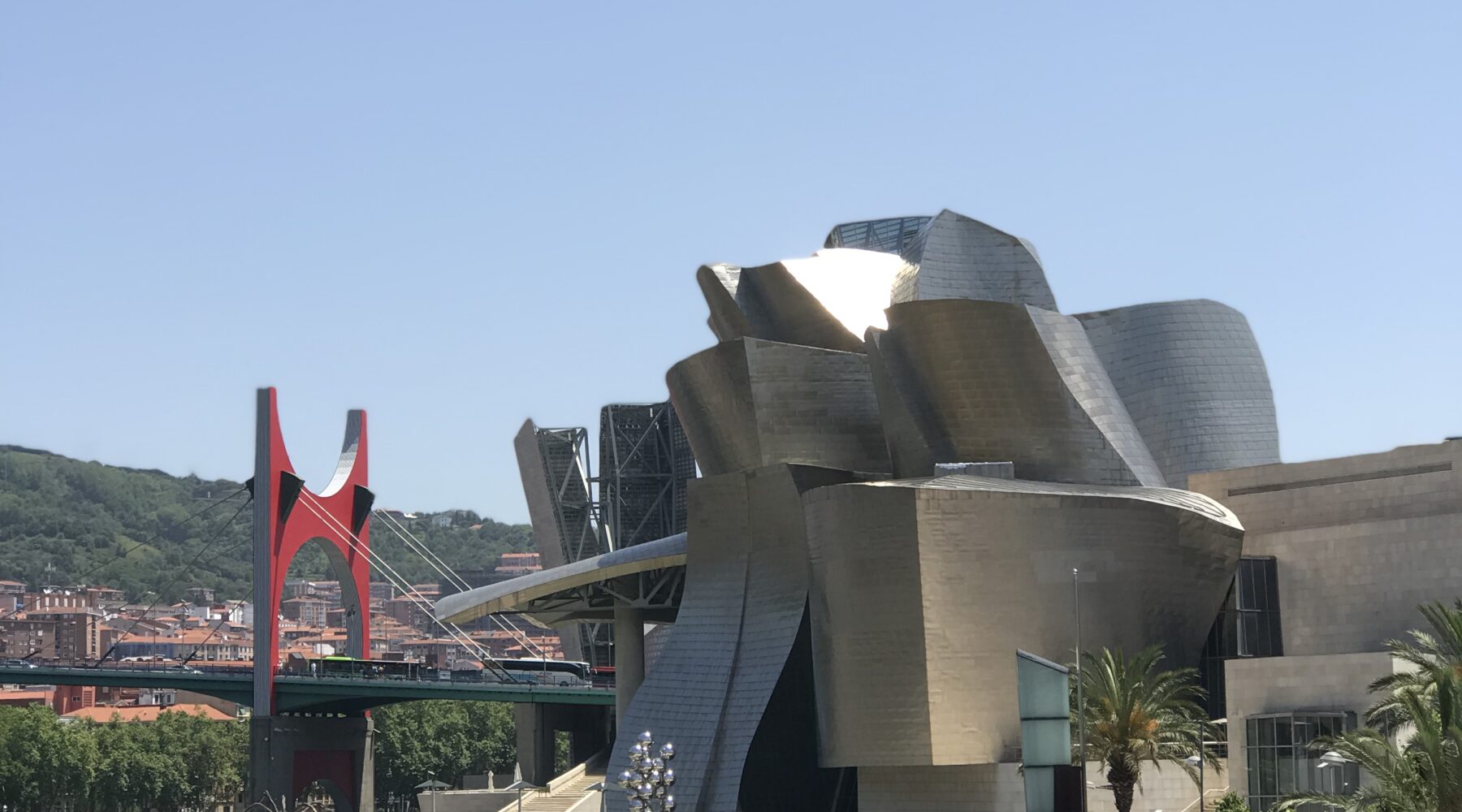
1. Guggenheim Museum — the building that changed everything
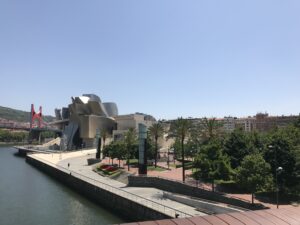
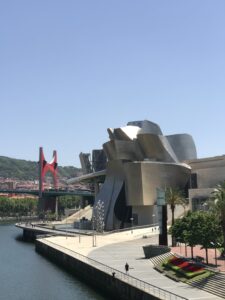
Frank Gehry’s museum of modern and contemporary art opened in 1997 and is a work of art before you even go in: rippling titanium panels that shift colour with the light and the weather. This single building kicked off the reinvention of the entire city, and urban planners still talk about the “Guggenheim effect”. Adult entry is €15 (about £13), students and over-65s pay €7.50, and under-18s go free. Open Tuesday to Sunday, 10:00–19:00, usually closed on Mondays.
💡 Tip: Entry is free every Tuesday between 18:00 and 20:00, but you must book a timed slot online in advance. Places are limited and they go fast.
2. Puppy and the outdoor sculptures — the art you don’t pay for
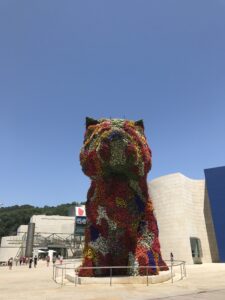
Before you go inside, walk a full lap of the outside. Guarding the main entrance is Puppy, Jeff Koons’s twelve-metre West Highland terrier planted with living flowers. Down by the water stands his mirror-polished Tulips, and further along Louise Bourgeois’s enormous spider, Maman. Overhead, the La Salve bridge sweeps through the site, which Gehry simply absorbed into the design. All of it is free, and it is the most photographed stretch of the city.
3. Zubizuri bridge — Calatrava in glass and steel
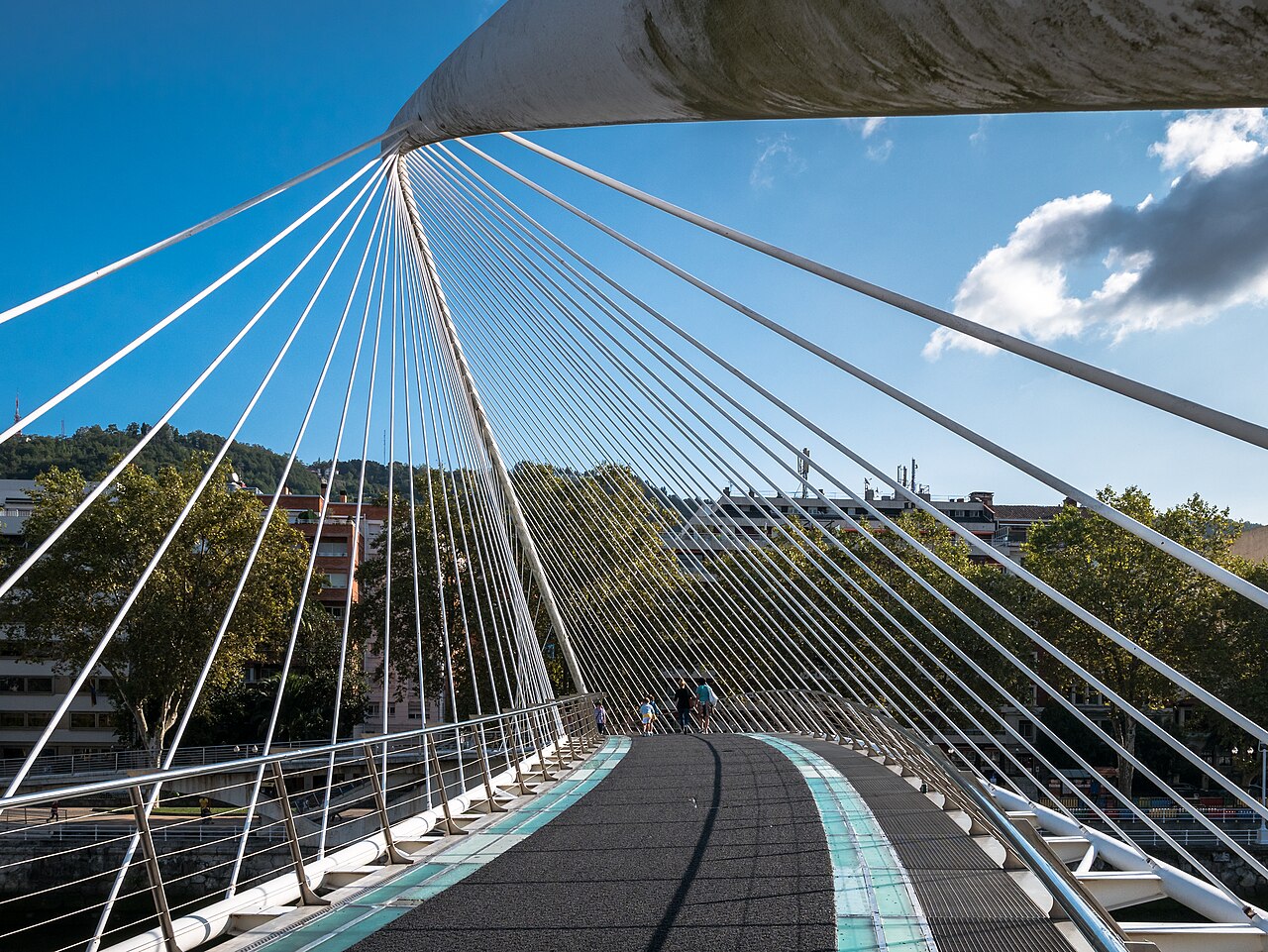
The white footbridge Zubizuri (Basque for, literally, “white bridge”) is the work of Santiago Calatrava. Its tilted arch and glass deck have become a shorthand for the new Bilbao, and it makes a natural starting point for a walk along the river. Crossing costs nothing. The glass does get slippery in the wet, so watch your footing.
4. Casco Viejo and the Siete Calles — the medieval core
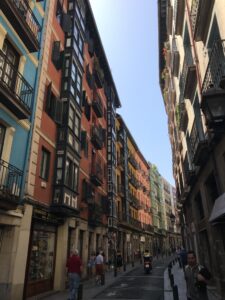
The old town, Casco Viejo, is the opposite of the polished modernism up the river: a tangle of pedestrian lanes, painted façades, tiny shops and a bar on every corner. At its heart are the Siete Calles, the “seven streets” laid out in the 14th and 15th centuries, where Bilbao began. Nothing to pay. The right way to do it is to get lost, order a coffee, and hop from one pintxos bar to the next.
5. Plaza Nueva — the best address for pintxos
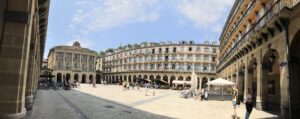
This neoclassical square with its arcades is the epicentre of the Basque pintxo: small, precise mouthfuls skewered on a cocktail stick or perched on bread. Under the colonnade you will find institutions such as Gure Toki, Víctor Montes and Café Bar Bilbao. On Sunday mornings the square fills with a flea and collectors’ market. Reckon on €2–4 per pintxo.
💡 Tip: Basques eat pintxos standing up and in stages. One or two bites and a glass of txakoli (the local crisp white) in each bar, then on to the next. Do not settle in at one table, because the crawl is the whole point.
6. Santiago Cathedral — a stop on the pilgrim road
The Gothic Catedral de Santiago, built through the 14th and 15th centuries, stands in the middle of the Casco Viejo and was an important waypoint on the northern branch of the Camino de Santiago. Inside, the quiet cloister and star-ribbed vaulting are the draw. Entry to the main body of the church is nominal, around €5; the streets and squares around it cost nothing at all.
7. San Nicolás church and El Arenal — baroque calm by the water
The baroque church of San Nicolás, finished in 1743, sits where the old town gives way to the river, on the edge of the leafy El Arenal promenade. It is dedicated to St Nicholas, patron of sailors, and holds altarpieces and statuary by the baroque master Juan de Mena. Entry is generally free, with the doors open in the morning and again in the early evening. El Arenal, complete with its bandstand, is a good place to sit down for ten minutes.
8. Teatro Arriaga — Bilbao’s opera house
The neo-baroque Teatro Arriaga of 1890, with its exuberant riverside façade, is one of the handsomest buildings in the city and is often called Bilbao’s opera house. Besides performances, weekends bring guided tours in Basque, Spanish and English that take you into the salons and auditorium otherwise closed to visitors. Tours pause in July and August and return in September. From the outside it photographs beautifully, especially lit up at night.
9. Mercado de la Ribera — Europe’s largest covered market
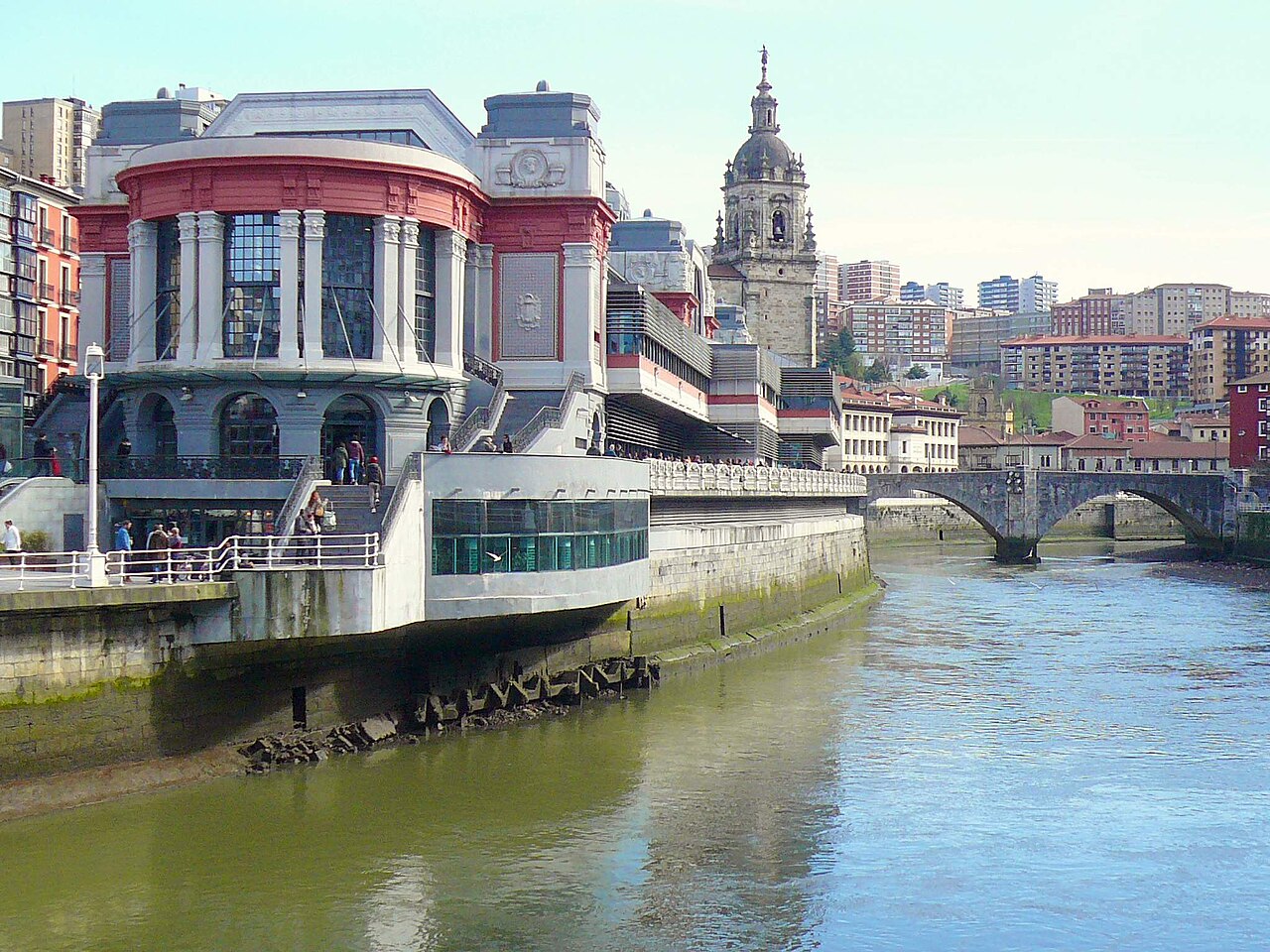
This 1929 market hall on the riverbank is billed as the largest covered market in Europe. The ground floor is a working food market of fish, meat, cheese and vegetables, while upstairs a gastro plaza of stalls serves pintxos, gildas (anchovy, olive and pickled pepper on a stick) and local sweets. Free to enter. Most traders shut on Sunday, so aim for a weekday or Saturday.
10. Basilica of Begoña — the spiritual heart of Biscay
Above the old town rises the Basilica of Our Lady of Begoña, the spiritual centre of the whole province. Begun in the early 16th century in Gothic style and finished with a Renaissance front, it shelters an ornate high altar and the shrine of the Virgin whom Basques affectionately call amatxu, “little mother”. Free to enter. You can climb the steps, but the civic lift from Calle Esperanza in the old town is kinder on the legs. Pilgrimage days fall on 15 August and 11 October.
11. Euskal Museoa — a window into Basque culture
If you want to understand what makes the Basque Country its own place, spend an hour in the Basque Museum in the Casco Viejo. More than 20,000 objects trace fishing, shepherding, crafts and the enduring puzzle of euskera, a language with no known relation to any other in Europe. Entry is cheap, around €3, and free on certain days.
12. Artxanda funicular — the best view in Bilbao
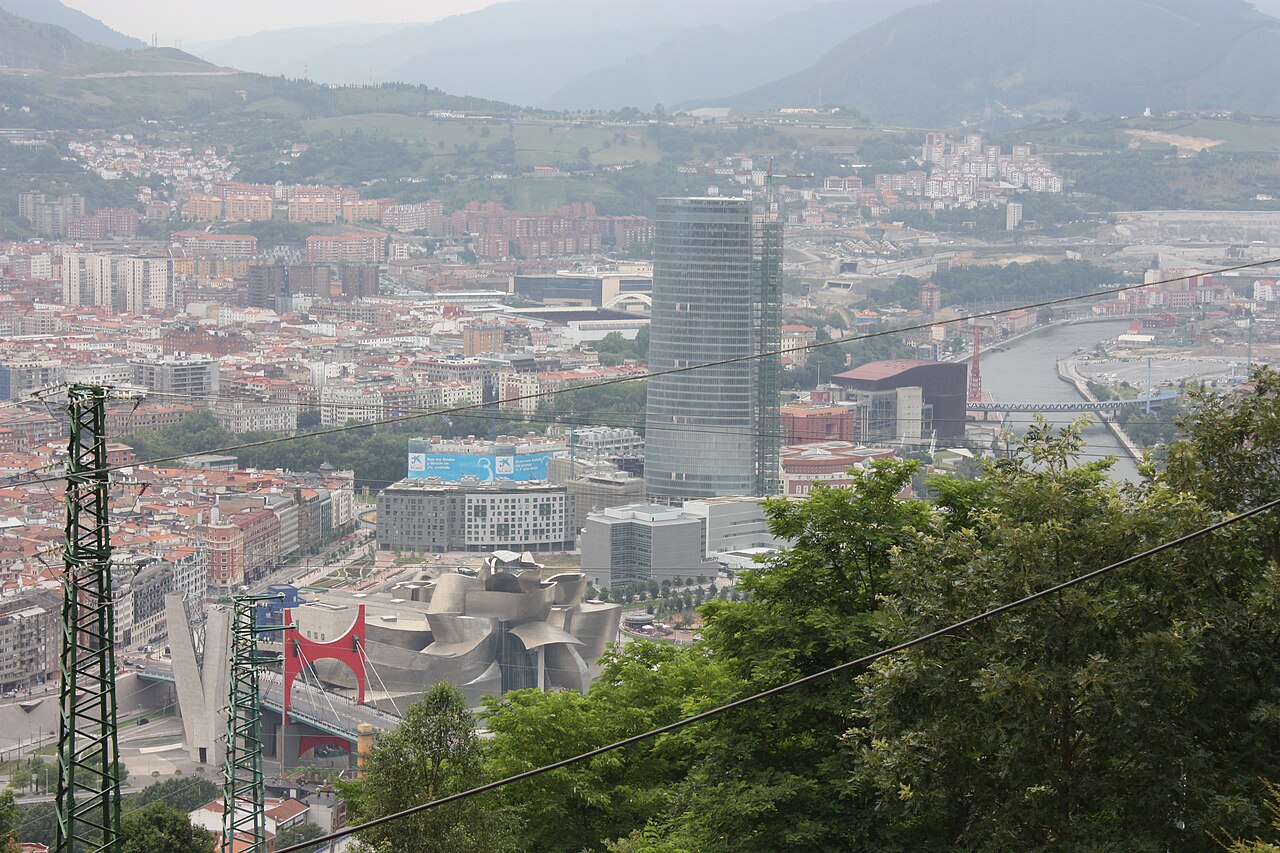
The Funicular de Artxanda has been hauling passengers up the hillside since 1915 and does the job in under three minutes. From the Mirador de Artxanda at the top you get the full sweep of Bilbao: the Guggenheim, the river threading through the valley, the hills closing it all in. Tickets run about €3.50 one way or €6 return, dropping to roughly €0.65 with a Barik card. Up top there are terraces, restaurants and walking paths. Departures roughly every 15 minutes until 22:00.
13. Azkuna Zentroa — culture beneath 43 columns
The Alhóndiga, a former municipal wine warehouse, was reworked by designer Philippe Starck in 2010 into the Azkuna Zentroa cultural centre. The whole building stands on 43 columns, no two alike, each nodding to a different culture and era. Inside there is a cinema, a library, exhibition halls and, on the roof, a swimming pool with a glass floor you can look up through. The atrium and most of the public spaces are free.
14. Museo de Bellas Artes — the one art lovers rate
The Fine Arts Museum is among the best in Spain and spends its life overshadowed by its famous neighbour. The collection runs from Gothic panels through El Greco, Goya and Zurbarán to Basque and contemporary work. It sits beside Doña Casilda park, so the two combine neatly into an afternoon. Entry is around €10 and is usually free in the afternoons — worth confirming on the day.
15. Doña Casilda Iturrizar park — somewhere to slow down
The city’s main park, with its pond, fountain and resident peacocks, is where locals come to run and picnic; in summer there are concerts. It is the natural pause between museums, a short walk from both the Guggenheim and the Fine Arts Museum. Free.
16. Palacio Euskalduna — a concert hall on a slipway
The Euskalduna conference and concert palace, opened in 1999, stands on the site of a shipyard, and its jagged rusting skin is meant to evoke the last ship ever built here. It is home to the Basque National Orchestra and the ABAO opera season. Even if you never make it inside for a performance, the building is worth pausing at on a riverside walk near the Guggenheim.
17. Itsasmuseum — the story of the river and the yards
Next door to the Euskalduna, again on reclaimed shipyard land, the Maritime Museum tells the story of the estuary, the port and the shipbuilding that made Bilbao rich. Outside there are historic vessels and cranes; inside, models and hands-on displays. Entry is about €10, roughly €3.50 for students and over-65s, and free on Tuesdays outside July and August.
18. A walk along the Nervión — bridges and street art
The Nervión is the spine of the city, with promenades down both banks. What was once heavy industry is now sculpture, murals and a parade of bridges spanning six centuries of engineering. Walk it from the Guggenheim across the Zubizuri and on into the old town. It is one of the loveliest hours in Bilbao, and it costs nothing.
19. San Mamés and Athletic Club — Basque obsession
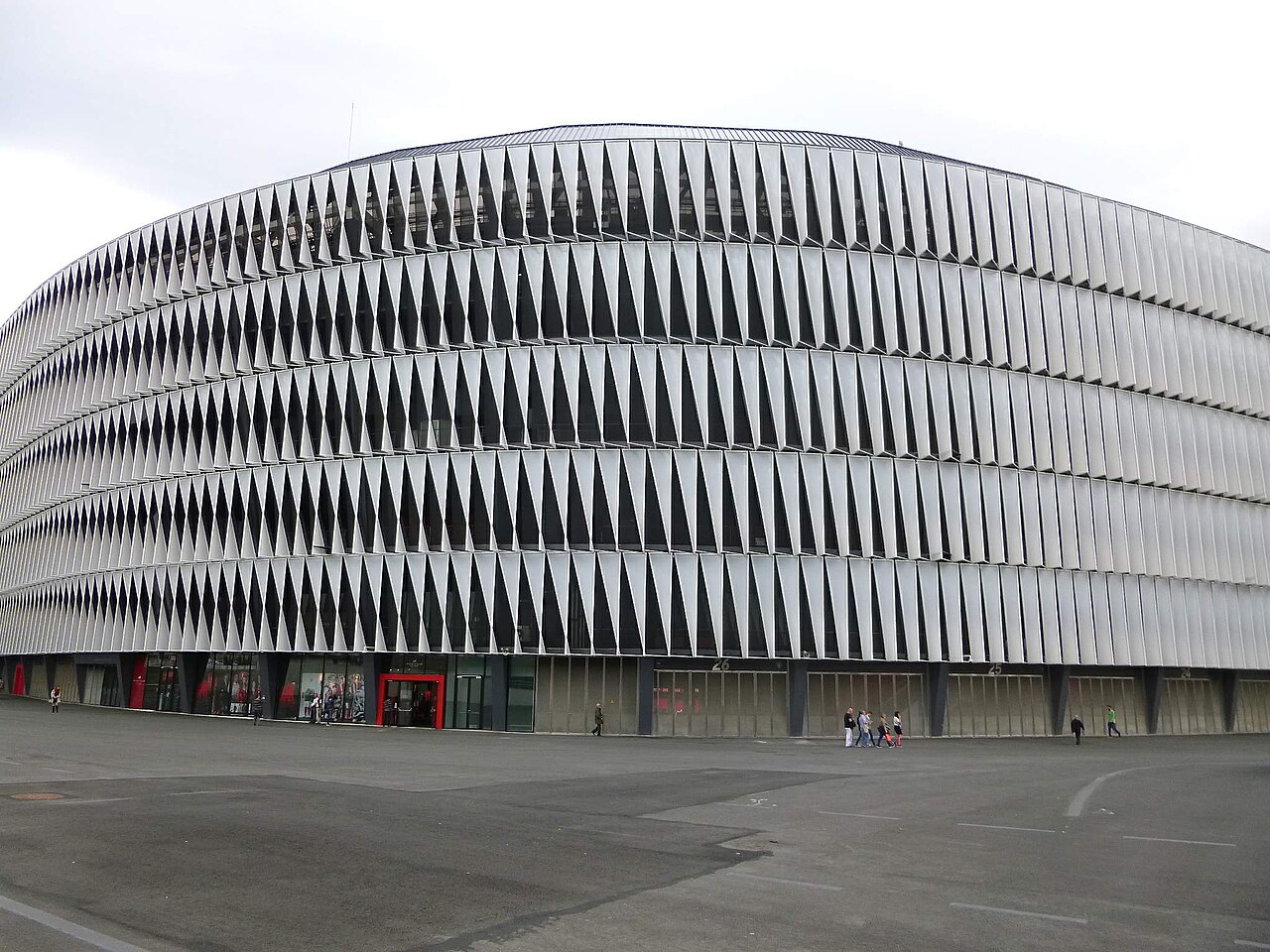
Athletic Club is famous for a rule nobody else follows: it signs only players with Basque roots, and still holds its own in the Spanish top flight. The modern San Mamés stadium, nicknamed “the Cathedral”, seats over 50,000. A guided tour with the club museum, taking in more than 500 exhibits plus the dressing rooms, the tunnel and the dugouts, costs around €16.50 and takes about an hour. Even if football leaves you cold, a match here is one of the most intense things you can experience in the Basque Country. The metro drops you at the door.
20. Bilbao La Vieja and San Francisco — murals and cheap eats
Across the river from the Mercado de la Ribera lie Bilbao La Vieja, San Francisco and Zabala, known collectively as “Bilbi”. Long neglected, the area has turned into the city’s most alive bohemian quarter: murals by local and international street artists, multicultural kitchens, scruffy good bars. Come for the art in the street and for food that costs less than in the centre.
21. Zorrotzaurre and ZAWP — the Basque Manhattan, mid-transformation
The old industrial peninsula of Zorrotzaurre is being rebuilt as a modern district, and in the meantime it has become a stronghold of alternative culture. The ZAWP project (Zorrotzaurre Art Work in Progress) fills the empty warehouses with galleries, studios, coworking spaces, exhibitions, gigs and festivals. If you like street art, industrial decay and the sight of a neighbourhood being born, this is the most interesting place in Bilbao that no tour bus goes near.
22. Mount Pagasarri — the local walk
Fancy stretching your legs? Pagasarri (roughly 673 m) is the hill the people of Bilbao climb at weekends. An old pilgrims’ path leads up straight from the city, starting in the Miribilla district, and you can walk the whole thing. Allow around 4 hours there and back; the reward is a 360-degree view over Bilbao and the hills of Biscay. Take water, decent shoes and a waterproof.
23. The stained glass at Abando station — a hidden showpiece
Even if you are not catching a train, put your head into the concourse at Bilbao-Abando. It is filled by a vast stained-glass window some 20 metres across, made up of more than 300 panes, illustrating the emblems of the region: the Begoña basilica, traditional trades, pelota, fishing. It is one of the most beautiful station halls in Spain and it costs nothing to look.
24. Gran Vía and the Ensanche — shops and the modern city
The main boulevard, Gran Vía, cuts through the newer Ensanche district and is where Bilbao shops: brand-name stores, cafés and the enormous El Corte Inglés department store. Around the elegant Plaza Moyúa, look up at the merchants’ mansions, above all the Palacio Chávarri. A good stretch for a rainy afternoon or for a break from monuments.
Best day trips from Bilbao
Bilbao makes an excellent base for the whole Basque Country and the coast beyond it. These are the trips worth an extra night.
San Juan de Gaztelugatxe — Dragonstone from Game of Thrones
A hermitage on a rocky islet, tied to the mainland by a zigzag causeway and 241 steps, is one of the most photographed places in Spain — and, for a certain generation, unmistakably Dragonstone. Entry is free, but at busy times (summer and weekends) you need a free timed booking made online in advance. From Bilbao, take bus A3518 towards Bakio from the Termibus coach station, or take the easier route and join an organised trip. Be ready for a serious quantity of steps, in both directions.
San Sebastián — the pearl of the Basque coast
San Sebastián (Donostia in Basque) is about an hour away by bus and is one of the loveliest cities in Spain. The pull is the perfect crescent of La Concha beach, an old town packed with pintxos bars that regularly gets called the best eating in the world, and the views from Monte Urgull and Monte Igueldo. It works as a day trip, but it deserves a night.
Getxo and the Bizkaia bridge — a UNESCO-listed piece of engineering
A metro ride from the centre takes you to seaside Getxo, with its grand villas and the celebrated Puente de Vizcaya of 1893, a transporter bridge on the UNESCO World Heritage list. A gondola slung beneath the steel frame ferries people and cars across the mouth of the estuary. You can ride the gondola across, or pay to walk the upper gangway for the view.
Gernika and La Rioja — history and wine
Gernika is the symbol of Basque identity and Basque tragedy alike: the town bombed during the Civil War and immortalised by Picasso. Here you will find the sacred oak and the Assembly House. For an entirely different mood, head south to the vineyards of La Rioja: tastings, hill towns such as Laguardia, and architectural set pieces like the Marqués de Riscal winery — Frank Gehry again.
Vitoria-Gasteiz — the green Basque capital
Vitoria-Gasteiz is the administrative capital of the Basque Autonomous Community and sits about an hour away by bus, with frequent departures from the Intermodal station. It is a green city with a beautifully preserved medieval core, the Gothic Santa María cathedral (which Ken Follett helped make famous) and a quieter, far less touristy feel than the coast. A first-rate day out for anyone who likes their history undisturbed.
Pamplona — bulls, walls and Hemingway
The Navarrese capital, Pamplona, is known worldwide for the bull runs of San Fermín in early July, immortalised by Ernest Hemingway. Outside the fiesta it still earns a visit for its massive walls, its cathedral and a lively old town with a pintxos scene of its own. It is roughly two hours by bus from Bilbao, which makes it a long day or, better, an overnight stop.
Where to stay in Bilbao
Bilbao is compact enough that your choice of district matters less than usual, since you will walk or take the metro anywhere. Still, three areas stand out:
- Casco Viejo (the old town) — the liveliest and most atmospheric, right among the pintxos bars and the market. Ideal for a first visit, as long as you can live with noise and a pedestrian zone that makes arriving by car awkward.
- Ensanche / Abando — the modern centre around Gran Vía, with smarter hotels, close to the station and the Guggenheim. Comfortable and calmer.
- Around the Guggenheim — for anyone who prefers the modern city and a quieter riverbank; the old town is a few minutes’ walk along the water.
A hostel bed runs from about €25–40 (roughly £21–34), while a double in a decent hotel starts at somewhere between €90 and €140 (about £75–120) a night depending on season. Compare what is available for your dates and district on the accommodation map for Casco Viejo →.
What to eat in Bilbao, and where
The Basque Country is one of the great eating regions of Europe and Bilbao holds up its end of it. The foundation is the pintxo: small plates you take from the bar top yourself and settle up for at the end. The best hunting grounds are Plaza Nueva, the lanes of the Siete Calles and the upstairs food floor of the Mercado de la Ribera. Do not leave without trying:
- Gilda — anchovy, olive and green pepper on a stick, the original pintxo and still the best.
- Bacalao al pil pil — salt cod in a silky emulsion of olive oil and its own gelatine.
- Txakoli — the crisp, faintly sparkling Basque white, poured from a height to wake it up.
- Idiazabal — nutty sheep’s cheese, often turned into a soup or a cream on top of a pintxo.
- Carolina and pantxineta — local pastries, both made for a mid-afternoon coffee.
💡 Tip: Basques eat late. Lunch runs roughly 13:30 to 15:30 and dinner rarely starts before 20:30. Turn up at a bar early and you will find it still setting out; the good pintxos land on the counter towards evening.
How many days in Bilbao, and what it costs
The city itself fits comfortably into 2 days: the Guggenheim, the riverside and the Artxanda funicular on day one; the old town, the market and a proper pintxos crawl on day two. Add the day trips to Gaztelugatxe, San Sebastián and Getxo, and you want 3 to 5 days. On money, Bilbao is gentler than Spain’s headline destinations: mid-range travellers get through roughly €70–100 (about £60–85) per person per day covering a bed, food and transport. Stick to hostels, the market and the long list of free sights and you can go a good deal lower.
Frequently asked questions
How many days do you need in Bilbao?
Two days is enough for the city itself and covers the Guggenheim, the old town, the Mercado de la Ribera, the Artxanda funicular and a pintxos crawl. If you want to add day trips such as Gaztelugatxe or San Sebastián, allow 3 to 5 days.
Is Bilbao worth visiting?
Yes, and it is one of the better-value city breaks in Spain. You get a world-famous museum, a genuine medieval old town, arguably the best pintxos in the country and easy access to the coast and the mountains, all in a city small enough to walk and far less crowded than Barcelona or Madrid.
How much are Guggenheim Bilbao tickets?
Adults pay €15 (about £13), students and over-65s €7.50, and under-18s go free. Entry is free every Tuesday between 18:00 and 20:00, but you have to book a timed slot online in advance and places are limited.
How do I get from Bilbao Airport to the city centre?
The simplest option is the Bizkaibus A3247, which reaches the centre at Plaza Moyúa in about 20 to 25 minutes. The fare is roughly €1.50 with a Barik card or about €4.50 in cash, and buses run every 15 to 30 minutes.
Which UK airports fly direct to Bilbao, and is there a ferry?
Vueling flies direct from London Heathrow and Gatwick and seasonally from Edinburgh, easyJet from Bristol and Manchester, and Wizz Air from Luton, all in around two hours. Brittany Ferries also sails Portsmouth to Bilbao roughly twice a week, a crossing of about 32 to 33 hours with two nights on board.
When is the best time to visit Bilbao?
May to September is the most comfortable stretch, with temperatures around 22 to 26 °C. Because the climate is Atlantic, Bilbao stays green and rain falls all year round, so pack a waterproof even in high summer.
How do I get to San Juan de Gaztelugatxe from Bilbao?
Bus A3518 towards Bakio leaves from the Termibus coach station, and you continue on foot or by connecting service from there. Entry is free, but at busy times you need a free timed booking made online in advance. There are 241 steps up to the hermitage.
Is the Barik card worth it?
Yes. The rechargeable Barik card cuts the price of the metro, tram, buses and the Artxanda funicular considerably, and one card can be used by a whole group. You buy it from the ticket machines and it pays for itself within a few journeys.
Potřebujete pomoct s cestováním?
-
Ubytování 🏨
Vyberte si to nejlepší ubytování, ať už jste kdekoliv, přes Booking.com. -
Půjčení auta 🚗
Auto si snadno najdete přes Booking.com, kde máte často slevu díky ubytování, nebo Rentalcars.com, kde porovnáte nabídky většiny půjčoven. -
Zážitky 🎟️
Přes GetYourGuide.com si vyberete z nejrůznějších výletů i zážitků po celém světě, navíc se zrušením zdarma do 24 h předem.