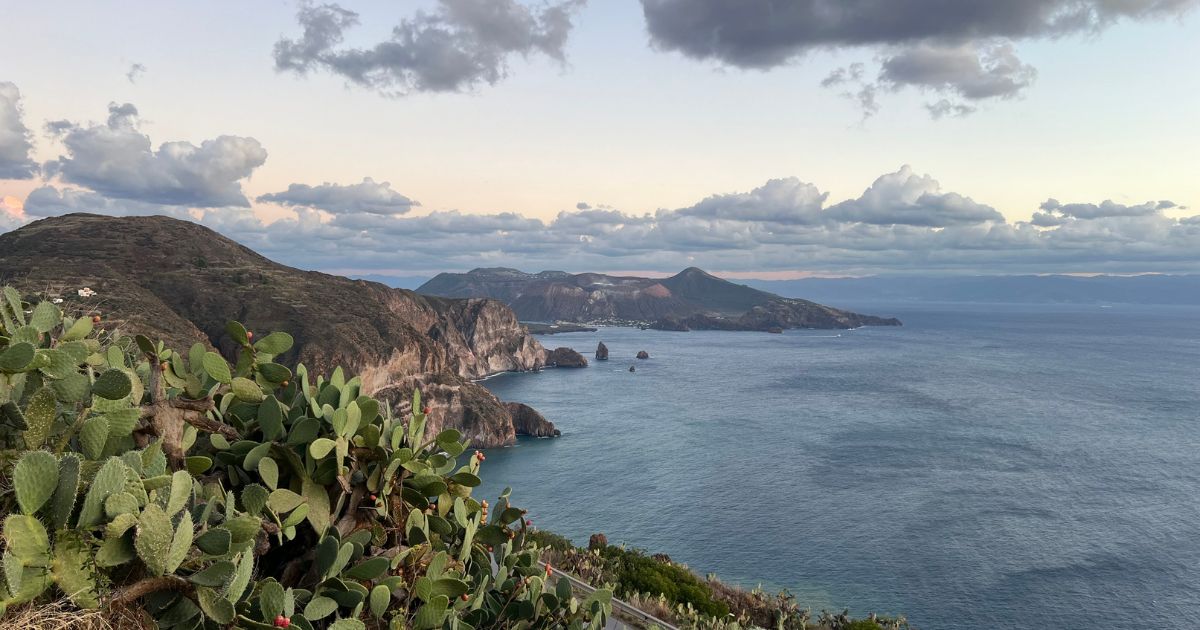
Last updated 5.11.2026
The weather in the Aeolian Islands is classic Mediterranean: hot, dry, sun-soaked summers and mild, slightly wetter winters. When it comes to planning a trip, though, one thing matters more than the average temperature: the wind, which can really pick up here and scupper your boat crossing. So what is the weather like in the Aeolian Islands through the year? We’ll walk you through air and sea temperatures month by month, how much it rains and how much the sun shines, when you can swim, when to tackle the volcanoes and when to enjoy the peace and quiet away from the crowds. For the 2026 season we recalculated all the figures from recent meteorological data and added a table of wind and waves, and at the end you’ll also find our tips on what to pack for each season.
What Is the Weather Like in the Aeolian Islands?
So what is the weather like in the Aeolian Islands? Picture that proper, sun-drenched Italian bliss. In summer, roughly from June to September, it’s blazing hot with cloudless skies — the perfect state of affairs for leaving your worries behind, hiring a little boat and lazing around in the sea all day long.
Winter won’t leave you frozen, but it can get pretty windy and wet, which sometimes means the ferries between the islands simply don’t sail because of the swell, and you end up stranded in port. The happy medium? Spring or autumn, hands down. The temperature is just right for a T-shirt, you won’t break into a sweat with every step, you’ll dodge the worst of the crowds and you’ll enjoy the climb up one of the smoking volcanoes to the absolute fullest.
TIP: The Aeolian Islands: a volcanic paradise
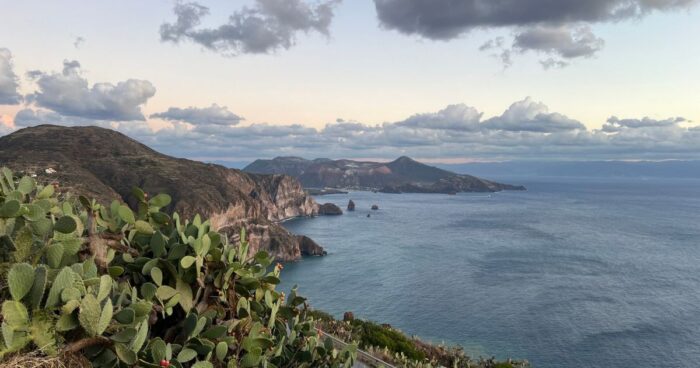
Aeolian Islands Weather Month by Month
The figures in the tables are averages, and the real weather varies from year to year. Air temperatures come from the European CERRA reanalysis (2017 to 2021), rainfall and wind from the ERA5 reanalysis (2015 to 2024) and sea temperatures from the Open-Meteo Marine model (2023 to 2024), all for a point just off Lipari town, pulled via Open-Meteo. Both air and sea:
| Month | Daytime high (°C) | Night low (°C) | Sea (°C) |
|---|---|---|---|
| January | 14.5 | 9.5 | 16.5 |
| February | 15.5 | 10 | 15.5 |
| March | 17 | 11 | 15.5 |
| April | 19.5 | 13 | 16.5 |
| May | 23 | 16.5 | 19 |
| June | 27.5 | 20.5 | 24.5 |
| July | 30 | 23.5 | 28 |
| August | 31 | 24.5 | 28.5 |
| September | 27.5 | 22 | 26 |
| October | 23.5 | 18 | 24 |
| November | 19.5 | 14.5 | 21 |
| December | 16 | 11.5 | 18 |
The warmest month is August (daytime highs around 31 °C, nights around 24 °C), the coolest is January (around 14 to 15 °C by day and 9 to 10 °C at night). With the sea all around, winters are never bitterly cold, and frost is practically unknown here.
Under the Köppen classification this is a hot-summer Mediterranean climate (Csa). The averages don’t tell the whole story, though. Every now and then in summer the sirocco rolls in, a hot, humid south-easterly that brings African heat, a hazy sky and sometimes Saharan dust. For a few days temperatures then shoot well above the figures in the table. The maestrale (the local name for the mistral) from the north-west does the opposite: it cools the air, clears the sky and whips up the sea.
When You Can Swim in the Aeolian Islands
The sea around the Aeolian Islands is pleasantly warm from roughly June to October. It peaks in August, when in recent years the water has reached 28 to 29 °C (almost 30 °C in the record-breaking August of 2024). September is wonderful too: the water stays around 26 °C and the crowds thin out noticeably. In October the sea still averages around 24 °C, so you can swim all month, and the hardier among us carry on into November (around 21 °C). The water is coldest in February and March, at around 15 °C.
Older guidebooks tend to give 26 to 27 °C for August. The sea has warmed up over the last few years, though, and the newer figures from 2023 to 2026 are one to two degrees higher. For us the nicest swimming is in September and early October, when the water is still warm and the sun no longer scorches.
💡 Tip: If warm water and peace and quiet are both priorities for you, go in September. The sea is still warm from the summer, and by then the August rush and the peak prices have eased off too. On top of that, the summer timetable for the fast boats runs until the end of September.
TIP: What to See in Sicily: 30+ best places, beaches and tips for your trip
Rainfall and Sunshine
Summer is very dry and sunny: July sees around 12 mm of rain and the sky is almost always clear (around 11 hours of sunshine a day). Most of the rain, on the other hand, falls in autumn and winter, roughly from October to January, with November usually the wettest month. According to the ERA5 reanalysis around 620 mm falls over the whole year, while other climate tables give as much as 900 mm. They all agree on one thing, though: from June to August there are only 2 to 4 rainy days a month.
Watch out in September and October. It doesn’t rain often, but when it does, it tends to be a violent thunderstorm that can dump several tens of millimetres in a few hours. It usually blows over quickly, though, and the next day is clear again.
Here’s how rainfall and sunshine are spread across the year (rainfall and days with at least 1 mm of rain from ERA5, 2015 to 2024; monthly sunshine hours are rough long-term averages):
| Month | Rainfall (mm) | Rainy days | Sunshine hours |
|---|---|---|---|
| January | 84 | 13 | 135 |
| February | 52 | 8 | 145 |
| March | 70 | 11 | 185 |
| April | 40 | 6 | 215 |
| May | 33 | 6 | 280 |
| June | 18 | 3 | 305 |
| July | 12 | 2 | 345 |
| August | 26 | 4 | 315 |
| September | 50 | 7 | 250 |
| October | 58 | 9 | 200 |
| November | 104 | 13 | 155 |
| December | 71 | 11 | 125 |
In practice this means that from May to August you can count on sunshine almost for certain, whereas in autumn and winter it’s wise to build a little slack into your plans in case of rain and a grey day or two.
Wind: the Most Important Factor of the Trip
The Aeolian Islands are noticeably windy, and in practice the wind matters more than the temperature. It blows hardest roughly from November to April, while July and August are usually the calmest. Strong winds and rough seas lead to ferries — and especially the fast hydrofoils — being cancelled: during a storm the connections can be cut for days at a time. The larger ferries sail more reliably.
The prevailing winds here come from the west and north-west (ponente and maestrale); in winter and spring the south-easterly sirocco and the south-westerly libeccio join in. The table shows how much this varies through the year. The first column is the average daily maximum wind speed, the second the number of days a month with gusts of at least 50 km/h (ERA5, 2015 to 2024), and the third the number of days when the waves off Lipari reached at least 2 metres (Open-Meteo Marine, 2022 to 2024).
| Month | Wind, daily max (km/h) | Days with gusts of 50+ km/h | Days with waves of 2+ m |
|---|---|---|---|
| January | 32 | 11 | 6 |
| February | 30 | 9 | 5 |
| March | 30 | 10 | 4 |
| April | 26 | 6 | 3 |
| May | 23 | 4 | 0 |
| June | 19 | 1 | 0 |
| July | 17 | 1 | 0 |
| August | 17 | 1 | 2 |
| September | 21 | 4 | 2 |
| October | 24 | 6 | 0 |
| November | 29 | 9 | 7 |
| December | 30 | 10 | 5 |
The main takeaway from the table: from June to August the sea is mostly calm and the boats run to schedule, even if the odd stormy day turns up in summer too. From November to March, by contrast, expect several days every month when the wind is strong enough that you can’t rely on the fast boats. The wind also cancels full-day boat trips around the islands and evening cruises to Stromboli, so if you have a trip like that planned, don’t leave it for the last day of your stay.
The timetable plays its part too. In the 2026 season the Liberty Lines fast boats ran on the summer timetable from 1 June to 30 September; from 1 October the autumn and winter timetable applies, with fewer sailings. So when one crossing is cancelled because of the wind, the next may not run for several hours, or not until the following day. You’ll find current departures and cancellations on the Liberty Lines website, and the wind and wave forecast on any weather site with a marine forecast. On the morning of a crossing we mainly check the wave height, which tells you far more than the temperature does.
💡 Tip: Always leave a buffer day in your itinerary, particularly outside the main season and before your return flight from Sicily. We go into exactly how the transport works in our article on how to get to the Aeolian Islands.
Does the Weather Differ Between the Islands?
Temperatures and rainfall are essentially the same across the whole archipelago — the islands lie close together. The real difference comes down to wind and waves: the smaller, more exposed islands such as Stromboli, Alicudi and Filicudi take the brunt of any bad weather first, and their connections are the first to be dropped. High up on the volcanic slopes (say, on the climb up Stromboli or to the crater of Vulcano) it tends to be cooler and windier than down by the sea, so an extra layer comes in handy even in summer.
The Aeolian Islands Season by Season
Spring (April to May)
The landscape is green and in full bloom, daytime temperatures climb from 19 to 23 °C and the rain quickly eases off. The sea is still cool (16 to 19 °C), so swimming is really one for the hardy, but this is the ideal time for hiking and climbing the volcanoes. There are few tourists and prices are agreeable — just bear in mind that the wind can still be brisk and some services are only just gearing up.
Summer (June to September)
Peak season. Sun from morning till night, daytime highs of 27 to 31 °C and a warm sea of 24 to 29 °C (in June the water is still noticeably cooler than in August). It barely rains and the wind is at its gentlest, so the boats run reliably. The price you pay for it is the most tourists and the highest prices, especially in July and August. Save your volcano climbs for early morning or late afternoon — it’s sweltering in the middle of the day.
Autumn (October to November)
October is still glorious: around 23 °C by day, the sea holds around 24 °C and swimming is very much on the cards. In our view it’s the most underrated month of the whole year. Gradually, though, the rain and wind build up, November is already the wettest month of the year and the weather tips over into its winter mode. It’s a quieter and cheaper period, but with a higher chance of cancelled crossings, so plan with some slack.
Winter (December to March)
Mild, but the windiest and wettest stretch of the year. Daytime temperatures of around 14 to 17 °C, a sea of 15 to 18 °C, plenty of rain and the least sun. Lots of accommodation and restaurants are closed, connections are limited and cancelled during storms. For lovers of peace and quiet and dramatic volcanic atmosphere it has its charm, but it’s not the time for swimming or carefree sightseeing.
Aeolian Islands Weather: What Each Month Brings
A quick rundown of what to expect in each month. The figures are rounded from the tables above.
- January: the coolest month, 14 to 15 °C by day, frequent rain and wind. Much of the accommodation is closed and the boats run on the winter timetable.
- February: much like January, just a little drier. The sea drops towards 15 °C. Not one for swimming, but fine for a walk around Lipari on a clear day.
- March: spring is on its way, but the wind and waves are still wintry. The sea is at its coldest of the year.
- April: around 19 to 20 °C by day, the islands are in bloom and hotels start to open. Good for hiking; the sea is only around 16 °C.
- May: 23 °C by day, little rain and calmer seas. A superb month for the volcanoes and a first dip for the hardy (19 °C).
- June: summer begins, 27 to 28 °C by day, and the sea warms up quickly to 24 °C. The summer timetable runs from 1 June.
- July: hot at around 30 °C, hardly any rain, sea around 28 °C. The calmest sea of the year, but the main rush gets going.
- August: the warmest month, 31 °C with a sea of 28 to 29 °C. Packed, with the highest prices; on 24 August Lipari celebrates its patron saint, San Bartolomeo (St Bartholomew), with fireworks.
- September: still summer, 27 °C by day, sea around 26 °C, and the crowds thin out fast. The first autumn thunderstorm may roll in.
- October: around 23 °C, sea 24 °C, swimming still comfortable. From 1 October, though, fewer boats run and some services close for the season.
- November: the wettest month, with more wind and more cancelled crossings. The sea is still around 21 °C, but the season is over.
- December: mild and windy, around 16 °C by day, short days and plenty of quiet. Only really for those looking for peace.
When to Visit the Aeolian Islands, Depending on What You Want
- Swimming and the sea: June to September, peaking in August; September is excellent too.
- Volcano hikes and sightseeing: April to June and September to October — pleasant for climbing, little rain and bearable heat.
- Peace and low prices: November to March (expect part of the services to be closed and the odd cancelled boat); of the shoulder months, May and September are the calmest.
- Snorkelling and diving: June to September, when the sea is warm and calm. Best of all, in our view, in September, when the water is at its warmest and there are fewer boats by the rocks.
- Boat trips and sailing: May to September, when there’s the smallest chance of the wind cancelling your trip. July and August are the least windy.
- Lava on Stromboli: the eruptions are best seen after dark, so in spring and autumn, when night falls earlier, you don’t have to wait so late into the evening. We cover how the climbs work in our article on the volcanoes of the Aeolian Islands.
The main season is July and August: hot, the busiest with tourists and the most expensive — book your accommodation 2 to 3 months ahead. It’s at its busiest around the feast of San Bartolomeo on 24 August. How many days to set aside for the islands and what it all costs is covered in our article on a holiday in the Aeolian Islands.
TIP: We’d definitely recommend setting aside a few days for the Aeolian Islands, simply because they’re stunning. The easiest thing is to sort your accommodation through Booking — you’ll have it chosen and reserved in no time.
What to Pack for the Aeolian Islands
Whenever you go, one thing always holds true: because of the wind and the volcano climbs, layering and a decent pair of shoes are your friends. Then, depending on the season, add:
- Summer (June to September): light clothing, swimwear, strong sun cream and sunglasses, a hat, plenty of water and sturdy footwear for the volcanoes; a light jumper for windy evenings and the boat deck.
- Spring and autumn: layers you can mix and match (T-shirt plus jumper), a light waterproof jacket against the wind and showers, walking boots for the trails; swimwear still comes in handy (especially in September and early October).
- Winter: warmer layers, a windproof or waterproof jacket, an umbrella won’t be much use (the wind), and comfortable shoes for the rain.
💡 Tip: For climbing the volcanoes (Stromboli, Vulcano), count on a head torch, plenty of water and an extra layer — it’s cooler and windier at the top than down by the port. On top of that, the volcanic dust on Vulcano wrecks your shoes, so an old pair of trainers is an advantage here.
What We’d Do Differently
We wouldn’t check the forecast every hour. In the Aeolian Islands the weather is ruled by the wind anyway, and the wind does as it pleases. When the boats aren’t running, it’s more of a gift than a problem: an extra day on one island with nowhere to rush off to is one of the best things you can experience here.
We wouldn’t plan a different island for every day. Better two or three at a relaxed pace, with time to sit in the harbour in the evening over a granita or a glass of Malvasia from Salina and just watch the light change over the sea. The prettiest coves, in our experience, are found by walking a little further along the coast than everyone else does.
And when the most beautiful sunset of all is playing out over Alicudi and Filicudi, we’d happily leave the phone in our pocket. It never looks the same in a photo as it does in real life.
Where to Next
- The Aeolian Islands: what to see, how to get there and which island to choose
- A holiday in the Aeolian Islands: how many days, where to go and what it costs
- Volcanoes of the Aeolian Islands: Stromboli, Vulcano and where to see lava
- How to get to the Aeolian Islands (and where they actually are)
Experiences and tickets in the Aeolian Islands
traveller-approved · GetYourGuide


Prices and ratings are indicative (source: GetYourGuide); you’ll see the latest once you click through.
Frequently Asked Questions (FAQ)
What is the weather like in the Aeolian Islands?
Mediterranean: hot, dry, sunny summers (highs around 30 to 31 °C) and mild, wetter winters (highs around 14 to 16 °C). The islands are fairly windy.
When is the best time to visit the Aeolian Islands?
May, June and September (and October too): pleasant temperatures, fewer tourists and services still open. Summer is the warmest, but busy and expensive.
What is the sea temperature around the Aeolian Islands?
In summer roughly 24 to 29 °C, warmest in August (28 to 29 °C in recent years). In September it’s around 26 °C, in October 24 °C, and it’s coldest in February and March, at around 15 °C.
When can you swim in the Aeolian Islands?
Roughly from June to October, most pleasantly from July to September. In September the sea is still around 26 °C, and in October around 24 °C.
What is the warmest month in the Aeolian Islands?
August: an average daytime high of around 31 °C and a sea of about 28 to 29 °C.
Is it windy in the Aeolian Islands, and do ferries get cancelled?
Yes. It blows hardest from November to April, and strong winds cancel connections; the fast hydrofoils are the most sensitive. That’s why you should keep a buffer day in your plans.
How much does it rain in summer in the Aeolian Islands?
Hardly at all. July sees only around 12 mm, usually across just 2 rainy days; summer is the driest and sunniest part of the year.
What should you pack for the Aeolian Islands?
In summer, light clothing, swimwear, sun cream and sturdy shoes for the volcanoes, plus a light jumper for windy evenings. In spring, autumn and winter, add layers and a waterproof windbreaker, as wind and showers come with the territory.
Is it worth visiting the Aeolian Islands in winter?
For peace and low prices, yes, but expect part of the accommodation and restaurants to be closed, limited connections and possible cancellations due to the wind.
What is the weather like in the Aeolian Islands in October?
Still pleasant: around 23 °C by day, 18 °C at night and a sea of around 24 °C, so you can swim. There is more rain and wind, though, and from 1 October fewer boats run.
What is the weather like in the Aeolian Islands in May?
Warm and dry, around 23 °C by day, with rain only a few times a month. The sea is around 19 °C, so swimming is for the hardy, but it’s an ideal month for climbing the volcanoes.
How do I find out if the ferries are running because of the weather?
Liberty Lines publishes cancelled and current fast-boat sailings on its website, and the ferry companies announce changes at the port. Keep an eye on the wind and wave-height forecast beforehand: with waves of around 2 metres or more, you can’t rely on the hydrofoils.
Potřebujete pomoct s cestováním?
-
Ubytování 🏨
Vyberte si to nejlepší ubytování, ať už jste kdekoliv, přes Booking.com. -
Půjčení auta 🚗
Auto si snadno najdete přes Booking.com, kde máte často slevu díky ubytování, nebo Rentalcars.com, kde porovnáte nabídky většiny půjčoven. -
Zážitky 🎟️
Přes GetYourGuide.com si vyberete z nejrůznějších výletů i zážitků po celém světě, navíc se zrušením zdarma do 24 h předem.