Last updated 5.11.2026
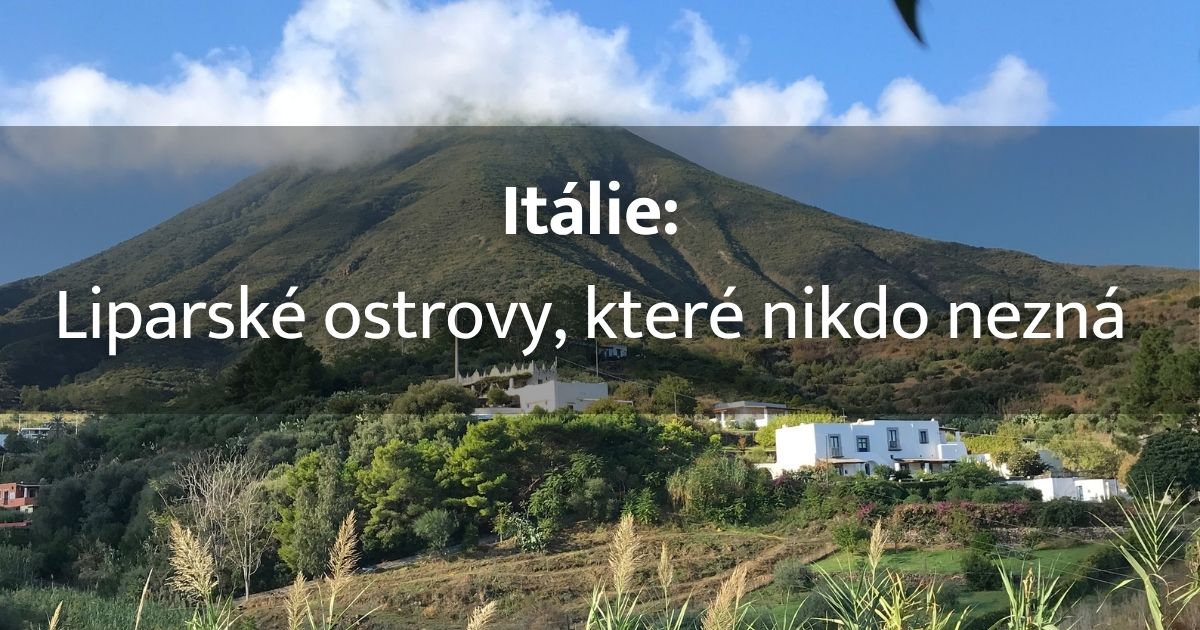
Picture a place where volcanic cones rise straight out of the sea, sulphurous steam drifts up from the ground, and at night you can watch glowing rock tumble down a slope into the water. The Aeolian Islands are our not-so-secret tip for anyone drawn to raw, untamed nature. Seven volcanic islands just off the coast of Sicily, on the UNESCO World Heritage List since 2000, roll adventure, easy swimming and wonderful food into one. We’ll show you exactly what to see in the Aeolian Islands, how to get there and which island to choose as your base. We’ve gone back through the volcano rules, the mud baths and the boat connections and updated everything for the 2026 season. So what do these islands actually hold?
What to See in the Aeolian Islands at a Glance
The islands and their volcanoes
Each of the seven islands has a completely different character. Here’s what you shouldn’t miss:
- Lipari: the largest island and the ideal base, with a citadel on a rock above the harbour and an excellent archaeological museum.
- Stromboli: the “lighthouse of the Mediterranean”, a volcano that has been active more or less non-stop, with regular explosions.
- Vulcano: the island of sulphur, mud baths and the steaming Gran Cratere.
- Salina: the greenest island, famous for its vineyards and capers, a haven for peace and walking.
- Panarea: the small, chic island with whitewashed houses and lively summer nights.
- Filicudi and Alicudi: wild, remote islands for anyone chasing a complete escape from it all.
Beaches and swimming
Don’t come expecting classic sandy beaches here. The Aeolian Islands are all about volcanic wildness:
- Spiaggia Bianca (Lipari): a beach below brilliant white pumice slopes, with turquoise water.
- Spiaggia delle Sabbie Nere (Vulcano): the famous beach of black volcanic sand.
- Ficogrande (Stromboli): a black-sand beach looking straight out at the smoking volcano.
- Cala Junco (Panarea): a rocky cove with crystal-clear water, perfect for snorkelling.
- Acque Calde (Vulcano): swimming in the sea where hot sulphurous bubbles rise up from the seabed.
Food and experiences
- An evening boat trip below Stromboli: watching the volcano erupt and the Sciara del Fuoco slope light up, straight from the sea.
- Malvasia delle Lipari: a tasting of the famous sweet dessert wine, above all on Salina.
- The climb to the Vulcano crater: a walk up to the rim with views over the whole archipelago.
- Mud baths: natural wellness on Vulcano, open again since April 2026 (mind the sulphur smell!).
Where to Stay in the Aeolian Islands
It mostly comes down to the pace you’re after. Lipari is the most practical base: it has the most accommodation and restaurants and the best connections to the other islands, so day trips are easy to organise from here. After peace and greenery? Choose Salina. Stromboli is worth at least one night for the volcano alone, Panarea is the place for a chic atmosphere, and for a complete getaway there’s Filicudi or Alicudi. Whichever island you pick, book well ahead: capacity is limited, and in summer the best addresses fill up months in advance. You can compare and choose here: accommodation in the Aeolian Islands →.
For a week, we’d combine two bases: a few nights on Lipari for the connections, then a move to Salina or Stromboli. You only drag your suitcase across the harbour once, and your evenings are spent in two very different places.
Lipari (Lipari town)
- Hotel Tritone →: outdoor pool, rooms with a balcony or terrace, breakfast on a sea-view terrace, about 500 m to Portinente beach.
- Arciduca Grand Hotel →: in the historic centre, a short walk from Marina Corta and the hydrofoil pier, with a hydromassage pool and late-19th-century Sicilian-style interiors.
- Hotel Aktea →: a four-star hotel with a large garden and pool and a restaurant serving Sicilian food, about 400 m from the nearest beach.
Salina (Malfa and Santa Marina Salina)
- Hotel Signum → (Malfa): views over the bay of Malfa, a geothermal spa, an infinity pool and a Michelin-starred restaurant.
- Hotel Ravesi → (Malfa): restored 19th-century farmhouses close to the main square, with a heated infinity pool looking out to Stromboli and Panarea.
- Hotel Mamma Santina → (Santa Marina Salina): a cluster of Aeolian-style houses, terraces with hammocks and a pool, about 600 m from the harbour.
Stromboli
- La Sirenetta Park Hotel →: about 100 m from the shore, with a pool, a garden, a fish-focused restaurant and a rooftop bar in summer.
- Hotel Ossidiana Stromboli Center →: by the black-sand beach about 150 m from the port, rooms as well as apartments with a kitchenette, and breakfast with a sea view.
Vulcano
- Therasia Resort Sea and SPA →: on the Vulcanello peninsula, with a spa, private sea access and a free shuttle to the port.
- Les Sables Noirs & Spa →: about 90 m from the black-sand beach, with a pool overlooking the Ponente bay, a sauna and a hammam.
Panarea
- Hotel Cincotta →: on a cliff with views of the neighbouring islands, a saltwater pool and a large sun terrace.
- Hotel Lisca Bianca →: opposite the port of San Pietro with a view of Stromboli; in July and August there are terrace parties until late (not one for light sleepers).
Filicudi and Alicudi
- Hotel Phenicusa → (Filicudi): its own pebble beach with free sun loungers, a three-minute walk from the port.
- Da Nino sul mare Filicudi → (Filicudi): a few steps from the beach by the port, with its own restaurant and bar and some sea-view rooms.
- Casa 3 archi → (Alicudi): a small guesthouse with a sea view, a garden, a terrace and a hot tub, breakfast included.
- L’Olivuzza → (Alicudi): a two-bedroom holiday home with a fully equipped kitchen and a sea-view balcony.
TIP: By far the simplest option is to book your accommodation through Booking: you’ll have it found and reserved in no time.
When and How to Get to the Aeolian Islands
The Aeolian Islands have no airport, and that’s exactly what helps them keep their charm. The easiest route is to fly to Sicily (Catania or Palermo) and then travel by car or bus to the port of Milazzo. From Milazzo, ferries and fast hydrofoils (aliscafo) sail several times a day. A Liberty Lines hydrofoil reaches Lipari in about an hour, and in the 2026 season a one-way ticket costs roughly €20 to €32; the slower Siremar or Caronte & Tourist ferries are cheaper. There are also connections from Messina, Palermo and Naples. We cover every option in detail in our guide on how to get to the Aeolian Islands.
The high season is July and August, when it’s hot and busy, mostly with Italian holidaymakers. We prefer to travel in May, June or September: the temperatures are lovely for both swimming and hiking, and you sidestep the biggest crowds. For a month-by-month picture, see our guide to the Aeolian Islands weather.
TIP: Mount Etna: how to climb it, the cable car and what to know
💡 Tip: Leave your car on the mainland in a guarded car park in Milazzo. You won’t use it on the islands anyway, and in summer you mostly can’t take it over: in 2026 non-resident cars may not be landed on Lipari, Vulcano and Filicudi from 1 June to 30 September, on Salina from 15 June to 15 September, on Alicudi from 1 June to 31 October, and on Panarea and Stromboli from 1 May right through to 31 October. Exemptions apply to electric cars, cars with foreign number plates and guests staying at least seven days who can show a confirmation from their accommodation (if you’re relying on an exemption, check with the ferry company before you book). On the islands you get around on foot, by boat or on a scooter.
Lipari: the Heart of the Archipelago and the Best Base
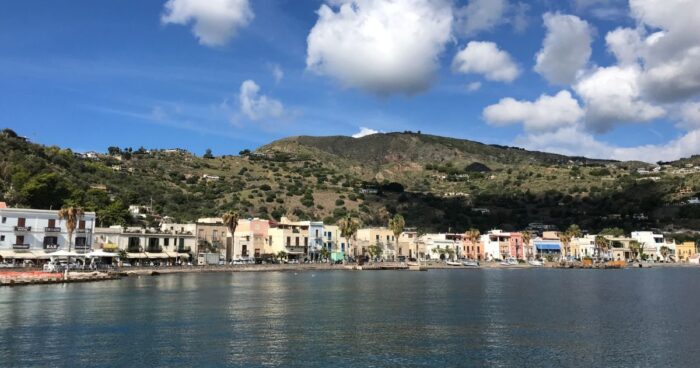
Lipari is the largest island and has the best connections to all the others. Want to see as much as possible? Base yourself right here. The town of Lipari has a beautiful historic centre and a citadel on a rock above the harbour that houses a first-rate archaeological museum (Museo Archeologico Regionale Eoliano “Luigi Bernabò Brea”), one of the finest in southern Italy. The collections run from Neolithic obsidian tools through Greek pottery to finds from ancient shipwrecks. You climb up to the citadel on foot, and besides the museum you’ll find San Bartolomeo Cathedral and a view over both harbours.
Below the citadel lies the little fishing harbour of Marina Corta, with a tiny church on the jetty and a row of cafés. This is where we like Lipari best in the evening: the boats come back in, the waterfront lights up and all you need is a granita or a glass of Malvasia. The main street, Corso Vittorio Emanuele, is lined with small shops selling capers, wine and obsidian souvenirs.
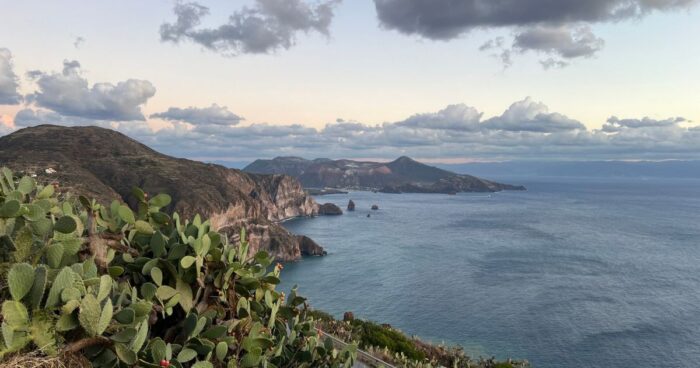
Hire a scooter and loop right around the island; the circuit is only about 30 km. Stop at the Belvedere di Quattrocchi viewpoint, which offers the iconic view across to neighbouring Vulcano and the faraglioni sea stacks. In the north-east you’ll ride past the former pumice quarries at Porticello and Acquacalda, where white slopes drop straight into the sea and the water below glows turquoise. For a swim, head to Spiaggia Bianca near Canneto or the wilder beach at Valle Muria below the cliffs (access by land to both is sometimes restricted because of falling rocks, in which case water taxis run from Lipari town). On the west side of the island, the village of Quattropani with its church above the sea is worth a stop too.
💡 Where to stay: Hotel Tritone → has an outdoor pool and breakfast on a terrace overlooking the sea. You’ll find more options among the places to stay on Lipari →.
Vulcano: Sulphur, Mud and a Smoking Crater
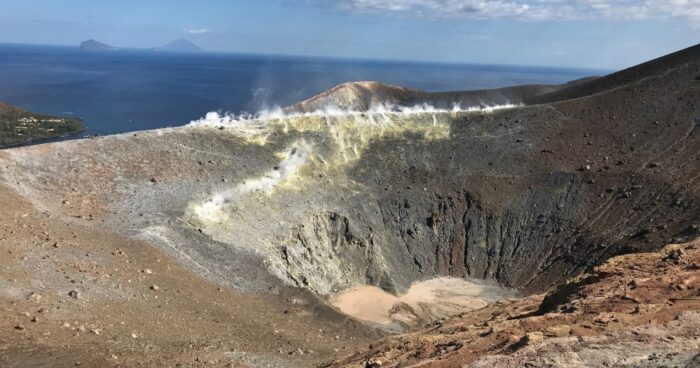
The moment you step off the boat you’ll catch that unmistakable whiff of sulphur (think “rotten eggs”). Don’t let it put you off, though, because Vulcano serves up some of the most fascinating natural sights in the whole archipelago. The main draw is the climb to the Gran Cratere (Fossa di Vulcano, around 390 m): from the port of Porto di Levante it takes roughly an hour to the top, where you look down into a crater lined with fumaroles hissing out steam and crusted with yellow sulphur crystals. This volcano gave its name to a whole type of eruption: after it erupted between 1888 and 1890, scientists began to speak of “Vulcanian” eruptions.
Crater rules for the 2026 season: access to the path is controlled by traffic lights that react to wind direction and gas levels. Green means go; red, or no light at all, means the path is closed. From 1 April to 20 October you may only walk up between 6:30 and 10:30 and between 16:00 and 19:30; from 21 October to 31 March the hours are 7:30 to 16:30. The local rules forbid hiking alone (you must be at least two), leaving the marked path, and going up without sturdy shoes and water. We wouldn’t recommend the climb to anyone with breathing problems or to small children. We explain how active the volcano is in our guide to the volcanoes of the Aeolian Islands.
Down by the harbour is the mud pool, Laghetto dei Fanghi (Pozza dei Fanghi). Prosecutors sealed it off in June 2025 after a visitor was injured, and it reopened in April 2026. There’s an entry fee, and silver jewellery turns black in the sulphurous mud, so leave it at your hotel. Right next door is Acque Calde, where hot gas bubbles up through the sea from the seabed. Beach lovers will appreciate Spiaggia delle Sabbie Nere, with its fine black sand in the Ponente bay, where the whole island seems to gather in the evening for the sunset.
If you have a full day on Vulcano, walk out to the Vulcanello peninsula in the north. Twenty minutes on foot from the port is the Valle dei Mostri, the “valley of monsters”, where solidified lava has taken shapes that, with a little imagination, look like animals. In the south of the island lies the quieter beach of Gelso with its lighthouse, which you can reach by scooter or by boat. We’d happily give Vulcano two days: one for the crater at dawn, the other for swimming and lazing about.
💡 Tip: Black volcanic sand gets scorching hot in the sun, so water shoes or flip-flops are essential at Sabbie Nere. And do the crater climb first thing, right after 6:30, before the day heats up and the day-trippers arrive on the boats.
TIP: What to see in Sicily? 30 of the most beautiful places and tips for your trip
Stromboli: Theatre of Fire
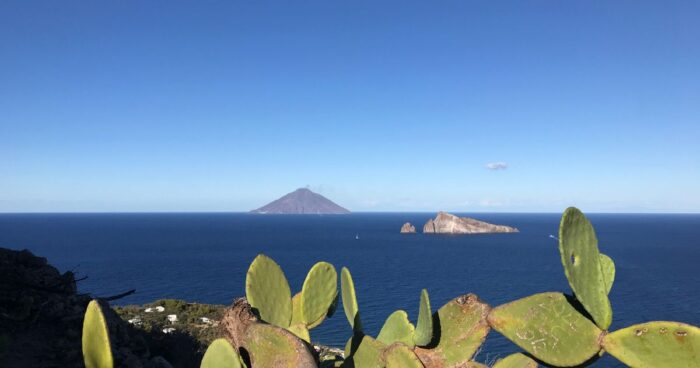
Stromboli is one of the longest continuously active volcanoes on Earth. It has been throwing out lava almost without pause for more than two thousand years, which is exactly why it earned the nickname “lighthouse of the Mediterranean”. Smaller explosions repeat roughly every 15 to 20 minutes. By day you can relax on the black-sand beaches of San Vincenzo, a village with hardly any cars, just electric buggies and scooters. Locals simply call the volcano “Iddu”, meaning “Him”.
The main event comes in the evening, and you have two options: a guided hike, or a comfortable boat trip below the Sciara del Fuoco slope, where glowing rocks tumble into the sea. The rules are set by an ordinance of the municipality of Lipari according to the volcano’s activity: without a guide you may only go up to 290 m, and with an authorised guide up to 400 m. The summit (over 900 m) is currently off limits altogether, even though many older guidebooks and leaflets still promise it. As of September 2026 the civil protection alert level is yellow. We cover the hike, the kit and the guides in our article on the Stromboli volcano.
There’s more to the island than the volcano. On the west side lies the village of Ginostra, reachable only by boat and home to just a few dozen people. Off the north coast, the rocky islet of Strombolicchio with its lighthouse rises from the sea, and most boat trips sail around it. In San Vincenzo, wander the white lanes up to the church, which looks out to Strombolicchio, and wait for the sunset on Ficogrande beach. We enjoy Stromboli most when we stay the night: once the excursion boats leave, the village goes completely quiet and you can see the explosions above the rooftops without climbing anything at all.
💡 Tip: Book both the hike and the evening eruption cruise ahead through GetYourGuide →, as spaces fill up fast in season. Above 290 m you may only go with an authorised guide, and a helmet is compulsory. In summer 2026 the authorities were also considering a cap on day visitors to Stromboli and Panarea, so check the current situation before you travel.
Salina: the Green Island of Wine
After peace and greenery? Salina is exactly your island. Unlike its neighbours it has plenty of water, so it’s covered in lush vegetation and vineyards. This is the home of the famous Malvasia delle Lipari wine. Drop into one of the local wineries (around Malfa, for instance) and enjoy a tasting at sunset.
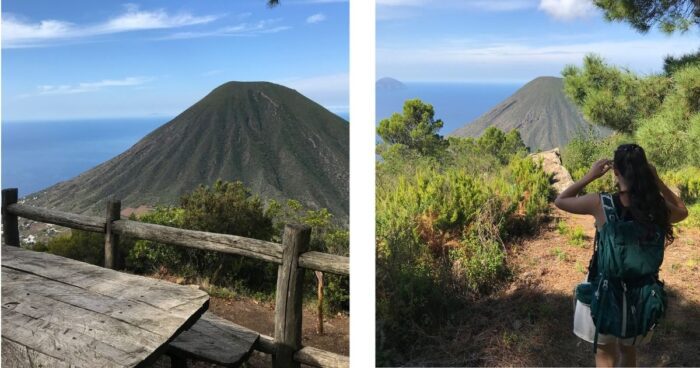
Salina is wonderful for walking, too. You can hike up Monte Fossa delle Felci (962 m), the highest peak in the whole archipelago, and see the Aeolian Islands spread out below you. The climb is a proper one, but the path is well kept and mostly follows steps and forest trails. From the top you look straight across to the island’s second green cone, Monte dei Porri. And if it all looks familiar, Salina was the setting for the film Il Postino (The Postman).
The island has three municipalities (Santa Marina Salina, Malfa and Leni), and every village feels a little different. Santa Marina Salina, with the port, is the liveliest, with shops and restaurants along its main lane. In the hamlet of Lingua, a small salt lagoon by the lighthouse gave the island its name, and the bar Da Alfredo draws people from all over the archipelago for granita and pane cunzato. Malfa in the north is surrounded by vineyards and caper fields. In the west is Pollara, a bay set in a half-sunken crater where scenes from Il Postino were filmed. Walking down to the beach itself is forbidden because of rockfalls, but the sunset from the viewpoint above the bay is one of the loveliest things we’ve seen on the islands. For calm swimming, head to Rinella in the south.
💡 Where to stay: The iconic Hotel Signum → in Malfa is one of the loveliest addresses in the entire archipelago, with a geothermal spa and a Michelin-starred restaurant.
Panarea, Filicudi and Alicudi: From Luxury to the End of the World
The remaining islands are smaller, but no less intriguing:
- Panarea is the smallest and the most exclusive. In summer it fills up with yachts; it has beautiful whitewashed architecture and superb snorkelling in the Cala Junco cove.
- Filicudi and Alicudi are the “islands at the end of the world”. On Alicudi there are no roads: goods are carried up the steps by donkeys and mules. Ideal for a complete digital detox.
Panarea
From the port of San Pietro it’s a half-hour walk south to the Cala Junco cove. On the headland above it, Capo Milazzese, are the remains of a Bronze Age village with the outlines of oval huts, and the view of the cove from here is one of the most photographed on the islands. Zimmari is one of the few sandy beaches. From a boat you’ll see the islets of Basiluzzo, Dattilo and Lisca Bianca, where bubbles of volcanic gas rise from the seabed. In the evening Panarea changes: the bars by the port play until dawn, and the prices match. We prefer to be here by day and sleep somewhere else.
Filicudi
Only a few hundred people live on Filicudi, and there are few tourists even in August. Above the port, on the Capo Graziano headland, lies a prehistoric village that gave its name to a whole Early Bronze Age culture. The most famous view, though, is from the sea: off the west coast the rock needle of La Canna rises more than 70 metres, and close by is the sea cave Grotta del Bue Marino, which you enter in a small boat. In our view, a boat trip around the island with swimming stops in the coves is the best way to get to know Filicudi. On foot you can climb to the abandoned village of Zucco Grande or walk down to the fishing hamlet of Pecorini a Mare.
Alicudi
The westernmost island is essentially a single volcano with stone houses clinging to its slopes. Around a hundred people live here, there are no roads or cars, and from the port there are only hundreds of stone steps. Mules carry the cargo. The highest point, Filo dell’Arpa (675 m), is a tough climb up steps and trails, rewarded with a view over the whole archipelago. There’s one shop and a handful of restaurants. And that’s exactly why people come: it’s the quietest place you’ll find in the Aeolian Islands.
💡 Tip: Panarea, Filicudi and Alicudi can all be visited on a day trip from Lipari. But if you’re craving silence and a starry sky with no one around, set aside at least one night on Alicudi. Bear in mind that Filicudi and Alicudi have fewer connections, and out of season only a few boats a day call there.
Aeolian Islands Boat Trips: How to See More Islands in a Day
If you don’t have a week in the archipelago, a boat is the way to see the most. Several kinds of trips leave Lipari harbour every day (and in season also Milazzo, or Tropea in Calabria):
- Panarea and Stromboli with an evening stop at the Sciara del Fuoco: an afternoon swim and stroll on Panarea, dinner on Stromboli and, after dark, the eruptions seen from the sea. The most popular trip of all.
- Around Lipari and Vulcano: the faraglioni, the white pumice slopes, the Grotta del Cavallo sea cave and swimming stops in coves you can’t reach by land.
- Filicudi and Alicudi: a full day out west, sailing round La Canna and stopping at the Bue Marino cave.
- Salina: a cruise below Pollara and a granita stop in Lingua.
- Your own boat: on Lipari you can rent a small boat without a skipper’s licence (with a limited engine power) and explore the coves at your own pace.
You can buy trips straight from the kiosks at Lipari harbour, which usually offer more choice and departure times, or book them online in advance. In July and August it’s better to book ahead, especially the evening cruises to Stromboli. Prices vary with the route and the type of boat, and trips are cancelled when the wind is strong.
A Little History: From Obsidian to UNESCO
The islands take their name from Aeolus, god of the winds, who according to Homer’s Odyssey hosted Odysseus and gave him a leather bag holding the winds. Their real history starts thousands of years earlier. In the Neolithic, Lipari was one of the main sources of obsidian, the sharp volcanic glass used to make knives and arrowheads. Lipari obsidian has been found at sites all over the western Mediterranean, and the island grew rich on it.
In the Bronze Age the islands had fortified villages, whose remains you can still see at Capo Graziano on Filicudi and Capo Milazzese on Panarea. Around 580 BC Greek colonists founded the city of Lipara on Lipari; during the Punic Wars it sided with Carthage, and in 252 BC it was taken by the Romans. In 1544 the Ottoman admiral Barbarossa sacked Lipari and carried off much of its population into slavery. The mighty citadel walls you see above the harbour were built by the Spanish afterwards.
At the end of the 19th century phylloxera devastated the vineyards and thousands of islanders left to work in Australia and the Americas, which is why some villages are still half empty today. In the 20th century the Fascist regime used Lipari as a place of internal exile for political opponents. Films put the islands back on the map: Rossellini shot Stromboli with Ingrid Bergman here in 1950, and 44 years later Il Postino was filmed on Salina. In 2000 UNESCO added the Aeolian Islands to its World Heritage List for their volcanoes, on which scientists described two types of eruption: Strombolian and Vulcanian.
Food: What You Simply Must Try
Aeolian cooking is built on fresh fish, capers and tomatoes. Capers grow everywhere here and find their way into almost everything; the ones from Salina are among the best in Italy.
- Pasta all’Eoliana: pasta with capers, olives, tomatoes and often tuna too.
- Pane Cunzato: bread piled high with tomatoes, cheese, olives and capers (a Salina speciality).
- Granita: the crushed-ice treat, arguably the best in all of Italy here, eaten with a brioche for breakfast.
- Fish and seafood: fresh swordfish (pesce spada) or grilled squid are always a safe bet.
- Arancini: fried rice balls filled with ragù or cheese, the perfect snack for a boat trip.
- Malvasia delle Lipari: a sweet wine made from sun-dried grapes, served with dessert or cheese.
Give the restaurants right by the jetties, with photos of the dishes on the menu, a miss. Our best meals were in the trattorias in the side streets of Lipari and on Salina, where the locals eat. For dinner in August, book a table.
Practical Tips to Finish
Carry some cash. On Lipari and in larger hotels and restaurants you can pay by card without any trouble, but in smaller places, at stalls and on Filicudi and Alicudi you won’t get far without euros in cash. Sturdy footwear is a must: flip-flops won’t cut it for climbing the volcanoes, where the terrain is loose and sharp. And above all: book early. Accommodation on the islands is limited and fills up months ahead in summer.
Landing fee: the municipality of Lipari (which covers every island except Salina) and the municipalities on Salina charge visitors a landing fee (contributo di sbarco) of €5 from June to September and €2.50 the rest of the year. It’s usually included in your boat ticket, so you don’t need to deal with it separately. On some islands a tourist tax is also charged at your accommodation.
How many days? Three to four days are enough for Lipari, Vulcano and Stromboli; for the whole archipelago at a relaxed pace, allow a week. We show how to put the days together and what it all costs in our guide to an Aeolian Islands holiday.
💡 Tip: Keep an eye on the wind forecast. In rough weather the connections between the islands are cancelled and you could be stranded an extra day, so build in a little buffer, especially before your return flight from Sicily.

What We’d Do Differently
In the Aeolian Islands the temptation to tick off all seven is huge, and the timetables positively encourage it: Vulcano in the morning, Panarea in the afternoon, Stromboli in the evening. But then you spend half your holiday on the jetty and below deck on a hydrofoil. Next time we’d pick two or three islands and stay longer on each.
The best moments rarely happen at the famous viewpoints. They happen in the back lanes of Lipari below the citadel, at a small winery on Salina that no guidebook mentions, or in a trattoria with no English menu where the owner recommends the catch of the day. Try whatever you’re offered, even if you can’t work it out from the menu: pane cunzato tastes slightly different on every island, and the local Malvasia varies from one winemaker to the next.
And you don’t have to see the Stromboli eruption at any cost. If the wind cancels your boat trip, sit on Ficogrande beach or on the roof of your guesthouse in the evening and watch the sky above the crater flush red every now and then. Sometimes the best thing is to leave your phone in your pocket, take no photos, look for nothing and just listen to the sea.
More on the Aeolian Islands
- A holiday in the Aeolian Islands: how many days, which island and what it costs
- Volcanoes of the Aeolian Islands: Stromboli, Vulcano and where to see lava
- How to get to the Aeolian Islands (and where they are)
- Aeolian Islands weather: when to go for the volcanoes and the sea
- Mount Etna: if you want to add Sicily’s biggest volcano to the list
Frequently Asked Questions About the Aeolian Islands (FAQ)
How do you get to the Aeolian Islands?
The islands have no airport. The easiest way is to fly to Sicily (Catania or Palermo) and continue from the port of Milazzo by ferry or hydrofoil (aliscafo). Services run several times a day, and the hydrofoil crossing to Lipari takes roughly an hour.
Which Aeolian island is best to stay on?
Lipari: it has the best connections to all the other islands and the most accommodation and restaurants. If you’re after peace and greenery, choose Salina; for the volcano at night, spend at least one night on Stromboli.
How many days do you need in the Aeolian Islands?
For a taster (Lipari, Vulcano, Stromboli), 3 to 4 days is enough. To explore more islands at a gentler pace, including Salina and the remote Filicudi and Alicudi, allow a week.
Can you climb Stromboli?
Yes, but only partly. Without a guide you may go up to 290 m, and with an authorised guide up to 400 m. The summit is currently closed. A more relaxed alternative is the evening boat trip, from which you’ll see the eruptions and the glowing rocks tumbling down the Sciara del Fuoco slope.
Are there sandy beaches in the Aeolian Islands?
Not the classic golden kind. The beaches are volcanic, with black sand (Sabbie Nere on Vulcano) or below white pumice slopes (Spiaggia Bianca on Lipari). The water, though, is crystal-clear and perfect for snorkelling.
Do you need a car on the islands?
No. Leave your car on the mainland in Milazzo; in summer, non-resident cars aren’t allowed on most of the islands anyway. You get around on foot, by boat or on a scooter you hire locally. On Alicudi there are no cars at all.
When is the best time to visit the Aeolian Islands?
May, June and September: pleasant temperatures for both swimming and hiking, and fewer crowds than in July and August. Out of season (in winter), some accommodation and connections are limited.
Can you visit several Aeolian Islands in one day?
Yes, on an organised boat trip from Lipari or Milazzo. The most popular one combines Panarea and Stromboli with the eruptions seen from the sea in the evening. You’ll only spend an hour or two on each island, though.
Is there a landing fee for the Aeolian Islands?
Yes. From June to September it’s €5 per person, and €2.50 the rest of the year. The fee is usually included in the price of your boat ticket.
Are the Aeolian Islands a UNESCO World Heritage Site?
Yes, since 2000. The archipelago was listed for its volcanoes: on Stromboli and Vulcano scientists described two types of eruption, Strombolian and Vulcanian.
Potřebujete pomoct s cestováním?
-
Ubytování 🏨
Vyberte si to nejlepší ubytování, ať už jste kdekoliv, přes Booking.com. -
Půjčení auta 🚗
Auto si snadno najdete přes Booking.com, kde máte často slevu díky ubytování, nebo Rentalcars.com, kde porovnáte nabídky většiny půjčoven. -
Zážitky 🎟️
Přes GetYourGuide.com si vyberete z nejrůznějších výletů i zážitků po celém světě, navíc se zrušením zdarma do 24 h předem.