Last updated 5.11.2026
The Aeolian Islands were quite literally born from fire. The whole archipelago was thrown up by volcanic activity, and two of its volcanoes are still very much alive. If it’s the volcanoes of the Aeolian Islands that are drawing you here, you’re in the right place: we’ll show you where to watch molten lava spill towards the sea, at what time the traffic light lets you up the crater of Vulcano, how high you’re allowed to go on Stromboli, and which of these rules apply in the 2026 season. What we love most is how close together it all is: in the morning you stand above a smoking crater, in the evening you watch lava from a boat, and in between there’s time for lunch on a third island.
In brief: The Aeolian Islands volcanoes are everywhere you look, but only two are active: Stromboli (which erupts every 10–20 minutes, best seen after dark) and Vulcano (with its smoking Gran Cratere and sulphur fumaroles). The finest way to see lava is on an evening boat trip beneath Stromboli. In 2026 you may climb Stromboli to 290 m without a guide and to 400 m with one; the summit stays closed. The Vulcano crater is free to climb, but only when the traffic light is green, and from April to 20 October only in the morning (6:30–10:30) and early evening (16:00–19:30). The Vulcano mud baths have been open again since 11 April 2026.
Which of the Aeolian Islands are volcanoes?
Every island in the archipelago is volcanic in origin. They sit in an active volcanic belt between Etna and Vesuvius, and since 2000 they have been a UNESCO World Heritage Site for their importance to volcanology. Only two, though, are active today:
- Stromboli: a ceaselessly active stratovolcano, the “lighthouse of the Mediterranean”. Its summit reaches 924 m, but most of the volcano is hidden below the waves (measured from the seabed it rises more than 2,700 m). In September 2026 the Italian Civil Protection Department was keeping it on a yellow alert level.
- Vulcano: an active volcano in a quiet (fumarolic) phase, its last eruption in 1888–1890. The rim of the Gran Cratere della Fossa lies at 391 m, and the crater itself is about 600 m across. After the gas crisis of 2021 to 2023, it has been back on green alert since December 2023.
- Lipari, Salina, Panarea, Filicudi, Alicudi: dormant or extinct volcanoes. Salina even holds the archipelago’s highest point, Monte Fossa delle Felci (962 m), while submarine fumaroles still bubble away off Panarea.
Here’s a lovely bit of trivia: the very word volcano comes from here. The island of Vulcano was named after Vulcan, the Roman god of fire and metalworking, who was said to keep his forge hidden beneath it. One small island ended up giving its name to every volcano on Earth.
Stromboli: the volcano that never stops erupting
Stromboli gave its name to a whole style of volcanic activity, the Strombolian eruption. These are rhythmic, relatively gentle bursts that fling out glowing lava, ash and rock, repeating roughly every 10–20 minutes, and they have carried on like this for thousands of years without pause. The explosions come from several vents on a crater terrace at around 700 m, at the top of the steep “fiery groove” of the Sciara del Fuoco. After dark it becomes a spectacle you can’t tear your eyes from: red bursts against the night sky and glowing boulders tumbling down the Sciara straight into the sea.
The volcano shows no sign of slowing down in 2026. According to the weekly bulletin of Italy’s volcanology institute INGV from September 2026, it is showing normal Strombolian activity in both crater areas, and in August 2026 small lava overflows spilled from the craters into the Sciara several times. The Civil Protection Department keeps it on yellow alert. On top of the regular bursts, stronger explosions come several times a year, and every few years a paroxysm that can hurl rocks down to lower slopes.
How high you can climb Stromboli in 2026
Following powerful eruptions in 2019, 2022 and 2024, you are not allowed up to the summit craters. The rules come from Lipari mayoral ordinance no. 16 of 5 May 2025, and as of September 2026 we couldn’t find a newer one. They do shift with the volcano’s activity, though, so check again just before you travel:
- From Stromboli village: up to 290 m without a guide (via the Strada vicinale Parroco and the Salvatore di Losa mule track), and up to 400 m with an authorised guide.
- From Ginostra: up to 130 m without a guide, and up to 400 m with a guide to the Punta dei Corvi viewpoint.
- The Sentiero Natura trail towards the Sciara has been closed since the landslides and floods of autumn 2024, and will stay shut until the nature reserve makes it safe.
- Above 290 m a helmet and a dust mask are compulsory; guides usually lend them out and check your footwear.
When the activity level allows, guided climbs on Stromboli usually set off in the late afternoon so the group reaches the viewpoint at dusk, when the explosions show best. The whole outing takes around 5 to 6 hours (the climb, the watching, and the descent in the dark by head-torch). Going it alone above the permitted line is banned and fined, from roughly €500. The trek isn’t suitable for pregnant women or for anyone with heart, breathing or mobility problems. We go into the route, the gear and how to choose a guide in our article on the Stromboli volcano: hiking, boat trips and what to know.
Honestly, if the climb isn’t your dream, you won’t miss much. From the 400 m viewpoint you see the craters from roughly the same angle as from 290 m, just a little closer. What makes most sense to us is walking up on your own in the afternoon from the former observatory (Osservatorio, about 100 m above sea level) along the mule track to the 290 m line, and then heading out on a boat in the evening.
💡 Tip: The best and most reliable way to see the eruptions is an evening boat trip beneath the Sciara del Fuoco. It sails at dusk from Scari harbour and costs roughly €45–65 per person; from Lipari and Milazzo there are full-day trips that stop off Stromboli after dark. The boats keep their distance from the shore below the Sciara, because lava meeting the sea can hurl rocks several hundred metres. Book ahead through GetYourGuide →, as places fill up fast in season.
Vulcano: the crater, the fumaroles and the sulphur mud
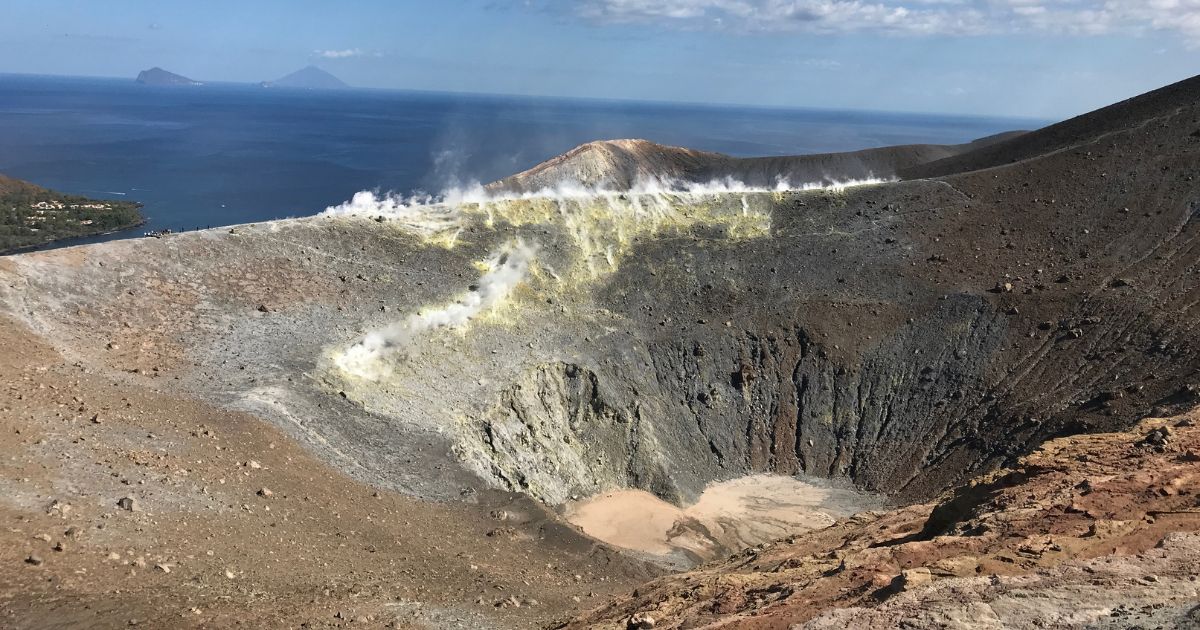
You’ll smell Vulcano before you even step off the boat: that unmistakable whiff of sulphur (“rotten eggs”) hangs over the whole island. Don’t let it put you off, because this is home to some of the archipelago’s most fascinating natural sights. The star attraction is the climb up the Gran Cratere della Fossa. From the trailhead a short walk beyond the Porto di Levante harbour it takes about 40 minutes to the viewpoint (1.5–2 hours there and back), and at the top you look down into an active crater whose walls hiss with steam-belching fumaroles. On a clear day you can see all seven islands from up here. The climb is free; no entrance fee is charged.
Between 2021 and 2023 the crater was closed because of increased gas emissions. It reopened in April 2023, but now runs on a traffic-light system. The lights on the trail are controlled by the municipality of Lipari according to the wind direction, which decides where the gases from the fumaroles drift. Green means you can go up. Red, or a light that’s switched off, means the trail is closed and climbing is banned.
When the traffic light lets you up
The rules for the climb were issued by the municipality of Lipari (ordinance no. 17 of 23 April 2023, with the regulations last updated on the municipal website in October 2025), and for the 2026 season they look like this:
| Period | When you may be above the crater-zone boundary |
|---|---|
| 1 April – 20 October | 6:30–10:30 and 16:00–19:30 |
| 21 October – 31 March | 7:30–16:30 |
The times apply to being up top, not to leaving the harbour, so factor in the descent too. The ordinance also says that you may not climb alone (at least two people must go together in case a rescue is needed), you must not leave the marked trail, and the route is watched by cameras. Walking the full crater rim, as people used to, is no longer possible; the permitted route is fenced off. The municipality also explicitly asks you to bring sturdy shoes, water, food and a phone. What works best for us is setting off right at 6:30: it’s still cool, there’s nobody at the top, and the morning light makes the yellow sulphur crusts glow.
Vulcano has other faces too. The beach of Spiaggia delle Sabbie Nere, with its fine black volcanic sand, is struggling with erosion in 2026: a local association warns that the sea has split it into two parts separated by about twenty metres of water. At Acque Calde beach by Porto di Levante, fumaroles bubble straight up from the seabed, so you swim among warm bubbles. In past years, however, the municipality closed the part of the bay right above the strongest vents to swimmers because of the gases, and the beach was shut at night, so follow the signs. On the island’s northern tip you’ll find the Valle dei Mostri, a cluster of lava formations sculpted by erosion into shapes that look like animals, and right next to it the Vulcanello peninsula. It rose from the sea as a separate islet in 183 BC and was only joined to Vulcano by an isthmus in the 16th century, which makes it the youngest piece of the archipelago.
💡 Tip: The famous mud baths (Pozza dei Fanghi, also called Laghetto di Fanghi) by Porto di Levante have had a turbulent few years. Volcanic gases and structural problems kept them closed from 2020; on 1 June 2025 they reopened after five years, and ten days later the Carabinieri sealed them off because a tourist had burned his legs in the mud on 8 June. They have been open again since 11 April 2026, after the public prosecutor lifted the seizure and the operator, Geoterme, met the safety requirements. According to the operator’s price list, entry in 2025 was €5 for adults; the 2026 prices haven’t been published yet. Access has changed overnight more than once in the past, so don’t plan a trip around the mud alone. The black sand at Sabbie Nere also gets scorching hot, so water shoes or flip-flops are a must.
Extinct and sleeping volcanoes: Lipari, Salina and Panarea
Today you’ll only see eruptions on Stromboli and smoke on Vulcano, but every island wears its fiery past on its sleeve. The rest of the archipelago is made up of extinct or dormant volcanoes, and it’s precisely these that explain why the beaches here are both black and white and why the sea bubbles in places.
Lipari, the island of pumice and obsidian
The largest and most populous island in the archipelago is also purely volcanic. Its last eruptions came as recently as the Middle Ages (roughly between 776 and 1230): the Monte Pilato cone spewed out huge layers of white pumice, and a flow of lava set into glossy black obsidian known as the Rocche Rosse. The pale pumice slopes and dark obsidian flows above the northern coast near the village of Canneto are still a visible reminder of that fiery chapter. Pumice was quarried here right up until 2007.
Salina, the twin of extinct craters
Salina grew from several volcanoes and today it’s defined by two prominent extinct peaks: Monte Fossa delle Felci (962 m, the highest point in the whole archipelago) and Monte dei Porri. Hence the island’s old Greek name, Didyme, meaning “twin”. The volcanoes here have been silent for around 13,000 years (the last to erupt was the Pollara crater), the slopes have turned green with vineyards and caper bushes, and Salina feels like the very opposite of bare Vulcano. A beautiful, unrestricted trek climbs Fossa delle Felci; just bring proper footwear.
Panarea and the bubbling sea
Panarea is the smallest inhabited island in the archipelago and also one of the oldest geologically. Its above-water volcano last erupted around 50,000 years ago, yet the activity hasn’t stopped entirely. Between Panarea and the surrounding rocks (Bottaro, Dattilo, Lisca Bianca) and off Calcara beach, submarine fumaroles and hot gas vents rise from the seabed. Snorkelling over the strings of bubbles streaming up from the shallows is an experience in itself. Filicudi and Alicudi to the west are the most remote extinct cones, reached by only a handful of visitors.
A little history: how the volcanoes shaped the islands
The ancient Greeks placed the home of Aeolus, god of the winds, here, and that’s where the archipelago gets its name, the Aeolian Islands (Isole Eolie in Italian). To them Vulcano was the sacred island of Hiera, and they took the smoke from its crater for the fumes of the smith god’s forge, the god the Romans knew as Vulcan. But people were drawn here by the volcanoes for very practical reasons as far back as the Neolithic: razor-sharp black obsidian from Lipari was traded right across the Mediterranean, and the island grew rich on it long before the Greeks arrived.
Modern volcanology owes the islands two of its terms. Vulcano’s eruption of 1888–1890, when the crater blasted ash some ten kilometres into the sky and volcanic bombs landed as far away as Lipari, was described by Giuseppe Mercalli and Orazio Silvestri. Ever since, this explosive type of eruption has been called “Vulcanian” all over the world. Stromboli, in turn, gave its name to the Strombolian eruption.
Stromboli can bare its teeth, though. The paroxysm of 11 September 1930 claimed lives, and some of the islanders left for good afterwards. In 1950 the island became famous through Roberto Rossellini’s film Stromboli, starring Ingrid Bergman. At the end of December 2002 part of the Sciara slope collapsed and a tsunami damaged houses along the coast, followed by another paroxysm in April 2003. In July 2019 an explosion killed a hiker on the volcano’s slopes, and in May 2022 a fire during the filming of a TV series burned much of the vegetation above the village; since then the scorched slopes send mud into the streets during downpours. The last major flood came in October 2024, and it’s the reason the Sentiero Natura is still closed. Since 2000 the Aeolian Islands have been on the UNESCO list precisely as a textbook of volcanic processes.
When to go volcano-spotting
The nicest times are spring (April to June) and early autumn (September to October): it isn’t too hot for the climbs, the sea is warm and there are fewer visitors. From April to 20 October the Vulcano crater is closed between 10:30 and 16:00, so go early in the morning or towards evening. From 21 October to the end of March you can go up any time between 7:30 and 16:30, but there are fewer ferries and some accommodation and businesses are shut. Stromboli’s eruptions are visible all year round; all you need is a clear night and a calmer sea for the boat trip. Our own favourite is September and early October: the sea is at its warmest of the year and you can still climb the crater in the pleasant cool of the morning. We go through it month by month in our guide to the Aeolian Islands weather.
💡 Tip: In high season, both the night boat trips beneath Stromboli and the guided climbs sell out days ahead. Book as soon as your dates are fixed, and leave a spare day in your plan: the volcanoes and the sea have the final say, and trips are cancelled in poor weather.
How to reach the volcanoes and where to stay
You reach the islands by boat from the port of Milazzo in Sicily. Vulcano is about 50 minutes away by hydrofoil, Lipari around an hour. Stromboli is the furthest out, so allow for a longer crossing or a change at Lipari. We cover the connections and fares in detail in our article on how to get to the Aeolian Islands.
Bear in mind that a third volcano nearby also has a say in your plans: Etna. When it spews ash, Catania airport closes, and that’s where most people fly in on their way to the islands. The last time it happened was on 26 and 27 September 2026. So leave yourself a buffer between landing and the last boat from Milazzo, and don’t plan your return from the islands at the last minute before your flight home. If you fancy Etna as well, you’ll find everything you need in our guide to Mount Etna.
If you want to enjoy the volcanoes at a relaxed pace, stay on the island itself. On Vulcano you’ll find places to stay a short walk from the crater →, and for Stromboli try one of the guesthouses right in the village beneath the volcano →, just a few steps from the evening eruptions. If you’d rather stay in one place and visit both volcanoes on day trips, Lipari is the obvious choice; Vulcano is only about ten minutes away by boat.
Where to stay on Vulcano
On Vulcano, stay near Porto di Levante or Porto di Ponente, from where you can walk to the start of the crater trail and to the mud baths. That way you can be on the climb at 6:30 sharp, before the first boats full of day-trippers arrive.
- Hotel Conti: a few minutes’ walk from the harbour by the black beach in the Ponente bay, rooms with their own entrance, air conditioning and a terrace with sea views.
- Hotel Faraglione: 200 m from the harbour and the mud baths, and about a 10-minute walk to the start of the crater trail. Simple rooms, breakfast and a restaurant serving local food.
- Therasia Resort Sea and SPA: the luxury option on the Vulcanello peninsula, with views of the islands, a spa, its own sea access and a shuttle to the centre and the harbour.
Where to stay on Stromboli
On Stromboli you stay in the village on the north-east side (Scari, San Vincenzo, Ficogrande, Piscità). The advantage is obvious: by day you can walk up to the 290 m line, in the evening go up with a guide or out on a boat, and then stroll back to bed, with no stress about the last boat back to Lipari.
- Hotel Ossidiana Stromboli Center: 150 m from the harbour by the volcanic beach at Scari, rooms and apartments with kitchenettes, and a buffet breakfast in a dining room with sea views.
- La Sirenetta Park Hotel: 100 m from the shore, with an outdoor pool, a garden and a fish-focused restaurant; in summer you dine on the rooftop terrace.
- La Sciara Resort Hotel: a four-star hotel with a seasonal pool and garden, close to the beaches of Piscità, Ficogrande and Punta Lena.
Lipari as a base for both volcanoes
Lipari has the most boats going in every direction, so from here you can climb the Vulcano crater one morning and take a full-day trip with an evening stop beneath Stromboli on another day.
- Hotel Tritone Lipari: an outdoor pool, soundproofed rooms with a balcony or terrace, breakfast on a terrace overlooking the sea, 500 m from Portinente beach.
- Hotel Carasco: right on the sea, 300 m from the centre and the square at Marina Corta, with a pool and a restaurant. The hotel also runs boat trips around the archipelago and out to the volcanoes.
Staying safe on the volcanoes: what to keep in mind
- Stromboli above 290 m only with a guide (from Ginostra, above 130 m): a helmet, dust mask, sturdy boots and a head-torch are compulsory, as you descend in the dark.
- On Vulcano, respect the traffic light and the signs, don’t climb alone and don’t step into the fumarole fields. Green doesn’t mean there are no gases, only that they’re at an acceptable concentration. Anyone with breathing or heart conditions, and small children, should take care because of the hydrogen sulphide.
- Do the climbs in the morning or towards evening, not in the midday heat. The volcanic terrain is loose and sharp, with no shade at all; bring at least one and a half litres of water per person.
- Silver jewellery will tarnish in Vulcano’s sulphurous air, so leave it at your guesthouse.
- Don’t fly drones over Stromboli’s craters: rescue and research helicopters operate above the volcano.
What we’d do differently
Volcanoes tempt you to plan a climb every single day. Next time we’d take it easier. One morning is enough for the Vulcano crater; spend the rest of the day lying on the black sand and letting the bubbles at Acque Calde warm you up. Save Stromboli for one evening and don’t fret over whether you’ll see ten explosions from the boat or thirty. You won’t forget the first one anyway.
Our best moments on the islands didn’t happen at the viewpoints anyway. It was an early evening in the dimly lit lanes beneath the volcano, a granita in a bar nobody had written about, a glass of sweet Malvasia from Salina with dinner. Try the dishes you don’t know too: Salina capers, tuna cooked a different way every time. And when the wind picks up at the crater and steam billows out of the fumaroles, put your phone away for a moment. A photo will never capture the hissing or the smell of sulphur.
Where to next
- What to see in the Aeolian Islands: a guide to all 7 islands
- A holiday in the Aeolian Islands: how many days, which island and what it costs
- How to get to the Aeolian Islands: ferries, ports and tips
- Aeolian Islands weather and the best time to visit
- Stromboli volcano: hiking, boat trips and what to know
- Volcanoes in Italy
Experiences and tickets in the Aeolian Islands
traveller-verified · GetYourGuide


Prices and ratings are indicative (source: GetYourGuide); you’ll see the current ones after clicking.
Frequently asked questions about the volcanoes of the Aeolian Islands
Is Vulcano an active volcano?
Yes. Vulcano is classed as an active volcano; its last eruption was in 1888–1890. Today the activity shows itself mainly through fumaroles and gas emissions rather than explosions. The volcano has been on green alert since December 2023.
Can you climb the crater on Vulcano?
Yes, and it’s free. The Gran Cratere reopened after the 2021–2023 closure, and the climb is controlled by a traffic light set according to the wind and gases; when it’s red, the path is shut. From 1 April to 20 October you may go up between 6:30 and 10:30 and between 16:00 and 19:30, and from 21 October to 31 March between 7:30 and 16:30. You’re not allowed to go alone; there must be at least two of you. The walk to the viewpoint takes about 40 minutes.
Can you climb Stromboli?
Only partway. Under the Lipari ordinance of May 2025, which still applies in the 2026 season, you may climb from Stromboli village to 290 m without a guide and to 400 m with a licensed guide, and from Ginostra to 130 m without a guide. The summit with its craters has been closed since the eruptions from 2019 onwards. You’ll still see the eruptions superbly, though, from an evening boat trip beneath the Sciara del Fuoco.
How often does Stromboli erupt?
During normal activity, roughly every 10–20 minutes, in gentle explosions. That’s why it’s known as the “lighthouse of the Mediterranean”. Stronger explosions come several times a year, and a paroxysm every few years.
Why does Vulcano smell so bad?
The “rotten eggs” smell comes from hydrogen sulphide (H₂S) given off by the fumaroles, the volcanic vents of steam and gas. It’s noticeable across the whole island and completely normal.
Are the Vulcano mud baths open?
Yes. The Pozza dei Fanghi mud pool was closed from 2020; after a brief reopening in June 2025 it was sealed off by the Carabinieri following an injury to a tourist, and it has been open again since 11 April 2026. Entry in 2025 was €5 for adults. Access has changed overnight more than once in the past, so check the latest just before you travel.
Which volcano in the Aeolian Islands is the most active?
Stromboli, without question: a ceaselessly active stratovolcano that has erupted several times an hour for thousands of years.
When is the best time to visit the Aeolian Islands volcanoes?
The nicest times are spring (April to June) and early autumn (September to October): it isn’t too hot for the climbs, the sea is warm and there are fewer visitors. From April to 20 October the Vulcano crater is closed between 10:30 and 16:00, so go early in the morning or towards evening.
How tall is the Stromboli volcano?
It rises 924 m above sea level (at the Vancori summit), and the active craters sit on a terrace at around 700 m. Most of the volcano is underwater, though: measured from the seabed it stands more than 2,700 metres tall.
When did Stromboli last erupt?
Stromboli is erupting practically all the time, with small explosions every few minutes. In August 2026 lava also overflowed from the craters into the Sciara del Fuoco several times. Of the major events, the paroxysms of July and August 2019 and the effusive phases of 2022 and 2024 stand out.
Potřebujete pomoct s cestováním?
-
Ubytování 🏨
Vyberte si to nejlepší ubytování, ať už jste kdekoliv, přes Booking.com. -
Půjčení auta 🚗
Auto si snadno najdete přes Booking.com, kde máte často slevu díky ubytování, nebo Rentalcars.com, kde porovnáte nabídky většiny půjčoven. -
Zážitky 🎟️
Přes GetYourGuide.com si vyberete z nejrůznějších výletů i zážitků po celém světě, navíc se zrušením zdarma do 24 h předem.