Last updated 1.9.2026
A thermal bath is a pool filled with water that came out of the ground already hot. No boiler, no heating bill. Slovakia sits on a layer of geothermal aquifers, and in places the boreholes bring the water up hotter than anything you would want to sit in. At Podhájska, a well drilled in 1973 reaches 1,900 metres down and the water leaves the pipe at 80 °C (176 °F). It is piped through cooling towers and open channels on the way to the pools, where it arrives at a bearable 39 °C.
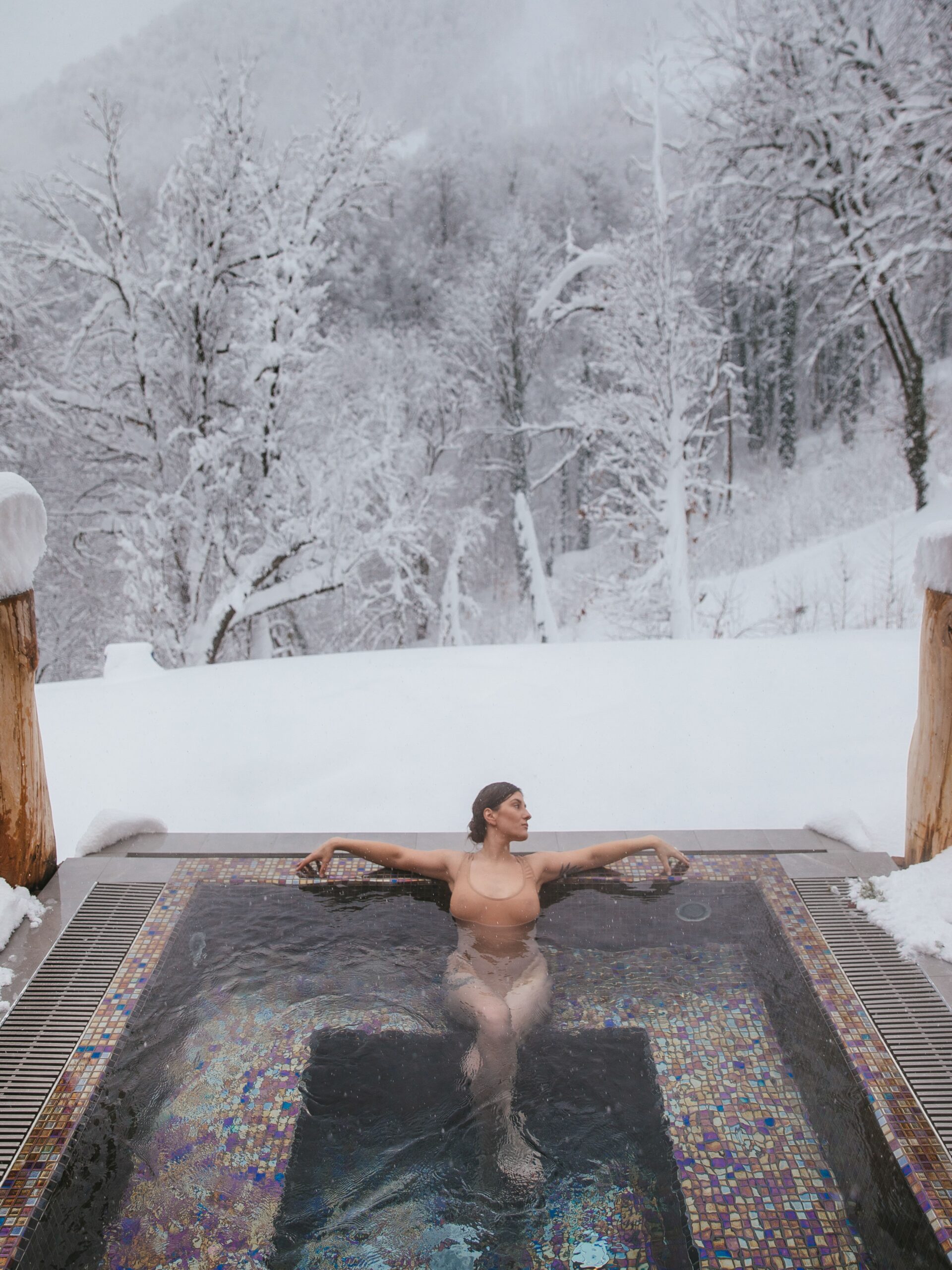
That is the whole trick, and it is why thermal baths in Slovakia keep running in November, in January and through a snowstorm, long after ordinary lidos in this part of Europe have been drained for the winter. The colder the air, the better the thing works. Sitting in 38-degree water with frost in your hair is the entire point.
Anglophone travellers usually know the Hungarian bath houses in Budapest or the Slovenian terme, and those are excellent. Slovakia is the quieter, cheaper version of the same geology: the same Pannonian basin water, but with the High Tatras on the horizon, half the crowds and a day ticket that mostly lands between 15 and 20 euros instead of 30 or 40. Slovakia is in the eurozone, so every price below is in euros, with an approximate pound figure at a rate of 0.84 GBP to the euro.
This guide covers 21 thermal baths, aquaparks and spa towns, plus the one place in the country where you can sit in hot spring water for nothing. For each one you get the water temperature, what is actually in the complex, the admission price, the season, and whether you can get there without a car.
Thermal baths in Slovakia at a glance
- Three different things: a thermal swimming pool (cheap, simple), an aquapark (expensive, slides, indoor hall) and a medical spa (quiet, treatments, age limits). Do not book one expecting another.
- Prices in 2026: from 7.50 € (about £6.30) for three hours at Dudince to 50 € (£42) for a full day at Rajecké Teplice. Most complexes charge 15 to 20 € (£12.60 to £16.80) for an adult day ticket.
- Open all year: Vrbov, AquaCity Poprad, Veľký Meder, Turčianske Teplice, Bojnice and Bešeňová, among others.
- Hottest water: the Parenica cave at Sklené Teplice, 42 °C (108 °F), inside actual rock.
- Free: the only freely accessible spot in this guide is the Kalameny hot spring in the Liptov region.
- Without a car: Poprad, Štúrovo, Veľký Meder, Dunajská Streda and Galanta all have a railway station in the town itself.
- Money: euros everywhere, cards accepted at the large resorts, small village pools sometimes cash only.
What a thermal bath actually is, and the three kinds Slovakia has
The word covers three quite different experiences, and the gap between them is the single most common thing foreign visitors get wrong. In Slovak they even have separate words for them, and locals would never confuse the two.
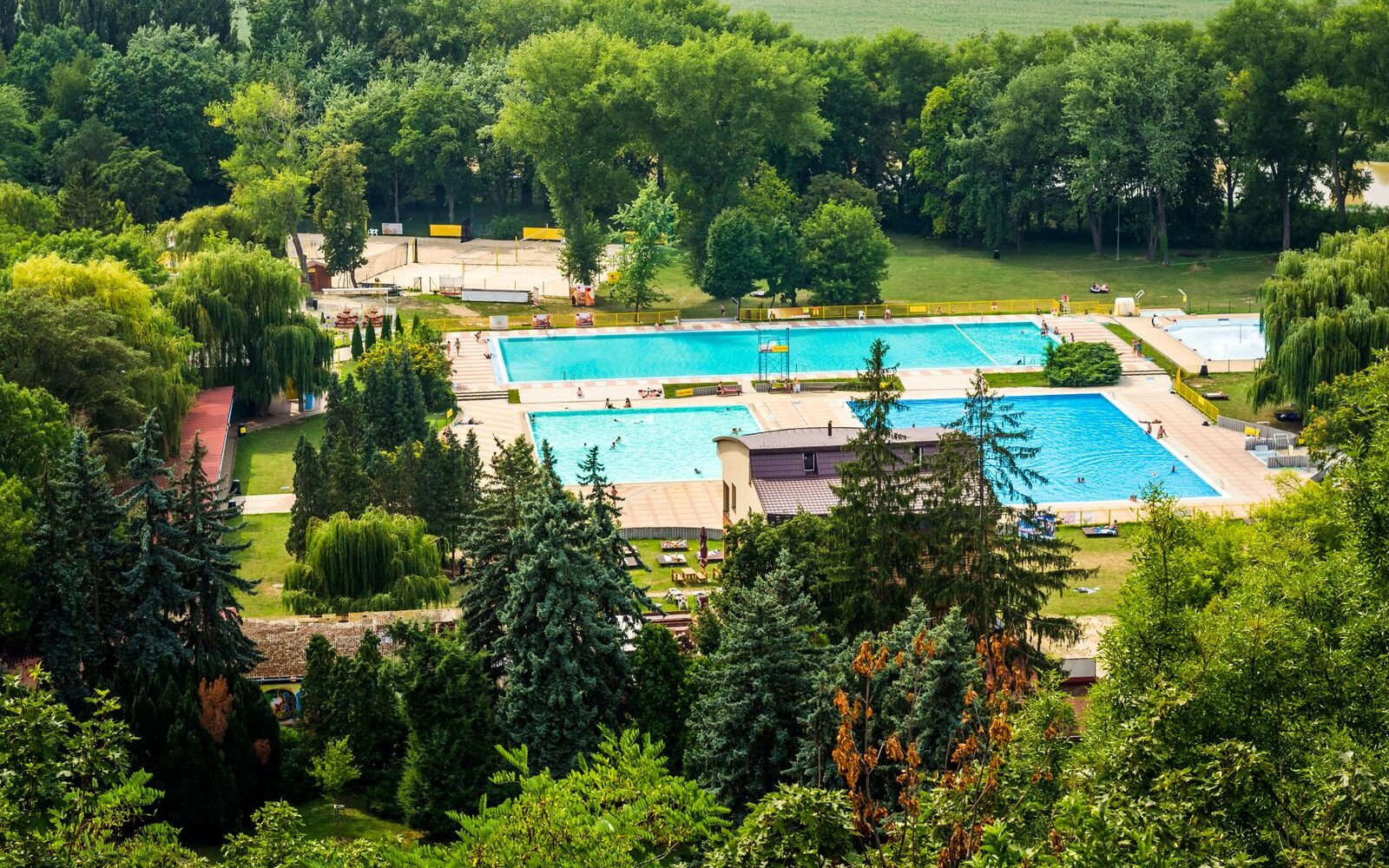
A thermal swimming pool (termálne kúpalisko) is the cheapest option and the most common. A handful of open-air pools fed by geothermal water, a lawn to lie on, a snack bar, maybe one slide. Podhájska, Chalmová, Diakovce and Vyhne belong here, and admission sits between 8 and 17 € (£6.70 to £14.30). Most of them are village-run and unglamorous, which is exactly why they cost what they cost.
An aquapark adds slides, a wave pool, a sauna world and a heated indoor hall that runs through winter. Tatralandia, Bešeňová, AquaCity Poprad and Vadaš are the big ones. You pay roughly twice as much, but when the weather turns you have somewhere to go.
A spa (kúpele) is a different animal altogether and the distinction matters. Bojnice, Sklené Teplice, Dudince and Rajecké Teplice are primarily medical institutions, where most guests are on a doctor-prescribed course of treatment lasting a week or more. The pools are smaller and much quieter, there is often an age limit of 15, and you buy your ticket at the reception desk of a treatment house rather than at a turnstile. If you are travelling with children, check before you drive there.
💡 Tip: Almost everywhere, an afternoon or evening ticket costs a fraction of the day rate. At Podhájska you pay 5 € (£4.20) after 5 pm instead of 16 €, at Kováčová 11 € (£9.20) after 6 pm instead of 18 €. If you only want two or three hours in the water, turn up in the early evening.
Getting there: airports, trains and the vignette that catches people out
Most visitors arrive through Bratislava airport (BTS) or, more often, through Vienna Schwechat, which is only about 60 km from Bratislava and has far more routes. Budapest, Kraków and Katowice all work as entry points too, depending on which end of the country you are heading for, and Košice (KSC) has seasonal flights that put you within an hour of the eastern spas. Poprad has an airport but almost nothing flies into it.
Slovakia is long and thin, and the thermal baths are spread from the Danube lowlands in the south-west to the Tatra foothills in the north-east. From Bratislava, the train to Poprad-Tatry takes around four hours and the train to Košice around five. That sounds slow until you realise how many of the best complexes are within walking distance of a station.
Because plenty of readers travel without a car, every entry below says whether public transport gets you there. In short: Poprad, Štúrovo, Veľký Meder, Dunajská Streda and Galanta have stations in the town itself, and Turčianske Teplice and Rajecké Teplice do too. Kalameny, Oravice, Vyšné Ružbachy and Chalmová are genuinely awkward without your own wheels.
💡 The vignette trap: if you drive on Slovak motorways you need an electronic vignette. A 10-day vignette costs 10.80 € (about £9) and exists only in digital form, bought online at eznamka.sk against your number plate. There is nothing to stick on the windscreen and nothing sold at the border kiosk. Hire cars picked up in Vienna or Budapest usually do not include it, and the fines are enforced by camera, so buy it yourself before you cross.
Aquaparks: the big year-round resorts
These are the complexes with the indoor halls, the slide towers and the sauna worlds. They are the most expensive way to sit in Slovak thermal water and, in bad weather or in February, comfortably the most sensible.
1. Tatralandia (Liptovský Mikuláš)
The largest aquapark in Slovakia, running ten pools all year and fourteen in summer. The oddity here is Tropical Paradise, a seawater hall with a thalasso effect, so you swim in salt water in the middle of the mountains. Open daily 9 am to 8 pm. Tickets go through the GoPass system with prices that change by date, so check before you travel. By public transport: Liptovský Mikuláš is on the main Bratislava to Košice railway, but the park sits on the edge of town, so you finish the journey by local bus or taxi. Accommodation in Liptovský Mikuláš →
2. Vodný park Bešeňová (Liptov)
The best-known complex in the Liptov region, between Ružomberok and Liptovský Mikuláš. It offers 18 summer pools, five of them thermal, and nine pools that run all year, plus slides and a sauna world. Open daily 9 am to 8 pm. Pricing is dynamic by date and sold through GoPass, so the rate you see online is the rate you get. By public transport: there is no station in the village centre, and most visitors arrive from Ružomberok or Liptovský Mikuláš.
If you are choosing between the two Liptov giants: Tatralandia is bigger, louder and better for teenagers and slide addicts, Bešeňová has more actual thermal water and more space to just sit in it.
3. AquaCity Poprad
The complex directly under the High Tatras, and the one with the clearest price list of any big Slovak aquapark. An adult day ticket costs from 31 € (£26) online and 36 € (£30) at the gate, a child, student or senior from 26 € and 31 €, a child under 120 cm pays 1 €, and a three-hour ticket starts at 28 €. The outdoor thermal pool runs at 38 °C (100 °F), the relaxation pools at 33 to 35 °C, the covered Blue Diamond at 34 °C and the 50-metre swimming pool at 26 to 28 °C. Open 9 am to 8 pm. By public transport: the easiest of the lot. Poprad-Tatry station is a short walk away and it is the junction for the electric mountain railway up to Štrbské Pleso, so you can combine a Tatra day with an evening in hot water.
4. Meander Thermal Resort Oravice
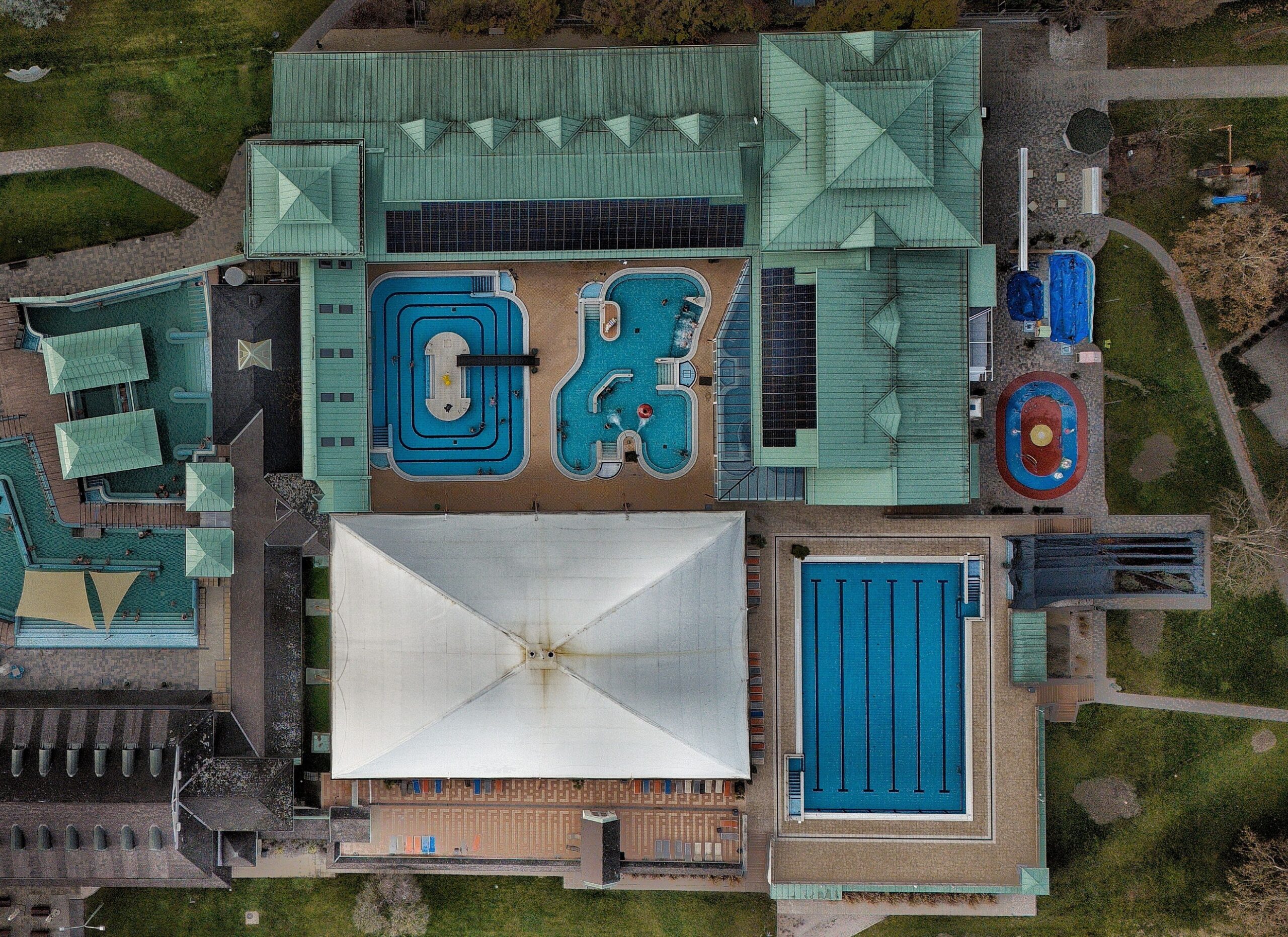
The northernmost entry in this guide, tucked into a valley below the Roháče peaks near the Polish border. It runs all year, with outdoor pools set against the forest and a small ski park next door, so skiing and bathing in the same day is a realistic plan. Prices are published only through the resort’s own online shop, so check them before you set off. Oravice lies well off the main roads and stays calm even when Bešeňová is heaving. By public transport: difficult. This is a car destination, or a taxi from Trstená.
5. Vadaš Thermal Resort Štúrovo
A sprawling resort in the far south, a short walk from the Danube and in full view of the basilica at Esztergom on the Hungarian bank. The Relax adventure pool reaches 40 °C (104 °F), the children’s pool 35 °C, and there is a wave pool called Lagúna and a naturist beach open from 1 June to 31 August. The slide park runs on the same dates, 10.30 am to 7 pm. An adult day ticket is 18 € (£15.10), a child aged 4 to 15 pays 14 €, a 2+2 family ticket costs 60 € (£50), and after 4 pm the rates drop to 15 € and 12 €. By public transport: excellent. Štúrovo is on the main line from Bratislava to Budapest, and the station is in town.
6. Thermalpark Dunajská Streda
A large complex with both indoor and outdoor sections and a sauna world where entry is from 16 and swimwear is not worn. An adult pays 16 € (£13.40) off season and 18.50 € (£15.50) at weekends, on public holidays and in high season from 16 June to 15 September, with concessions from 13.50 €. The slides run daily from 28 June to 31 August. By public transport: straightforward, the town is on the Bratislava to Komárno line and has its own station.
7. Vodný svet Galandia (Galanta)
A town aquapark that stays open daily from 9 am to 9 pm, later than almost anyone else, which makes it the obvious choice if you are arriving late from Bratislava or Vienna. Alongside the pools and attractions there is a sauna world and children’s play areas. The best value is the multi-entry pass: ten full-day entries for 149 €, so 14.90 € (£12.50) each. By public transport: Galanta is a railway junction with a station in town, so it works well without a car.
Thermal swimming pools: the cheaper, simpler side
No slide towers, no branding, often no English signage either. What you get instead is geothermal water at a third of the aquapark price, and in several cases water that is a good deal hotter.
8. Termálne kúpalisko Podhájska
The legend of Slovak bathing, and the place that made the whole idea famous here. The 1973 borehole reaches 1,900 metres down and delivers water at 80 °C (176 °F) at a yield of 30 litres per second. People come specifically for its reputed effect on joints and skin. The outdoor relaxation thermal pool reaches 39 °C (102 °F). The summer season runs from 27 April to 27 September 2026, and a full day costs 16 € (£13.40) for an adult, 12 € and 8 € for concessions, dropping to 5 € after 5 pm. In winter the Aquamarin wellness centre and the covered swimming pool take over. By public transport: the village has no station of its own and buses are infrequent, so this is realistically a car or taxi trip. Find a place to stay in Podhájska →
9. Thermal park Vrbov (Spiš)
Our pick for value under the Tatras. It opens every day of the year including public holidays, and closes only on 24 December. The sitting pool holds 36 to 38 °C (97 to 100 °F), the channel pool 31 to 33 °C and the swimming pool 26 to 28 °C. The price list valid from 26 June 2026 starts at 13.50 € (£11.30) for two and a half hours for an adult and 11.50 € for concessions, with a four-hour ticket from 14.50 € and weekends roughly 3 € dearer. Night bathing runs from 5 pm to 9.30 pm, which in winter means steam, floodlights and almost nobody else. By public transport: awkward. Kežmarok and Poprad are the nearest towns and you would need a local bus or taxi for the last stretch.
10. Vyšné Ružbachy
A summer mountain lido in the Spiš region where a spruce tree grows out of the middle of one of the pools, which tells you most of what you need to know about the atmosphere. Open daily 10 am to 6 pm including holidays. An adult pays 10 € (£8.40) for the day and concessions start at 2 €, with half price after 3 pm. Besides the swimming pool, the island pool and two children’s pools, there is an indoor thermal pool. By public transport: hard without a car, this is one of the four places in this guide we would not attempt on buses alone.
11. Thermal Corvinus Veľký Meder
A Danube-lowland complex set in a pine forest, and our choice for winter bathing in the south. The ticket covers seven year-round thermal pools and two slides. The 2026 price list: an adult pays 13 € (£10.90) for three hours and 19 € (£16) for the day, seniors over 62, children aged 3 to 15 and disabled visitors pay 12 € and 16 €, and a 2+1 family package costs 33 € and 49 €. Open daily 9 am to 8 pm. By public transport: good. The town is on the Bratislava to Komárno railway with a station in the centre.
12. Wellness Patince
A quiet complex near Komárno where the thermal park connects to an open-air summer lido. The indoor pools run all year, the summer lido from 26 June to 31 August 2026. An adult day ticket costs 15 to 17 € (£12.60 to £14.30) depending on the day, a child, student or senior 12 to 14 €, and a child under 120 cm pays 1 €. By public transport: possible with effort. Komárno has a station and a bus link, but a car makes it much simpler.
13. Holidaypark Kováčová
A complex near Zvolen in central Slovakia built on a spring that comes out at 45 °C (113 °F) and also feeds the neighbouring medical spa. A day ticket is 18 € (£15.10) on weekdays and 23 € (£19.30) at weekends, concessions 16 € and 21 €, and an evening entry after 6 pm from 11 €. The indoor pools and the indoor slide run all year, the outdoor pools only in summer. By public transport: Zvolen is a major rail junction a few kilometres away, with local buses onward to the village.
Slovak spa towns: where the water is treated as medicine
This is the part that confuses visitors most, so it is worth spelling out. A Slovak spa town is not a resort with a swimming pool attached. It is a town whose entire economy is built around a licensed mineral or thermal spring, where doctors prescribe courses of treatment on the national health system and where guests typically stay a week or more with a daily programme of baths, mud wraps and physiotherapy. The buildings are grand, the parks are manicured, the atmosphere is closer to a nineteenth-century sanatorium than to a water park, and the pools are for soaking rather than swimming lengths.
The practical consequences for a day visitor are simple. Some of these places sell day tickets to their pools, some sell only individual treatments, some restrict parts of the complex to over-15s, and the ticket desk is usually the reception of a treatment house rather than a turnstile. Always check the current arrangement before you build a day around it.
14. Piešťany
The most famous spa town in the country and the one anglophone visitors are most likely to have heard of. The springs come up from around 2,000 metres at 67 to 69 °C (153 to 156 °F), sulphurous and sulphate-carbonate in composition, and the town’s real speciality is the healing mud dredged from the arms of the river Váh and applied at around 39 °C in full-body wraps. The treatment houses stand on Spa Island between two branches of the river, reached by the functionalist Colonnade Bridge built between 1930 and 1933, with the neoclassical Napoleon Baths alongside. Over 40,000 patients a year pass through, more than half of them from abroad. By public transport: as easy as it gets. Piešťany is 75 km north-east of Bratislava on the main railway to Žilina, and the spa island is a walk from the station.
15. Trenčianske Teplice
A small spa town of under 4,000 people in a side valley near Trenčín, working with sulphurous thermal water that rises from around 1,200 metres and picks up its minerals through limestone. The signature building is the Hammam in the Sina spa house, a Moorish-style Turkish bath from the late nineteenth century that is genuinely unlike anything else in central Europe. The spa specialises in disorders of the locomotive system and the nervous system, combining the thermal water with mineral mud. By public transport: the town is linked to Trenčianska Teplá on the main line by a 5.9 km narrow-gauge electric railway opened in 1909, which now runs seasonally, with buses filling the gap.
16. Bardejovské Kúpele
The spa quarter above Bardejov, in the far north-east near the Polish border, and a completely different proposition from the water parks. This is a working medical spa built around mineral drinking springs, with a colonnade where guests take the waters from little spouted cups, treatment houses, physiotherapy and a wellness hotel with pools and saunas mainly serving residents. Add the open-air museum of folk architecture next door and the UNESCO-listed medieval square down in Bardejov itself, and it makes a proper day out rather than a swim. By public transport: Bardejov has a station and a regular town bus up to the spa, so it works without a car, though the connections from western Slovakia are slow.
17. Kúpele Bojnice
A spa complex just below the fairytale silhouette of Bojnice Castle, running all year. On weekdays from 9 am to 2 pm the outdoor pool is restricted to visitors aged 15 and over, in the afternoon three indoor pools open up, and at weekends the whole Vodný svet runs from 9 am to 8 pm. The historic Jánov bazén operates separately. Tickets are bought at the reception of the Turzov dom treatment house. By public transport: the spa has no station of its own, but the neighbouring town of Prievidza does, with frequent local buses to Bojnice.
18. Sklené Teplice
A European curiosity in the Štiavnické vrchy hills. Parenica is a natural cave containing hyperthermal water at 42 °C (108 °F), high in magnesium and calcium, so you sit in hot water inside the rock with steam pooling under the ceiling. It is the hottest water in this guide by some margin, and sessions are short for good reason. Alongside it are Zrkadlisko at 37 to 39 °C and the Banský kúpeľ at 34 to 36 °C, the latter with a copy of a Botticelli fresco on the wall. Entries are sold as individual treatments rather than as a day ticket. By public transport: difficult, this is a village in the hills best reached by car from Žiar nad Hronom.
19. Kúpele Dudince and the Dudinka lido
The cheapest entry in the whole guide. The Dudince mineral water fills a sitting pool at 33 to 34 °C, the recreation pool runs at 26 to 28 °C, the slide pool at 28 °C and the children’s pool at 30 °C. Three hours costs an adult 7.50 € (£6.30), each further hour started 2.50 €, and a 2+1 family ticket for three hours 18 €. If you want to try Slovak thermal water without spending anything much, start here. By public transport: Dudince is a small town on the road from Budapest towards Zvolen with bus links, but rail access is poor.
20. Spa & Aquapark Turčianske Teplice
The Turiec mineral water carries 1,524 mg of dissolved minerals per litre, which under Slovak law puts it in the category of certified healing springs. The aquapark is open daily from 10 am to 8 pm, with pools and attractions running until 7.30 pm. The price list valid from 1 July 2026: a full day is 28 € (£23.50) for an adult, three hours 23 €, two hours 19 €, and a single hour after 6 pm just 9 €. That last one is the bargain. By public transport: the town has its own railway station within walking distance, one of the few spa towns where that is true.
21. Spa Aphrodite Rajecké Teplice
The most luxurious and by a distance the most expensive place in this guide. The thermal pools cost 28 € (£23.50) for two hours and 50 € (£42) for a full day, a child under 12 pays 16 € and 30 €. The sauna world, which includes pool access, is 40 € for two hours and 80 € (£67) for the day. Open daily 9 am to 10 pm, so it also works as a long evening. By public transport: the town sits on the branch line from Žilina to Rajec and has a station, which makes it one of the easiest luxury spas in central Europe to reach without a car.
Cheap and lesser-known thermal baths
If slides are not the point and you would rather not hand over 20 € a head, these are the village complexes that foreign visitors almost never find.
- Termálne kúpalisko Chalmová (Bystričany, upper Nitra region): a municipal lido with both covered and open-air pools. An adult pays around 8 to 9 € (£6.70 to £7.60), dropping to 4 to 5 € after 5 pm, children and students from 3.50 €. A ten-entry pass costs 70 €. No station in the village, so you need a car.
- AVA Thermalpark Diakovce near Šaľa: main season 25 June to 31 August, an adult roughly 16.50 € (£13.90), 12.90 € after 4 pm. The unusual bit is night bathing from 8 pm to midnight, which almost nowhere else offers.
- Vodný raj Vyhne in the Štiavnické vrchy: pools filled with natural thermal water at 29 to 36 °C (84 to 97 °F), the outflow pool at 36 °C. Open daily 9 am to 8 pm.
- Vincov les near Sládkovičovo and Horné Saliby in the Danube lowlands: classic summer complexes where the clientele is almost entirely local, which is precisely the appeal.
Several of these have a campsite or a motorhome pitch immediately next to the complex, which is a cheap way to combine a night’s sleep with a morning in hot water. We cover the individual campsites, tent prices and which ones stay open all year in a separate guide to camping in Slovakia.
Natural and free hot springs in Slovakia
This is the question anglophone readers ask most and the answer is more sober than most people hope. Freely accessible natural hot springs in Slovakia are almost non-existent. Nearly every productive spring has been piped into a paying complex, and the ones that have not usually sit inside protected nature reserves where bathing is banned outright. If you have seen photographs of wild Icelandic or Bulgarian pools and expect the same here, adjust your expectations before you drive anywhere.
The one place in this guide you can walk into for nothing, at any hour, is the Kalameny hot spring in the Kalamenská valley in the Chočské vrchy hills, roughly a kilometre north of the village of Kalameny in the Liptov region. It is not wilderness in the strict sense: the spring is an artificial borehole drilled in 1991 and 1992, around which a pool of 20 by 10 metres with water at about 33 °C (91 °F) has formed. The water is only weakly mineralised, smells strongly of sulphur and has a golden tint. The outflow pushes up a small fountain at the surface that you can sit under and let the pressure work on your shoulders. There is a fire pit and a few benches, and people bathe here well outside summer.
Entry is free, but the village charges for parking: 5 € (£4.20) for a car, 2 € for a motorbike, 11 € for a caravan trailer and 15 € for a motorhome. At weekends it gets crowded and the facilities really are minimal, meaning a fire ring and not much else. Bring your own everything, take your rubbish home, and go early.
One warning to finish. The Bešeňová travertines, those photogenic orange terraces above the river Váh that circulate on social media, have been a protected natural monument since 1984, covering roughly 3.18 hectares. They are a place to look at, not to get into, and the same applies to the travertine sites in the Spiš region.
Thermal baths in Slovakia in winter
Winter is the best season for this, not a fallback. The gap between freezing air and 38-degree water is the entire experience, and it is the reason Slovaks drive three hours in January to sit outdoors in the dark. The only thing that matters is choosing a complex with outdoor pools connected to the thermal source rather than one that simply keeps an indoor hall heated.
Running all year: Vrbov (except 24 December), AquaCity Poprad, Bešeňová with nine year-round pools, Tatralandia with ten, Veľký Meder with seven thermal pools and two slides, Oravice, Dunajská Streda, Patince, Galandia, Turčianske Teplice and Rajecké Teplice, Bojnice and Sklené Teplice. Vadaš, Vyšné Ružbachy and most of the small southern lidos close in winter or keep only their wellness sections open.
Podhájska switches over to the Aquamarin wellness centre and the covered swimming pool for the cold months, which is a considerably tamer experience than the summer complex with its big outdoor thermal pool. Prices and opening hours differ from the summer list too, so do not plan a January trip from a July price sheet.
💡 Tip: before setting off in winter, open the “aktuálny stav bazénov” (current pool status) page on the complex’s website. Places like Vrbov and Bešeňová publish planned shutdowns and cleaning schedules for individual pools there. Nothing ruins a day quite like driving four hours to find the one pool you came for has been drained.
Prices, temperatures and seasons: the full list
Use this as a rough map of the country’s thermal water. Prices are adult rates for 2026 and operators reserve the right to change them, so confirm on the official website before you travel.
| Place | Water temperature | Indicative adult admission | Season |
|---|---|---|---|
| Tatralandia, Liptovský Mikuláš | thermal and seawater pools | dynamic price (GoPass) | all year |
| Bešeňová, Liptov | 5 summer and 9 year-round pools | dynamic price (GoPass) | all year |
| AquaCity Poprad | 26–38 °C | from 31 € (£26) online per day | all year |
| Meander Oravice | thermal | price list on the website | all year |
| Vadaš Štúrovo | up to 40 °C | 18 € (£15) per day | seasonal |
| Thermalpark Dunajská Streda | indoor and outdoor | 16–18.50 € (£13–16) per day | all year |
| Galandia, Galanta | thermal | 14.90 € (£12.50) on a pass | all year, 9 am–9 pm |
| Podhájska | source 80 °C, pools up to 39 °C | 16 € (£13.40) per day | 27 Apr–27 Sep |
| Thermal park Vrbov | 26–38 °C | from 13.50 € (£11.30) / 2.5 hrs | all year |
| Vyšné Ružbachy | mountain lido | 10 € (£8.40) per day | summer |
| Thermal Corvinus Veľký Meder | 7 year-round pools | 19 € (£16) per day | all year, 9 am–8 pm |
| Wellness Patince | thermal | 15–17 € (£12.60–14.30) per day | all year |
| Holidaypark Kováčová | spring at 45 °C | 18 € weekday, 23 € weekend | all year |
| Piešťany | springs 67–69 °C, sulphurous | treatments and spa packages | all year |
| Trenčianske Teplice | sulphurous thermal | at the spa reception | all year |
| Bardejovské Kúpele | mineral drinking springs | at the spa reception | all year |
| Kúpele Bojnice | hyperthermal pool | at the spa reception | all year |
| Sklené Teplice | cave 42 °C, pools 34–39 °C | charged per treatment | all year |
| Dudinka, Dudince | 26–34 °C | 7.50 € (£6.30) / 3 hrs | summer season |
| Turčianske Teplice | healing mineral, 1,524 mg/l | 28 € (£23.50) per day | all year, 10 am–8 pm |
| Rajecké Teplice | luxury spa complex | 50 € (£42) per day | all year, 9 am–10 pm |
| Chalmová, Bystričany | thermal | 8–9 € (£6.70–7.60) per day | all year |
| Kalameny (natural) | about 33 °C | free (parking 5 €) | all year |
At an exchange rate of 0.84 GBP to the euro, a 16 € day ticket is about £13.40 and the 50 € day at Rajecké Teplice about £42. Operators publish their price lists in euros only, so check the current rate for your own currency before you budget.
Which thermal baths can you reach by train?
A car is not a requirement, which is worth saying plainly because most English-language coverage assumes one. A good number of the best complexes sit in towns with their own railway station: Poprad for AquaCity, Štúrovo for Vadaš on the main Bratislava to Budapest line, Veľký Meder and Dunajská Streda on the line towards Komárno, Galanta as a junction in its own right, Piešťany on the main line north from Bratislava, and the spa towns of Turčianske Teplice and Rajecké Teplice, the latter on the branch line up from Žilina to Rajec.
Trains in Slovakia are cheap by western European standards, run by ZSSK, and tickets are bought online or at the counter without much fuss. What defeats you is the last few kilometres: Kalameny, Oravice, Vyšné Ružbachy and Chalmová have no useful public transport at all, and Bešeňová, Vrbov, Podhájska and Kováčová need a local bus or a taxi from the nearest town. If you are basing a whole trip on trains, build it around Poprad in the north and the Danube towns in the south.
Where to go next
- Things to do in Slovakia: a wide spread of ideas across every region, for a first trip.
- Castles in Slovakia: admission, opening hours and which ones need a guided tour.
- Camping in Slovakia: campsites, prices and the ones that stay open all year, including several next to the thermal complexes above.
- Lakes in Slovakia: mountain tarns, reservoirs and the places where swimming is actually allowed.
- Slovakia by train: tickets, routes and itineraries without a car.
- Where to stay in Slovakia: timber chalets, mountain guesthouses and glamping.
Frequently asked questions
What is a thermal bath, and how does it work?
A thermal bath is a pool filled with geothermal water that comes out of the ground already hot, rather than water heated by a boiler. In Slovakia the boreholes reach 1,200 to 2,000 metres, and at Podhájska the water leaves the well at 80 °C, far too hot to enter. It is cooled on its way to the pools, which typically hold 33 to 40 °C. Because the heat comes from underground, the pools work just as well in January as in July, which is why the outdoor ones stay open through the winter.
Are there free natural hot springs in Slovakia?
Practically the only freely accessible spot is the Kalameny hot spring in the Liptov region, a pool of 20 by 10 metres around a borehole drilled in 1991 and 1992, with water at about 33 °C. You can bathe there in winter and entry is free, though the village charges 5 € for a car and 15 € for a motorhome to park. Every other productive spring is either piped into a paying complex or lies inside a protected area where bathing is not allowed.
What is the difference between a thermal swimming pool, an aquapark and a spa in Slovakia?
A thermal swimming pool is a simple complex of pools filled with geothermal water, with admission between 8 and 17 €. An aquapark adds slides, a wave pool and a heated indoor hall, and costs roughly twice as much. A spa is a medical institution with smaller, quieter pools, often with an age limit of 15, where tickets are sold at the reception of a treatment house and most guests are on a prescribed course of treatment.
Which thermal baths in Slovakia are open in winter?
Vrbov runs every day of the year except 24 December, and AquaCity Poprad, Bešeňová, Tatralandia, Veľký Meder, Oravice, Dunajská Streda, Patince, Galandia, Turčianske Teplice, Rajecké Teplice, Bojnice and Sklené Teplice all stay open too. Podhájska switches to its Aquamarin wellness centre and covered pool for the winter, while Vadaš and Vyšné Ružbachy close.
How much does it cost to enter a thermal bath in Slovakia?
The range is wide. The cheapest are Dudinka at Dudince, at 7.50 € for three hours, and Chalmová at around 8 to 9 € for a day. The middle band covers Podhájska at 16 €, Patince at 15 to 17 €, Vadaš at 18 €, Veľký Meder at 19 € and Kováčová at 18 to 23 €. The most expensive are AquaCity Poprad from 31 € online, Turčianske Teplice at 28 € and Rajecké Teplice at 50 € for a day, which is about £42.
Which thermal baths in Slovakia are best for families with children?
Tatralandia, AquaCity Poprad, Thermal Corvinus Veľký Meder and Thermalpark Dunajská Streda all have children’s pools and slides. Cheaper options are Vadaš at Štúrovo, where a 2+2 family ticket is 60 €, and Dudinka at Dudince, where a family ticket for three hours costs 18 €. Spa complexes such as Bojnice and Rajecké Teplice apply age limits to some of their pools, so check before you go.
Can you reach Slovak thermal baths without a car?
Yes, for a good number of them. Poprad, Štúrovo, Veľký Meder, Dunajská Streda, Galanta, Piešťany, Turčianske Teplice and Rajecké Teplice all have a railway station in the town. Kalameny, Oravice, Vyšné Ružbachy and Chalmová are effectively car-only, and Bešeňová, Vrbov, Podhájska and Kováčová need a local bus or a taxi for the final stretch from the nearest town.
Do I need a motorway vignette to drive to the thermal baths?
If you use Slovak motorways, yes. A 10-day electronic vignette costs 10.80 €, roughly £9, and is sold only online at eznamka.sk against your registration number, with no sticker and no border kiosk. Hire cars collected in Vienna, Budapest or Kraków usually do not come with one, and checks are automated, so buy it yourself before crossing the border.
What are the Slovak spa towns, and can you visit them for a day?
Piešťany, Bardejovské Kúpele, Trenčianske Teplice, Rajecké Teplice, Turčianske Teplice, Bojnice, Dudince and Sklené Teplice are the best known. They are working medical spa towns rather than leisure resorts, built around licensed springs, and most guests stay for a week of prescribed treatment. Day visits are possible at several of them, but what you buy is usually a pool session or an individual treatment bought at a treatment house reception, not a general admission ticket.
What about Aquapark Senec?
Aquapark Senec, about half an hour east of Bratislava, is the one people ask about most often after the list above. It is a large water park with slide towers, a set of pools and a sauna world, and it runs mainly as a summer resort rather than as a geothermal bathing complex, which is why it is not among the thermal baths listed here.
When is the best time to visit thermal baths in Slovakia?
Between October and March, when the gap between air and water temperature is greatest and the complexes are at their emptiest. Summer is both the most expensive and the most crowded season, particularly at weekends. If you do come in summer, either arrive at opening time or wait for the discounted evening ticket.
Potřebujete pomoct s cestováním?
-
Ubytování 🏨
Vyberte si to nejlepší ubytování, ať už jste kdekoliv, přes Booking.com. -
Půjčení auta 🚗
Auto si snadno najdete přes Booking.com, kde máte často slevu díky ubytování, nebo Rentalcars.com, kde porovnáte nabídky většiny půjčoven. -
Zážitky 🎟️
Přes GetYourGuide.com si vyberete z nejrůznějších výletů i zážitků po celém světě, navíc se zrušením zdarma do 24 h předem.