Last updated 30.8.2026
A walled old town squeezed onto a small island, linked to the mainland on one side and to another island on the other, with lanes so narrow you can cross the whole place in the shade at midday. Trogir is a UNESCO World Heritage Site on Croatia’s Dalmatian coast, and it is the easiest stop in the region to reach: Split Airport is six kilometres away and the city of Split about half an hour by road. Here are 15 things to do in Trogir, plus the beaches on Čiovo, the boat trips worth booking and the timing trick that keeps you out of the cruise-ship crush.
In short: the best things to do in Trogir
- The old town has been a UNESCO World Heritage Site since 1997, listed as the best preserved Romanesque and Gothic complex in central Europe.
- The town sits on its own islet between the Dalmatian mainland and the island of Čiovo, with a bridge to each.
- The single greatest sight is the portal of the Cathedral of St Lawrence, which the master carver Radovan finished and signed in 1240.
- You can climb the cathedral bell tower. It is 47 metres tall and gives you the best view in town.
- The old town takes about two hours to walk. That is why most people pair Trogir with a boat trip or a beach day on Čiovo.
- Split is 27 km away and Split Airport only 6 km, which makes Trogir an ideal first or last stop of a Croatian holiday.
- Come early or late. Between ten and four the lanes fill with day trippers, and after six in the evening the town empties out again.
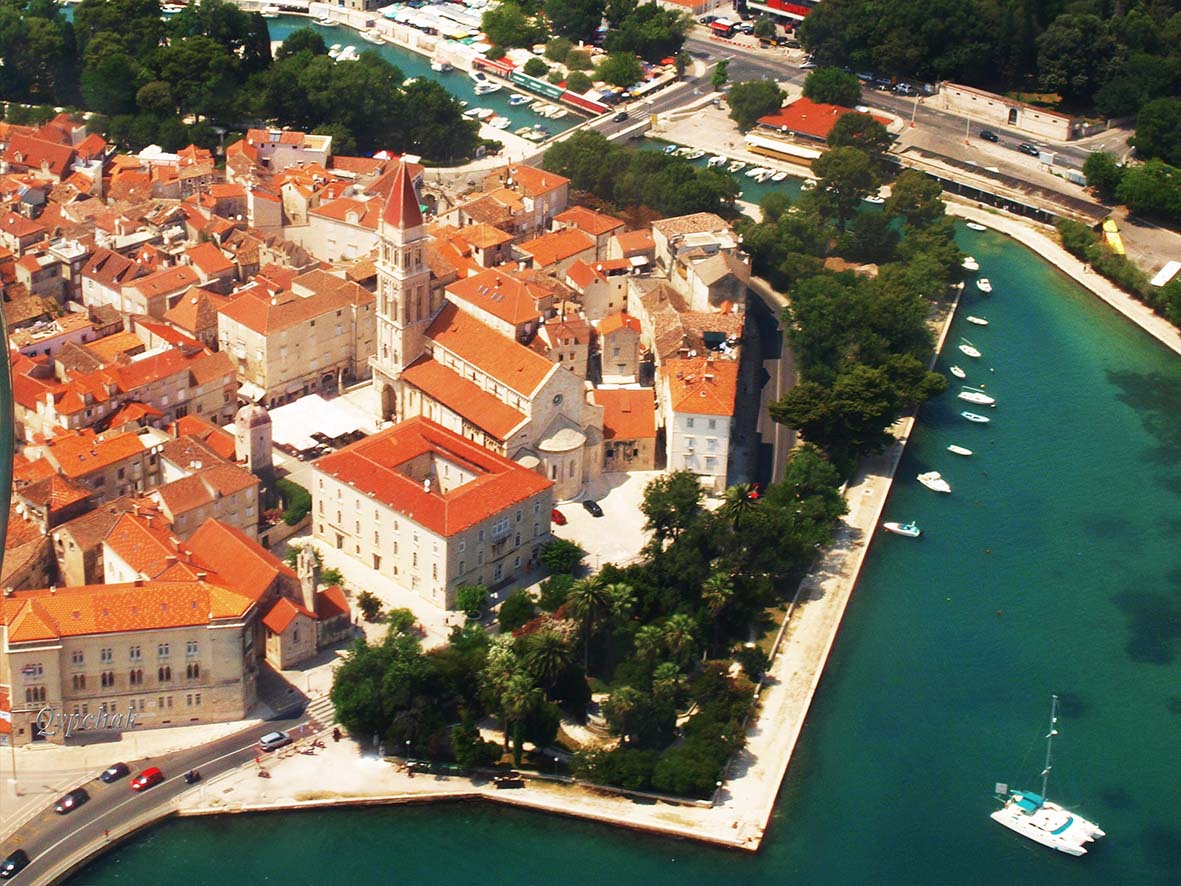
Trogir: two and a half thousand years on one small island
Trogir was founded in the 3rd century BC by Greek colonists from the island of Vis, who called it Tragurion. Romans, Byzantines, Hungarians, Venetians and Austrians all took their turn afterwards, and each period left something behind. That layering is exactly why the old town is on the UNESCO list: since 1997 it has been inscribed as the best preserved Romanesque and Gothic complex in central Europe, with a strong Venetian overlay on top.
The key to understanding Trogir is its ground plan. The old town occupies a small island between the mainland and the island of Čiovo, so it is ringed by water and could never spread outwards. It grew denser instead. The streets are narrow, the houses tall, and nothing is more than five minutes’ walk away. Just over ten thousand people live here today.
15 things to do in Trogir
So here is what we have lined up for you.
1. Cathedral of St Lawrence and the Radovan portal
This is the reason most people come. Work on the cathedral began in 1213, the bulk of it went up in the 13th century and the finishing touches were still being added in the 17th. It is dedicated to St Lawrence, known locally as Sveti Lovre.
The real treasure, though, is the west portal, finished and signed by the master carver Radovan in 1240. It is a densely carved stone doorway crowded with figures, animals, the months of the year and scenes from everyday life, and the inscription on it says Radovan was “the best in this craft of all”. Give it more than a minute. Every section tells a different story.
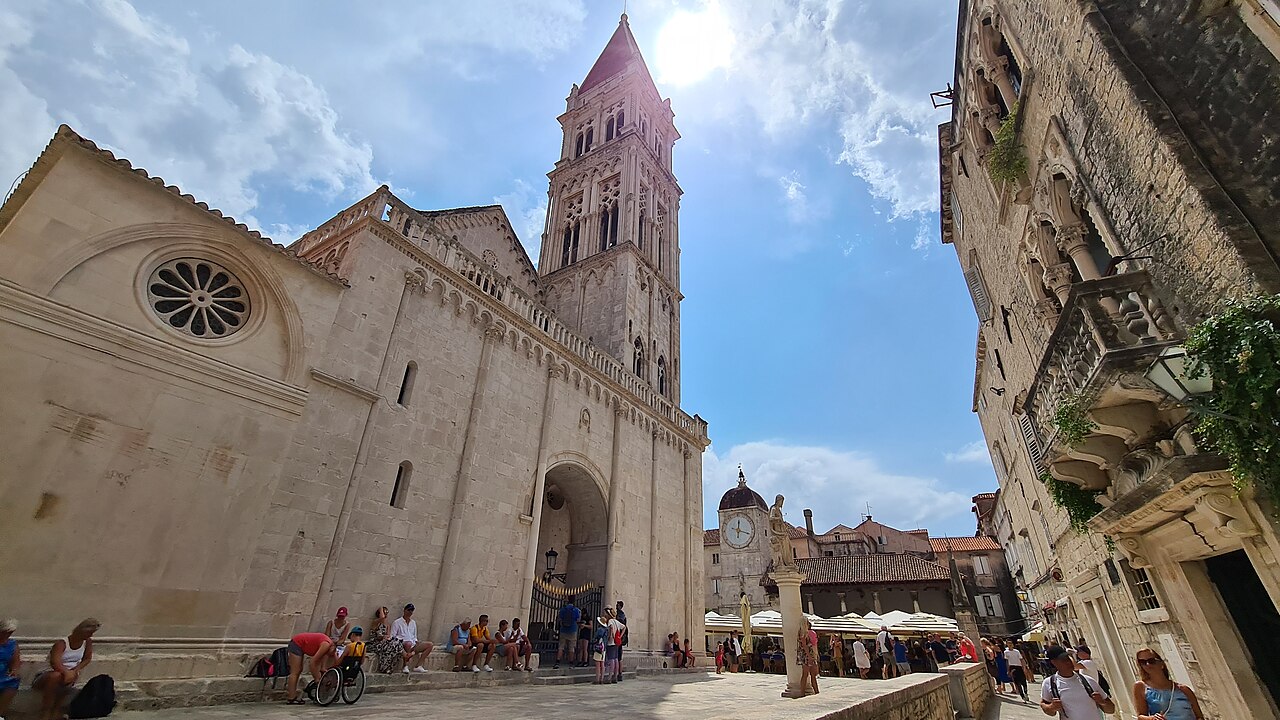
2. The cathedral bell tower
The tower beside the cathedral is 47 metres tall. It was begun at the end of the 14th century and only completed at the end of the 16th, and each storey shows a different style as the work dragged on. You can climb it, and it gives the best view there is over the roofs of Trogir, the channel and Čiovo. The staircase is narrow and steep, so it is not for everyone.
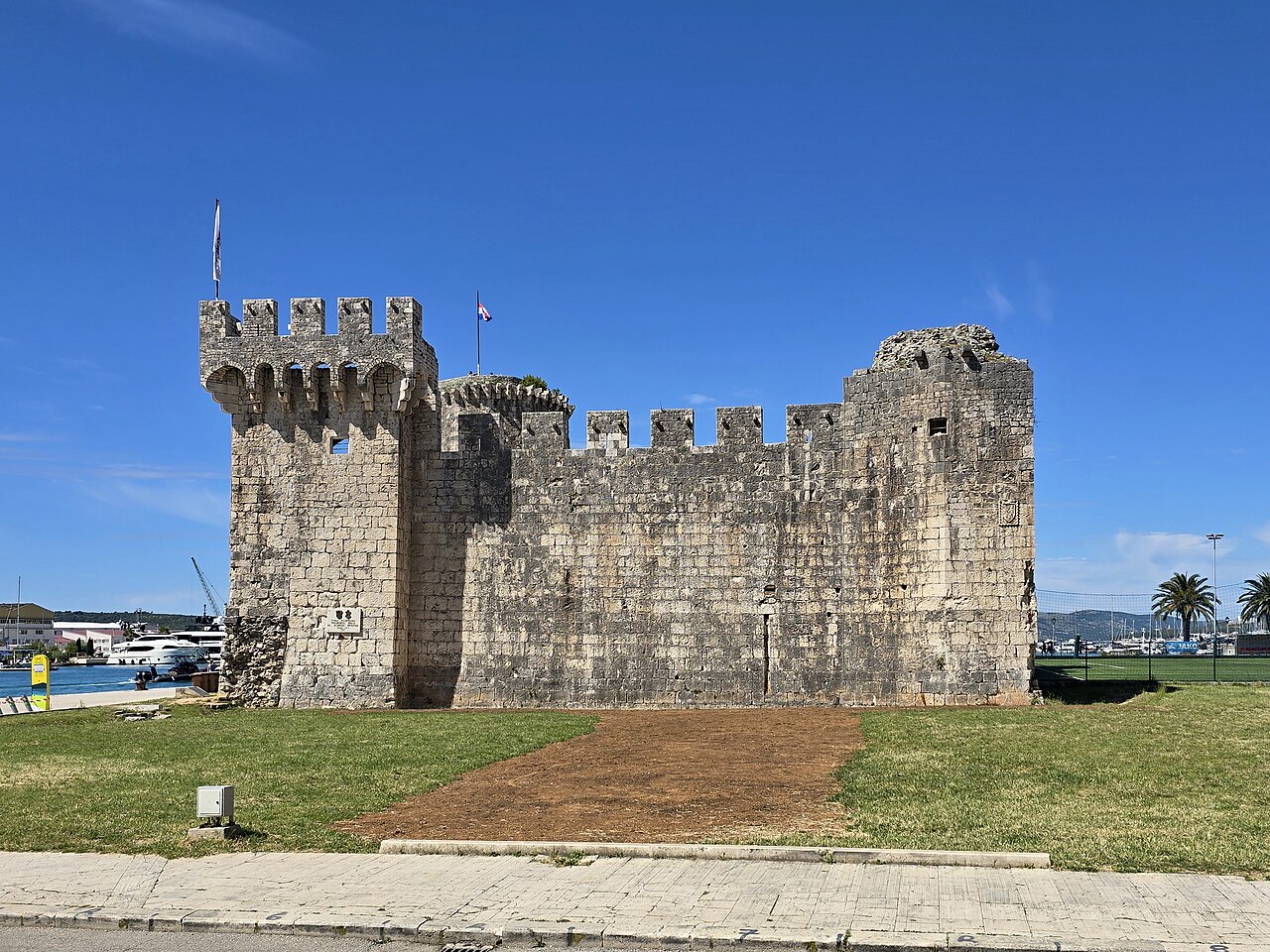
3. Kamerlengo Fortress
A 15th-century Venetian fortress on the western tip of the island, built to control access to the channel. Today it is an empty stone shell you can walk right around on the ramparts, and in summer it hosts concerts and open-air film screenings. The view from the walls is different from the one off the bell tower: lower down, but straight out to sea.
4. St Mark’s Tower
A round bastion a short walk from Kamerlengo, the surviving remnant of the same defensive system. The green strip between the two buildings, with a playground and a few cafés, is the pleasantest spot in town to sit down.
5. Cipiko Palace
Facing the cathedral stands a cluster of houses that belonged to Trogir’s most prominent family. What deserves the most attention are the Gothic triple windows on the facade, among the finest in Dalmatia. Most of the palace is in private hands, but the important part is visible from the street.
6. The town loggia and clock tower
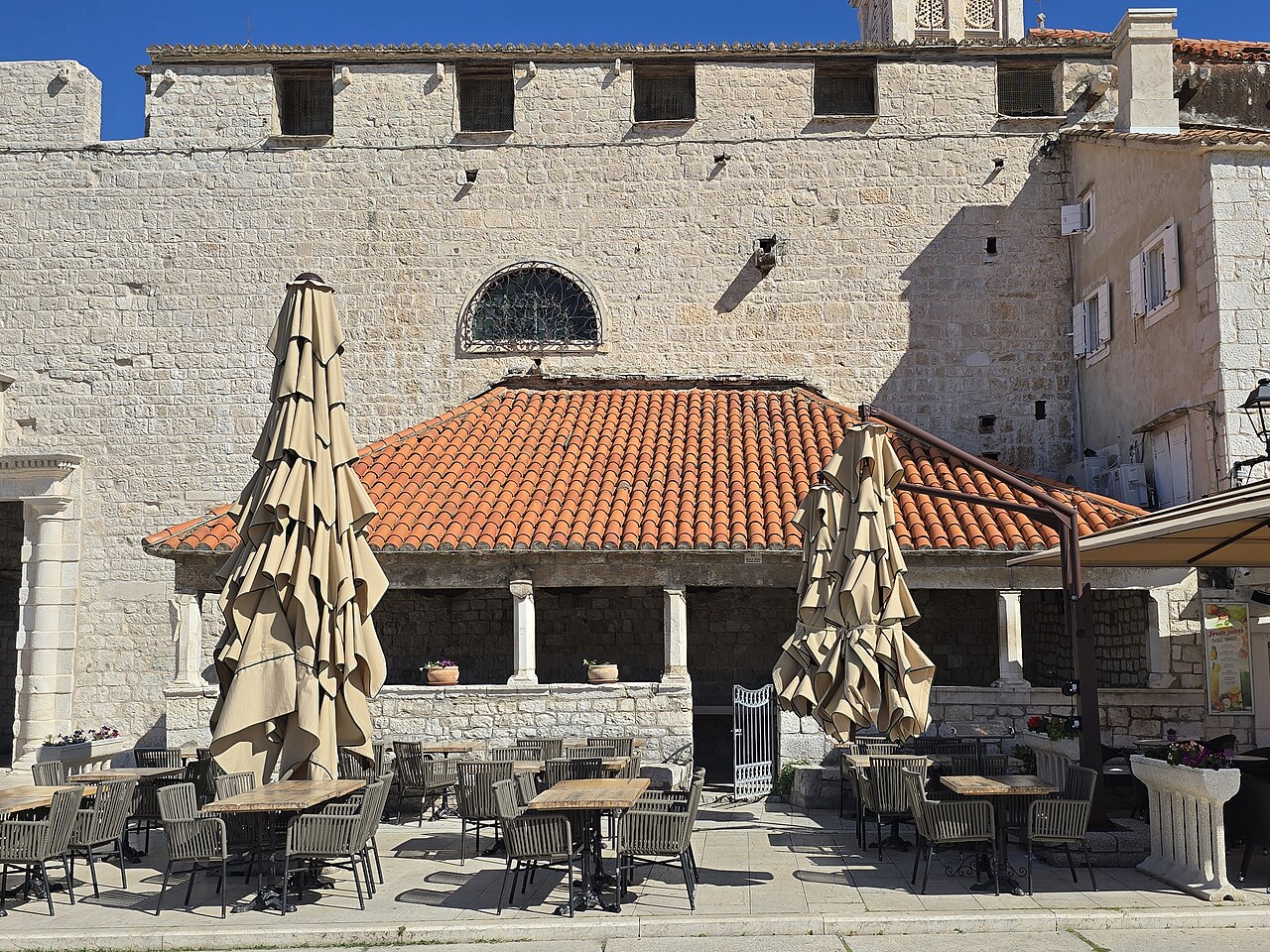
On the main square opposite the cathedral stands an open 15th-century loggia where trials were once held. The stone judge’s table and a relief of justice are still in place. Next to it is the clock tower with the chapel of St Sebastian. St John Paul II Square is enclosed on all sides and is the finest open space in Trogir.
7. The Land Gate and the walls
The northern entrance to the old town from the mainland side, with a statue of the town’s patron saint above it. This is the way you come in from the car parks and the market, and it is the best place to start a visit. Sections of the wall survive around the edge of the island.
8. Monastery of St Nicholas and the Kairos relief
A Benedictine convent that houses Kairos, a Greek relief of the god of the favourable moment carved in the 1st century BC. It is a small collection and few visitors know about it, so it stays quiet even in high season.
9. St Dominic’s Monastery
A Gothic church and monastery on the southern side by the waterfront, with a plain white interior and the tombstones of Trogir’s nobility. It is noticeably cooler inside than out, which in August is an argument in itself.
10. Church of St Peter
A smaller church tucked into the lanes of the old town, given a Baroque makeover, and easy to walk straight past if you are not looking up. It is precisely these small finds that make wandering Trogir more than a march towards one cathedral.
11. Trogir Town Museum
A collection housed in one of the palaces by the northern gate: documents, paintings, carved stone fragments and an old pharmacy. An hour of your time and a good plan for when it is baking outside.
12. The Riva promenade and the harbour
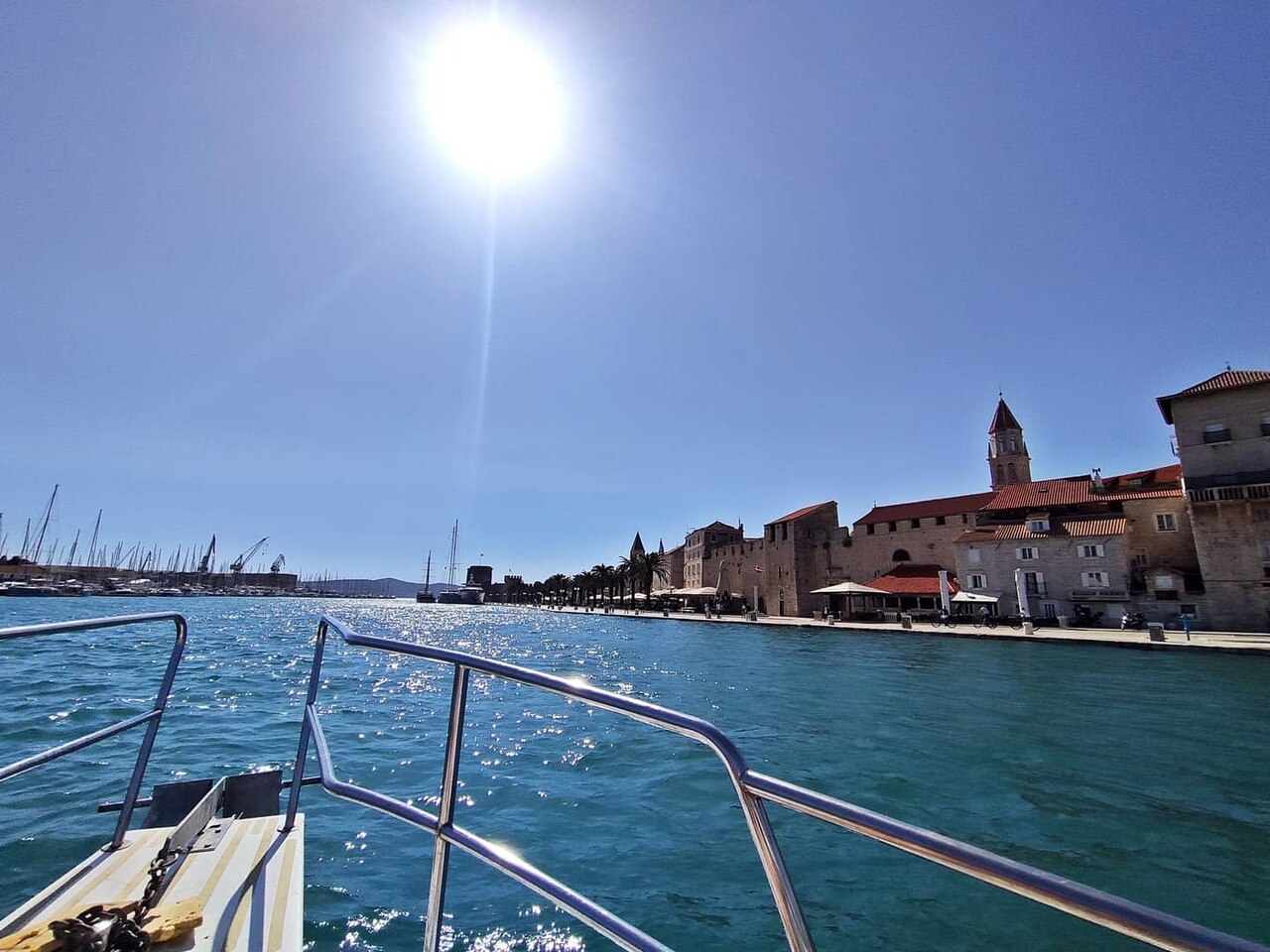
The southern side of the island is one long promenade lined with palms, cafés and moored yachts. By day it is the town’s shop window, in the evening it is the main place to stroll. The excursion boats leave from here too.
13. The market and the fish market
Just over the bridge on the mainland side you will find the fruit and vegetable market, with the fish market next door. Mornings are the time to go, and it is the best place in Trogir to shop for dinner if you are staying in an apartment.
14. The beaches on the island of Čiovo
Trogir itself has no large beaches. Those are just over the bridge on Čiovo. The best known is Okrug Gornji, a long pebble beach with the full range of services, nicknamed Copacabana and packed in season. It is quieter in the coves further along the island, around Slatine for instance, though you will need a car to get there.
15. Pantan beach and the river mouth
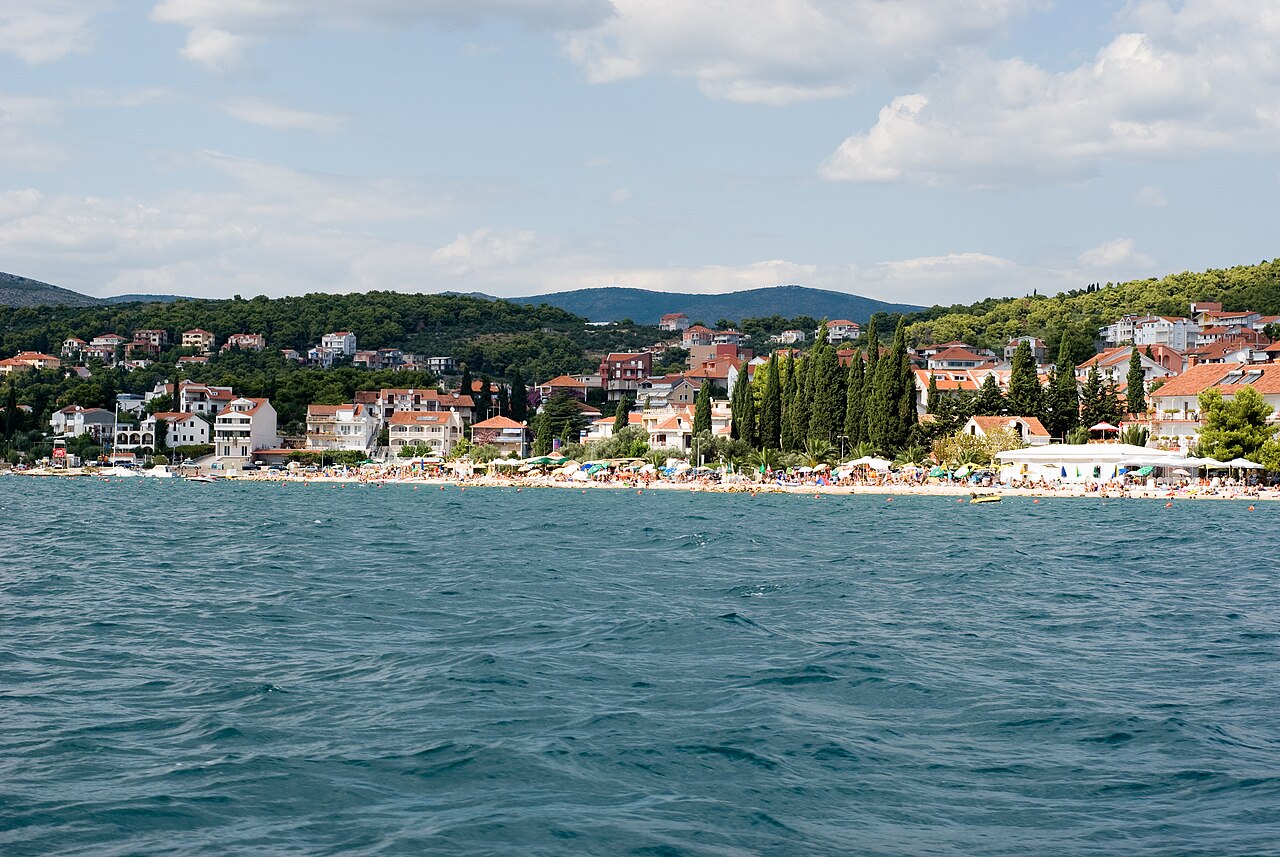
East of town on the mainland side lies a sand and pebble beach at the mouth of the little Pantan river, with a protected wetland and an old watermill behind it. The water here is shallow, which makes it the best choice for families with small children.
The Trogir trick: the town is worked through in one big wave by day-trip coaches and cruise passengers, who arrive roughly between ten and four. Turn up at eight in the morning or after six in the evening and you will have the same lanes almost to yourself, with the cathedral floodlit. The difference really is that big.
Boat trips from Trogir
Trogir is a good base for getting out on the water, and trips are sold along the harbour front for most of the day:
- Blue Cave and Hvar: a full-day circuit to the island of Biševo for the light effect inside the cave, usually with a stop on Hvar or at Palmižana. The most popular and the longest trip, so write off the whole day.
- Blue Lagoon: a shallow turquoise bay between the islets of Drvenik Veli and Krknjaš, half a day, ideal for swimming and snorkelling. The best value in terms of time spent against what you get.
- Drvenik Veli and Drvenik Mali: quiet, barely built-up islands opposite Trogir.
- Šolta: an island of olive groves and small fishing villages, the right call if you want one day with no plan at all.
What to eat in Trogir
The cooking here is Dalmatian, which means plenty of fish, plenty of olive oil and very few sauces. Things worth ordering:
- Gregada. A fish stew of white fish, potatoes, onion and white wine, cooked in one pot. It comes originally from Hvar, but Trogir makes it as a matter of course and it is the best way to eat the local catch.
- Pašticada. Beef larded with bacon, marinated in vinegar and then braised with wine and prunes, served with homemade gnocchi. A Sunday dish, and restaurants often want a day’s notice for it.
- Crni rižot. Risotto blackened with cuttlefish ink. You will know it was good by the state of your teeth.
- Trogirski rafioli. The local baked pastry parcels with an almond filling, made mainly for feast days and weddings. Bakeries in the old town sell them the rest of the year too.
- Grilled fish. In a konoba you pick your fish off the ice and pay by weight. The price per kilo is far higher for the prized species, while oily fish, meaning sardines and mackerel, is cheap and every bit as good.
- Wine from the Kaštela bay. This is the home of the Crljenak kaštelanski grape, which genetic analysis in 2001 showed to be the same variety as Californian Zinfandel and Italian Primitivo.
How to get to Trogir
- From Split Airport it is only 6 kilometres, so ten minutes by taxi or a short bus ride. That is why Trogir works so well as the first or last day of a holiday, before or after a flight.
- From Split it is 27 kilometres west. City and suburban buses run the route, and in season there is also a passenger boat line, which is more comfortable than sitting in the coach queue.
- Flying in: Split Airport (SPU) is the nearest airport and handles seasonal flights from a number of European cities over the summer. Check what is actually flying on your dates rather than assuming a route exists.
- Driving: reaching Dalmatia from central Europe is a full day behind the wheel via Austria, Slovenia and Zagreb. Worth it if you plan to island-hop by car, hard to justify for a short break.
Parking is the single most common headache of a visit. There is no parking at all inside the old town. You leave the car in the car parks on the mainland side by the market, or on Čiovo just over the bridge. In season they are full by midday and a guarded space is not cheap. Arrive after nine and expect to spend a while hunting.
Where to stay in Trogir
- In the old town: apartments in the stone houses, the best atmosphere and everything on foot. Expect noise from the bars and a suitcase dragged over cobbles.
- On Čiovo, just over the bridge: the best compromise. Ten minutes’ walk to the old town, closer to the beaches, and usually somewhere to park by the house.
- Okrug Gornji: for a beach holiday with full services and some nightlife.
- Seget and the mainland side: quieter and cheaper, an easy walk or cycle into town.
You can compare accommodation in Trogir and the surrounding area on a single map with Stay22.
How long to spend in Trogir
Two to three hours is enough for the old town itself, including the climb up the bell tower. Trogir is small, and that is both its charm and its limit: turn up purely for the monuments and your afternoon is free.
Which is why it pays to treat it as a base for two to four days: one day for the town, one for a boat trip, one for a beach on Čiovo, and perhaps one for Split or the Krka waterfalls. In that combination Trogir works far better than as an hour-long stop on the way somewhere else.
Things to do near Trogir
- Split and Diocletian’s Palace, half an hour away by car or boat.
- Krka National Park and its waterfalls, around an hour and a half to the north.
- Primošten and Rogoznica, two photogenic little towns on the way to Šibenik.
- Klis, the fortress above Split that Game of Thrones fans will recognise.
- Marina, a quiet town on a bay a few kilometres west, the sort of place people drive to for lunch.
- Salona, the ruins of the ancient city beside Solin, once the capital of the Roman province of Dalmatia. The amphitheatre, the walls and the basilicas survive, and it is just under thirty minutes from Trogir.
- The Kaštela riviera, seven villages with Renaissance castles strung out between Trogir and Split, which gave the bay its name. People come here for calmer beaches and cheaper lunches than in Trogir.
- The Pantan nature reserve, a wetland fed by a karst spring with an old Venetian mill on the eastern edge of town, and a bird hide.
Frequently asked questions about Trogir
Is Trogir worth visiting?Yes, and it is one of the easiest side trips in Dalmatia. The old town is compact enough to see in two to three hours, it is a UNESCO World Heritage Site with a genuinely exceptional cathedral portal, and it sits 6 kilometres from Split Airport. Come outside the ten to four window and it is a very different place from the one on the day-trip photos.
Why is Trogir a UNESCO World Heritage Site?The old town has been inscribed since 1997 as the best preserved Romanesque and Gothic complex in central Europe, with a strong layer of Venetian architecture. Its finest monument is the Cathedral of St Lawrence with the portal carved by the master Radovan in 1240.
How long do you need in Trogir?Two to three hours covers the old town itself, including the climb up the bell tower. As a holiday base it is better to allow two to four days so you can fit in a boat trip and a beach day on Čiovo as well.
How far is Trogir from Split and from the airport?Split is 27 kilometres to the east, and Split Airport is only 6 kilometres away, roughly ten minutes by road. That is exactly why so many people put Trogir on the first or last day of the trip.
Are there beaches in Trogir?Not in the old town itself. The beaches are just over the bridge on the island of Čiovo, the best known being the long pebble stretch at Okrug Gornji, nicknamed Copacabana. Families with small children are better off at the shallow Pantan beach east of town.
Can you drink the tap water in Trogir?Yes. Tap water is drinkable throughout Croatia and Trogir is no exception. There is no need to buy bottled water, just carry a refillable bottle.
Can you pay by card in Trogir?In restaurants, shops and paid car parks, yes. Keep some cash for the fish market, the produce market and smaller konobas outside the centre. Croatia has used the euro since 1 January 2023 and kuna are no longer accepted, so budget in euros (roughly 85p to the euro).
Where do you park in Trogir?Not in the old town, which is pedestrianised. You use the paid car parks on the mainland side by the market or on Čiovo immediately over the bridge. In high season they tend to be full by midday, so it pays to arrive early in the morning.
Can you climb the bell tower of Trogir cathedral?Yes. The tower is 47 metres tall, built between the end of the 14th and the end of the 16th century, and it gives the best view over the town, the channel and Čiovo. The staircase is narrow and steep.
Which boat trips from Trogir are worth doing?For half a day, the Blue Lagoon among the islets off Drvenik Veli, where the water is shallow and turquoise and the snorkelling is good. For a full day, the circuit to the Blue Cave on Biševo with a stop on Hvar. Both are sold directly along the harbour.
When is Trogir least busy?Early morning until about nine, and evenings after six. Between ten and four the day-trip coaches and cruise ships arrive and the lanes are packed. The contrast between late morning and early evening in Trogir really is dramatic.
Potřebujete pomoct s cestováním?
-
Ubytování 🏨
Vyberte si to nejlepší ubytování, ať už jste kdekoliv, přes Booking.com. -
Půjčení auta 🚗
Auto si snadno najdete přes Booking.com, kde máte často slevu díky ubytování, nebo Rentalcars.com, kde porovnáte nabídky většiny půjčoven. -
Zážitky 🎟️
Přes GetYourGuide.com si vyberete z nejrůznějších výletů i zážitků po celém světě, navíc se zrušením zdarma do 24 h předem.