Last updated 30.8.2026
Most of the Valencia landmarks people fly in for sit inside one small loop, and that loop can be walked in a single morning. The old town, known locally as Ciutat Vella, fills the arc left behind by a diverted river. It is flat, it is closed in on itself, and there is not a single hill in it. From the city gate on the northern edge to the second gate on the western side is a little over two kilometres of walking, and in between you pass a Gothic cathedral, a chalice that many people believe is the Holy Grail, a UNESCO listed silk exchange and a food market that is really a piece of architecture with fishmongers in it.
What follows is that loop, stop by stop: where to start, what sits between the stops, how long each one realistically takes and where the queue forms. Nothing here needs a car, a tour or a booking made weeks in advance.
In short: the Valencia landmarks on this old town walking route
- The whole loop is roughly two to three kilometres with no climbing at all. Three hours gets you round it. A full day lets you enjoy it.
- Start at Torres de Serranos, the northern city gate. It is the most logical way into Ciutat Vella and you can climb it.
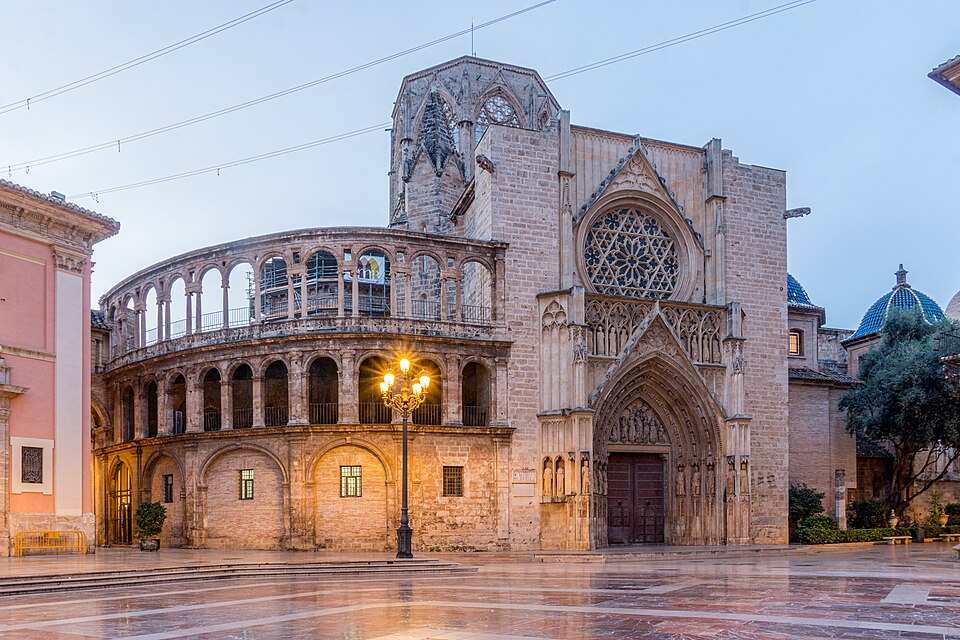
- Valencia Cathedral stands on Plaza de la Almoina and took so long to build that Gothic, Renaissance and Baroque sit side by side inside it.
- The Holy Grail has its own chapel in the cathedral. The chalice was given to the cathedral by Alfonso V of Aragon in 1436 and Benedict XVI used it at a mass in Valencia in 2006.
- Lonja de la Seda, the silk exchange, was built between 1482 and 1533 and has been on the UNESCO World Heritage list since 1996.
- Mercado Central is a building first and lunch second. It opens Monday to Saturday, 7.30 to 15.00, so it only fits into the route in the morning.
- Torres de Quart close the loop on the western side. They are rougher, plainer and far less visited than Serranos.
- Walk early. Between nine and eleven the lanes are cool and quiet. After midday the centre fills up and the sun drops straight onto squares with no shade.
Where to start a walk through Valencia’s historic centre
Ciutat Vella has no single front door, but it has two gates that work better than any other entry point, and the northern one wins. Torres de Serranos is where this route begins, for two reasons. First, the walk then runs naturally from the edge to the middle and out again on the far side, so you never retrace your steps. Second, the approach is the nicest in the city.
That approach is the Turia gardens, the old river bed turned into a green belt that wraps around the old town from the north and the west. For this walk it matters only as a link: whichever part of Valencia you are staying in, you can drop down into the park, follow the floor of the vanished river for a while and come up right underneath the towers. You walk in tree shade the whole way and you do not cross a single junction.
Getting to that starting point is straightforward. Valencia is served by direct flights from several UK airports, including London, Manchester and Birmingham, and the schedule is thickest between spring and early autumn, so check what is actually flying on your dates rather than assuming. From the airport, metro lines 3 and 5 run into the city and drop you a short walk from the northern edge of the centre, which is the cheap and simple option with hand luggage. If you arrive by train at Estació del Nord in the south, flip the route and walk it backwards, from Mercado Central and the Lonja up through the cathedral to the gates. That works just as well, with one condition: do the market genuinely early, because the doors shut at three in the afternoon.
Tip: set off shortly after nine. At that hour the lanes of Ciutat Vella are still in shade, the cafés on the squares are opening and there are no tour groups parked in front of the cathedral. The difference between nine in the morning and one in the afternoon is enormous, and temperature is only part of it.
The route step by step: seven stops across the old town
This is the skeleton of the walk. The times assume you are not rushing and that you stop for a coffee somewhere. The distances between the stops are short, usually a few minutes through narrow lanes in which it is easy to get lost, which is incidentally the best part of the whole day.
| # | Stop | What you see here | Time | To the next stop |
|---|---|---|---|---|
| 1 | Torres de Serranos | City gate, climb to the walkway, views over the Turia gardens and the old town roofs | 30 to 40 min | 8 min on foot |
| 2 | Plaza de la Virgen | Square with the basilica and fountain, the historic core of the city | 20 min | 1 min |
| 3 | Cathedral and the Miguelete | Interior, the Holy Grail chapel, climb up the bell tower | 60 to 90 min | 7 min |
| 4 | Plaza Redonda and the lanes | Circular little square, small shops, the way south through the centre | 15 min | 4 min |
| 5 | Lonja de la Seda | Main hall with twisted columns, orange tree courtyard, tower | 45 min | 2 min |
| 6 | Mercado Central | Iron frame, domes, stained glass, market stalls (mornings only) | 30 min | 12 min |
| 7 | Torres de Quart | Western gate, artillery scars, climb to the top | 30 min | end of the loop |
Added up, that comes to just under four hours of actual sightseeing, which in practice means a morning and a slice of the afternoon. If you have more time, keep an hour spare between stops three and four, because that is where the narrowest lanes and the best doorways are.
1. Torres de Serranos: the gate you walk in through
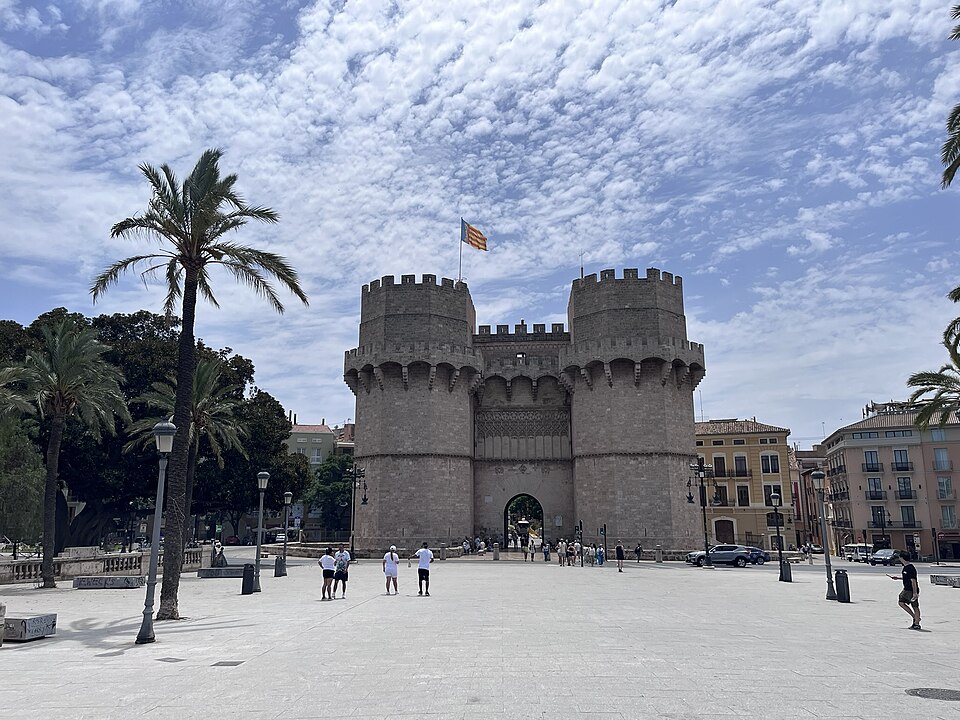
Standing underneath them, it is hard to believe these were built to keep people out. Torres de Serranos, Porta dels Serrans in Valencian, is a pair of heavy polygonal towers joined by a passage that once belonged to the city walls. The walls themselves are long gone, cleared as the city expanded, and two gates are all that survived. This is the handsomer and more ceremonial of the pair.
From the street it almost looks like stage scenery, standing on its own at the edge of a square with the park opening up behind it. The interesting view is from the inner side: there the gate has no wall, so the staircases and walkways are exposed in cross section and you can read exactly how the thing was put together. You can climb the towers, and from the top you get the green ribbon of the Turia gardens on one side and a sea of Ciutat Vella rooftops on the other. For the effort involved it is the best view in the centre, because the staircase is short and wide rather than a punishing spiral.
The surprise here is how empty it is early on. Most visitors head straight for the cathedral and tick the gates off from the pavement without ever going up. Arrive shortly after opening and the walkway is likely to be almost yours.
A word on numbers: check admission and opening hours for Torres de Serranos the day before on visitvalencia.com. Municipal monuments change both rates and timetables by season, and some days come with reduced or free entry. Prices are in euros, and as a rough guide 1 € is about 0.85 £. Copying specific figures out of other people’s articles is the fastest way to get this wrong.
2. Plaza de la Virgen: the square where the city started
It is a few minutes from the gate to the cathedral, and the way there runs through exactly the kind of lanes that make old towns worth visiting: narrow, shaded, washing on the balconies, workshop doors that have clearly been in the same family for generations. Then the space opens without warning and you are standing on Plaza de la Virgen.
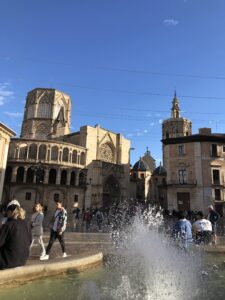
This is the heart of the historic centre. Arcades and café tables run round the edges, a fountain sits in the middle, and three of the most important buildings in the city meet here: the basilica of the Virgin of the Forsaken, the flank of the cathedral, and the building where the water court still sits, an ancient tribunal that settles disputes between irrigators farming the land around the city. It convenes in the open air right by the cathedral door, and it is one of those things that looks like a tourist attraction and is not one.
A few steps away, on Plaza de la Almoina, you can go underground into the archaeological site. Layers of the Roman, Visigothic and Islamic city survive stacked under the paving, and you walk over them on glass walkways. It is a small stop, but anyone who wants to understand why the cathedral stands on this precise spot should go down.
3. Valencia Cathedral: Gothic with four more centuries grown onto it
Of all the Valencia landmarks on this loop, the cathedral is the one that eats the most time. It stands on Plaza de la Almoina and its underlying style is Valencian Gothic, except that it was built and rebuilt for so long that you can also point at Romanesque, French Gothic, Renaissance, Baroque and Neoclassical elements on the same building. The clearest way to see this is from outside: walk right round it and you pass three completely different facades, each from a different world. A Romanesque portal on one side, a heavily decorated Baroque entrance on the other.
Inside, the cathedral is brighter and less cluttered than most people expect. The nave is tall, the choir feels airy and the side chapels can be worked through fairly quickly. Be aware that a queue tends to build at the entrance around midday, because that is when the organised groups arrive. Early morning is a different experience entirely, with people walking straight in; by one in the afternoon the line can stretch across half the square.
The Miguelete: the tower you climb
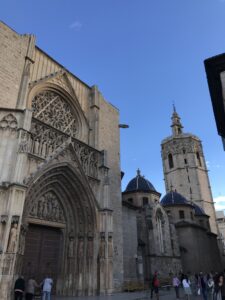
The cathedral bell tower, called the Miguelete (Micalet in Valencian), stands at the corner by the main facade and is the most obvious landmark in the old town. It is octagonal, built of stone, and you can climb it up a spiral staircase. The exact number of steps differs from source to source, and even the cathedral does not settle the question, so save your legs rather than your counting.
The staircase is narrow, and at some point people going up meet people coming down, which takes patience. The reward is the whole historic centre from above: you can see how compact Ciutat Vella is, where it stops and where the modern city takes over. More to the point, this is where the shape of your own route finally makes sense.
Practical note: the Miguelete and the cathedral are separate visits with separate entrances in different places. If you want both, do the interior first and the tower afterwards, because after that climb an audio guided tour is the last thing you will feel like.
The Holy Grail: the chalice an Aragonese king gave away
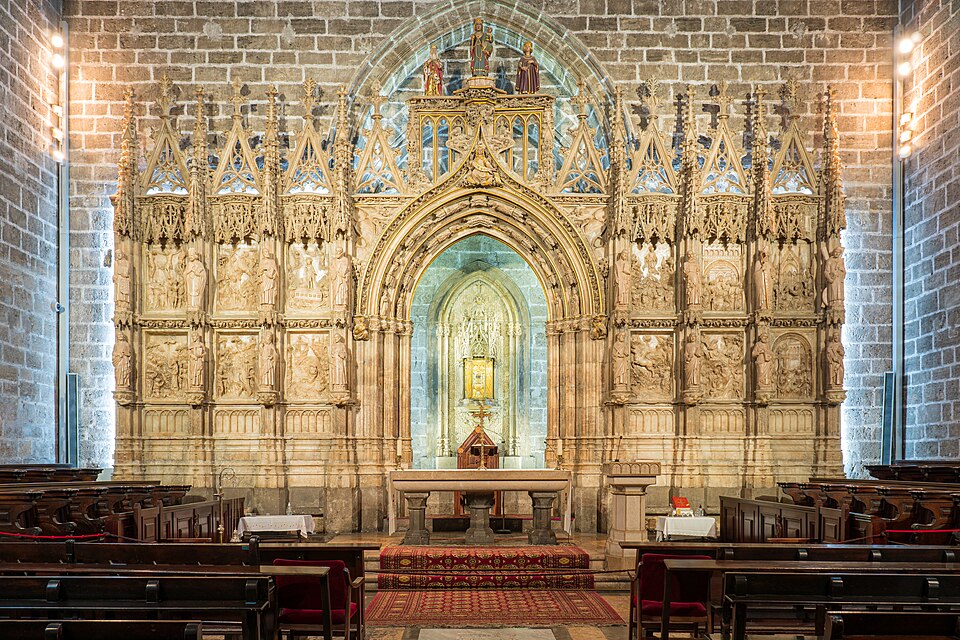
This is the part of the cathedral that many people come for in the first place, and the part guidebooks word most carefully. In one of the chapels, the former chapter house, sits the Santo Cáliz, a chalice widely believed to be the true Holy Grail, the vessel of the Last Supper.
The documented facts look like this. The chalice was given to the cathedral by Alfonso V of Aragon in 1436 and has been in Valencia ever since. Its upper part, a bowl of dark stone, is estimated by specialists as possibly dating to the first century, while the gold stem, the pearls and the gemstones around it are medieval additions. And because the Church has never formally closed the question or dismissed the relic, it is used in worship: Pope Benedict XVI celebrated mass with it in Valencia in 2006.
Expectation and reality part company here, and that is said without any irony. The chapel is small, the chalice is small, and it sits behind glass in a well lit niche. Anyone arriving with a Hollywood set in mind will need a moment to adjust. Anyone who sits down in a pew and lets it sink in that people have been coming to look at this object for nearly six hundred years tends to leave with a completely different feeling. It is a quieter stop than the nave and, for many visitors, the more memorable one.
4. Lonja de la Seda: the silk exchange and the only UNESCO site in the centre
Lonja de la Seda, Llotja de la Seda in Valencian, means silk exchange, and that is what it was. This is a commercial building from the period when Valencia ranked among the richest ports in the Mediterranean and the silk trade paid for everything else. In English it is usually simply called the Silk Exchange, and it has been a UNESCO World Heritage site since 1996, the only one in the historic centre.
It was built between 1482 and 1533 to a design by the architect Pere Compte, and it comes in three parts: the main trading hall, the consulate pavilion and the central tower. The hall is the knockout. It is called the Sala de Contratación and it is carried on a row of tall twisted columns that look as though somebody took each one by both ends and wrung it. At the top they branch out into the vaulting like palm trees. It went up between 1483 and 1498, that is in fifteen years, and it is proud enough of the fact to say so on the wall in Latin: Inclita domus sum annis aedificata quindecim, “I am a famous house, built in fifteen years”.
Beyond the hall you come out into a courtyard planted with orange trees, where there is shade to sit in, and a staircase leads up into the tower. On the upper floor of the consulate pavilion there is a gilded coffered ceiling that plenty of visitors miss simply because they do not realise they are allowed up there. Go up.
Good news for planning: the Lonja stands directly opposite Mercado Central, across the street. The two stops are done back to back and there is no way to confuse them.
5. Mercado Central: the market worth seeing for the building
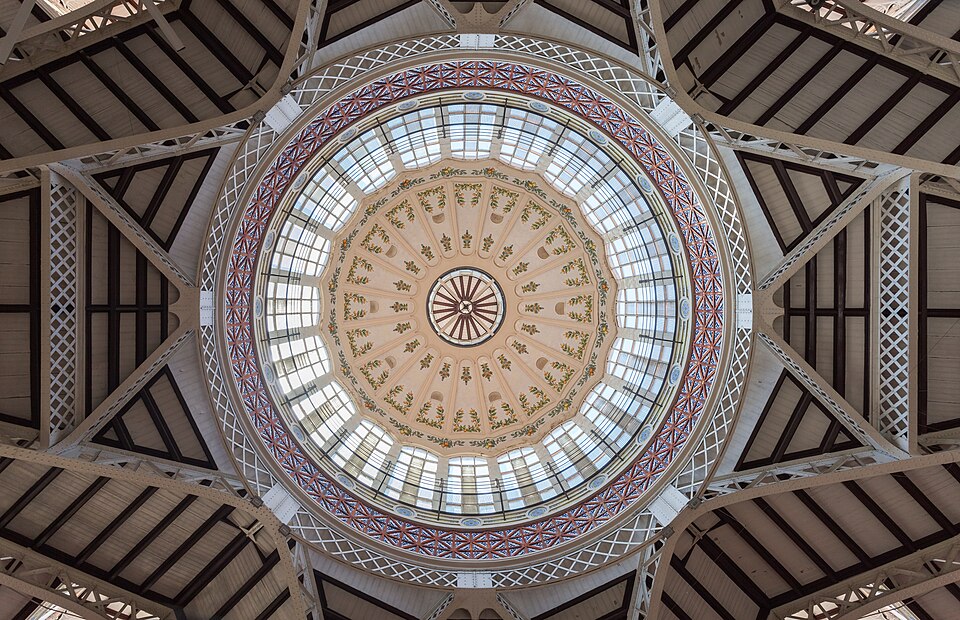
Mercado Central, Mercat Central in Valencian, is nearly always written about as a place to eat. It belongs on this route for a different reason: it is one of the finest buildings in the historic centre, and even if you bought nothing at all, not one orange, walking through it would still be worth the detour.
It is a large hall in the Valencian Art Nouveau style, from the moment when cast iron columns and glass first became something architects could play with. The steel frame carries glazed domes that drop daylight into the middle of the floor, the walls carry coloured stained glass and ceramic tiling, and the interior is one open space with no partitions at all. Walk in from the Lonja side and the first thing you do is look up. Everybody does.
The practical detail that decides the order of the stops: the market is open Monday to Saturday from 7.30 to 15.00 and closed on Sundays. That means it only fits into the walk if you slot it in during the morning or shortly after midday. Turn up at four in the afternoon and you will find the shutters down and be admiring the outside, which is a shame, because the outside is handsome and the inside is astonishing.
The hour makes a difference inside, too. It is busiest until about ten, while locals are doing their shopping, then the visitors with cameras arrive, and by two the traders are packing up. Shortly after nine is the sweet spot: the hall is still working, and the light coming down through the domes falls at an angle that photographs well.
6. Torres de Quart: the second gate and the end of the loop
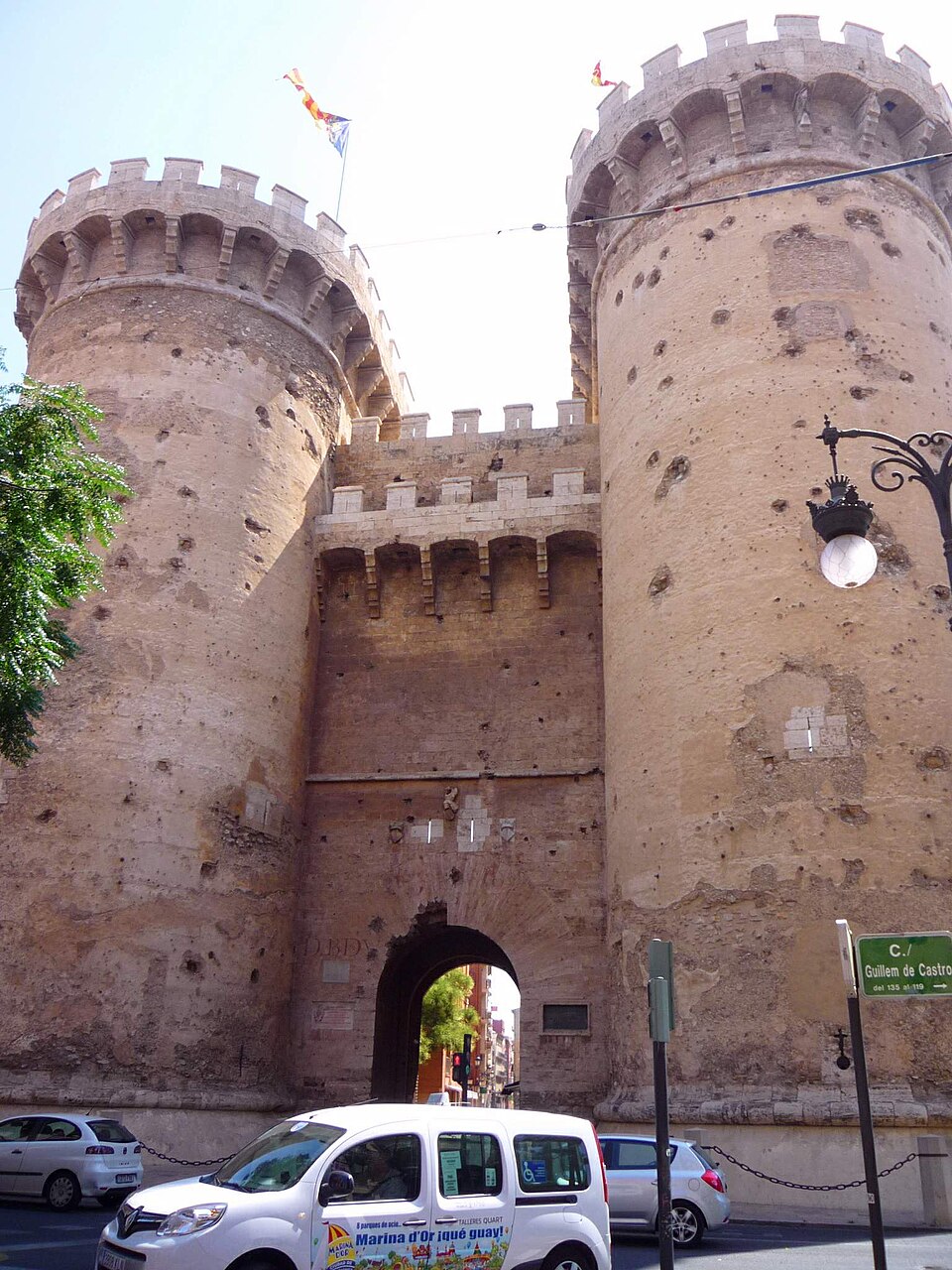
From the market the route heads west, and about ten minutes of walking brings you to Torres de Quart, the other surviving city gate. It is a different building from Serranos, even though it did the same job. Serranos is decorative and ceremonial; Quart is purely military: two heavy cylindrical towers, almost no ornament, rough stone.
The most striking thing about it is the face turned away from the city. The stone is pitted and chipped, damage described here as the scars of artillery from the sieges the city went through. Nowhere else in Valencia is it so obvious that the walls were not decoration. You can climb the towers much as you can at Serranos, and the view takes in the western half of the old town.
Quart is the least visited stop on the whole loop, and that is precisely its advantage. Where the cathedral has you threading between groups, here the walkway is often close to empty. It also makes a sensible place to finish, because the El Carme district and its cafés start a short walk away, so you sit down and the day is done.
Tip on the order: the two gates work in reverse as well, starting at Quart and finishing at Serranos. The only real difference is the light. Serranos looks better in the morning, when the sun is on its decorated face, and Quart looks better late in the day. If you are taking photographs, turn the loop around accordingly.
More Valencia landmarks worth a stop in the historic centre
The seven stops above are the spine of the route. If you have more time, or you are coming back to Valencia, these can be folded in without ever taking you more than a few hundred metres off course:
- The Silk Museum (Colegio del Arte Mayor de la Seda), the seat of the old silk weavers’ guild, south of the centre. It pairs well with the Lonja, because it explains what the city was actually trading in.
- Plaza del Ayuntamiento, the big square with the town hall and the main post office on the southern edge of Ciutat Vella. Architecturally this is a completely different Valencia from the lanes around the cathedral: the turn of the nineteenth and twentieth centuries at full volume.
- Plaza Redonda, a small circular square tucked away between buildings, entered through three passageways. It is easy to miss even when you walk half a metre from it.
- The El Carme district, the north western part of the old town, with the best street art and the tightest streets. It is not a monument, it is an atmosphere.
- Plaza de Toros, the bullring by the main railway station. A lot of people search for it as the “colosseum in Valencia”, because a circular brick building really does look the part. There is no Roman theatre in the city itself: for that you need Sagunto, about half an hour north by train.
When to walk the old town and what to avoid
Valencia’s historic centre has one quality worth knowing in advance: it is small, and a lot of it has no shade. The square in front of the cathedral, the open ground by the Lonja and the space in front of Torres de Serranos are all exposed, and in summer there is genuinely no point standing on them around midday. The lanes in between are the opposite, shaded and cool, so it feels as though the weather changes every fifty metres.
That gives you a simple timetable. Between nine and twelve, do the outdoor parts: the gates, the squares, the tower climbs. Around midday, move indoors, which means the cathedral and the Lonja. After three in the afternoon the centre is at its quietest, because locals take a siesta and some shops close, and it comes back to life towards evening. That lull is the best possible moment for a wander through El Carme, when you will meet fewer people than at any other hour of the day.
Two practical details that catch people out. First, bring something to cover your shoulders: a vest top and shorts may not get you into the cathedral. Second, the paving in Ciutat Vella is uneven and polished smooth by centuries of use, so sandals with flat soles are slipperier here than you would expect.
And a word on pace. This loop can be marched in three hours, but there is little sense in doing so. The old town of Valencia is built for getting lost in rather than for ticking off, and the best thing that happens to most visitors here is a wrong turn. If you want to set your travelling up that way more generally, our piece on slow travel has a few tips that work even over a single afternoon.
The modern half of the city, with its science and arts complex, the aquarium and the city beaches, is not part of this walk. It sits somewhere else entirely, and the sand has its own guide: see the beaches in Valencia for where to swim once you are done with the stone.
Frequently asked questions about Valencia landmarks
Which Valencia landmarks can you see in one morning?
Comfortably: Torres de Serranos, Plaza de la Virgen, the cathedral with the Holy Grail, and Lonja de la Seda. That is around three and a half hours including the interiors. Add Mercado Central only if you set off straight after nine, because it closes at 15.00.
Where is the Holy Grail in Valencia, and is it real?
The chalice known as the Santo Cáliz is displayed in its own chapel in the cathedral, the former chapter house. It was given to the cathedral by Alfonso V of Aragon in 1436. Many people consider it the true Holy Grail; its stone upper part is estimated as possibly dating to the first century, while the gold stem and the decoration are medieval. Benedict XVI celebrated mass with it in Valencia in 2006.
What is Lonja de la Seda and why is it a UNESCO site?
Lonja de la Seda, the silk exchange, is a late Gothic commercial building constructed between 1482 and 1533 to a design by the architect Pere Compte. It was inscribed on the UNESCO World Heritage list in 1996 as an exceptionally well preserved example of secular Gothic architecture. The most valuable part is the main hall with its twisted columns, built between 1483 and 1498.
Can you climb the Miguelete tower at Valencia Cathedral?
Yes. A spiral staircase leads up the Miguelete bell tower and the climb is normally open to visitors. The exact number of steps varies between sources, so we would rather not quote one. The staircase is narrow, which means waiting at the top and the bottom while people coming the other way get through. From up there you get the clearest sense of how the whole historic centre fits together.
What are the opening hours of Mercado Central in Valencia?
According to the market’s official website it is open Monday to Saturday from 7.30 to 15.00 and closed on Sundays. It is busiest until about ten in the morning, when locals do their shopping. After two in the afternoon many of the stalls start packing up.
What is the difference between Torres de Serranos and Torres de Quart?
Both are surviving gates of the city walls, but they have different characters. Serranos, on the northern side, is more decorated, more ceremonial and busier, and it has that interesting open cross section on the inner face. Quart, on the west, is a purely military structure with two cylindrical towers and artillery scars on its outer wall. Both can be climbed.
How big is Valencia’s old town and can you walk it?
Ciutat Vella is compact, flat and contained within the arc of the former river bed. The full loop from Torres de Serranos through the cathedral and the Lonja to Torres de Quart is roughly two to three kilometres with no gradient. You need neither a car nor public transport inside the centre.
Does Valencia have a colosseum?
There is no Roman colosseum in Valencia. People searching for one usually mean the Plaza de Toros bullring by the main railway station, a circular brick building from the nineteenth century. The surviving Roman theatre is in Sagunto, about half an hour north of Valencia by train.
Where to stay in Valencia
If you are coming mainly for the landmarks, stay in Ciutat Vella, the old town. From there you can walk to the cathedral, the silk exchange and the central market, and you never have to travel across the city in the evening. A cheaper and quieter alternative is Ruzafa, ten minutes to the south, where locals live and the best bistros are.
- Budget: a hostel bed in the old town roughly €20 to €35 per person per night.
- Mid-range: a double room in Ciutat Vella or Ruzafa €90 to €140.
- If you drive: the area around the City of Arts and Sciences, where parking is easier and the centre is a short metro ride or a bike ride through the Turia park.
- By the sea: Cabanyal and Malvarrosa, fifteen minutes from the centre by tram. Great in summer, quiet out of season.
You cannot really drive into the old town and parking is expensive, so budget for a garage if you arrive by car. Compare current prices and availability through accommodation in Valencia.
Potřebujete pomoct s cestováním?
-
Ubytování 🏨
Vyberte si to nejlepší ubytování, ať už jste kdekoliv, přes Booking.com. -
Půjčení auta 🚗
Auto si snadno najdete přes Booking.com, kde máte často slevu díky ubytování, nebo Rentalcars.com, kde porovnáte nabídky většiny půjčoven. -
Zážitky 🎟️
Přes GetYourGuide.com si vyberete z nejrůznějších výletů i zážitků po celém světě, navíc se zrušením zdarma do 24 h předem.