Last updated 8.10.2026
Bali is warm all year round, and that is exactly why picking dates is tricky: the thermometer won’t help you decide, because it barely moves. The best time to visit Bali comes down to other things: rain, swell, underwater visibility, prices and public holidays. Below we go through Bali month by month, explain what really changes between the dry and the rainy season, show when it’s cheapest, and look at the one day of the year when the whole island shuts down and can upend your travel plans.
Best time to visit Bali: the short version
- The dry season runs from April to October, the rainy season from November to March.
- Temperatures hardly change through the year, sitting at roughly 26 to 31 °C during the day.
- May, June and September are the best compromise. Dry weather, but not yet (or no longer) peak season.
- July and August are the most expensive and the busiest, because European and Australian school holidays overlap.
- Rainy season doesn’t mean rain all day. Showers usually come in the afternoon, short but heavy.
- Nyepi, the Day of Silence, shuts down the entire island, airport included. Check the date before you book.
- Surfers should flip the rules: the west coast works in the dry season, the east coast in the rainy season.
Bali dry season vs rainy season: what actually changes
If you check the forecast for Bali in January and again in August, you’ll see almost the same numbers. Average daytime temperatures stay between 27 and 32 degrees all year, and on the hottest days they climb towards 35. The sea is around 28 degrees in every month, so whether you can swim is never a question of water temperature, only of weather and waves. What does change is rainfall. Bali has a tropical climate with two seasons, and the difference between them is humidity and rain, not heat.
Dry season: April to October
Less rain, lower humidity, clearer skies and better visibility underwater. This is the main tourist season, and you’ll feel it both in prices and in the crowds at the Tegallalang rice terraces. July and August are the absolute peak, because that is when European summer holidays meet the Australian ones. For travellers from the UK, the school summer break falls right into this window, so families should expect the highest prices of the year.
Rainy season: November to March
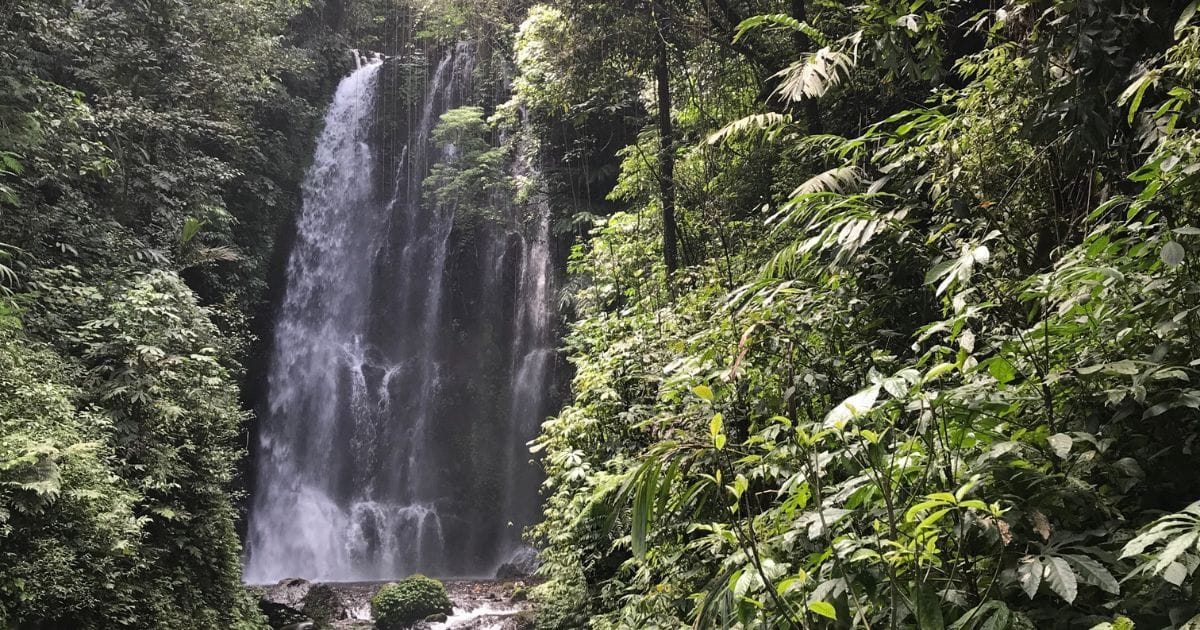
Higher humidity and frequent showers, but here’s a common misconception: it doesn’t rain all day. A typical rainy-season day starts with a sunny morning, brings an hour-long downpour in the afternoon and then clears up again. This is when the landscape is at its greenest, the waterfalls carry the most water and prices drop to their lowest.
What really is unpleasant: the humidity, which makes it hard to sleep without air conditioning, mosquitoes, and on some beaches washed-up rubbish that the sea brings in at exactly this time of year.
Bali weather by month: when to go
The table below sums up what each part of the year looks like in terms of weather, crowds and prices, and who it suits best. Treat the months on the edge of each season (March, April, October and November) as transitional: the weather can lean either way.
| Month | Weather | Crowds and prices | Best for |
|---|---|---|---|
| January to February | wettest months, high humidity | cheapest of the year | travellers chasing low prices who don’t mind rain |
| March | rain easing off, very green | cheap | watch out for the Nyepi date |
| April | start of the dry season | still quiet | best value for money and weather |
| May and June | dry and pleasant | mid-range | in our view the best time to go |
| July and August | driest, windy | most expensive and crowded | anyone tied to school holidays |
| September | dry, calmer sea | prices falling | second-best time to go |
| October | end of the dry season | cheaper | travellers who want peace and quiet |
| November and December | start of the rains | cheap, except at Christmas | Christmas is the exception, prices peak then |
Nyepi: the day Bali stands still
This is the one thing worth rearranging your dates for. Nyepi is the Balinese New Year and a Day of Silence, when all activity on the island stops. No planes fly, no cars drive, no lights are switched on and nobody is allowed outside, and that includes tourists in hotels. Hotel staff work in a limited mode, so meals are arranged in advance.
The evening before, processions carry giant ogoh-ogoh figures through the streets before they are burned. It is one of the most powerful experiences you can have in Bali.
What it means in practice: the date follows the Balinese calendar and moves every year, usually falling in March. Check it before you buy your flights, because the airport is closed for a full 24 hours. If you’re flying from the UK with a connection, a flight landing on Nyepi simply won’t operate, so plan your arrival for a day either side. And if you’d like to experience Nyepi itself, book a place with a pool and bring a good book.
Best time to visit Bali depending on what you want to do
Weather that’s perfect for a beach holiday isn’t necessarily what a surfer or someone heading for the rice terraces is after. Here’s how the seasons line up with the most common reasons people travel to Bali:
- Swimming and beaches: April to October, when the sea is calmer and there’s less washed-up debris.
- Surfing on the west coast (Uluwatu, Canggu and Kuta): the dry season, April to October.
- Surfing on the east coast (Sanur, Nusa Dua and Keramas): the opposite, the rainy season from November to March.
- Diving and manta rays off Nusa Penida: the dry season, when visibility is at its best.
- Volcano treks: April to October; in the rainy season the climbs are often closed because of slippery trails.
- Rice terraces: greenest during and shortly after the rainy season, so February to April.
- Waterfalls: fullest in the rainy season, though the water tends to be murky.
- Lowest prices: January to March, outside the Christmas holidays.
A trade-off worth thinking about: the prettiest rice terraces and the most powerful waterfalls come with the rainy season, while the best sea and underwater visibility come with the dry season. If you’re going for two weeks, decide based on what matters most to you. If you want both, go in April or October, right at the turn of the seasons.
Flying from the UK: flights from London to Bali usually involve one connection, typically via Doha, Dubai, Istanbul or Singapore, so check current routes and schedules when you book. Fares tend to follow the same holiday calendar as prices on the island: the UK summer holidays and Christmas are when demand is highest, so book those dates well ahead.
Fears about Bali’s seasons that are overblown
- That you’ll be soaked all day in the rainy season. You won’t; it usually rains in the afternoon and briefly.
- That the heat is more bearable in the dry season. Temperatures barely change through the year; the main difference is humidity.
- That you can’t get anywhere in peak season. The famous spots are packed, but the north and east of the island stay quiet even in August.
Where to stay in Bali depending on the season
When you travel also affects where it makes sense to stay. In the rainy season you’ll appreciate a place with a covered outdoor area and air conditioning, and it’s better to be closer to the centre because you’ll spend less time getting around. In the dry season you can happily stay further away from the bustle.
- Backpackers: a hostel bed costs roughly 150,000 to 300,000 IDR (around £8 to £15) per person per night, and less outside the season.
- Mid-range: a room with a pool from 500,000 to 1,000,000 IDR (around £25 to £50).
- Low season: prices drop considerably, especially for villas, where the difference between January and August can run into tens of per cent.
- Christmas and New Year are the exception: even in the middle of the rainy season, prices hit their peak.
Compare current prices and availability with our search for places to stay in Bali.
Best time to visit Bali: FAQ
What is the best time to visit Bali?May, June and September. It’s the dry season but not (or no longer) peak season, so you get pleasant weather, reasonable prices and fewer people than in July and August.
When is the rainy season in Bali?From November to March. That doesn’t mean rain all day: a typical day brings a sunny morning, an hour-long downpour in the afternoon and clear skies again afterwards. The bigger nuisances are the high humidity and the mosquitoes.
Is it worth going to Bali in December or January?Yes, if you don’t mind afternoon showers. Temperatures barely change through the year and stay at around 26 to 31 °C, so the European winter is warm in Bali. It is the rainy season, so expect humidity and afternoon rain, but January is also one of the cheapest and greenest times of the year. Just avoid Christmas and New Year if you’re on a budget, as prices peak then.
What is Nyepi and how does it affect a holiday in Bali?It’s the Balinese New Year and Day of Silence, when the whole island stops. No planes fly, no cars drive, no lights are switched on and nobody may go outside, tourists in hotels included. The date follows the Balinese calendar and changes every year, usually falling in March. Check it before you buy your flights, as the airport is closed for 24 hours.
What is the cheapest time to go to Bali?January to March, in the middle of the rainy season, with the exception of the Christmas and New Year holidays, when prices are at their highest.
When is the best time to surf in Bali?It depends on the coast. The west side (Uluwatu, Canggu and Kuta) works in the dry season from April to October. The east side (Sanur, Nusa Dua and Keramas) works in the rainy season from November to March.
When are Bali’s rice terraces at their best?During and shortly after the rainy season, roughly February to April, when they’re at their greenest. The waterfalls carry the most water then too, although it tends to be murky.
Is it worth going to Bali in July and August?Only if you’re tied to the school holidays. It’s the driest time of year, but also the most expensive and the busiest, because European and Australian school holidays overlap. Even then, you’ll find quieter places in the north and east of the island.
Potřebujete pomoct s cestováním?
-
Ubytování 🏨
Vyberte si to nejlepší ubytování, ať už jste kdekoliv, přes Booking.com. -
Půjčení auta 🚗
Auto si snadno najdete přes Booking.com, kde máte často slevu díky ubytování, nebo Rentalcars.com, kde porovnáte nabídky většiny půjčoven. -
Zážitky 🎟️
Přes GetYourGuide.com si vyberete z nejrůznějších výletů i zážitků po celém světě, navíc se zrušením zdarma do 24 h předem.