Last updated 26.10.2026
Some roads you drive slowly even when you’re in no hurry at all, and the Llogara Pass is one of them. Known in Albanian as Qafa e Llogarasë, the road climbs from Vlorë through pine forest to 1,027 metres, and then, at one particular bend, the trees simply step aside and the Ionian Sea is lying beneath you. Not a glimpse of blue somewhere far off, but the whole Albanian Riviera at once: the pale strip of Palasa beach, the rooftops of Dhërmi and water that looks almost unnaturally blue from up here.
The first time we crossed Llogara it was late afternoon, the sun was going down straight into the sea, and we pulled over so often that twenty kilometres took us an hour and a half. We don’t regret a minute of it. Since 2024 you can skip the whole pass through a tunnel in seven minutes, and plenty of people now do exactly that without realising what they’ve missed. All it costs is a few dozen extra minutes. And a night up in the park and a night down on the beach are two completely different holidays.
Llogara Pass at a glance
- Where it is: on the SH8 road between Vlorë and the Albanian Riviera, in the Ceraunian Mountains above Dhërmi.
- Height of the pass: 1,027 m.
- Llogara National Park: established in 1966, 10.1 km².
- Pass or tunnel: the Llogara tunnel (opened July 2024, roughly 6 km) cuts the section from about 30 minutes to 7. The old road over the pass is still open and free.
- Tunnel toll: approved at 250 lek (about €2.60, £2.20) one way, but as of 18 July 2026 nobody was collecting it. Keep some lek in cash just in case.
- Highest peak above the pass: Maja e Çikës, 2,045 m. Rising directly over the saddle is Maja e Qorrës (2,018 m).
- Best time to go: May, June, September and October, in our view. Summer means crowds at the top and heat at the bottom; winter brings fog and snow.
- Where to stay: up in the park (cool, quiet, forest) or down in Dhërmi and Himarë (sea, buzz, high-season prices).
- Bring a jumper. It’s usually several degrees colder at the top than on the beach, and windy.
Where the Llogara Pass is and why everyone talks about it
The Llogara Pass is a saddle in the Ceraunian Mountains, the range that rises straight out of the sea in southern Albania. That’s really the whole point of the place: nowhere else in the country do you get a 2,000-metre peak and a beach on the same horizon. The SH8 climbs here from Vlorë through the small towns of Orikum and Dukat, crosses the saddle at 1,027 metres and then drops in hairpins to the first villages of the Riviera: Palasa, Dhërmi, Vuno, Himarë.
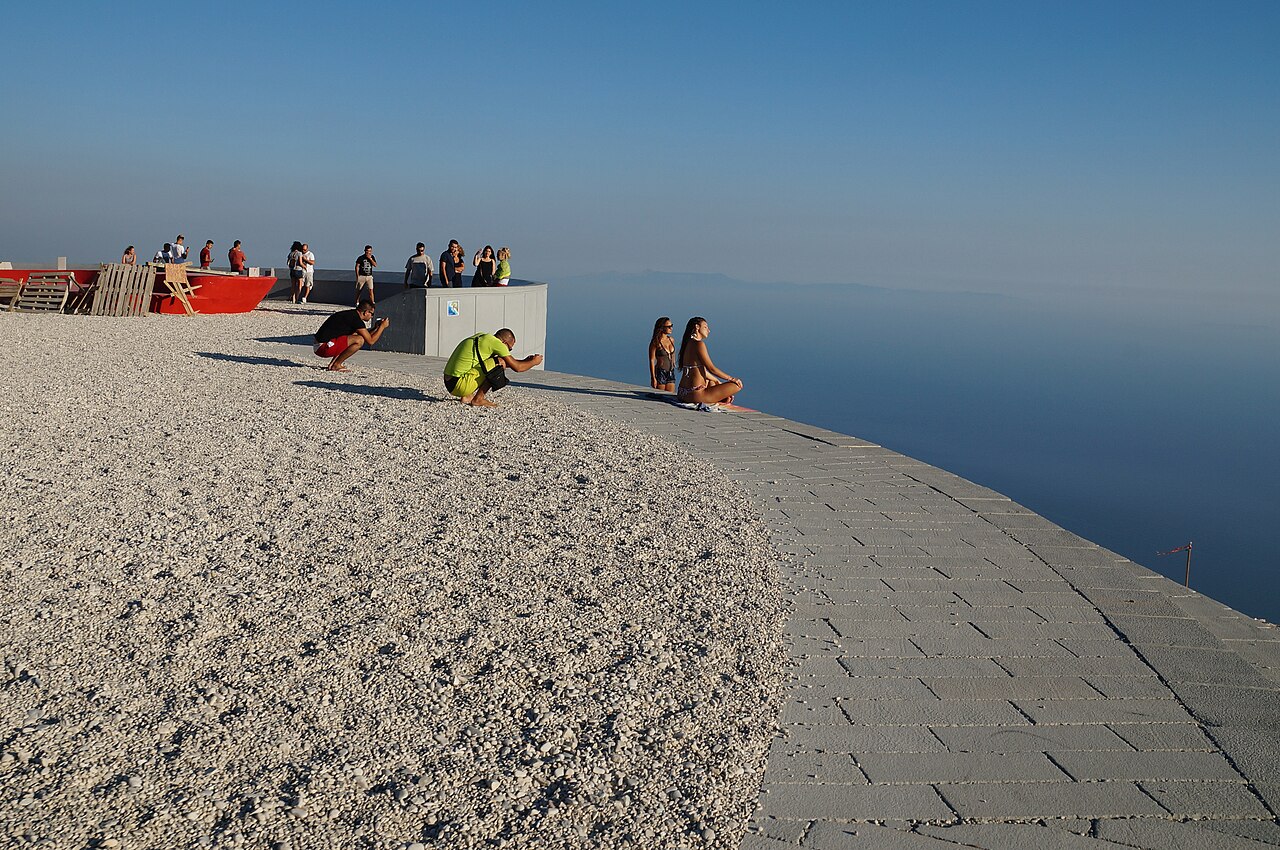 The viewing platform on the Llogara Pass, with Corfu in the distance. Photo: Albinfo, CC BY-SA 4.0, Wikimedia Commons.
The forest around it is protected as Llogara National Park, established in 1966. It’s a small park, only about 10.1 km², but it runs practically from sea level up to the summits of the Ceraunian range. The highest of them, Maja e Çikës, stands at 2,045 metres and is the highest mountain on the Albanian coast. The slopes are covered in pines and firs that the sea wind has been bending in one direction for decades, until they end up looking like flags.
Directly above the saddle rises Maja e Qorrës (2,018 m), and if you’re in the mood you can hike up it from the pass in about three hours. But let’s be honest: the vast majority of visitors come for that one bend in the road and the view from it. And even that, in our opinion, is worth the detour.
A bit of history for the coffee stop. The pass is also called Qafa e Cezarit, Caesar’s Pass. According to ancient sources, Gaius Julius Caesar crossed here with his legions in 48 BC. He landed on the beach at Palasa, which you can see laid out below you from the viewpoint, and marched over this saddle inland to fight Pompey.
Llogara Pass or the tunnel? That’s the real decision now
Until July 2024 there was no choice. If you wanted to get from Vlorë to the Riviera, you went over the top. Then the Llogara tunnel opened: a tube of roughly six kilometres under the mountain and the longest road tunnel in Albania. A section that used to take around thirty minutes shrank to seven. The northern entrance is near Dukat and the southern exit down at Palasa on the Riviera, so both routes split and rejoin at the same points. The old one simply climbs a kilometre higher in between.
One thing needs saying plainly: the old road over the pass is still open and still free. The tunnel didn’t replace it, it just bypassed it. And because sat navs optimise for time, Google Maps and the rest will almost always send you through the tunnel by default. Before you set off, look at the route on the map. If it cuts through the mountain in a near-straight line, you’re in the tunnel. If it wiggles, that’s the one you want.
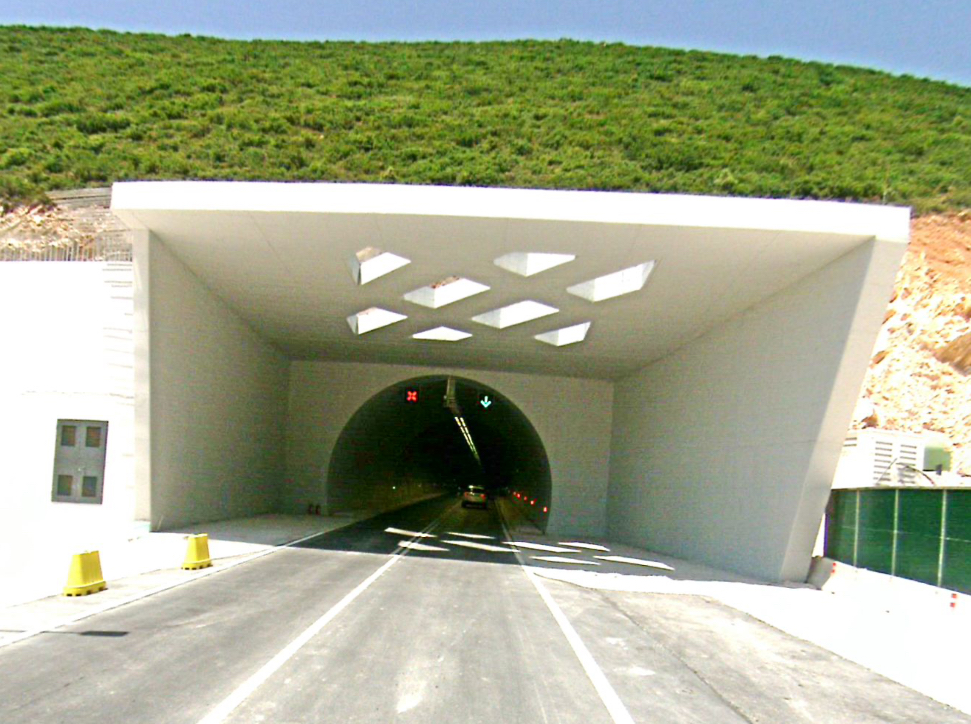 The southern portal of the Llogara tunnel near Palasa, opened in July 2024. This is the fast option: seven minutes and no view at all. Photo: Tubjjni, CC0, Wikimedia Commons.
| Old road over the pass | Llogara tunnel | |
|---|---|---|
| Time for the section | about 30 minutes, easily 1.5–3 hours with photo stops | about 7 minutes |
| View | the reason you came | none |
| Cost | free | not collected as of 18 July 2026; approved at 250 lek (about €2.60, £2.20) one way, 500 lek (about €5.30, £4.50) return |
| Best for | clear weather, a first visit, a road trip | fog, rain, night driving, anyone who gets carsick on hairpins |
The Albanian authorities approved a toll for the tunnel in April 2026, but as of 18 July 2026 drivers still weren’t paying: cameras at the gate read number plates, staff stand by the barrier and nobody takes any money. No official start date has been announced, so treat it as a cost that could appear at any moment. A few hundred lek in cash in the car is a good idea either way.
What we’d do: head south over the pass and come back through the tunnel. You get the hairpins once, you see the view from the better side (driving towards the sea, not away from it), and on the way back, usually tired and with something else to fit in, you save half an hour.
How to get to the Llogara Pass
Coming from the UK, you’ll most likely fly into Tirana, which has direct flights from London; routes and seasonal schedules change, so check what’s flying before you book. From Tirana it’s a drive south via Vlorë, which is also how most people first meet the pass. The other option is to fly to Corfu, cross by ferry to Sarandë and drive north along the Riviera, in which case you reach Llogara from the sea side, climbing up from Dhërmi.
A car is by far the easiest way to get here, as it is almost everywhere in Albania. The road is paved and in good condition, but it’s narrow, steep and full of tight bends. Drive in daylight, take your time and expect someone to overtake you where they really shouldn’t. In a campervan or a larger van it’s a good deal more work.
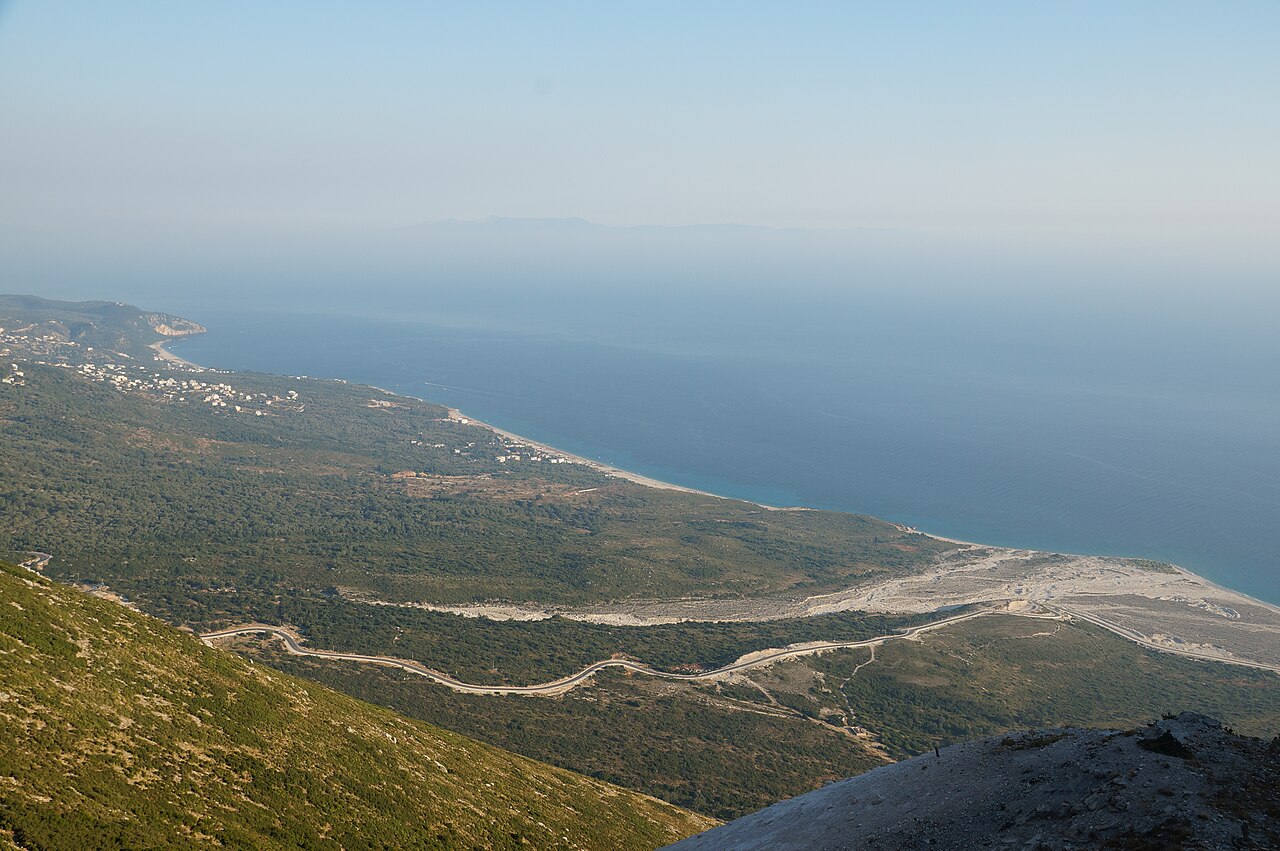 Looking down from the saddle. The pale line across the middle of the slope is the old road, which twists like this all the way down to the beaches of Palasa and Drymades. Photo: Albinfo, CC BY-SA 4.0, Wikimedia Commons.
| From | Distance and time | Note |
|---|---|---|
| Vlorë → pass | about 40 km, 45–60 minutes | northern approach, the climb starts after Orikum and Dukat |
| Pass → Dhërmi | about 15–20 km, around 30 minutes | hairpins down to the first Riviera beaches |
| Tirana → Llogara | about 180 km, around 3 hours | via Vlorë, typically the first leg of a trip to the Riviera |
You can do it without a car, too. Buses and furgons (shared minibuses) on the Vlorë–Sarandë route run over the pass, as do direct services from Tirana to Himarë. The catch is that operators never say whether a particular bus will take the pass or the tunnel, and since the tunnel opened it varies. If the view matters to you, ask the driver before you get on. And don’t count on a stop at the viewpoint.
The second option is a day trip from Vlorë or one of the Riviera towns. Most Riviera tours include the Llogara viewpoint and build in a photo stop. It’s the simplest way to see the pass if you’d rather not drive.
Watch out for parking. There’s little space at the main viewing platform, and on summer afternoons cars end up parked along the verge on the bend. The best time, in our experience, is before nine in the morning, before the first tour groups arrive, and again after five in the afternoon, when the light falls straight onto the sea and the coaches have gone.
Things to do on the Llogara Pass beyond a photo from the car
The viewpoint, with Corfu on a clear day
The classic stop. A railing on the edge of the drop, a kilometre of empty air beneath you and then the coastline curving away to the south. On a clear day you can see Corfu from the platform. What we enjoyed most here wasn’t the viewpoint itself but a spot a little way along, where you can walk a few hundred metres along the ridge away from everyone and have the same view to yourself.
Pisha e Flamurit, the flag-shaped pine
The symbol of the park. A lone pine that decades of sea wind have shaped so that every branch points the same way, like a flag in a breeze. It stands on one of the easy loops in the park, and it’s a five-minute stop that tells you more about this place than the whole viewpoint: this is how hard it blows here, all the time.
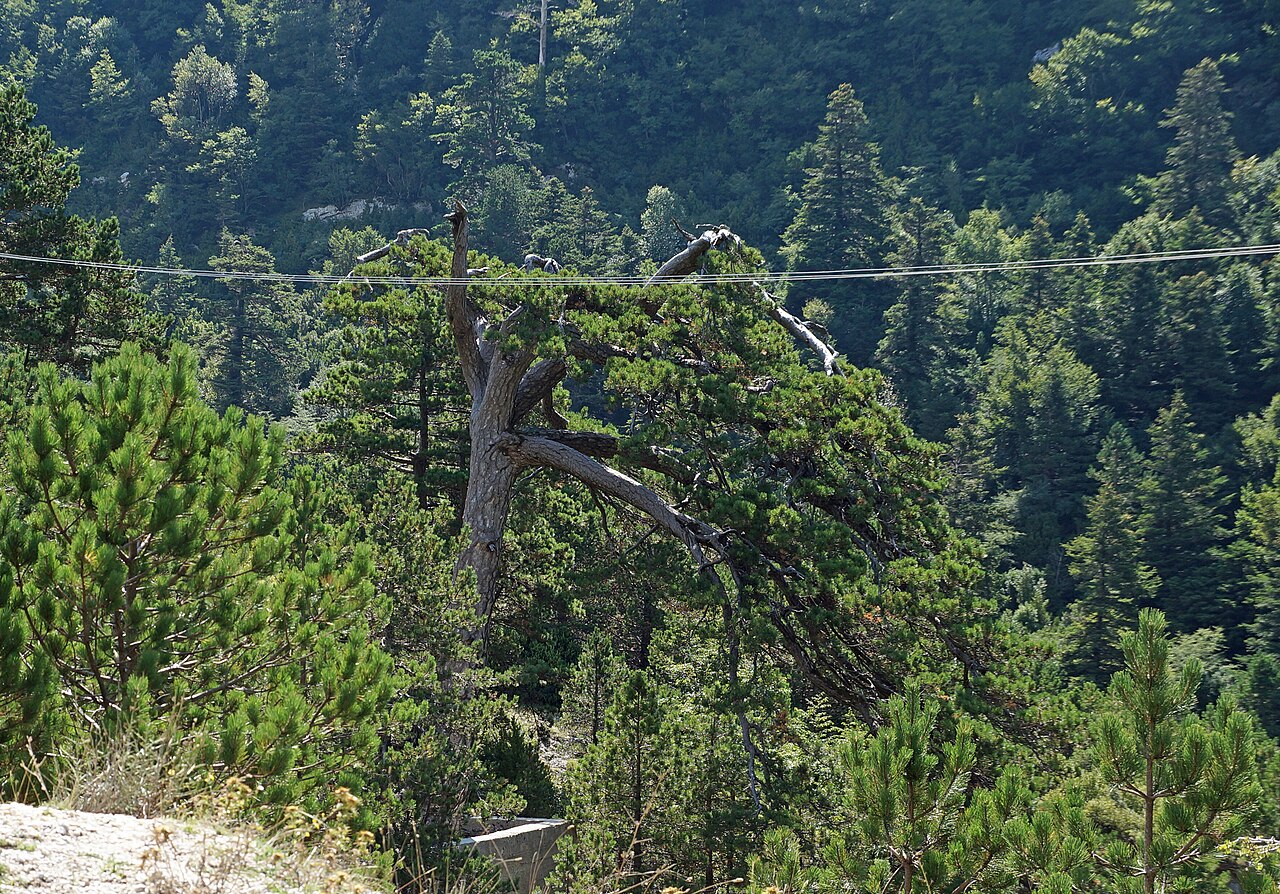 Pisha e Flamurit, the “flag pine” of Llogara National Park. Photo: Albinfo, CC0, Wikimedia Commons.
Paragliding
A high launch, warm sea right below and reliable thermals. That’s why Llogara is one of the best places for paragliding in Albania, and in season several operators run tandem flights here. You take off from the slope near the saddle, fly out over the coast and land down by the beaches around Palasa. Even if you’re not flying, the launch site is a great viewpoint in its own right, and there’s nearly always someone laying out a wing.
Cycling over the pass
Llogara is one of the best-known climbs in the Balkans, and since May 2025 it carries a stamp from pro cycling too: stage three of the Giro d’Italia, a Vlorë-to-Vlorë loop, climbed it from the southern, coastal side. That side runs about 10.5 kilometres from the sea to the saddle at an average gradient of 7.4 per cent. The northern approach from Dukat is longer and slightly gentler, around 13.7 kilometres and 861 metres of climbing at an average of 6.5 per cent, but over ten per cent at its steepest. There’s hardly any shade on the road, so in summer you ride early in the morning or not at all. We wouldn’t cycle through the tunnel: six kilometres in an enclosed tube with traffic is no place for a bike. Up and down by the old road, then.
Visitor centre and information boards
Below the saddle there’s a newer national park visitor centre, where you can learn about the local wildlife and the waymarked trails. Check the opening hours on the spot; it’s often closed out of season.
Bunkers
On the way up you’ll pass concrete bunkers from the communist era, including some near a former military post above the Riviera. Albania has them everywhere, but these ones have the best address of all.
Llogara Pass hikes and trails
The saddle is a natural starting point for several waymarked routes, and the park has about eight of them, from a stroll to a proper mountain day. These three are the most popular:
| Route | Length and time | Elevation gain | Difficulty |
|---|---|---|---|
| Llogara National Park loop | 14 km, about 5 hours | 682 m | easy |
| Traverse over Maja e Qorrës (2,018 m) to Dukat | 16 km, about 8 hours | 1,355 m | hard |
| Maja e Çikës (2,045 m), the highest peak on the Albanian coast | 16 km, about 9 hours | 1,420 m | hard |
A shorter option if you don’t want to spend all day in the mountains: from the saddle head west past the antennas over the summit of Maja e Thanasit (1,352 m), then down to the visitor centre and the tourist village below the pass. That’s around ten kilometres in total and a nice compromise between ridge and forest.
If one day isn’t enough, you can set off from the pass on a multi-day traverse of the coastal mountains: up to Maja e Qorrës, onto the main ridge below its summit and along it all the way to Maja e Çikës. It’s one of the finest treks in the country and a completely different Albania from the beach version.
What to watch out for on foot. The ridge is exposed, there’s almost no shade and the weather changes fast. There’s no water on the route, so carry everything you’ll need. Even in summer pack an extra layer: at 2,000 metres with wind coming off the sea, it can easily be fifteen degrees colder than on the beach.
When to visit the Llogara Pass
The view is worth it all year round. Everything around it, though, changes quite a lot with the seasons.
- May and June: the best combination, in our view. The forest is green, the trails are empty, it’s pleasant for walking and you can already swim down below.
- July and August: the road is at its busiest, the viewpoint is packed and the coast is hot, with beach temperatures regularly topping thirty degrees. It’s more bearable at the top, but parking is a nightmare.
- September and October: the sea is still warm, there are far fewer people and the trails are quiet. If we had to pick one month, it would be September.
- Winter: snow, fog and occasional closures at the top. That’s when the tunnel makes sense even for people who would otherwise take the pass.
And one more word about that jumper, because every summer someone gets caught out. You leave Vlorë at thirty-two degrees in a T-shirt, and an hour later you’re standing at a thousand metres in the wind, shivering. On a trip that’s mainly about the view, that’s a pointless way to spoil it.
Where to stay near the Llogara Pass: up in the park or down by the sea
At Llogara this is a bigger decision than it looks. The saddle divides two completely different worlds that are only twenty minutes’ drive apart, and which side you sleep on shapes the whole holiday.
Up in the national park
Below the saddle sits the so-called Llogara tourist village: a cluster of hotels, guesthouses and mountain restaurants among the pines, strung out along the road. You sleep in the forest, at night all you hear is the wind, and the terrace is chilly in the morning even in August. The restaurants here are known for spit-roast lamb and mountain cheeses, which is to say the food of the Albanian highlands, not the coast.
Who it suits: people heading out on the trails who want an early start. Families who find the August nights on the coast too warm. Anyone who wants one quiet night after a week on the beach. And, frankly, anyone driving a long day from Tirana to the south who doesn’t fancy tackling hairpins in the dark.
The trade-off: the sea is a drive away, you can’t walk to a beach. In the evening there’s nowhere to go except your hotel’s restaurant. And out of season it’s pretty dead up here, with some places closing. Accommodation is usually cheaper than on the seafront in Dhërmi, but not dramatically so; it’s a popular spot.
Two names worth knowing here are Hotel Alpin Llogara and Llogora Tourist Village (listed on Booking.com as Te’Dreri – Llogora Tourist Village). Prices change every season, so it’s only worth comparing them once you know your dates.
See places to stay in Llogara and around the pass →
Down in Dhërmi and Palasa
Dhërmi is the first Riviera village below the hairpins and the classic answer to the question of where to sleep after the pass. It has two faces: old stone Dhërmi on the hillside, and the beach area down by the water, where most of the hotels, bars and music are concentrated in season. Neighbouring Palasa is quieter and has a long pebble beach, the very one you look down on from the viewpoint.
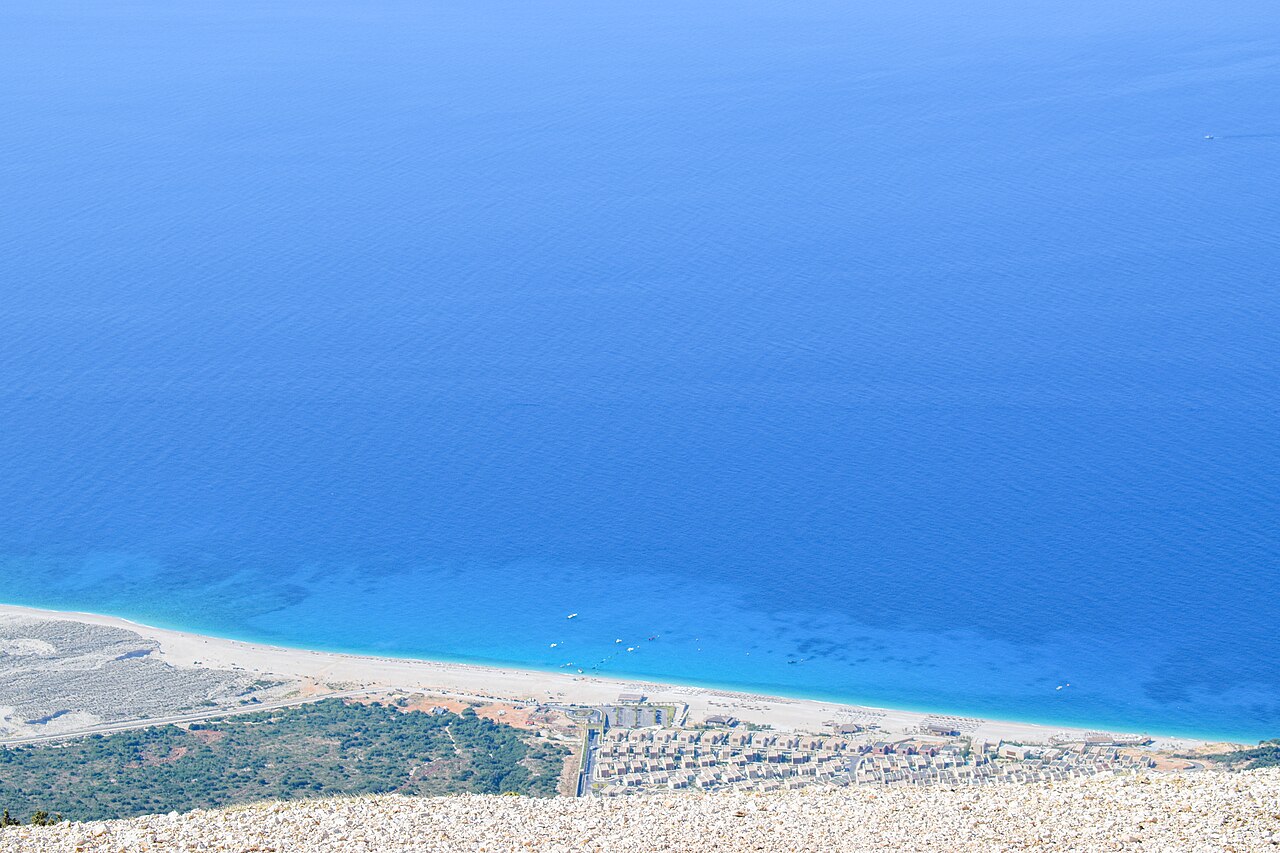 Palasa from above. Behind the strip of beach you can see the new resort complex that has gone up here over the past few years. Photo: Liridon, CC BY-SA 4.0, Wikimedia Commons.
Who it suits: people who are mainly here for the sea and see the pass as a bonus on the way. Anyone who wants to step out of the hotel in the evening and have their feet in the water.
The trade-off: in July and August Dhërmi is one of the pricier addresses on the Riviera, and the beach area gets noisy at night. Don’t come here looking for a quiet holiday in peak season.
See places to stay in Dhërmi →
Down in Himarë
Himarë lies a little further south. It’s more of a small town than a resort and has a normal life outside the season too: shops, a promenade, a few smaller beaches within walking distance and more coves around it. Accommodation is usually cheaper than in Dhërmi, and it’s a handy base for boat trips.
Who it suits: a longer stay on the Riviera, exploring the area from one base. Travellers without a car, because buses run here and you can get onward from Himarë.
See places to stay in Himarë →
On the northern side: Vlorë, Orikum, Dukat
If you’re arriving late from Tirana, there’s no point crossing the pass at night. Vlorë is about forty kilometres from the saddle, has the widest choice of accommodation in the area and all the infrastructure, and in the morning you can head up to the pass in daylight and in the best light. We like this option a lot: sleep in Vlorë, drive up to the saddle at seven, have the viewpoint almost to yourself and only then roll down to the sea.
Our advice if you only have one night. Sleep at the top. You can get down to the sea any time, and Albania has hundreds of beaches, but a night in a pine forest a kilometre above the Ionian Sea is something you can’t buy anywhere else. In the morning you drive down to the water and spend the rest of the holiday on the beach.
What to combine with the Llogara Pass
The pass is a bridge between two parts of Albania, and hardly anyone makes the trip just for it. On the northern side you have Vlorë, with the bays of Karaburun and Sazan Island; on the southern side the whole Riviera begins, running all the way down to Ksamil. On the way from Tirana you can detour to ancient Apollonia near Fier, and if you’d like one more town between the mountains and the sea, add Berat.
If you’re still putting together a route along the coast, start with our guide to the best beaches in Albania. And if you’re coming via Corfu, our Corfu holiday guide covers the island side of the trip.
What we’d do differently
If we drove Llogara a second time, we’d go slower and focus less on that one viewpoint everybody knows from Instagram. The platform is lovely, but it’s also the busiest spot on the whole pass, and people squeeze off five photos between the coaches and move on. Yet all it takes is driving two bends further, pulling onto the verge and walking a few hundred metres. Same view, no people, and suddenly you hear wind in the pines instead of engines.
We’d also set aside time for something almost nobody does at Llogara: leave the main road and walk into the forest. The park is small, the paths are waymarked, and even an hour among the bent pines tells you more about the place than the viewpoint does. The first time we rushed it because the sea was pulling us, and that was a mistake. The sea will still be there tomorrow.
And finally: you don’t have to do both. Our first crossing of the pass was a race to reach Himarë “before it gets dark”, so really we just drove through something beautiful while thinking about check-in. Better to stay up top, order the lamb in a mountain restaurant, leave your phone in the car and spend half an hour just looking down at the sea. The best part of Llogara isn’t something you photograph; it’s something you stand and take in.
Llogara Pass FAQ
How high is the Llogara Pass?The saddle sits at 1,027 metres above sea level. The road climbs practically from sea level, so you gain all that height over a short stretch. The highest peak above the pass, Maja e Çikës, is 2,045 metres.
Is there a toll for the Llogara tunnel?As of 18 July 2026, no toll was being collected. A fee was approved in April 2026 at 250 lek (about €2.60, £2.20) per car one way and 500 lek (about €5.30, £4.50) return, but its start has not been officially announced. Keep some lek in cash just in case. The old road over the pass is free.
Is the old Llogara Pass road still open now the tunnel is built?Yes, it’s still open and free. The tunnel simply bypasses it. Watch your sat nav, though: by default it suggests the faster tunnel, so check the route on the map before you set off.
Is the Llogara Pass dangerous to drive?The road is paved and maintained, but narrow, steep and full of hairpins. It’s mainly risky at night, in fog and in winter, when snow falls up here. In a larger or unfamiliar car, allow extra time. If mountain roads aren’t your thing, there’s the tunnel.
How do you get to the Llogara Pass without a car?Buses and furgons between Vlorë and Sarandë run over the pass, as do services from Tirana to Himarë. Operators don’t say whether a particular bus will take the pass or the tunnel, though, so ask the driver. The other option is a day tour from Vlorë or the Riviera towns.
How much time do you need for the Llogara Pass?The crossing itself takes half an hour, but with stops at the viewpoints allow one to two hours. Add lunch in a mountain restaurant or a short walk in the park and it easily becomes half a day.
When is the best time to visit Llogara?May, June, September and October, in our view. They’re the best months for walking, the view is usually clear and it isn’t crowded at the top. In July and August the viewpoint is packed and parking is a problem; in winter, expect snow and fog.
Is it cold at the top of Llogara even in summer?Yes, and it regularly catches people out. At a thousand metres it’s usually several degrees colder than on the beach, plus there’s wind off the sea. Even in August, keep a jumper or a jacket in the car.
Is it better to stay up in Llogara National Park or down by the sea?It depends on what you want from your holiday. Up top you get quiet, forest, cool nights and mountain food, but you need the car to reach the sea. Down in Dhërmi and Himarë the beach is round the corner, but in season it’s busy and pricier. If you only have one night, we’d say go up; you can get down to the sea any time.
Can you go paragliding at the Llogara Pass?Yes, Llogara is one of the best paragliding spots in Albania. In season several operators run tandem flights; you launch near the saddle and land down by the beaches around Palasa. Check current prices and dates directly with the operator, as they change.
Where next
- What to see in Albania: 35 of the most beautiful places (our big guide to the whole country)
- Vlorë (the nearest big town on the northern side of the pass)
- Best beaches in Albania
- Ksamil, Albania’s “Maldives”
- Berat, the city of a thousand windows
Potřebujete pomoct s cestováním?
-
Ubytování 🏨
Vyberte si to nejlepší ubytování, ať už jste kdekoliv, přes Booking.com. -
Půjčení auta 🚗
Auto si snadno najdete přes Booking.com, kde máte často slevu díky ubytování, nebo Rentalcars.com, kde porovnáte nabídky většiny půjčoven. -
Zážitky 🎟️
Přes GetYourGuide.com si vyberete z nejrůznějších výletů i zážitků po celém světě, navíc se zrušením zdarma do 24 h předem.