
Last updated 5.11.2026
Timanfaya National Park is exactly the sort of place where you stop in your tracks, hold your breath and quietly wonder whether you’ve somehow landed on Mars. Spread out in front of you are the Fire Mountains – Montañas del Fuego, a frozen sea of lava, craters and slopes streaked in rust, black and ash. Fancy visiting Timanfaya National Park on Lanzarote? We’ll show you how to reach this gateway to the centre of the Earth, what to see nearby and what to watch out for.
Why Timanfaya National Park has to be on your list
The whole island of Lanzarote feels like it belongs to another planet. There are volcanic plains, striking works of art and a gorgeous coastline. But nature can turn genuinely fierce here too. Timanfaya National Park is one of the strangest and, at the same time, one of the finest places we’ve ever been.
In a single day you’ll see geothermal demonstrations – water that turns to scalding steam the moment it’s poured into a borehole, and ground that still radiates heat just a few centimetres below the surface. From the sightseeing coach you’ll travel the Ruta de los Volcanes, the fiery heart of the park, where smooth red slopes give way to rippling lava and volcanic cones. And if you want to go deeper, you can set out with a ranger on the Tremesana Trail, the one walking route that lets you step inside.
TIP: Heading to Lanzarote? We’ll point you towards the 20 most beautiful places on the whole island

The story of the Fire Mountains: how the eruptions reshaped Lanzarote
Between 1730 and 1736, Lanzarote lived through one of the longest and most destructive eruptions in the history of volcanology. Fire and lava swallowed a vast swathe of western Lanzarote, buried 11 villages and changed a third of the island beyond recognition. The volcanoes had one more, smaller but significant, outburst in 1824.
Today you walk through the aftermath of those events in what is now a protected area of the highest category, where access is strictly controlled so the landscape keeps its extraordinary character – and so that you don’t get burnt, naturally.
TIP: Fuerteventura review: tips, first-hand experience and what to know before you go
Timanfaya vs Los Volcanes: what’s the difference?
People mix these two up all the time. Timanfaya National Park is the strictly protected core. Wrapped around it is the Los Volcanes Natural Park, which is packed with gorgeous spots of its own, such as El Golfo, Los Hervideros and the La Geria vineyards. The ideal itinerary? Timanfaya in the morning, La Geria and El Golfo in the afternoon – and you’ve got one of the best days the Canaries can offer.
TIP: Fuerteventura: what to see + 30 of the most beautiful places
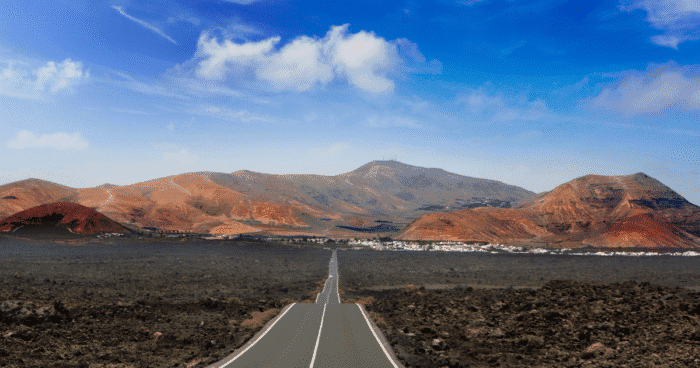
Timanfaya National Park: your complete guide
Let’s not beat about the bush. How do you get here, what will you actually see, where are you allowed to go, and what else is worth a look nearby?
How the tour works, or can you really walk on ground that hits 120°C?
Right off the bat, we have to tell you that Timanfaya National Park is so extraordinary that you can’t actually wander into it freely. In many places the ground is still genuinely hot: just 10 metres down it can reach up to 600°C (don’t worry, at the surface it’s only around 120°C in certain spots). That’s why you explore Timanfaya National Park aboard a special sightseeing coach. It might sound odd, but it’s absolutely worth it to see all of this.
The coach takes you on the Ruta de los Volcanes, a loop that lasts 35–45 minutes and winds between craters, lava tunnels and pyroclastic cones. You’ll pass among the hottest craters, some of them beautifully earthy in colour and, from a distance, looking as though they’re truly ablaze. But don’t worry, the park’s grounds are plenty big, and you can also watch hissing geysers, take a shorter stroll or tuck into chicken grilled over the volcano’s own heat.
TIP: Got a Lanzarote holiday coming up? We’ve handpicked the 20 most beautiful places to see on Lanzarote.

Getting there: how to reach Timanfaya National Park
The easiest way is a hire car and the LZ-67 road between Yaiza and Tinajo. At the entrance you’ll head for Islote de Hilario, where you park up and carry on aboard the official coach along the Ruta de los Volcanes.
If you don’t have a car, consider an organised excursion, which usually combines Timanfaya National Park with La Geria, Los Hervideros and the green lagoon on the black beach at El Golfo, one of Lanzarote’s icons. In high season expect queues on the access road, so it’s best to arrive early and have your ticket downloaded to your phone, as the internet and signal are weak out here.
TIP: We’d recommend buying an organised tour through GetYourGuide, where you know exactly what you’re getting, how it will run and you don’t have to worry about a thing. These tours come into their own especially if you don’t have your own car.
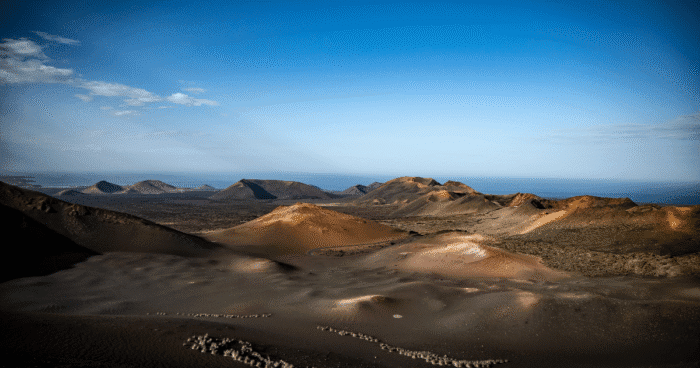
When to visit the Fire Mountains
You can visit Timanfaya National Park on Lanzarote all year round. In winter you’ll walk around in a T-shirt; in summer you’ll want a hat and a big bottle of water. The calmest times are spring and autumn, when you dodge the biggest crowds and the fiercest heat. Summer brings harsh sun and barely any shade, while winter can serve up wind and the occasional calima (a Saharan dust haze), but the park is impressive whatever the season.
Tickets and booking
A standard adult ticket costs €22, children aged 7–12 pay €11, and younger children go free. Buying online guarantees you entry on your chosen day as long as you turn up by 1 pm; it doesn’t, however, mean you’ll be waved straight through with no waiting.
Where to stay near Timanfaya National Park
You obviously can’t stay inside the park itself, but there are 3 lovely spots close by. We spent a few weeks on Lanzarote and criss-crossed the whole island, so we moved around a fair bit.
- Yaiza: Yaiza is genuinely close by, and you can stay at the cosy Casa de Hilario, just minutes from the park, or at the slightly smarter Hotelito La Era B&B in Mancha Blanca.
- Puerto del Carmen: In Puerto del Carmen you’ll be pleased with the reasonably priced Hotel Lanzarote Village, or treat yourself to the legendary Lani’s Suites de Luxe right beside the ocean.
WHERE WE STAYED: In this area, from where everything was within easy reach, our favourite was Caybeach Sun. The rooms were lovely and came with a little kitchen, and there was a pool in the grounds where they mixed cracking drinks.
Timanfaya National Park and 6 places to see nearby
If you’re visiting Timanfaya National Park under your own steam, do make time for the surrounding area too, as it’s dotted with plenty of fascinating places.
- El Golfo and Charco de los Clicos (the Green Lagoon): an emerald-coloured lagoon sitting in a crater right beside the ocean. The black sand and red cliffs around it create a striking clash of colour.
- Parque Natural de Los Volcanes (nature reserve): some of the spots listed here lie in the nature reserve that borders Timanfaya National Park. The different designation takes nothing away from the intensity of the experience.
- The LZ-67 road (photo stops across the volcanic landscape): driving this road serves up breathtaking views of the volcanic scenery. Even without entering the national park, you can pull in at the viewpoints and soak up the atmosphere.
- La Geria (wine region): traditional vineyards with vines sheltered by semicircular stone walls. The place to taste Malvasía wine and marvel at this one-of-a-kind way of growing grapes in volcanic soil.
- Caldera Blanca (crater hike): a large, well-preserved volcanic crater reached by an easy walk across the lava fields. From the top there’s a panoramic view over the whole south of the island, including Timanfaya and the ocean.
- Los Hervideros (volcanic cliffs and ocean): a wild lava coastline where the ocean crashes through the gaps and gives the impression of “boiling water”. Best visited at sunset for a powerful visual experience.
TIP: The ultimate holiday packing list: what you need wherever you’re headed
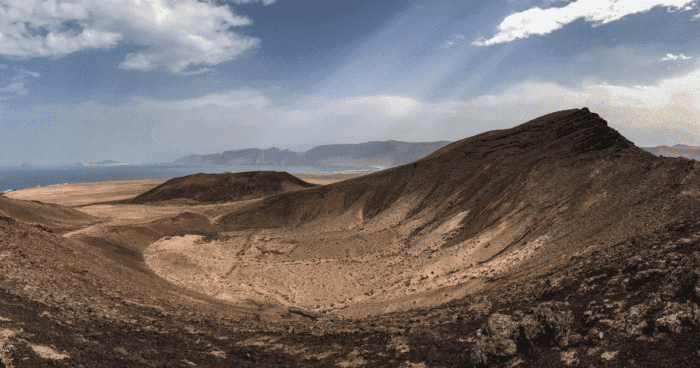
Camel rides
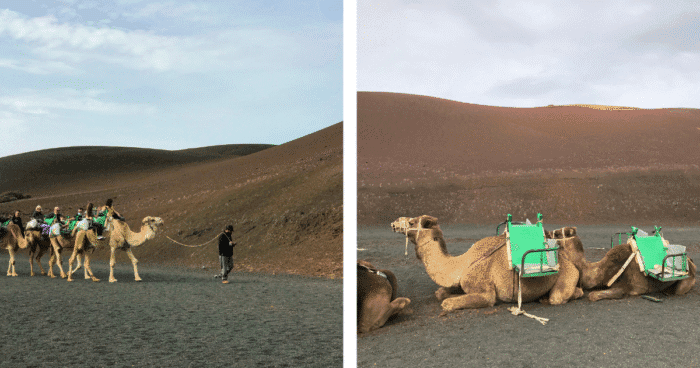
Did you know that camels live on Lanzarote? Camels were brought to Lanzarote from North Africa as far back as the 15th and 16th centuries. Thanks to their tolerance of drought and rough terrain, they became important helpers in farming and for hauling loads. As traditional agriculture declined in the 20th century, they found a new role in tourism – the best-known of all being the camel rides in Timanfaya National Park. Today they’re not just an attraction for visitors but a symbol of the island.
TIP: Sigiriya Rock Fortress in Sri Lanka was only recently uncovered. What to see nearby?
Frequently Asked Questions (FAQ)
How do you get to Timanfaya National Park?
The best way is by hire car along the LZ-67 between Yaiza and Tinajo. Park at Islote de Hilario and set off on the tour through the park – the Ruta de los Volcanes – aboard the official coach. Entering the core of the park on foot or in your own car is not permitted.
How much is a ticket to Timanfaya National Park and what does it include?
Adults €22, children aged 7-12 €11, younger children free. The price covers the coach route and the other activities in the park. Buying online guarantees entry on a specific day (arrival by 1 pm), but it doesn’t grant instant access with no waiting.
Potřebujete pomoct s cestováním?
-
Ubytování 🏨
Vyberte si to nejlepší ubytování, ať už jste kdekoliv, přes Booking.com. -
Půjčení auta 🚗
Auto si snadno najdete přes Booking.com, kde máte často slevu díky ubytování, nebo Rentalcars.com, kde porovnáte nabídky většiny půjčoven. -
Zážitky 🎟️
Přes GetYourGuide.com si vyberete z nejrůznějších výletů i zážitků po celém světě, navíc se zrušením zdarma do 24 h předem.