Last updated 26.10.2026
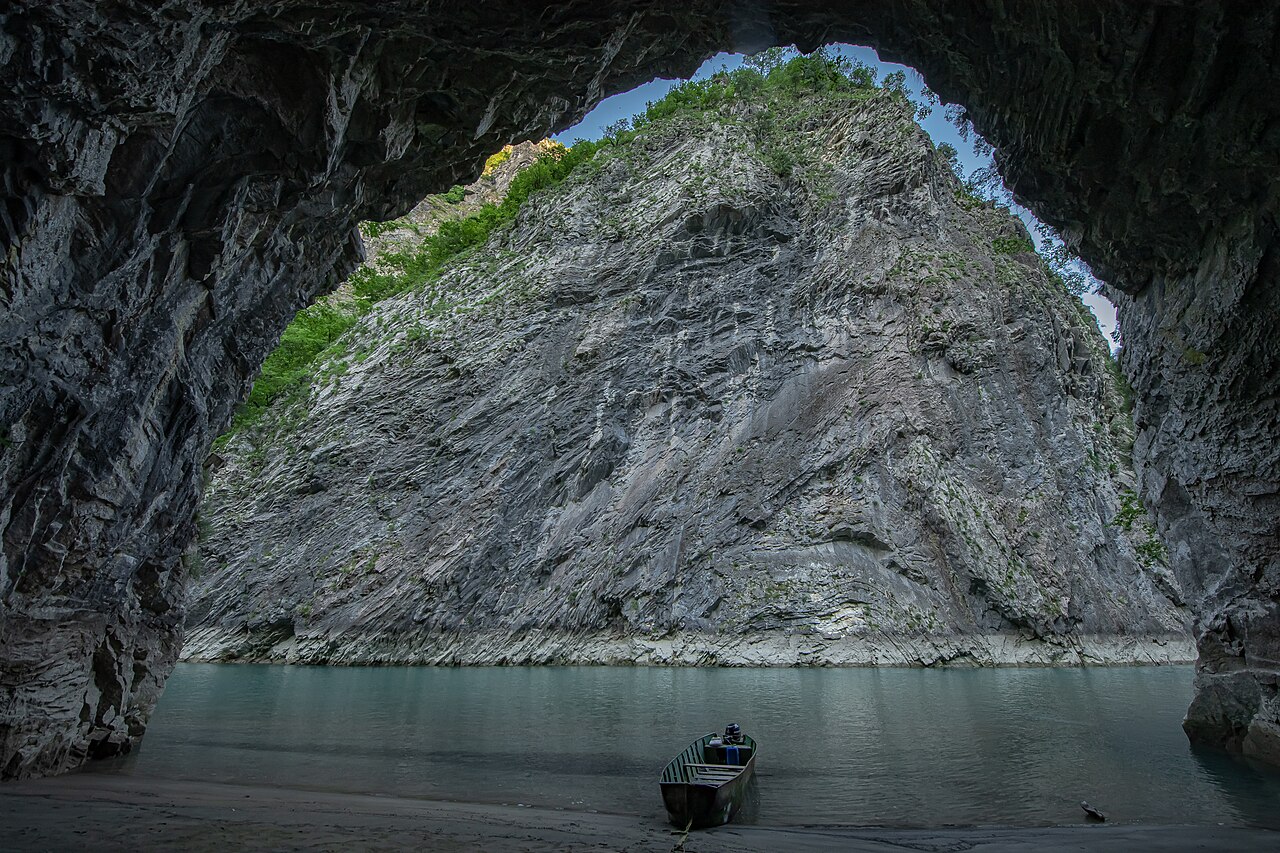
Show us a photo of it, tell us it’s Norway, and we’d believe you. Lake Komani in northern Albania is a narrow, flooded gorge where rock walls drop straight into the water, and in places the channel looks as if it simply runs out. It isn’t a fjord, though, and it isn’t a natural lake either. It’s a reservoir on the Drin river, built to generate electricity, and by some distance the best-looking by-product of Albania’s power industry.
For travellers, Komani does two jobs at once. It’s an experience in its own right, easy to fit into a long day trip from Shkodër. And it’s a transport link: there’s no sensible way into the Albanian Alps without the ferry, because there’s simply no road along the lake to the far shore. Which of the two you’re after changes the whole plan. Both, however, hinge on one boat that runs once a day.
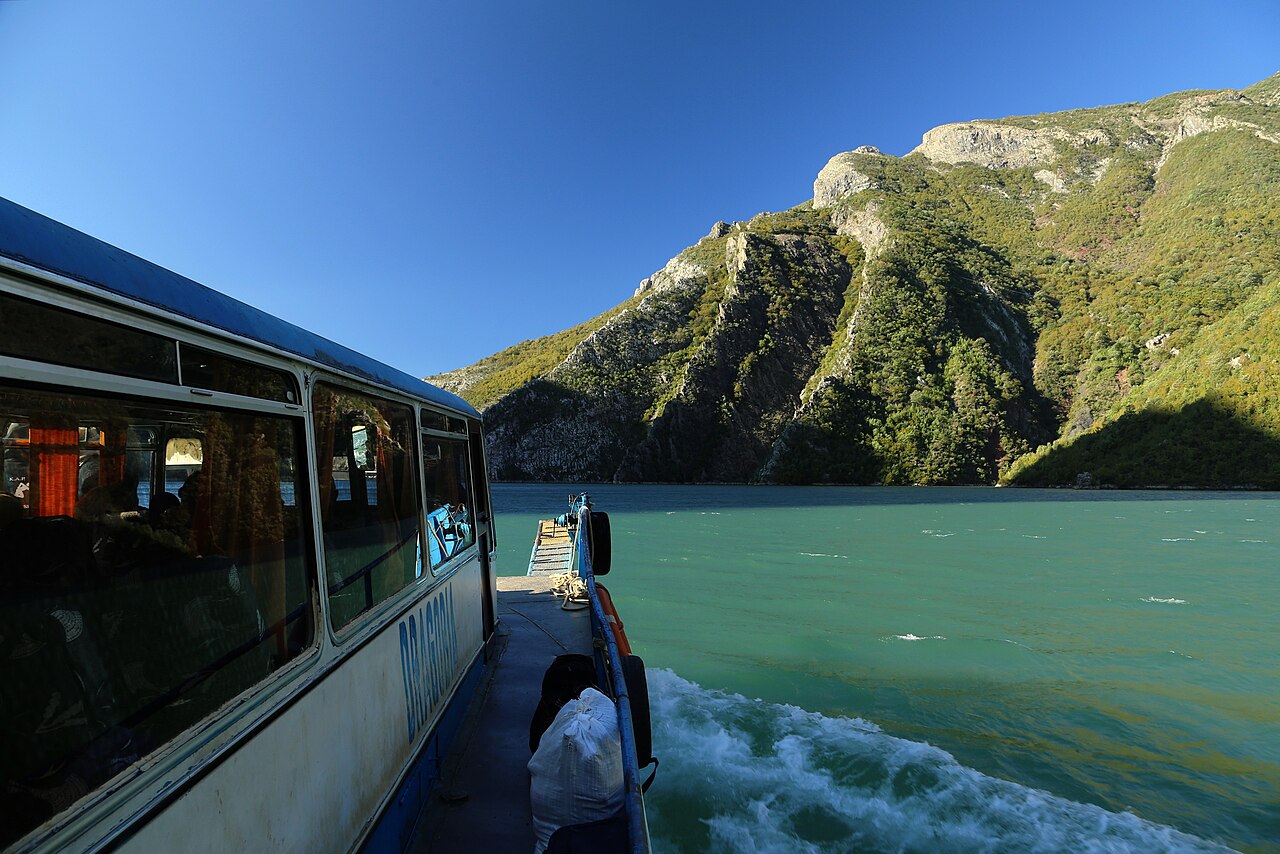
Lake Komani at a glance
- Where it is. Northern Albania, roughly 70 kilometres from Shkodër. Koman jetty in the west, Fierzë in the east, with 34 kilometres of water and no road between them.
- It isn’t really a lake. It’s the reservoir of the Koman hydroelectric plant on the Drin, the second of three dams in the Drin cascade. Installed capacity is 4 × 150 MW and average annual output 1,800 GWh.
- The main ferry is run by Berisha. It leaves Koman at 9:00 and Fierzë at 13:00, daily from roughly 15 April to 5 November. The crossing takes about 2.5 hours.
- Foot passengers pay €8.80 (about £7.50) if booked online, or €10 or 1,000 lek in cash at the jetty. Cars are priced by the square metre.
- A second boat, the Dragobia, leaves Fierzë at 6:00 and Koman at 9:00 and takes people and motorbikes, not cars. A third operator, Alpin, is more expensive and charges a flat rate per car.
- Getting to Koman: by minibus from Shkodër (departs 6:45, about €8) or from Tirana (5:30, about €12). Both are timed to meet the morning boat.
- The most common planning mistake is treating Komani as a stop along the way. It’s a dead end with one boat a day in each direction, so a missed connection costs you a whole day.
- Our favourite combination: the ferry east as your way into the Albanian Alps, then back over the mountains on foot, rather than the same stretch of water twice.
What Lake Komani is and why it looks like a fjord
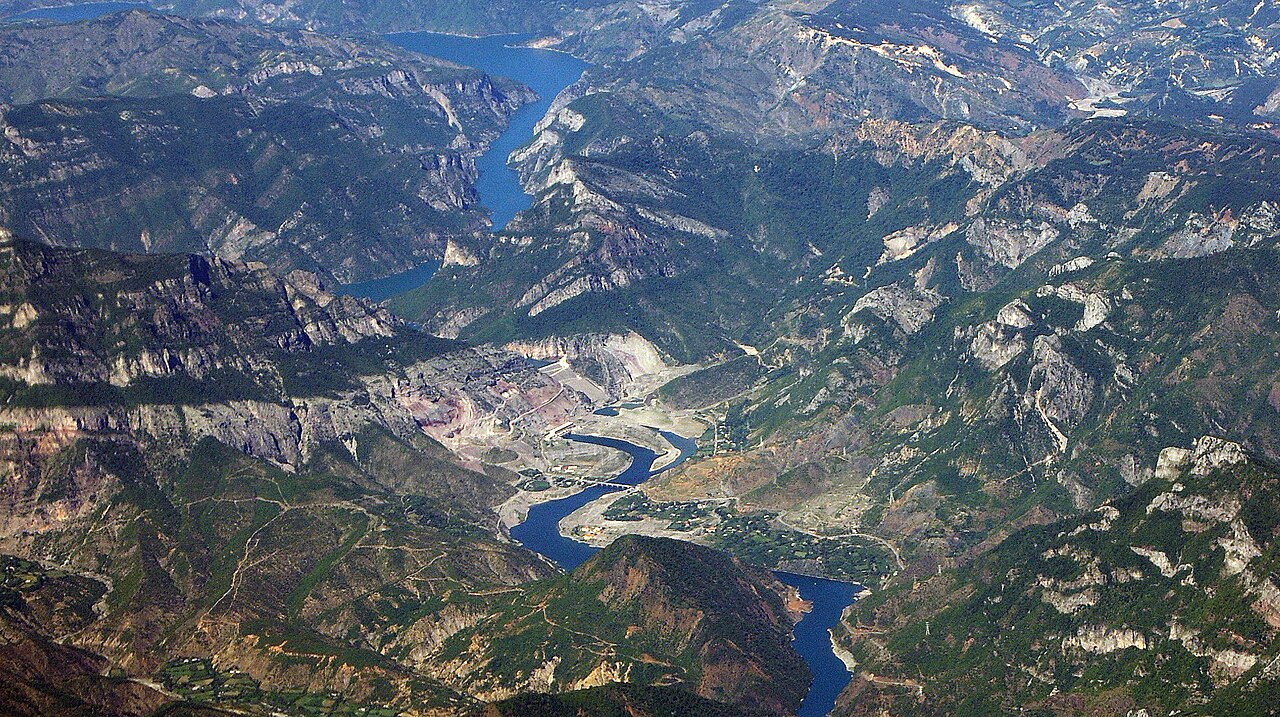
The Drin cut a tight gorge through soft limestone, barely wide enough for the river itself. When it was dammed, the water filled the gorge but had nowhere to spread sideways. The result has the proportions of a river and the depth of a lake: a reservoir around 34 kilometres long, in places only fifty metres wide, with cliffs several hundred metres high falling straight into the water. A real fjord is carved by a glacier, which is a different process altogether, but the shape you end up with is genuinely similar.
The reservoir is part of a cascade of three hydroelectric schemes on the Drin. Fierza sits highest, Koman below it and Vau i Dejës at the bottom. The Koman plant is still run by the state-owned company KESH, and according to its technical data it has four vertical Francis turbines of 150 MW each, 600 MW in total, an average annual output of 1,800 GWh and a maximum operating level of 175.5 metres above sea level. It’s the largest power station in the country, which incidentally explains why the water level of Lake Komani shifts noticeably through the year.
One detail we checked that most articles get wrong: almost every source gives 1978 as the year Lake Komani was created. That date actually belongs to the neighbouring Fierza dam, built between 1971 and 1978 and commissioned a year later. The Koman dam wasn’t built until the 1980s, and the reservoir filled in the second half of that decade. In practice it changes nothing, but it shows how second-hand figures get copied from one write-up about this region to the next.
The hills right by the water rise to between five hundred and a thousand metres, and further north the two-thousand-metre peaks of the Albanian Alps take over. There’s no continuous road anywhere along the shore, and the villages that remain can only be reached by boat. That’s also why the ferry isn’t a tourist attraction laid on for visitors: it’s public transport, and it would run even if nobody had ever heard of the lake.
The Komani Lake ferry: who runs it, when and how much
Three boats work the lake, and telling them apart is where most of the confusion starts. The table below is based on the price list and timetable published by the operator Berisha, checked on 13 September 2026.
| Boat | Departures | Foot passengers | Vehicles | Season |
|---|---|---|---|---|
| Berisha (main ferry) | Koman 9:00 → Fierzë Fierzë 13:00 → Koman | €8.80 online (about £7.50), €10 or 1,000 lek in cash (about £8.50) | €7/m² online, €8/m² or 800 lek/m² in cash | roughly 15 Apr – 5 Nov |
| Dragobia (smaller boat) | Fierzë 6:00 → Koman Koman 9:00 → Fierzë | similar to Berisha | motorbikes only, no cars | also runs outside the main season, with stops |
| Alpin | Fierzë around 8:00 Koman around 11:00 | about €15 to €20 (£13 to £17) | flat rate, a car around 4,000 lek (about £35) | summer season |
As well as cars, Berisha carries minibuses, campervans, bicycles and motorbikes. A bike costs €10.60 online and a motorbike €18.50, both roughly two euros more in cash. One small thing hardly anyone notices: the cash price in euros and the cash price in lek aren’t the same. At around 95 lek to the euro, ten euros is noticeably less than a thousand lek, so if you’re paying at the jetty, pay in euros.
Bookings go directly through the operator, and there are three ways to do it: the booking system on komanilakeferry.com, an email to kontakt@komanilakeferry.com, or a phone call to one of the Albanian numbers listed on the website. Online bookings are paid by card or PayPal; if you book by email or phone, you pay cash on board. In high season we’ve found it works to book a few days ahead, or a full week if you’re bringing a car; in spring and autumn the day before is enough. Download your confirmation to your phone while you’re still in Shkodër, because you can’t count on a signal at the jetty.
How to get to Lake Komani
Flying from the UK, you’ll land in Tirana. There are direct flights from several UK airports, mostly in the London area, but routes and seasons change, so check the current schedule before you book. From Tirana it makes sense to head straight to Shkodër and spend the night there before the boat (more on that below).
Koman jetty is about 70 kilometres from Shkodër and two and a half to three hours’ drive from Tirana. The road along the Drin is narrow and winding, and the last stretch down to the jetty is usually the worst part of the whole journey, so leave yourself some slack. The ferry operator runs its own connecting minivans, timed to fit the boat.
| Route | Departure | Price |
|---|---|---|
| Shkodër → Koman | 6:45 | €8 (about £7) |
| Koman → Shkodër | 15:45 | €8 (about £7) |
| Tirana → Koman | 5:30 | €12 (about £10) |
| Koman → Tirana | 15:45 | €12 (about £10) |
| Fierzë → Valbonë | 12:00 and 16:00 | €8 (about £7) |
| Valbonë → Fierzë | 10:30 | €8 (about £7) |
| Taxi Shkodër → Koman | by arrangement | from €70 (about £60) per car |
If you’d rather not get up at five in the morning in Tirana, you have two sensible options. Either spend the night in Shkodër and do just the two-hour ride in the morning, which is what we do, or pay for a taxi. A taxi pays off from three people upwards, and especially if you want to reach the jetty before the minibuses, because then you get to pick your spot on deck.
From Shkodër you can also take an ordinary local minibus, which leaves early in the morning from an informal stop near the central market. It’s cheaper, but connections aren’t guaranteed and it fills up fast in high season. Ask your accommodation to reserve you a seat the evening before.
Taking a car on the Koman ferry: when it makes sense and what it really costs
This is the question we get asked most, and also the one where people get the price most wrong. Berisha doesn’t charge a flat fee per car but by footprint, meaning width times length. An average hatchback, 1.8 metres wide and 4.2 metres long, comes to 7.56 m². Booked online, that’s roughly €53 (about £45); in cash, around €60 (about £51), one way. An estate or a van can easily go over €70.
Space for vehicles is genuinely limited in summer, and cars are loaded before foot passengers. The operator wants vehicles at the jetty thirty minutes before departure, but in July and August we’d recommend being there closer to an hour ahead. In high season, don’t count on getting a car on board without an online booking.
For us, taking the car across the lake wasn’t worth it. On the other side, in the Valbona valley, you get around on foot anyway, and the tarmac ends at the last hotel. You can easily pay around €100 (about £85) to ship the car there and back, only for it to sit in a field for four days. It only makes sense in two cases: if you’re carrying on into Kosovo via Bajram Curri, or if the car is loaded up for a longer Balkan road trip and you don’t want to haul everything with you.
The Shala River: the side valley that half the visitors come for
Roughly halfway along the lake, a side valley branches off to the north, carrying the small Shala River. The water there is shallow and clear, and in summer it’s lined with white pebble beaches, which is why people call the place “the Albanian Thailand”. It’s an exaggeration, but not a completely silly one: the water really is a different colour from the main reservoir, because the Shala comes straight down from the mountains and carries no sediment.
The Shala isn’t a stop on the regular Koman–Fierzë service. You get there either on a dedicated trip, which leaves Koman in the morning, spends three to four hours at the river and carries on to Fierzë or back in the afternoon, or by speedboat. Full-day trips cost roughly €25 to €50 depending on what’s included. The season is shorter than the ferry’s, in practice from mid-April to mid-October.
Three ways to do Lake Komani
Before you start juggling boat times, it pays to decide what you actually want out of it. There are three options, and each one is planned differently.
1. A day trip from Shkodër. Minivan to Koman in the morning, the nine o’clock boat to Fierzë, back on the one o’clock sailing and the return ride to Shkodër at about half past three. You’re back in town around six in the evening. You see the whole lake twice, you don’t have to pack anything and you sleep in the city again. The downside is five hours on the boat without getting off anywhere.
2. A way into the Albanian Alps. You use the ferry as transport heading east, switch to a minibus in Fierzë and ride up into the Valbona valley. You then come back over the mountains on foot to Theth, and from there take a direct furgon (shared minibus) to Shkodër. In our view this is the best option, because you see both the lake and the mountains once and never retrace your steps.
3. A trip to the Shala River. Either as a full-day outing from Koman, or as a Koman – Shala – Fierzë combination that drops you on the eastern side at the end of the day so you can carry on into the mountains. This one suits you if you’re travelling in July or August and want to swim.
Where to stay: Shkodër as a base, Koman and Fierzë as a fallback
There isn’t much right by the lake, and it’s worth knowing that in advance. At the jetty in Koman there are a few guesthouses and wooden cabins; in Fierzë there’s next to nothing. That’s why the vast majority of people sleep in Shkodër and treat the lake as a day trip or a pass-through.
Shkodër is the obvious base. It has cash machines, a pedestrian street that comes alive in the evening, a decent café or grill on every corner and, above all, everything leaves from here: the minivan to the ferry, the furgon to Theth and buses to Tirana and Montenegro. Prices are much lower than on the coast, and you can choose anything from hostels to new boutique hotels in the centre. We book two nights here, one before heading into the mountains and one after coming back, so neither day has to be rushed. See places to stay in Shkodër.
Koman makes sense in just one situation: when you don’t want a five o’clock start and want to be first at the jetty in the morning. The choice is small, mostly family guesthouses and new wooden cabins above the water. Book early, because capacity really is limited and it fills up in season. Check available accommodation in Koman.
Fierzë is more of a landing stage than a village, and nobody really stays the night there. If you arrive on the afternoon boat and miss the connecting minibus, you usually carry on to Bajram Curri or straight to accommodation in Valbona, where family-run guesthouses offer half board.
What to look for when choosing. First, whether your Shkodër accommodation can book you a seat on the ferry minivan, because that saves half an hour of running around. Second, parking, if you’re driving and leaving the car in town. And third, cash: there are no ATMs in the mountains beyond the lake, so take money out in Shkodër, not somewhere along the way.
When to go to Lake Komani and what to bring
The main ferry runs from about mid-April to early November. Outside that window only the smaller boat keeps going, and we wouldn’t recommend building your plans around it.
May and June are the best months in our view. After the winter the reservoir holds the most water, the level is high and thin waterfalls still run down the walls, drying up later in summer. There’s also room on deck. July and August mean a full boat, booking is a must and there’s the highest chance you won’t get your car on board. On the plus side, it’s warm enough to swim in the Shala. September and early October are a compromise: quiet, bearable temperatures, but after the summer the water level tends to be low and the narrowest stretches look less dramatic.
Even in summer it’s cold on the water. The boat spends two and a half hours in the draught between the cliffs, so a fleece or windproof jacket is worth bringing even in August. There’s nothing to buy on board, so bring water and food from Shkodër, along with cash in lek, as card payments usually aren’t accepted at the jetty. Download offline maps in advance; you’ll find practically no signal on the water.
Where to stand on the boat: on the open deck, not in the cabin. The gorge is the whole point of the trip, and it looks different through glass. Sunlight bounces off the water and it shows in photos, so what has worked best for us is the morning run from Koman, when the sun is still low and the walls don’t have harsh shadows. An overcast day is no disaster either; if anything, the canyon’s colours are softer.
What we’d do differently
The first time, we treated the lake as nothing more than transport. We got on, took photos for two and a half hours and worried about whether we’d make the minibus to Valbona. The second time, on the very same boat, we hardly took any photos, and it was far better. Komani is one of the few places where nobody makes you go anywhere, because for three hours you simply sit, and it would be a shame to spend them staring at a screen.
We also wouldn’t plan the day so that the boat is followed straight away by another transfer. If you step off in Fierzë and climb straight into a minibus, you don’t get a single hour in the whole day when you’re not on the move. We got much more out of just going as far as Valbona, not rushing on anywhere and sitting outside in the evening.
And above all: we wouldn’t try to fit the lake, the Shala, Theth and Valbona into one trip. This area has one boat a day and one furgon a day, and planning it like an itinerary around Italy is a sure way to spend the whole week on buses and boats. Better two places at a relaxed pace than four ticked off. Our best evening in this part of Albania was spent in a little restaurant nobody had written about, over fish from the local water and raki we were poured without asking. You can’t put that sort of thing in a plan, but you have to leave room for it.
Lake Komani FAQ
How much is the Komani Lake ferry?
With the main operator, Berisha, foot passengers pay €8.80 (about £7.50) when booking online, or €10 or 1,000 lek in cash at the jetty. A bicycle costs €10.60 online and a motorbike €18.50. Cars aren’t charged a flat fee but by footprint: €7 per square metre online or €8 in cash. A typical hatchback therefore costs around €53 to €60 one way. Prices checked on 13 September 2026.
What is the Lake Koman ferry timetable?
The main Berisha ferry leaves Koman daily at 9:00 and Fierzë at 13:00. The crossing takes about 2.5 hours and the season runs from roughly 15 April to 5 November. The smaller Dragobia leaves Fierzë at 6:00 and Koman at 9:00 and takes people and motorbikes. The third operator, Alpin, sails from Fierzë at around 8:00 and from Koman at around 11:00. Times change between seasons, so confirm them the day before.
How do I book Komani Lake ferry tickets?
Directly with the operator Berisha: through the booking system on komanilakeferry.com, by email to kontakt@komanilakeferry.com, or by phone on the numbers listed on the website. Online bookings are paid by card or PayPal; if you book by email or phone, you pay cash on board. The online price is also lower than the cash price: foot passengers pay €8.80 instead of €10. In high season book several days ahead, or a week if you’re bringing a car.
How do I get to Komani Lake from Shkodër?
On the ferry operator’s minivan, which leaves at 6:45 and costs €8 (about £7), or on an ordinary local minibus from near the central market. The journey takes about two hours. A taxi costs from €70 per car and is worth it for three or more people. From Tirana, the minivan leaves as early as 5:30 and costs €12.
Can you take a car on the Koman ferry?
Yes. The Berisha ferry carries cars, minibuses and campervans and charges by footprint. Space is limited in summer, though, vehicles are loaded before foot passengers, and in high season you can’t count on getting a car on board without an online booking. Be at the jetty at least thirty minutes before departure, and in July and August preferably an hour.
Is the Shala River worth visiting?
If you’re going in the warmer months and want to swim, yes. The water is shallow, clear and a different colour from the main reservoir, because it comes straight down from the mountains. The Shala isn’t a stop on the regular service, though: you get there on a dedicated trip or by speedboat, and a full-day outing costs roughly €25 to €50. The season is shorter than the ferry’s.
How long and how deep is Lake Komani?
The reservoir is about 34 kilometres long, only around fifty metres wide in places, and one of the deepest in Albania. Sources disagree on the exact depth, so we’d rather not state a figure as fact. What is certain is that it’s the reservoir of the Koman hydroelectric plant, which according to its operator KESH has an installed capacity of 600 MW and an average annual output of 1,800 GWh.
Can you do Lake Komani as a day trip?
Yes, and it’s the most popular option. You leave Shkodër at 6:45, board the boat at 9:00, sail back at 13:00 and are back in town around six in the evening. You’ll see the whole lake but won’t get off anywhere, and you’ll spend five hours on deck. If you want more out of the lake, use it as your route into the Albanian Alps.
Where next
- What to see in Albania: our overview of places across the whole country, from the coast to the mountains.
- Valbona Valley: the valley on the far side of the lake, reached by the connecting minibus from Fierzë.
- Theth National Park: the other half of the Albanian Alps, with a detailed description of the crossing over the pass.
- Best beaches in Albania: for when you want some coast after the mountains.
Potřebujete pomoct s cestováním?
-
Ubytování 🏨
Vyberte si to nejlepší ubytování, ať už jste kdekoliv, přes Booking.com. -
Půjčení auta 🚗
Auto si snadno najdete přes Booking.com, kde máte často slevu díky ubytování, nebo Rentalcars.com, kde porovnáte nabídky většiny půjčoven. -
Zážitky 🎟️
Přes GetYourGuide.com si vyberete z nejrůznějších výletů i zážitků po celém světě, navíc se zrušením zdarma do 24 h předem.