Last updated 26.10.2026
Valbona Valley is the other half of the Albanian Alps, and in many ways the easier half to like. Theth is a tight village in a bowl of rock; Valbona is open, bright and pastoral. A wide bed of white river stones, haybarns in the meadows, and guesthouses strung out along the road all the way to the last hamlet, where the tarmac gives up.
Most people treat Valbona as one stage of a well-known loop: arrive, sleep, and leave over the pass to Theth the next morning. We think that’s a mistake. The valley has side valleys where you’ll meet nobody all day except shepherds, and it’s a place where you can stay three days and still have somewhere new to walk each morning.
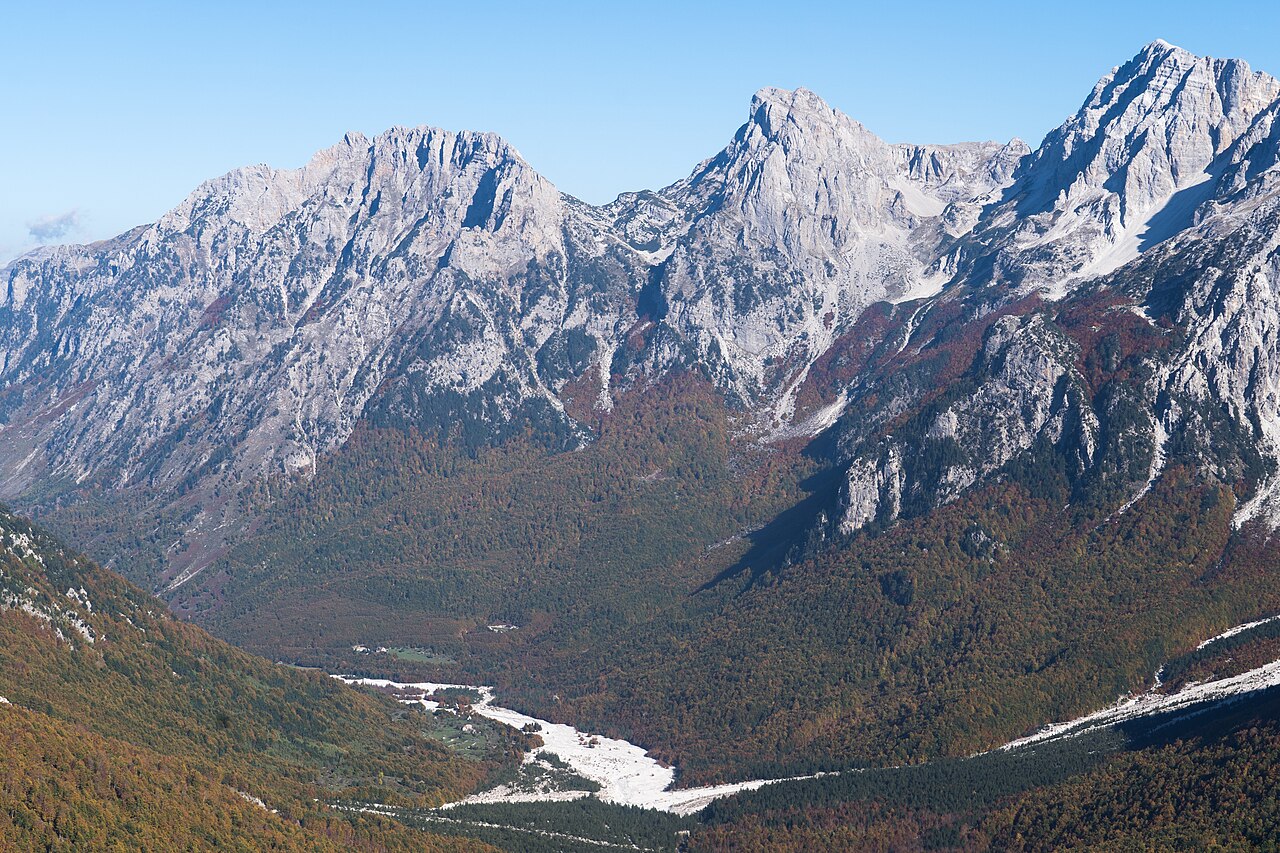
Valbona Valley at a glance
- Where it is. North-east Albania, Kukës County, Tropojë District. The valley runs for roughly 30 kilometres and the main village, Valbonë, sits at around 1,000 metres.
- Valbona Valley National Park (Lugina e Valbonës) was created in 1996 and covered 80 km². In January 2022 it was merged with Theth National Park and the Gashi reserve into the Albanian Alps National Park, roughly 828 km² in total.
- The highest peak above the valley is Maja e Jezercës (2,694 m), the highest summit in the whole Dinaric Alps.
- Getting there. The classic route is the ferry across Lake Komani to Fierzë and a minibus from there. Alternatively, by road via Bajram Curri, or through Kosovo.
- There is no ATM in the valley. The nearest one is in Bajram Curri, so sort out cash in Albanian lek before you arrive.
- You sleep in family guesthouses on half board, for around 2,500 to 4,000 lek (roughly £22 to £35) per person per night.
- The best-known hike is the crossing over the Valbona Pass to Theth, 6 to 8 hours. But there are plenty of loops that bring you back to the same guesthouse.
- Our take: if you want mountains and quiet and don’t need a postcard church next door, Valbona is the better choice than Theth.
What Valbona Valley is and how it fits together
A glacier carved this valley, and it shows: a flat floor and steep sides, the textbook U shape. The Valbona River runs through it, the largest river in the Albanian Alps, fed by karst springs below Maja e Jezercës. Its quirk is that for much of the year it flows in only part of its bed, or underneath the gravel, so instead of white water you see a broad channel of pale stones. After the spring melt it’s a completely different picture.
The government protected the valley in 1996, when Lugina e Valbonës National Park was set up over 80 square kilometres. Since 26 January 2022 it has been part of a bigger whole, the Albanian Alps National Park, which joined Valbona, Theth and the strict Gashi nature reserve. For visitors nothing has changed in practice: there’s no entrance fee, the waymarks are where they were and the guesthouses carry on as before.
Forest covers about nine tenths of the park, mostly beech, pine and oak, and it’s one of the few parts of Albania where Norway spruce grows. Brown bears, wolves, lynx, roe deer, chamois and wild goats all live here. The Gashi River in the eastern part of the park belongs to the ancient beech forests listed by UNESCO.
There are four settlements in the valley: Dragobi lowest down at the entrance, Valbonë as the main village in the middle, Rrogam (also spelt Rragam) as the last village at the top, and Çerem, tucked away in a side valley. Only a few hundred people live here altogether, and most of them make a living from either livestock or visitors.
How to get to Valbona Valley
There’s no quick way in, and that’s part of the point. From the UK you’ll almost certainly land at Tirana, which has direct flights from London; routes and seasonal schedules change, so check what’s flying before you book. From Tirana you either head north to Shkodër, the starting point for the classic ferry route, or drive east via Kukës. Once you’re in Albania, there are three ways to reach the valley, and they differ mainly in how much of the journey is an experience and how much is just transport.
1. Across Lake Komani (the classic). An early minivan from Shkodër to the Koman ferry landing, a 9 am boat through the gorge for two and a half hours to Fierzë, and a minibus from there up to Valbona. The minibuses wait right at the landing and leave at 12:00 and 16:00 for about €8 (roughly £7). The whole trip takes a day, but it’s the most beautiful ride in Albania. Boats, prices and times are covered in detail in our guide to Lake Komani.
2. By road via Bajram Curri. Bajram Curri is the district town about 25 to 30 kilometres from Valbona, and also the nearest place with an ATM. The minibus to the valley usually leaves at 14:30, and the one back from Valbona at 7:00 in the morning; you can also arrange a taxi. This option skips the ferry, so it suits the return leg, or days when the boat times don’t work. It’s the only service of the day, though, so ask your guesthouse to confirm it the day before.
3. From Tirana via Kukës and Kosovo. The fastest road route takes the motorway to Kukës, then crosses into Kosovo via Gjakova and back through the Qafa e Morinës border crossing. If you’d rather avoid Kosovo, you can turn off at Kukës onto a narrow road via Krumë: shorter in distance, longer in time. Bring your passport, as you cross the border twice. Without a car, there’s a bus that runs about five times a day, costs around 1,000 lek (roughly £9) and takes a little over four hours; local minibuses connect between Gjakova and Bajram Curri.
With your own car (or a hire car from Tirana). You can take a car across Lake Komani, but you pay by its footprint and summer capacity is limited. In Valbona it will mostly sit parked anyway, because both the tarmac and the scheduled minibus end at the Fusha e Gjesë mountain hotel, and beyond that only a 4×4 track continues to Rrogam. If you hike the pass to Theth, you’ll come out somewhere completely different. In our view a car only makes sense if you’re carrying on into Kosovo.
One boat a day means one chance a day. On the Shkodër – Koman – Fierzë – Valbonë route there’s no backup service. Miss the morning minivan and you’ve lost the whole day. That’s why we always book the last night before the mountains in Shkodër, not Tirana: from Tirana you’d be leaving at half past five in the morning, and nobody enjoys that.
Things to do in Valbona: what to see in the valley
The main attraction is the valley itself, but a handful of specific places are worth the detour.
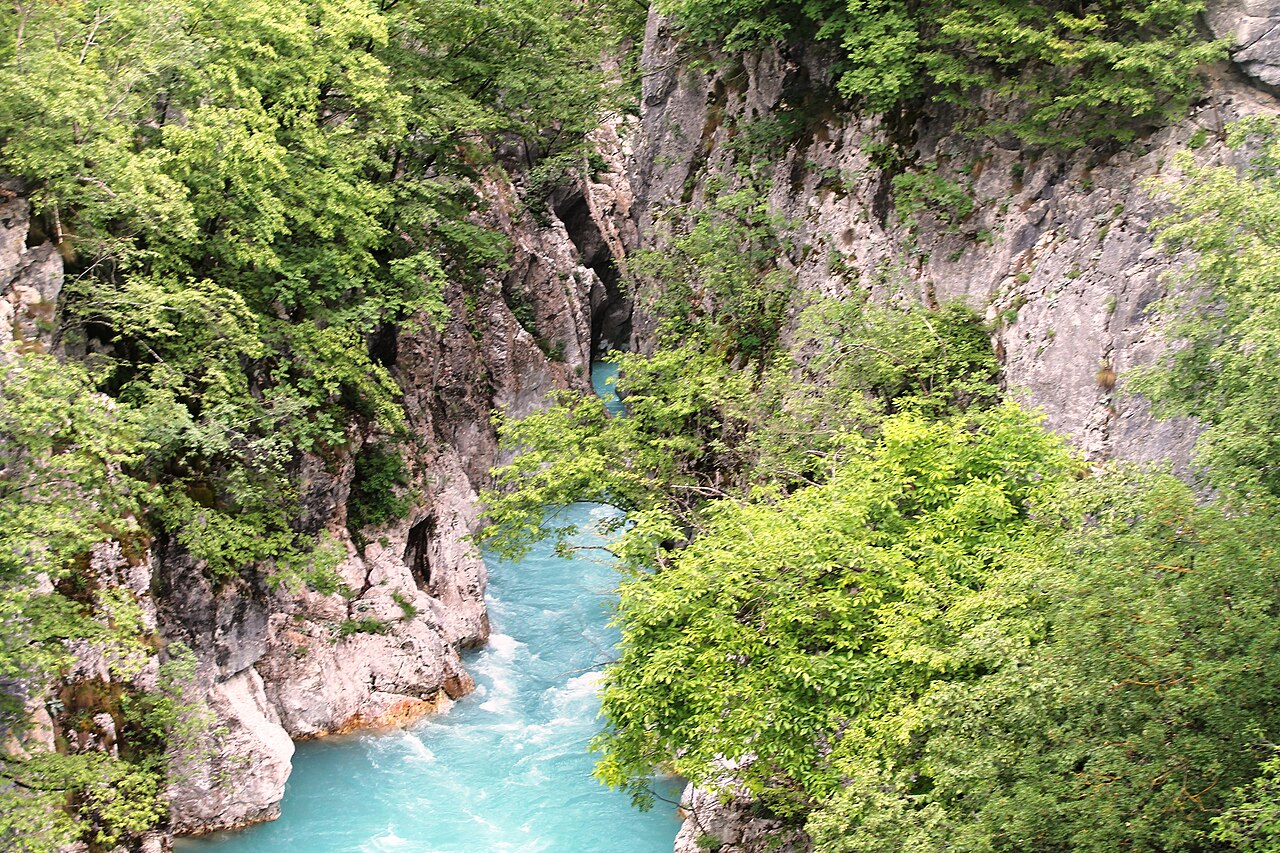
- Shoshan Canyon (Kanioni i Shoshanit) is the first thing you see when you arrive from Bajram Curri. A deep, narrow gorge with turquoise water running through it, and from the car park by the bridge you can scramble right down to the river. In the heat of summer it’s the best swimming spot in the whole area.
- Xhema Lake (Liqeni i Xhemës) lies about three kilometres downstream from Valbonë village, in the forest among boulders. It’s small, but the water is an unusual green-blue. On the way you pass an old mill reached by a narrow footbridge over the river, and just above it is a good place for a swim.
- Valbona Waterfall (Ujëvara e Valbonës) is just beyond the hamlet of Rrogam, right at the top of the valley. From the end of the tarmac it’s a little over three kilometres on a track that mostly follows the dry riverbed.
- Dragobi Cave (Shpella e Dragobisë) on the south side of the valley matters to Albanians mainly as a symbol. In 1925 Bajram Curri, a former commander of the Albanian army, hid here and chose to take his own life rather than be captured. The town below the valley bears his name.
- Çerem and Kukaj are mountain hamlets in side valleys, reached on foot or by 4×4. Both make excellent bases for full-day hikes, and both have a guesthouse where you can stay the night if you want to be properly remote.
- The Snake Meadows (Livadhet e Gjarpërit) are pastures on a terrace at around 1,200 metres, with a view along the full length of the valley. A six-kilometre 4×4-only track leads up, and the owners of the guesthouse there usually pick guests up from the road for a fee. Don’t expect luxury; expect hospitality, home-produced food and silence. If you’d rather not walk, you can hire a horse here and ride out over the surrounding pastures.
Valbona Valley hikes: choosing by fitness
This is the main reason to stay in Valbona for more than one night. Unlike the crossing to Theth, these routes are loops or out-and-back walks, so you come back to the same guesthouse in the evening and don’t have to deal with your luggage.
| Route | Distance and time | Ascent | Difficulty |
|---|---|---|---|
| To the viewpoint above Kukaj and the old mill | about 9 km, 4 h | around 675 m | easy |
| Snake Meadows loop | about 10 km, 4 h | around 540 m | easy |
| Dash and Sylbica lakes | about 9 km, 4 h | around 440 m | easy |
| Valbona to Çerem, optionally with a climb of Kollata (2,556 m) | about 12 km, 7 h | around 1,200 m | moderate |
| Çerem to the shepherds’ settlement of Dobërdol | about 16 km, 6 h | around 1,100 m | moderate |
| Ascent of Maja e Rosit | about 18 km, 10 h | around 1,590 m | hard |
| Ascent of Maja e Jezercës (2,694 m) | about 21 km, 12 h | around 1,700 m | very hard |
The figures are approximate and come from a published route database for the Albanian Alps. In reality they vary depending on exactly where you start, because the valley road is long and you can often get a lift for part of it.
Valbona is also one stage of the Peaks of the Balkans long-distance trail, a loop through Albania, Kosovo and Montenegro. It takes about ten days, and the cross-border sections need a permit arranged in advance. If you’re only hiking within Albania, you don’t need one.
What surprised us most in Valbona was how quickly you can disappear. Walk into a side valley and after an hour you won’t meet a soul. In August the main track between Valbona and Rrogam gets fairly busy, but a hundred metres higher it’s just silence and a flock of sheep. If you want mountains without crowds and don’t fancy climbing to 2,500 metres, it’s easier to find here than in Theth.
The Valbona to Theth hike: what to sort out before you leave Valbona
The Valbona Pass (Qafa e Valbonës) is the only direct link to the Theth valley, because there’s no road between the two. It’s roughly 15 kilometres and six to eight hours, and the pass itself sits at around 1,795 metres.
From the Valbona side the climb is gentler, because the valley floor is higher: you gain about 800 metres instead of a thousand. The waymarked path only starts up at Rrogam, though, so most people take an early-morning jeep to the trailhead rather than spend two hours trudging along the valley road. You book it the evening before and it costs about €25 (roughly £21) per vehicle. Guesthouses also routinely arrange to send your luggage on to Theth, so you walk with just a daypack.
A step-by-step description of the route, the waymarking, which direction to choose, the season and the logistics are all in our guide to Theth National Park.
Where to stay in Valbona Valley
Accommodation in the valley is almost entirely family guesthouses (bujtina), spread along the road from Valbonë village up to Rrogam. The rooms are simple, usually wood-panelled, and the model is nearly always half board: a bed, a home-cooked dinner and breakfast. They cook with whatever is to hand, so expect mountain cheese, fresh bread, vegetables from the garden and slow-cooked meat. Budget around 2,500 to 4,000 lek (roughly €26 to €42, or £22 to £35) per person per night, with July and August at the top end.
How to choose. Where you stay in the valley shapes the whole trip more than how the room is fitted out.
- Valbonë village is where things happen. The most options, restaurants, the school, the bus. A good choice if you want somewhere to go in the evening and don’t want to think about transport.
- Rrogam, at the top, is the last hamlet before the climb to the pass. If you’re doing the crossing in the morning, staying here saves you two hours of walking along the valley road. The choice is very limited, though, and in the evening there’s nothing but mountains.
- Dragobi, at the bottom by the valley entrance, is the quieter, more hotel-like option, handy if you arrive by car and don’t want to drive further up.
- Çerem and Kukaj are for people who want to be properly off the map. You get there on foot or by 4×4, and it’s more of an experience than just a place to sleep.
What to ask when you book. Whether they can do an early breakfast before the crossing, a packed lunch, luggage transfer to Theth and a jeep to the trailhead. Guesthouses handle all of this routinely, but it needs arranging in advance, not at seven in the morning. And ask about payment: most take cash only.
A few specific places in the valley: Hostel & Camping Rilindja is the oldest hiker base in the valley, and its restaurant is the traditional meeting point before and after the crossing. Bujtina Albjoni is one of the best-rated family guesthouses in the village. Oda N’Bjeshkë sits somewhere between a guesthouse and a small hotel, with a large garden and a covered restaurant terrace. For the full picture, browse all accommodation in Valbona.
If you arrive by ferry and miss the last minibus, look for a bed in Shkodër and travel the next day. If you’re carrying on after the crossing, you’ll need accommodation in Theth.
There’s no ATM in the valley. The nearest is in Bajram Curri, 25 kilometres and one minibus away. Withdraw lek in Shkodër or Tirana and add a buffer for an extra day. Bring small notes too: breaking a large one in the mountains is a problem.
When to visit Valbona Valley
The reliable season is June to September, stretching into May and October depending on the snow. The climate here is an interesting mix of Mediterranean and continental: summers are hot and dry, winters cold and extremely wet. Snow starts falling on the higher ground in October or November and lies until March or April; up high it builds up to several metres and stays for two to five months.
June brings the most water in the river, meadows in flower and a pass that has only just opened. July and August are the warmest and most reliable months, but the valley gets hot and the main track gets busy. September is our pick: quiet, clear air, colour. October is a gamble: guesthouses gradually close and there may be snow on the pass.
Only plan the crossing to Theth for the summer window. From November to the end of May the pass is under snow and dangerous for ordinary hikers.
What we’d do differently
The first time, we spent one night in Valbona and left over the pass the next morning. Of the famous valley, we saw the walk from the minibus to the guesthouse and the walk from the guesthouse to the trail. Looking back, that’s the worst possible way to do it: twelve hours of travel to get nine hours of rest in the dark.
If we were planning it again, we’d give Valbona two full days. The first for something easy, say Xhema Lake and the old mill, or simply walking upriver for as long as we felt like it. The second for a side valley, because that’s where Valbona is at its best. And only on the third morning would we cross the pass, on rested legs and without feeling that the crossing was the only reason we were there.
We’d also plan less. The best meal we had here was in a place nobody had recommended, grilled meat and cheese from the neighbour. And the best half hour we spent sitting on a rock in the riverbed, doing nothing, because it was hot and we didn’t feel like going anywhere. Neither would have fitted into an itinerary.
And you don’t have to see everything. Maja e Jezercës is the highest mountain in the Dinaric Alps and it’s tempting to tick it off, but it’s a twelve-hour day that leaves you good for nothing for the next two. If you have three days in the valley, three relaxed walks will give you more than one heroic one. The mountains aren’t going anywhere.
Valbona Valley FAQ
How do you get to Valbona from Shkodër?
The classic way is the Lake Komani ferry: an early minivan from Shkodër to the Koman landing, the 9:00 boat to Fierzë, and then a minibus at 12:00 or 16:00 up to Valbona for about €8. The second option is by road via Bajram Curri, the third from Tirana via Kukës and Gjakova in Kosovo. From Shkodër the whole journey takes a day. Coming from the UK, you’ll normally fly into Tirana first.
How much does accommodation in Valbona cost?
A family guesthouse on half board costs around 2,500 to 4,000 lek (roughly £22 to £35) per person per night, with July and August at the top end. That covers a bed, a home-cooked dinner and breakfast. You pay in cash; there’s no ATM in the valley and the nearest is in Bajram Curri. Prices checked on 13 September 2026.
Valbona or Theth: which is better?
It depends on what you’re after. Valbona is wider, brighter and quieter, with more side valleys you can have to yourself for the day. Theth has a denser village feel and famous sights such as the church, the blood-feud lock-in tower, Grunas Waterfall and the Blue Eye. If you mainly want to walk in peace, we think you’ll be happier in Valbona. Ideally see both and link them with the hike over the pass.
How long is the Valbona to Theth hike?
About 15 kilometres and six to eight hours; the Qafa e Valbonës pass is at around 1,795 metres. The climb is gentler from the Valbona side, about 800 metres, because the valley floor is higher. The waymarked path only starts at the hamlet of Rrogam, so most people take an early jeep to the trailhead for about €25 per vehicle. It’s a summer-only hike, roughly June to September.
Do you have to pay to enter Valbona Valley National Park?
No. There’s no entrance fee or road toll, and you don’t need a permit for routes inside Albania. Permits only apply to the cross-border sections of the Peaks of the Balkans trail into Kosovo and Montenegro. Guesthouses collect a small municipal fee in cash.
Can you drive to Valbona?
Yes, by road via Bajram Curri, or with the Lake Komani ferry, which charges for cars by footprint and has limited summer capacity. In the valley, though, the car will mostly sit idle: the tarmac ends at the last mountain hotel, a 4×4 track continues beyond it and everything else is on foot. If you hike over to Theth, you’ll finish somewhere other than where you parked.
What hikes are there in Valbona besides the trek to Theth?
Everything from easy to very hard. Easy options are the walk to Xhema Lake and the old mill, the Snake Meadows loop, or the Dash and Sylbica lakes, each about four hours. The route to Çerem and on to the shepherds’ settlement of Dobërdol is moderate. The hard ones are the ascents of Maja e Rosit and Maja e Jezercës (2,694 m), the highest peak in the Dinaric Alps: allow a full day and more than 1,500 metres of ascent.
Where next
- What to see in Albania: our big overview of the whole country, mountains and coast.
- Theth National Park: the other side of the pass and a detailed description of the crossing.
- Lake Komani: the ferry most people take to reach the valley.
- Best beaches in Albania: when you want some coast after the mountains.
Potřebujete pomoct s cestováním?
-
Ubytování 🏨
Vyberte si to nejlepší ubytování, ať už jste kdekoliv, přes Booking.com. -
Půjčení auta 🚗
Auto si snadno najdete přes Booking.com, kde máte často slevu díky ubytování, nebo Rentalcars.com, kde porovnáte nabídky většiny půjčoven. -
Zážitky 🎟️
Přes GetYourGuide.com si vyberete z nejrůznějších výletů i zážitků po celém světě, navíc se zrušením zdarma do 24 h předem.