Last updated 26.10.2026
Most of what you’ll read about Theth National Park could have been written in 2015, and that’s the problem. Two big things have changed since then. The road into the valley has been fully tarmacked since 2021, and since January 2022 the park no longer formally exists on its own: it was merged with neighbouring Valbona into one much larger protected area. Both changes affect how you plan the trip.
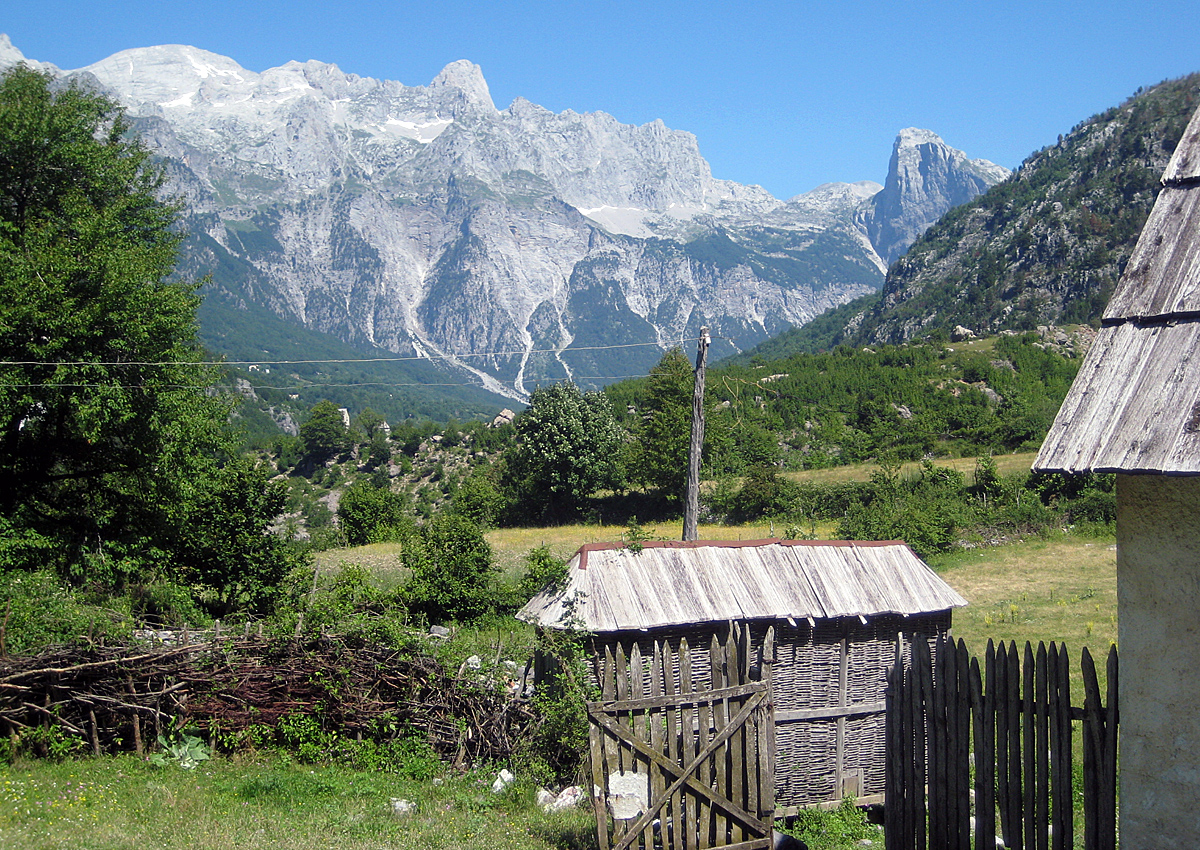
Theth itself is a mountain village in the Accursed Mountains (Prokletije), the range Albania shares with Montenegro and Kosovo. It sits in a glacier-carved valley at about 745 metres, ringed on every side by peaks well over 2,000 metres. It’s the starting point for nearly everything worth doing in the Albanian Alps, and most people come for one thing in particular: the hike over the pass into the Valbona valley.
Theth National Park at a glance
- Where it is. Northern Albania, about 70 kilometres from Shkodër. The drive takes 2.5 to 3.5 hours, not because the road is long but because it never stops twisting.
- The road is no longer a 4×4 track. The SH21 over the Qafa e Thorës pass (about 1,700 m) was finished in 2021, when the last gravel section was surfaced. It’s still narrow and steep, but it isn’t off-road any more.
- The park was merged in January 2022 with Valbona National Park and the Gashi reserve to form the Albanian Alps National Park, covering roughly 828 km². The original Theth National Park, founded in 1966, covered just 26.3 km².
- There’s no entrance fee and you don’t need a permit for the main trails. The exception is cross-border routes into Montenegro.
- There’s no ATM in the valley. Get your lek in Shkodër, because hardly anyone here takes cards.
- You sleep in a bujtina, a family guesthouse with half board. There are no hotels in the valley. Budget roughly 2,000 to 3,500 lek (about £18 to £31) per person per night.
- The main season runs from June to September, stretching into May and October depending on snow. The crossing to Valbona is strictly a summer hike.
- In one day you can do the village and one big hike, not both. The Blue Eye and the pass are two separate full days.
What Theth National Park protects and what changed in 2022
The park was created back in 1966, one of the first in Albania. It covered 2,630 hectares, about 26 square kilometres around the village: the peaks, the beech forests and the valley of the Shala river. You’ll find that figure in most guides, and it’s accurate. It just describes something that no longer exists.
On 26 January 2022 the Albanian government combined Theth National Park, Lugina e Valbonës National Park (created in 1996) and the Gashi strict nature reserve into a single protected area, Parku Kombëtar i Alpeve të Shqipërisë, the Albanian Alps National Park. At roughly 82,844 hectares, more than 828 square kilometres, it’s now the largest national park in the country.
On the ground, very little has changed for visitors. You walk the same paths, sleep in the same guesthouses and pay the same municipal tourist tax. What’s different is that the Albanian Alps are now managed as one landscape, wildlife corridors included, and that both valleys, Theth and Valbona, now come under a single name.
The geology is limestone karst, and you see it everywhere. Water vanishes into the porous rock and bursts out again further down as a powerful spring, which is exactly how the Blue Eye and the Grunas waterfall came about. The highest mountain in the wider area is Maja e Jezercës (2,694 m), the highest summit of the entire Dinaric Alps.
The wildlife list includes brown bear, wolf, chamois, wild goat, roe deer and the critically endangered Balkan lynx, of which only a few dozen remain across the whole region. In practice you won’t see any of them, and that’s a good sign. What you will see are birds of prey over the ridges and trout in the river. Beyond the beech woods, the plants worth looking out for are mountain orchids and the deep blue Wulfenia baldaccii, which grows in the Albanian Alps and nowhere else on earth.
The road to Theth: the most out-of-date information in Albania
For years Theth was described as a place you could only reach by 4×4 on a gravel track. That was true, and it’s why so few people came for so long. It isn’t true any more: the last unsurfaced section of the SH21 was tarmacked in 2021, and all of the roughly seventy kilometres from Shkodër are now paved.
What hasn’t changed is the character of the drive. The road climbs in hairpins to the Qafa e Thorës pass at around 1,700 metres, one of the highest points in Albania you can reach by car, and then drops into the valley. It’s narrow, has no crash barriers along much of its length, and on the bends you’ll meet minibuses coming the other way. That’s why seventy kilometres still take two and a half to three and a half hours.
In winter the pass is usually closed by snow and most guesthouses shut. The practical season is roughly June to September, give or take a few weeks depending on the weather. Outside it, you’ll need to arrange both transport and a bed in advance and in person.
Coming from the UK, the usual gateway is Tirana airport, which has direct flights from London. Check current routes and schedules before you book, as they change from season to season. From Tirana you continue north to Shkodër, which is the real jumping-off point for Theth: the minibuses and shuttles in the table below all start there. The other classic approach is the ferry across Lake Komani to the Valbona side, followed by the hike over the pass.
| Connection | Departs | Price | Notes |
|---|---|---|---|
| Furgon (minibus) Shkodër → Theth | usually 7:00 and 14:00 | about 1,200 lek (about £11) | leaves from near the Hotel Rozafa; times shift with demand |
| Tourist shuttle Shkodër → Theth | 7:00 and 14:00 | €12 (about £10) | run by the same company as the Komani ferry, booked online |
| Theth → Shkodër | 11:00 and 17:00 | €12 (about £10) | the same service in the opposite direction |
| Private 4×4 transfer | by arrangement | around €90 (about £77) per vehicle | door to door, split between passengers |
| Taxi Theth → Tirana | by arrangement | from €180 (about £155) | only worth it for a group heading to the airport |
Checked on 13 September 2026 against the price list of the operator that runs the services. Minibus times move around during the season, so ask your guesthouse to confirm them the day before.
Our honest take on driving: a car of your own is no use to you once you’re in Theth. You get around the valley on foot, the track to the Blue Eye is beyond an ordinary car anyway, and if you hike over the pass to Valbona you finish somewhere other than where you parked. If you’re hiring a car regardless, check with the rental company that you’re allowed on the SH21, because some contracts exclude mountain roads.
Things to do in Theth and how much time you need
Theth doesn’t come with a checklist of sights. It’s a village scattered across the valley floor, and almost everything here means walking somewhere. The most common planning mistake is to arrive for one night and expect to fit in the village, the waterfall and the Blue Eye.
| What | Time needed | Difficulty |
|---|---|---|
| Church and lock-in tower | under an hour | flat, in the village itself |
| Ethnographic Museum | under half an hour | in the village, token entry fee |
| Grunas Waterfall and canyon | half a day | short climb |
| Ndërlysa and the rock pools | half a day | easy, down the valley |
| Blue Eye (Syri i Kaltër) | half a day to a full day | longer, rocky in places |
| Peja Pass and Peja Lake | full day | demanding |
| Crossing the Valbona Pass | 6 to 8 hours, one way | hard, point to point |
| Climbing Maja e Harapit | 8 to 10 hours | very hard, exposed scrambling section |
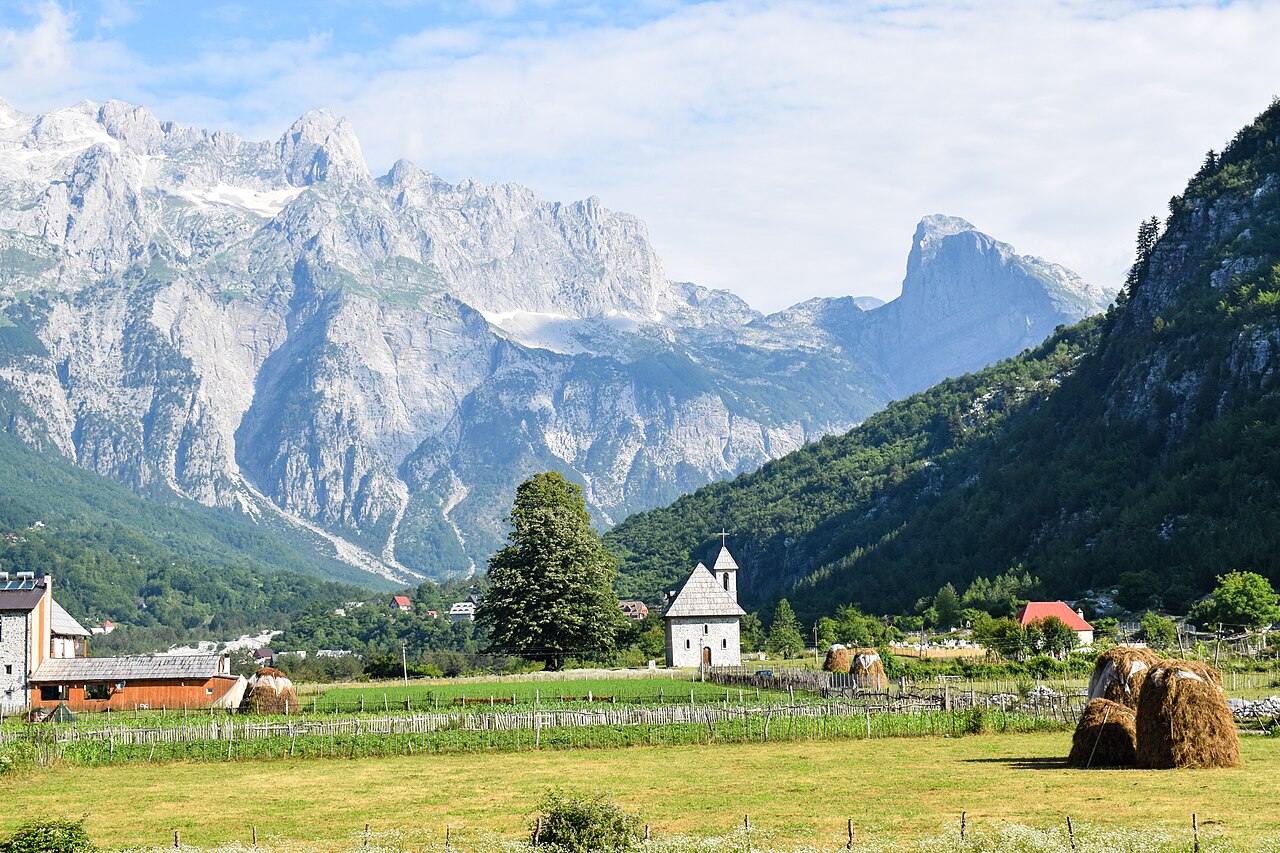
The church, Kisha e Thethit, built in 1892, is the photo you already know: a little stone church with a shingled bell tower on a green meadow beneath the cliffs. It’s two minutes from most guesthouses and the only thing in the valley you can see without breaking a sweat. There’s a reason it’s here at all. The Catholic community retreated up the valley from the lower Shala roughly three and a half centuries ago to escape forced conversion to Islam, and the church is the most visible trace they left.
The lock-in tower (Kulla e Ngujimit) is a small building with a huge story. Men marked for death in a blood feud under the customary law of the Kanun of Lekë Dukagjini shut themselves inside this stone tower, with gun slits instead of windows. Sometimes they stayed for weeks, sometimes for years, until the families were reconciled. The tower is about four hundred years old and one of the last surviving buildings of its kind. Two floors are open to visitors. In our view it explains more about northern Albania than all the viewpoints put together.
The Ethnographic Museum (Muzeu Etnografik) is a small display in a traditional mountain house on a rocky knoll above the village. It shows how people lived in the valley: livestock on the ground floor, the family one storey up. Entry is a token amount and half an hour is enough. For us it was the perfect plan for an afternoon when the cloud came down over the valley.
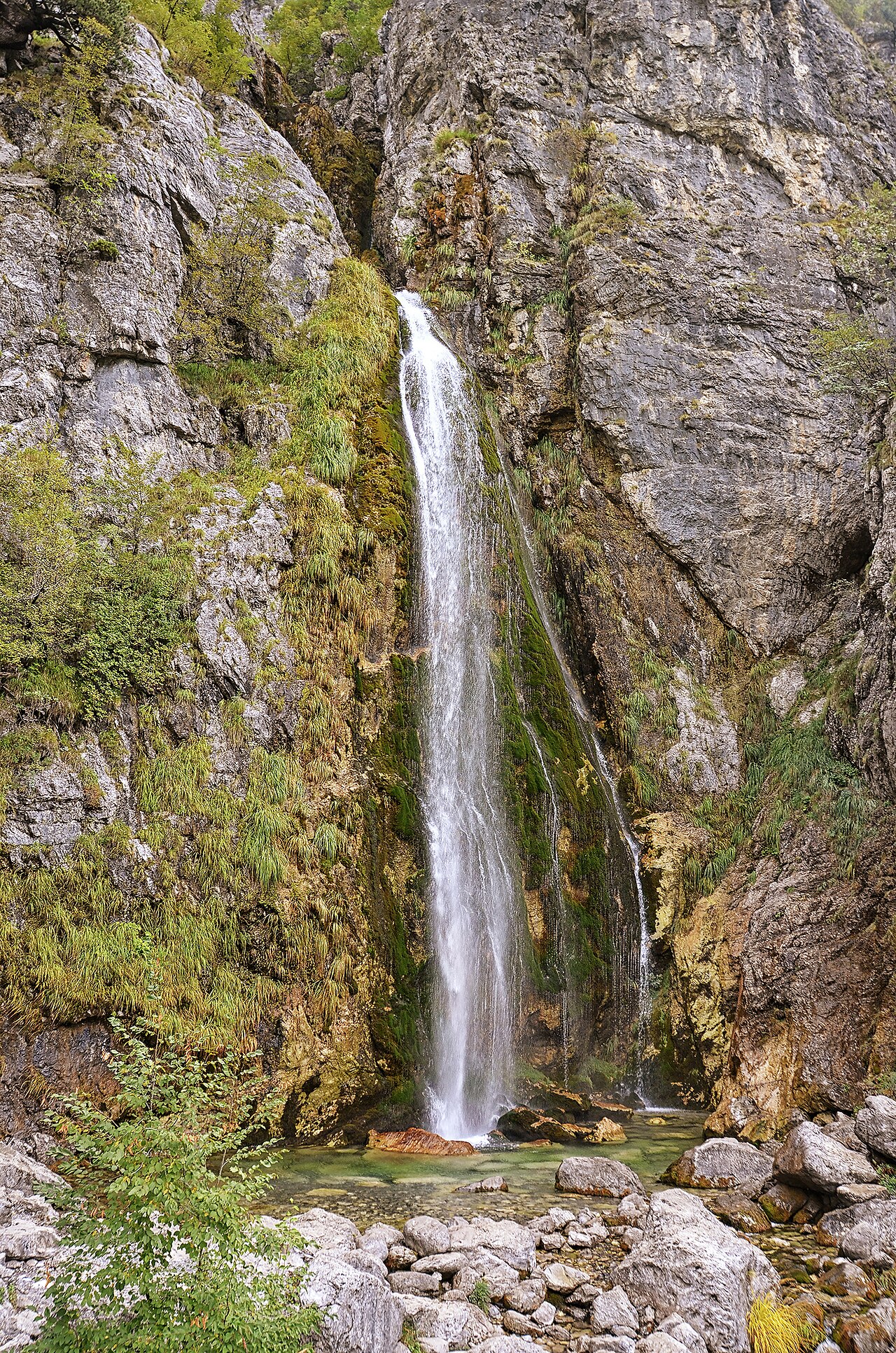
Grunas Waterfall drops about 25 to 30 metres into a cold pool and is fed mainly by snowmelt. It’s the easiest of the big Theth walks and works well for the afternoon you arrive. On the way you can detour to the Grunas canyon, up to sixty metres deep and in places only a few metres wide, crossed by a wooden footbridge.
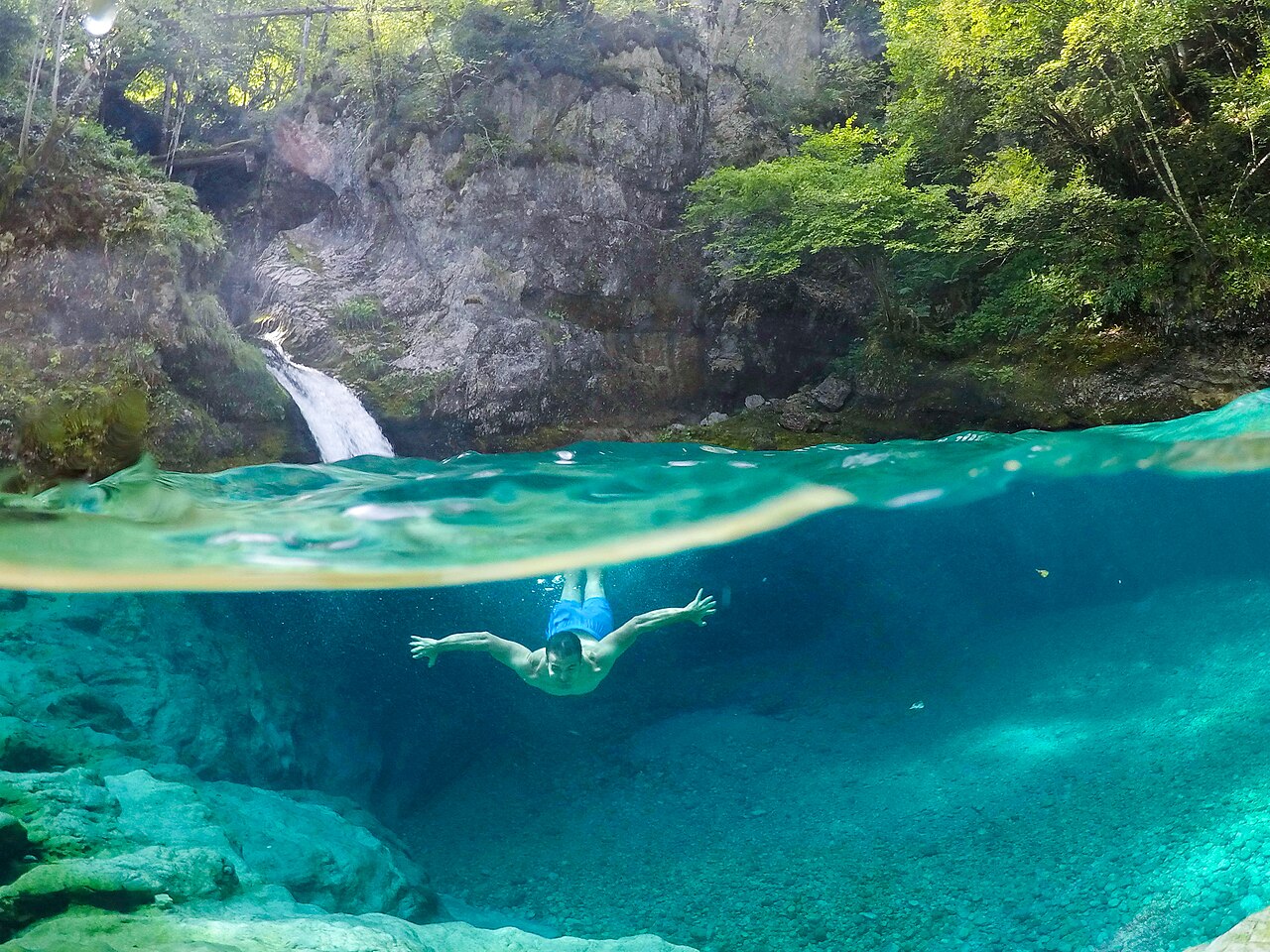
Ndërlysa is a hamlet further down the valley where the river has polished the rock into smooth natural pools you can swim in. It’s a much gentler outing than the Blue Eye, and there’s a grill restaurant at the start of the path, so it makes a pleasant, lazy half day.
The Theth Blue Eye (Syri i Kaltër, also called the Kaprre Blue Eye) is a karst spring in a wooded gorge above Ndërlysa, with water that stays at around 5 to 8 °C all year. Don’t mix it up with the spring of the same name near Sarandë in southern Albania, which is a completely different place. The hike there and back takes half a day to a full day, and in summer you won’t have it to yourself.
The Valbona to Theth hike: Albania’s best-known trek, step by step
There’s no road between Theth and the Valbona valley. The only direct link is the footpath over the Valbona Pass (Qafa e Valbonës), and that’s exactly why it’s the best-known day hike in the Balkans. It’s also one stage of the Peaks of the Balkans, the long-distance trail that loops through Albania, Kosovo and Montenegro.
The key numbers. Around 15 kilometres; depending on where you start and which variant you take, sources give anything from 14 to 17 kilometres. Six to eight hours of actual walking. The pass sits at about 1,795 metres. From the Theth side, where the village lies at just under 750 metres, you climb roughly 1,050 metres. On the Valbona side the valley floor is higher, at around 1,000 metres, so the ascent is about 800 metres and more gradual.
Theth to Valbona or Valbona to Theth? Starting in Valbona gives you a shorter, gentler climb, but the final descent into Theth is steep and rocky. Starting in Theth means more climbing but an easier way down. If your knees complain on descents, the Theth start is usually the better choice. The logistics, though, favour the other direction: from Theth a minibus goes straight back to Shkodër, while getting out of Valbona means a chain of minibus, ferry and minibus again. So we do it as a loop: in by boat across Lake Komani to Valbona, then on foot over to Theth and straight back to Shkodër from there.
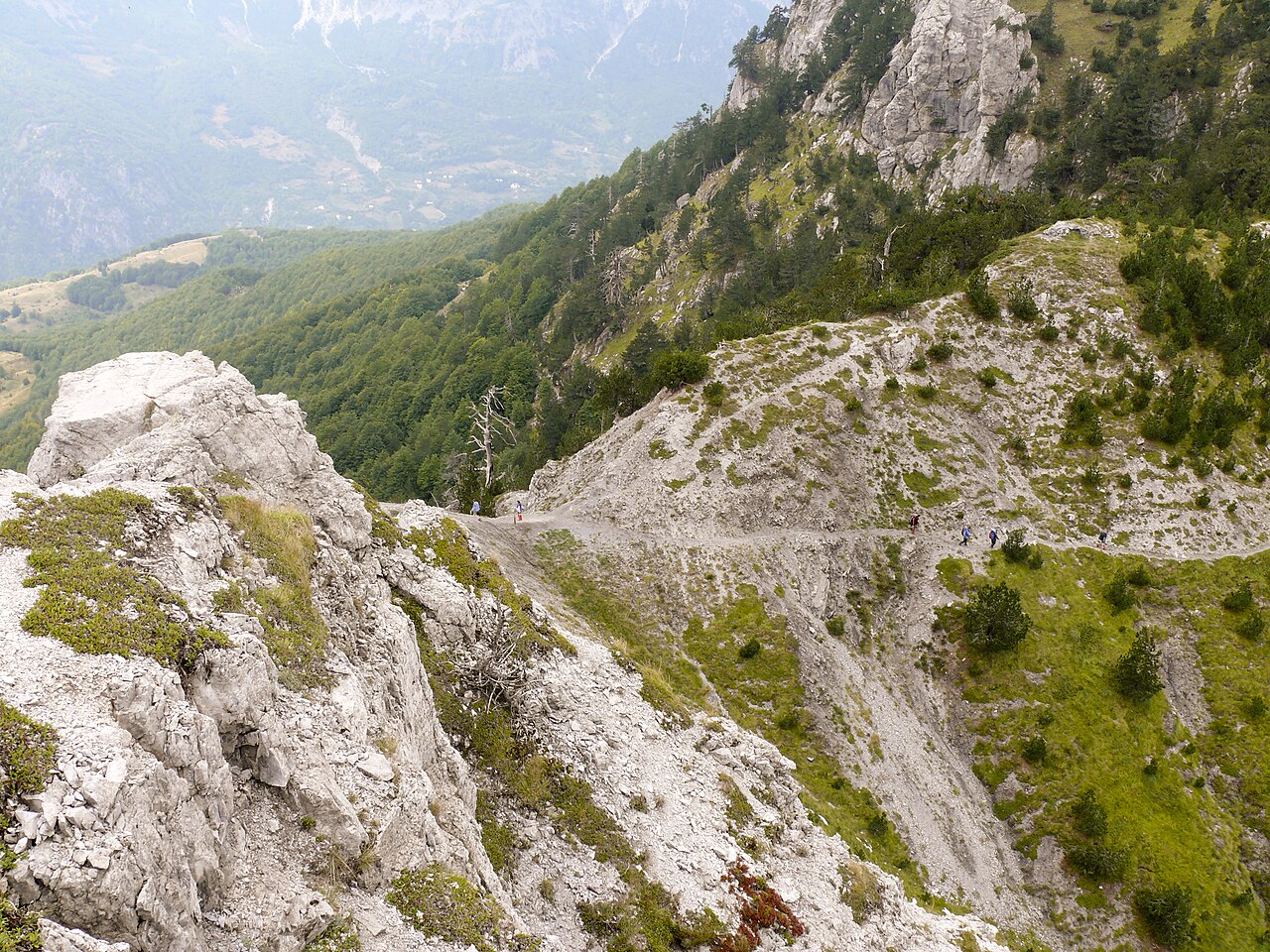
What the trail is like. From the valley floor you climb steadily through pine forest and across scree fields towards the pass. The climb to the pass is the hardest part; the rest is about stamina rather than technique. In season there are simple huts at the top selling drinks, a welcome stop before the long descent on the other side. Your reward is the panorama of the Accursed Mountains from the pass.
Waymarking. The route is marked with red and white stripes roughly every fifty to a hundred metres, and on the open climb and descent it’s practically impossible to get lost. The one tricky spot is the start on the Valbona side, where the path turns off from the village before the markings become obvious.
The logistics that make it a sensible day. The crossing is point to point, and with full luggage it’s needlessly hard. Guesthouses on both sides routinely arrange for your bags to be taken round to the other valley, so you only carry a daypack. Sort this out when you book, not on the morning itself. On the Valbona side the marked path only begins higher up the valley at the hamlet of Rragam, so most people take an early jeep to the trailhead rather than lose two hours walking the valley road. Book it the evening before; it costs around €25 (about £21) per vehicle.
Season and safety. This is a summer hike, realistically June to September, into October in a good year. From roughly November to the end of May there’s snow on the pass and the crossing is dangerous. Set off early, both to beat the heat and to avoid the thunderstorms that build over the ridges in the afternoon. Bring layers, because the pass is cold even in August, plenty of water and proper boots. There’s almost no phone signal on the route, so download an offline map and tell your guesthouse roughly when you expect to arrive.
The version without the crossing. If you came by car or don’t want to deal with the logistics of two valleys, you can walk up to the pass and come back the same way. The view from the pass is the real prize of the whole route, and this option gets you there without having to work out where you’ll sleep.
Where to stay in Theth: guesthouses and half board
There are no hotels or resorts in the valley. You stay in a bujtina, a family guesthouse where a local family opens up their stone-and-timber home to you, and it almost always comes with half board. That isn’t a sales gimmick but a necessity: there are only a handful of stand-alone restaurants in the valley, supplies are trucked in over the pass, and dinner at your guesthouse is simply the best food you’ll find here.
What it costs. Budget roughly 2,000 to 3,500 lek (about £18 to £31) per person per night with half board, with July and August at the top end. The price usually covers a multi-course dinner made from local produce, often with a welcome glass of raki, and a hearty breakfast. Lunch is extra: either a packed lunch from your hosts or a meal at one of the taverns. On top of that there’s a municipal tourist tax of roughly 35 to 350 lek per person per night, which usually isn’t included in online bookings and is paid in cash.
What’s for dinner. Mountain cooking here is simple and built around whatever is in the house. The basics are bread made from maize or wheat flour, homemade cheese and soured milk. Among the hot dishes you’ll most often come across flija, layered pancakes baked under a metal lid; kaçamak, Albania’s answer to polenta; and tavë kosi, lamb baked with rice and yoghurt. There’s usually roasted vegetables from the garden, and raki to start, offered whatever the time of day. Vegetarians will eat well without any fuss. If you’re vegan, mention it when you book, because cheese and yoghurt turn up in almost everything.
How to choose. This matters more than star ratings, because the bujtinas all look much the same in their listings.
- Location in the valley. Theth is spread out over several kilometres. A guesthouse near the centre puts you close to the church, the tower and the minibus stop. One in Gjeçaj or Fushë-Thethi means more peace and quiet, but also an extra half-hour walk every time you go anywhere.
- Whether they can transfer your luggage to Valbona and pack you a lunch for the trail. If you’re planning the crossing, this decides how comfortable the whole day will be.
- Heating and hot water. In June and September the nights in the valley are cold even after a hot day, and not every house is built for it.
- What actually works. Wi-Fi tends to be weak and the mobile signal comes and goes. If you need to be reachable while you travel, ask beforehand rather than assume it’ll somehow be fine.
Three bujtinas we looked at on Booking.com give a fair idea of what’s on offer. Guesthouse Marashi is close to the village centre, the best base if you want the church, the tower and the minibus all within easy reach. Bujtina Pllumi is a wooden chalet on a meadow near Fushë-Thethi and one of the best-rated places in the valley, mostly thanks to the food. Bujtina Terthorja is a restored stone farmhouse with a garden pavilion on a large meadow. To compare everything at once, browse accommodation in Theth on the map.
If you’re doing the crossing and sleeping on the far side, look at accommodation in Valbona, where the same model of family guesthouses with half board applies.
Book earlier than feels necessary. In July and August the best bujtinas fill up several weeks ahead, and the smaller ones take bookings by phone or email rather than through booking sites. Turning up on spec and looking for a bed on arrival doesn’t work as well here as it does on the coast, because there simply aren’t many rooms.
Money, cards and signal: four things that catch people out
There’s no ATM in Theth that you can rely on. The last safe places to withdraw cash are Shkodër and Koplik on the way. Take out enough for your whole stay, plus a buffer for an extra day in case the weather holds you up.
Withdraw lek, not euros. Plenty of guesthouses will take euros, but at an informal rate that works against you. Lek is what people pay with here.
Carry small notes. Breaking a large note in the valley is a challenge. Get change in Shkodër.
Cards are hardly accepted anywhere. A few of the larger guesthouses can handle a card or a bank transfer, but food, drinks, the minibus, guides and the tourist tax are all cash.
As a rough guide, a modest day in the valley comes to about 3,000 to 4,000 lek (about £27 to £35), a more comfortable one to 5,000 to 7,000 lek. Add transport there and back as a one-off. For three nights, a sensible traveller brings around 18,000 lek (about £160) including a buffer. Checked on 13 September 2026, but prices here move from year to year, so treat this as a planning estimate.
When to visit Theth National Park
When you go shapes the whole trip, so it’s worth picking the month to suit what you want from it.
- June is the best month in our view. The meadows are in flower, the river is full of snowmelt, Grunas Waterfall is at its most powerful and the pass is usually clear of snow. It’s also not yet as busy as high summer.
- July and August are peak season, with everything that goes with it: full guesthouses, a queue at the Blue Eye and heat in the valley. On the plus side, everything is running, the huts on the pass are open and the weather is at its most settled.
- September is our pick if you don’t mind shorter days. There are fewer people, the air is clearer and the colours are better. By the end of the month, though, some guesthouses are already closing.
- May and October are a gamble. The road is usually open, but there may be snow on the pass and some services aren’t running. Don’t count on the Valbona crossing at this time of year.
- November to May means a closed pass, most guesthouses shut and an unreliable road. A winter visit can be arranged, but only in advance and in person.
Theth National Park FAQ
Is the road to Theth paved?
Yes. The SH21 mountain road from Shkodër was completed in 2021, when the last gravel section was surfaced, so all of the roughly seventy kilometres are now paved. It’s still narrow, steep and full of hairpins as it crosses the Qafa e Thorës pass at around 1,700 metres, so the drive still takes 2.5 to 3.5 hours. In winter the pass is usually closed by snow.
Is there an entrance fee for Theth National Park?
No. There’s no entrance fee, no barrier or toll on the road, and you don’t need a permit for the main marked trails. The exception is cross-border routes into Montenegro, where permits are handled separately. The only charge is the municipal tourist tax of roughly 35 to 350 lek per person per night, collected in cash by your guesthouse.
How long is the Theth to Valbona hike?
About 15 kilometres (sources give 14 to 17, depending on where you start), which takes six to eight hours of actual walking. The Qafa e Valbonës pass sits at around 1,795 metres; from the Theth side you climb about 1,050 metres, from the Valbona side about 800. It’s a summer hike, realistically from June to September.
How many days should I spend in Theth?
Two nights is the minimum, because one full day gives you the village and one big hike, not both. Three nights is comfortable: a day for Grunas Waterfall and the village, a day for the Blue Eye or the Peja Pass, and a day for the crossing to Valbona. Arrive for one night and you’ll see the church, the tower and the waterfall, and nothing more.
Where do you stay in Theth and how much does it cost?
In a bujtina, a family guesthouse with half board. There are no hotels in the valley. Budget roughly 2,000 to 3,500 lek (about £18 to £31) per person per night, at the upper end in July and August. The price usually includes a multi-course home-cooked dinner and breakfast; lunch is extra. Book well ahead, as there are few rooms in the valley.
Is there an ATM in Theth?
No, and you can’t count on finding one. Withdraw lek in Shkodër or in Koplik on the way, and take more than you think you’ll need, including a buffer for an extra day. Only a few of the larger guesthouses accept cards; everything else, including food, the minibus, guides and the tourist tax, is cash only.
What is the best time to visit Theth?
The reliable season is June to September. June has the most water in the falls and meadows in bloom, July and August the most settled weather and the biggest crowds, September peace and quiet and better colours. May and October are uncertain: there may be snow on the pass and some guesthouses aren’t open. In winter the valley is effectively shut.
Is the Theth Blue Eye the same as the Blue Eye near Sarandë?
No, they’re two different places at opposite ends of Albania. The Theth Blue Eye (the Kaprre Blue Eye) is a karst spring in a gorge above the hamlet of Ndërlysa, with water at around 5 to 8 °C all year, and getting there takes half a day to a full day on foot. The better-known Syri i Kaltër is in the south near Sarandë and can be reached by car.
Where next
- What to see in Albania: our overview of places across the whole country, from the mountains to the coast.
- Valbona Valley: the valley on the other side of the pass, where the crossing takes you.
- Lake Komani: the ferry most people take into the Albanian Alps.
- Berat: if after the mountains you’d like a stone-built town as a stop on the way south.
Potřebujete pomoct s cestováním?
-
Ubytování 🏨
Vyberte si to nejlepší ubytování, ať už jste kdekoliv, přes Booking.com. -
Půjčení auta 🚗
Auto si snadno najdete přes Booking.com, kde máte často slevu díky ubytování, nebo Rentalcars.com, kde porovnáte nabídky většiny půjčoven. -
Zážitky 🎟️
Přes GetYourGuide.com si vyberete z nejrůznějších výletů i zážitků po celém světě, navíc se zrušením zdarma do 24 h předem.