Last updated 5.9.2026
The Orlické Mountains are one of the last corners of Czechia that mass tourism never really found. They lack the drama of the Giant Mountains and the crowds of the Beskids, and that is exactly the point. Plan a trip to the Orlické Mountains (Eagle Mountains, Orlické hory in Czech) and you get a long green ridge dotted with lookout towers, the wild gorge of the Divoká Orlice river, concrete forts from the pre-war border defences and a pilgrimage church roofed with glass. Plus the kind of silence you no longer get in the Czech mountains.
Here are 18 things to do in the Orlické Mountains, from the highest peak Velká Deštná through the Zemská brána gorge to lesser known towers and nature trails. For every stop you get the practical part: how to get there, how hard the walk is and what to watch out for.
The Orlické Mountains in short
- Highest point: Velká Deštná (1,115 m) with a lookout tower on the main ridge.
- Where it is: north-east Bohemia, right on the Polish border, about two hours by car from Prague.
- Must-see: Zemská brána gorge, Neratov (the church with a glass roof), the Masaryk Chalet at Šerlich, the Hanička artillery fort.
- With kids: Pěticestí junction, Suchý vrch with the Kramář Chalet, nature trails, the Pastviny reservoir.
- In winter: the ski areas of Říčky, Deštné and Čenkovice, and some of the best cross-country skiing in the country.
- When: May to October for hiking, January to March for skiing.
When to go and how to get there
The range works all year round, but each season gives you something different. For hiking and cycling, May to October is the sweet spot — the ridge is dry, the towers are open and the beech reserves turn every shade of gold in autumn. Midsummer (July and August) is the warmest, but expect company at the best known spots such as Velká Deštná or Neratov, especially at weekends.
In winter the region turns into a skiing and cross-country area. The main ridge track is groomed regularly and counts among the finest cross-country routes in Czechia. Downhill slopes are in Říčky, Deštné and in Čenkovice in the south of the range.
Getting around without a car is possible but slow — buses do reach the ridge villages, just not often. Driving is by far the easiest option: Deštné is roughly 165 km from Prague (a little over two hours), about 50 km from Hradec Králové, which is the nearest city with good train connections, and around 130 km from Wrocław in Poland if you are coming from the north. Good bases are Deštné v Orlických horách, Říčky or Rokytnice v Orlických horách — from all three you are minutes away from the ridge.
💡 Tip: If you are here for a weekend, sleep up in the mountains rather than down in the foothills — you will be on the ridge in the morning long before the day trippers arrive. Places to stay in Deštné and around →
18 things to do in the Orlické Mountains
The list runs roughly from north to south along the ridge and then down into the foothills. Most stops can be strung together into a longer hike, because the main ridge trail links almost all of the summit destinations.
1. Velká Deštná (1,115 m) — the roof of the range
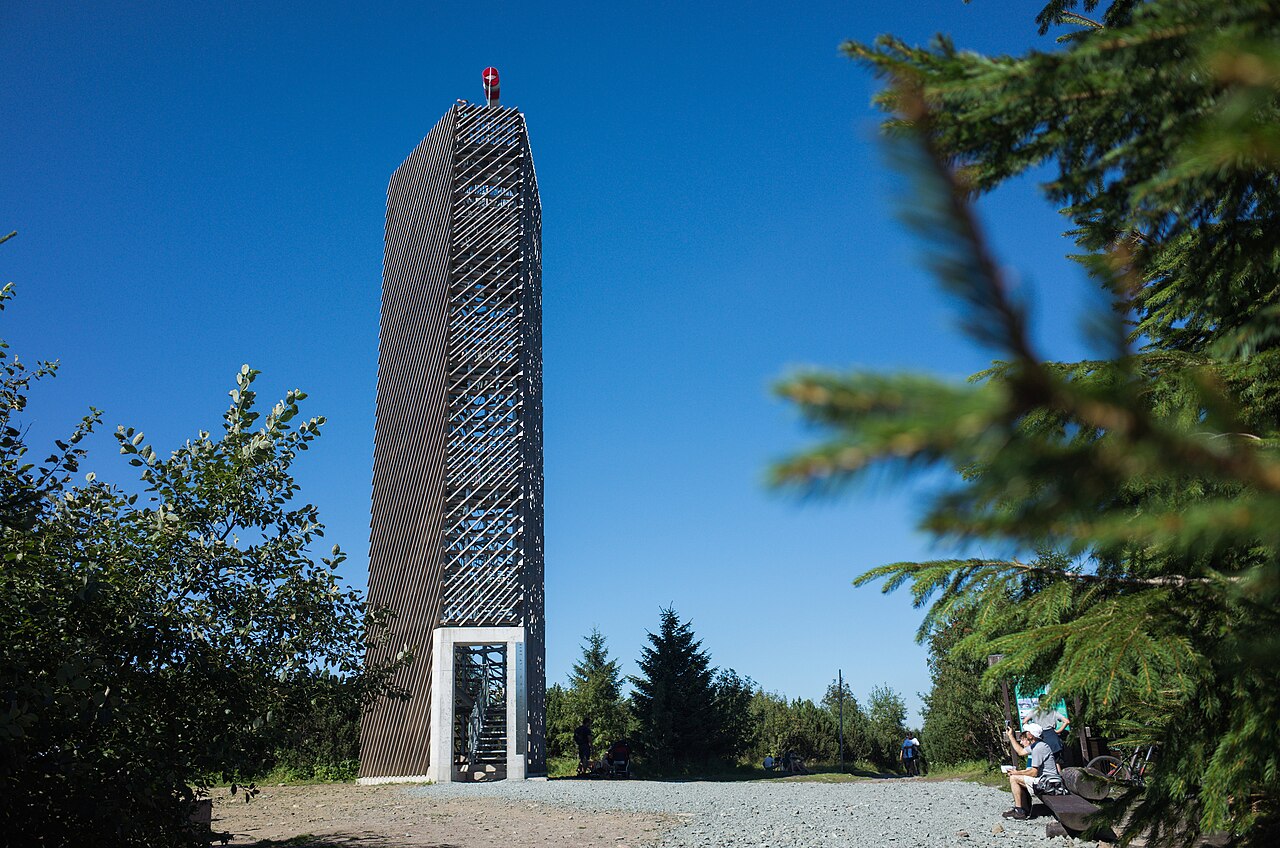
The highest summit and the obvious first stop. There is a lookout tower on top and on a clear day you can see all the way to the Giant Mountains and Sněžka, the highest peak in Czechia. The shortest ascent starts at the car park by Šerlišský mlýn or at the Masaryk Chalet — figure on 2 to 3.5 km on a marked trail, mostly along an easy forest track. Nothing technical, children manage it fine, it just gets busy up top in season.
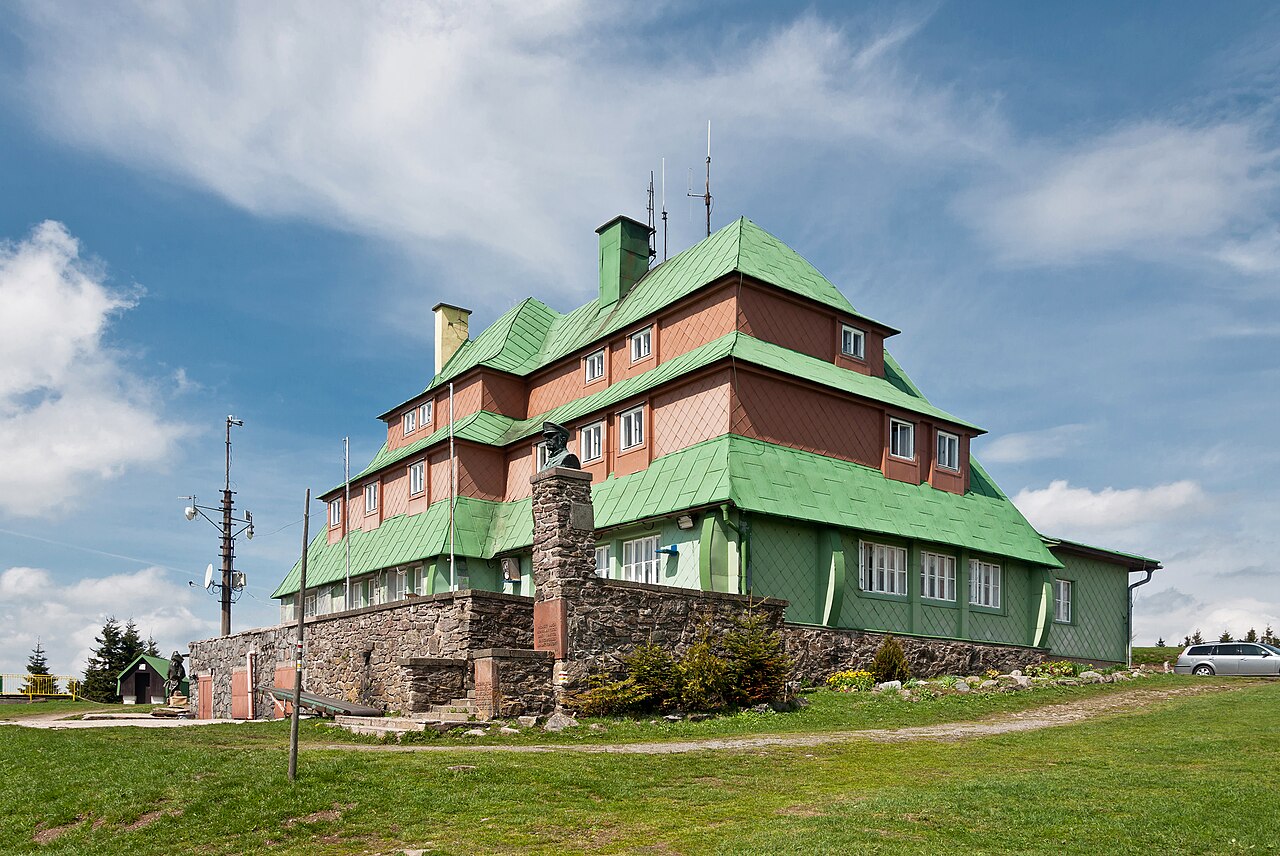
2. Šerlich and the Masaryk Chalet — the highest mountain hut here
Šerlich (1,027 m) is the heart of the ridge, a saddle from which you set off for Velká Deštná as well as for the Polish side. It is home to the Masaryk Chalet, one of the oldest and highest mountain huts in the range, with good food and beds for the night. From the car park it is only a few hundred metres to the door. Velká Deštná is about an hour away along the red-marked Jirásek Mountain Trail — roughly 4 to 5 km of gently rolling ridge with no steep climbing, so kids handle it too. In winter the whole area under a coat of rime ice is extraordinarily photogenic.
3. Vrchmezí / Orlica (1,084 m) — the tower on the Polish side
Vrchmezí, called Orlica in Polish, is the highest peak of the Polish part of the range (fifth highest overall) and sits directly on the Czech–Polish border. A short way over the line, on the Polish side, stands a free-to-enter wooden lookout tower opened in 2020 (Wieża widokowa na Orlicy), some 25 m tall, with a full circle view over the Giant Mountains, the Table Mountains and the Adršpach-Teplice Rocks. The easiest approach is the surfaced track from Šerlišský mlýn (roughly 4 to 5 km, fine with a pushchair-age family); the harder version climbs from Olešnice. There is no border control here — you simply walk across.
4. The Kunštát Chapel — the highest place of worship in the mountains
Right on the main ridge at 1,035 m stands the baroque Kunštát Chapel of the Visitation of the Virgin Mary, built in 1671. It is the highest place of worship in the Orlické Mountains: a small circular building 7 m across, shingle-roofed and completely plain inside. The red ridge trail and the Jirásek Trail both pass it, so it is an easy stop on the way to Velká Deštná or to the Pěticestí junction (the surfaced Bunkrovka track heads from here towards the Hanička fort). In winter it is a favourite target for cross-country skiers.
5. Zemská brána — the wildest gorge of the Divoká Orlice
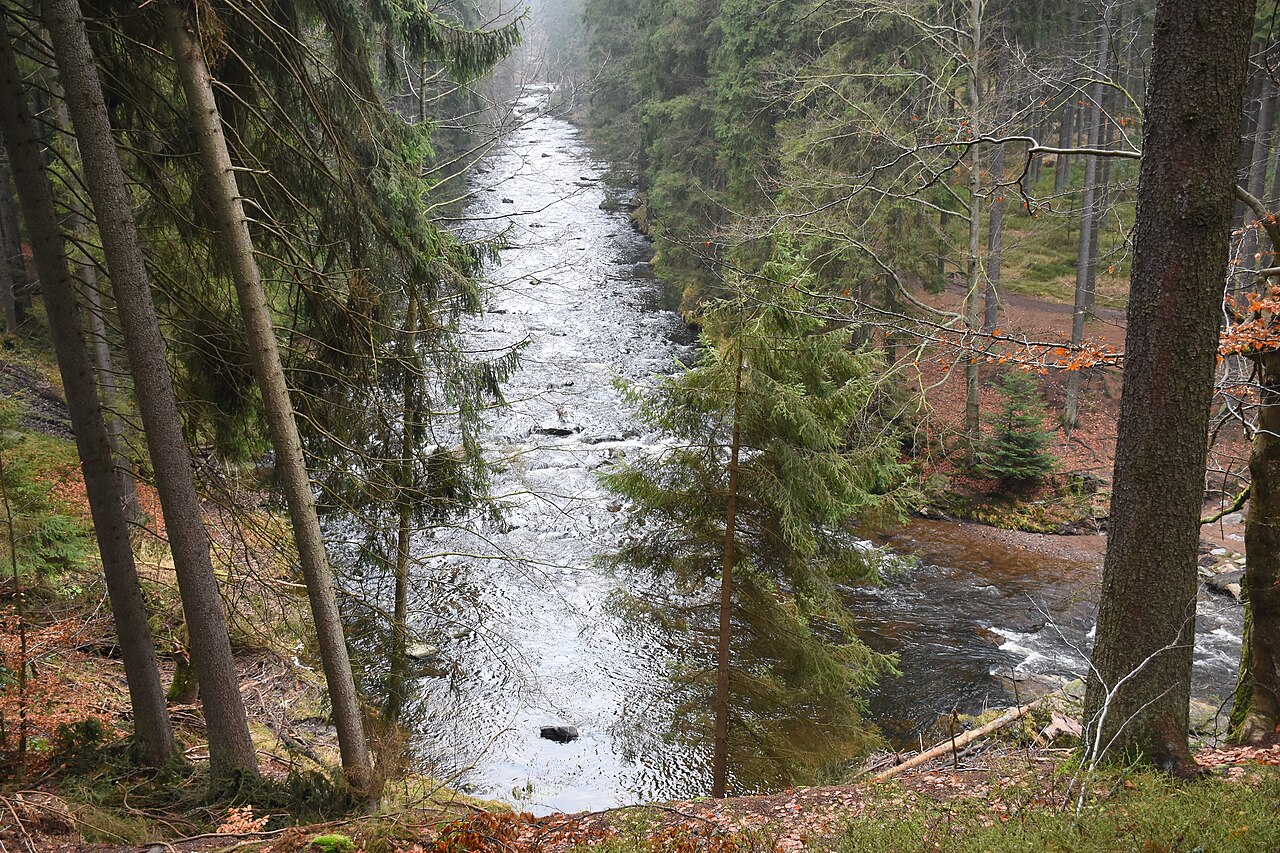
If you only see one place here, make it Zemská brána (the name means Land Gate). The Divoká Orlice forces its way through a boulder-choked bed between rock walls and the whole valley feels rough and romantic at once. A blue-marked nature trail runs through it, roughly 3 km from Klášterec nad Orlicí, easy going and always beside the water. Local legend places the bandit Ledříček here. It is at its best in spring, when the river is full, and again in autumn colours.
6. Pěticestí — the junction for families and skiers
Pěticestí (literally “five ways”) is a popular crossroads of ridge tracks in the southern part of the ridge above Říčky, where several waymarked trails meet — hence the name. You can walk up from the top station of the Zakletý vrch chairlift (about 1 km) or comfortably from Deštné. From here you continue north along the red ridge trail to Šerlich and Velká Deštná, or south to Anenský vrch — it is the ideal gateway to the whole main ridge. In summer it is the starting point for easy family walks, in winter one of the key nodes of the cross-country network. The surrounding forest is flat and open, so it is hard to lose your way.
7. Anenský vrch and the Anna tower — a free ridge viewpoint
Anenský vrch (992 m) sits on the main ridge about 7 km north-east of Rokytnice. Since 2010 it has carried the 17 m wooden Anna lookout tower, open all year and free of charge. Only a short red-marked spur of some 400 m branches off the Jirásek ridge trail to the summit; you can also come up on the blue trail from Říčky or on the red from the Panské pole car park by the Hanička fort. In 2024 the tower got new steel support columns. A perfect stop on a ridge traverse, and one where you never have to check opening hours.
8. Suchý vrch and the Kramář Chalet — five metres short of a thousand
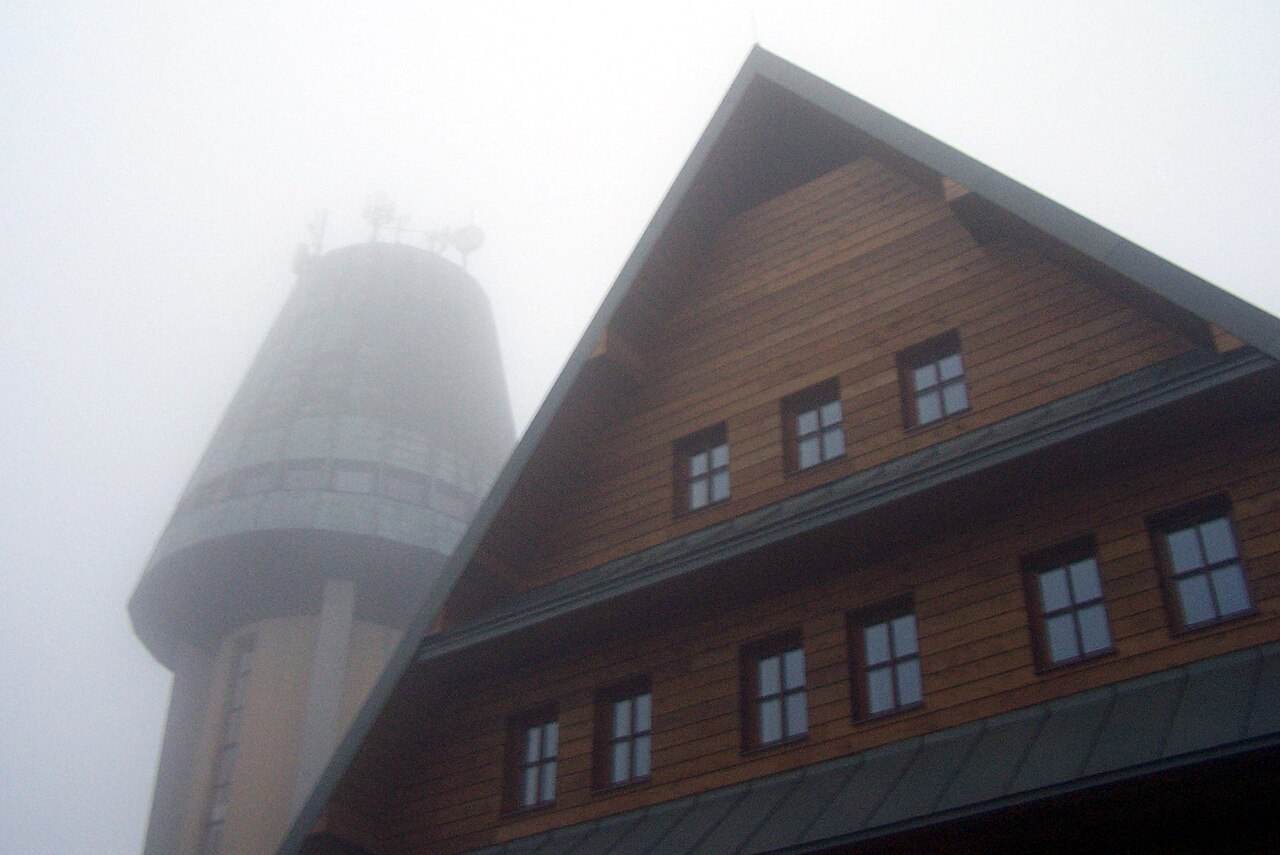
Suchý vrch (995 m) lies in the southern part of the range and carries the Kramář Chalet with a lookout tower and a full circle panorama. You can drive part of the way, which makes it a realistic target for less confident walkers — the walking section is then only about 3 km on the green trail. It pairs neatly with a visit to the nearby Bouda fort.
9. Hanička artillery fort — concrete from 1938
Hanička is an artillery fort of the Czechoslovak border fortifications, built between 1935 and 1938 against Nazi Germany. It is a museum today — you walk the underground corridors and halls and see how the whole system was meant to work. It stands above Rokytnice v Orlických horách. Visits are guided only and take about 60 minutes (a longer version runs to roughly 80); basic admission is around €6 (140 CZK) for adults and about €4 (100 CZK) for children and students — worth checking before you go, and note that you pay in Czech crowns on site. The season starts around May and the fort closes from December to March to protect hibernating bats, so check opening hours and tour times on the fort’s website.
💡 Tip: Inside the forts it stays around 8 °C even in August — bring a hoodie, however hot it is outside. Fort tours are the perfect plan B when it rains on the ridge.
10. Bouda artillery fort — the only one preserved as it was
Bouda is another artillery fort of the same defensive line, in the south of the range near Těchonín. It is the only artillery fort preserved in its original state and open to the public — you take a lift down into the underground and walk through the barracks and the combat blocks. You cannot drive to the entrance: the shortest approach is on foot from the Kramář Chalet on Suchý vrch, roughly 3.2 km through the forest (leave the car at the chalet). There is usually a shorter and a longer circuit — the standard tour takes about 65 minutes and costs roughly €3 (70 CZK) for adults, the full version about €4 (90 CZK) (check prices and times in advance). It combines well with Suchý vrch into one fortress day.
11. Dobrošov fortress — the artillery fort above Náchod
On the northern edge of the region, above Náchod, stands the Dobrošov artillery fort — one of the best known works of the 1935–1938 Czechoslovak fortifications, and one that was never finished. It went through an expensive reconstruction between 2019 and 2022 and now has a modern visitor centre and three tour routes: the centre itself, the Můstek and Zelený blocks, and the Jeřáb block with its underground. It is normally open from April to October (closed in winter); the visitor centre costs roughly €2.50 (60 CZK), the tour including the Jeřáb block about €4 (100 CZK) — verify prices and times. Tours are guided and the last group sets off some 90 minutes before closing.
12. Říčky v Orlických horách — summer and winter alike
Říčky is one of the main mountain villages and a popular ski resort (Ski centrum Říčky). In winter you ski here, in summer it is an excellent base for trips onto the ridge and into the forests around. A chairlift takes you up to the summit of Zakletý (991 m), with views of the Polish side, the Giant Mountains and the Jeseníky — and, more usefully, straight onto the main ridge: from the top station it is a short walk to the Pěticestí junction and on along the ridge to Anenský vrch. In summer the lift runs roughly from June to September (daily in the school holidays, weekends otherwise; check the timetable and fares), and it carries bikes too — Bikepark Říčky runs under the slopes.
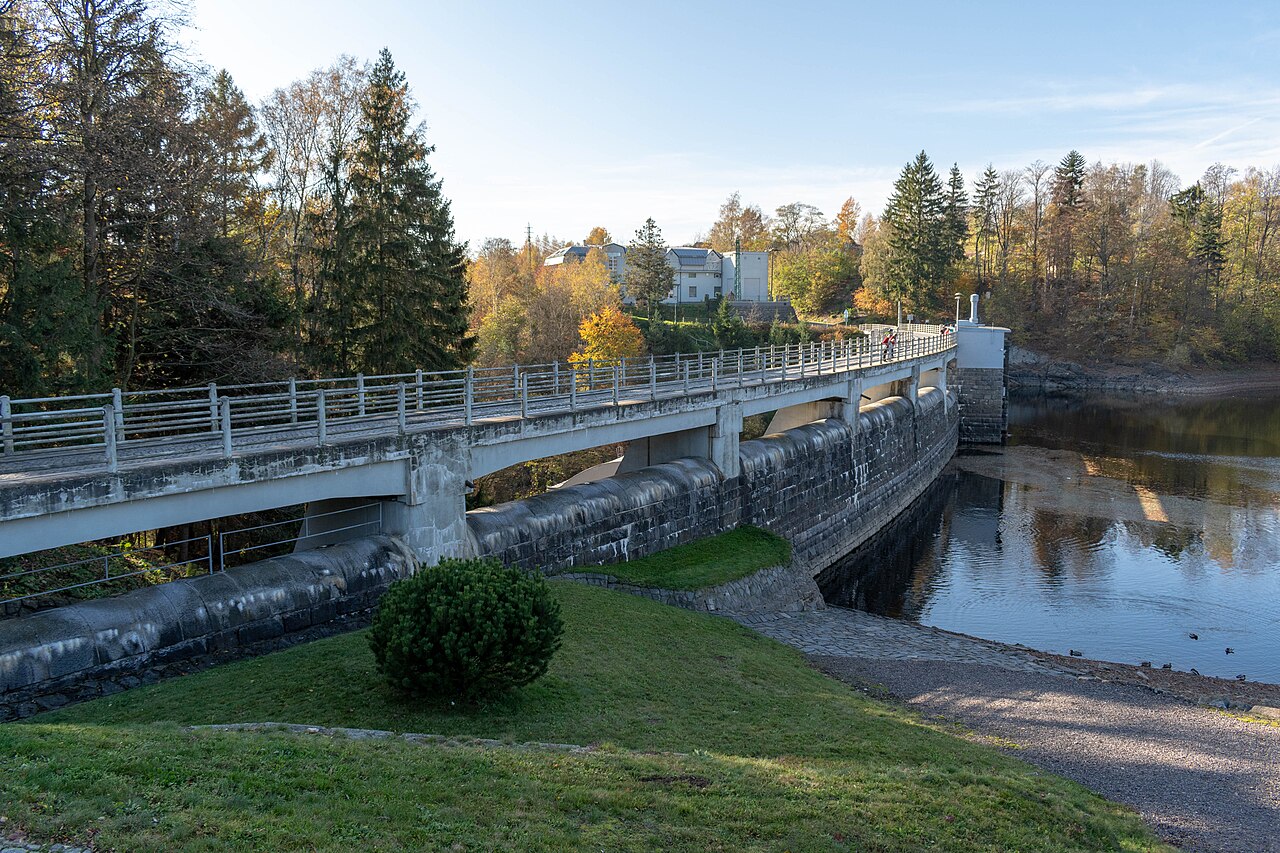
13. The Pastviny reservoir — swimming and watersports
Pastviny is a reservoir on the Divoká Orlice in the foothills of the southern part of the region, about half an hour by car from the ridge villages. It is the local summer cool-down: you can swim, and there are rentals of pedalos, electric boats and paddleboards around the water (by the Na Pláži restaurant, for one). Parking is by the bobsleigh track and on the meadows nearby, and an easy cycle route runs around the lake. For families it is the perfect counterweight to a hard day on the ridge.
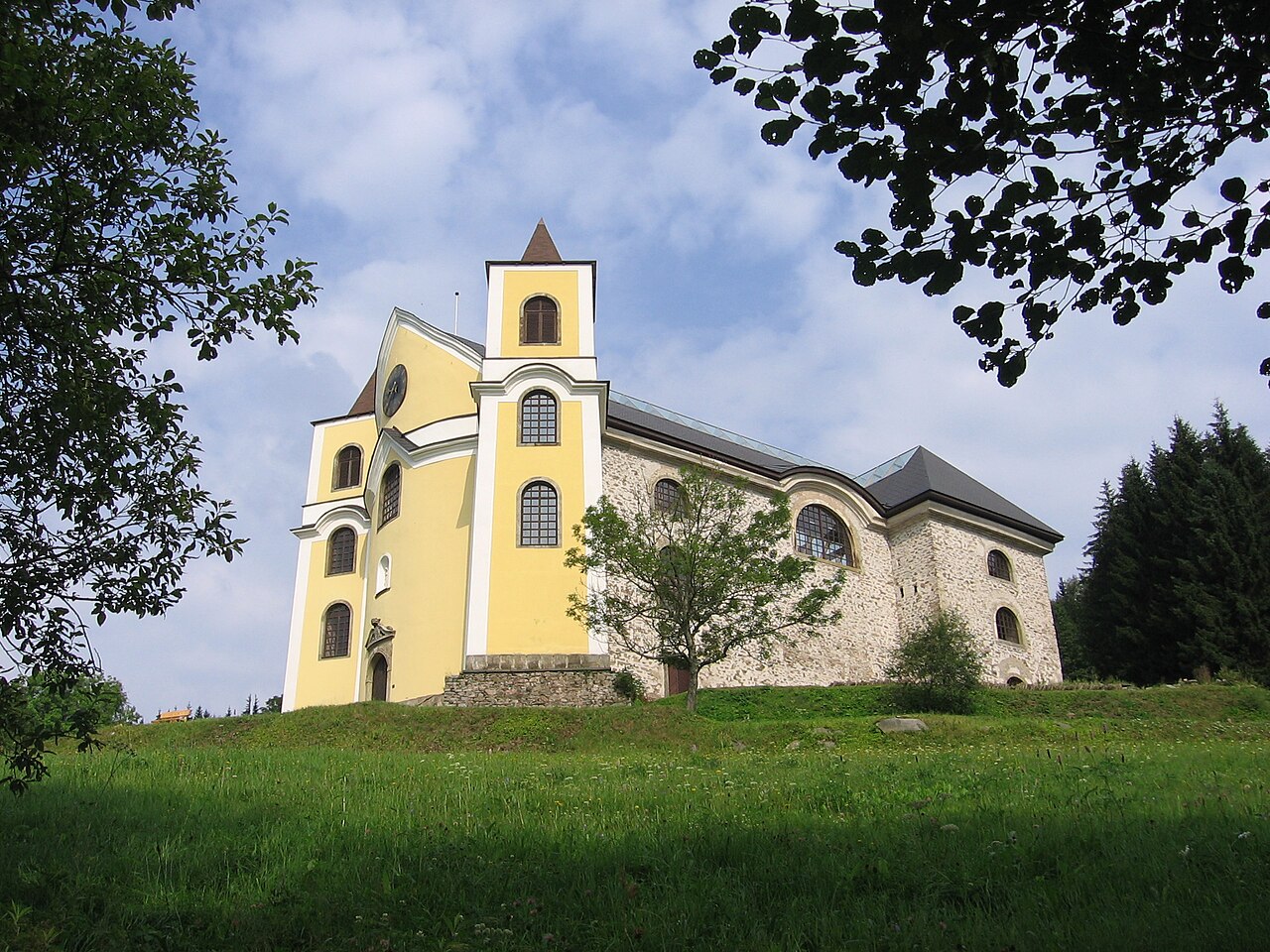
14. Neratov — the church with a glass roof
Probably the most photographed place in the whole range. The pilgrimage Church of the Assumption of the Virgin Mary in Neratov fell into ruin after the war, when the German-speaking population of these border villages was expelled and the buildings were left to rot. When restoration finally began, the nave was given a glass roof instead of a conventional one, so you look straight up at the sky from inside. The church is usually open and a living community has grown around it, run by the Neratov association, with a café and sheltered workshops. Beautiful in any season, extraordinary at dusk.
15. Deštné v Orlických horách — the heart of the mountains
If you are staying in Deštné anyway, it is worth exploring the village itself and not only the ridge above it. Skicentrum Deštné is one of the main downhill areas in winter (about 4.5 km of runs of every grade, chairlift), and in summer it turns into a bike park with rentals. The village has a baroque church of St Mary Magdalene and a small Museum of Winter Sports, Tourism and Crafts to duck into when it rains. For families there is also a nature trail with tasks for children. A good place to settle for a few days and alternate ridge days with quieter ones.
💡 Tip: If you would rather book tickets and experiences ahead (fort tours, chateaux in the foothills, cable cars), have a look at the experiences on offer in the Orlické Mountains →
16. Rampušák and the Sýpka Museum of the Orlické Mountains
Rampušák is the mythical ruler and spirit of the Orlické Mountains — the local counterpart of Krakonoš, the giant of the Giant Mountains, or Rübezahl as German speakers know him. He turns up in folk tales, in wood carvings and at festivals where he is ceremonially handed rule over the mountains. If the history and folklore of the region interests you, call in at Sýpka, the Museum of the Orlické Mountains in Rokytnice (Horská 174), which maps the nature, life and crafts of the range in a modern, hands-on way inside a 19th-century granary. Admission is close to symbolic, but opening hours are seasonal, so check before you set off (the museum comes under the Museum and Gallery of the Orlické Mountains). Another good rainy-day stop.
17. Nature trails — fortifications, geology and beer
The Orlické Mountains are laced with nature trails that turn a walk into a short lesson. Worth naming:
- The Concrete Border trail in Mladkov — devoted to the pre-war fortifications, linking several bunkers.
- The Feistův kopec geological trail in Olešnice — an introduction to the geology of the range.
- The Beer trail in Olešnice — a light-hearted forest route tied to the local brewery.
Most are easy and well waymarked — ideal for a day when you want a walk rather than a climb.
18. Bukačka and the Peklo valley — nature up close
Two tips away from the crowds, for anyone who comes for the nature. Bukačka is a national nature reserve of old wind-twisted beeches near Šerlišský mlýn — a short green route of about 1.5 km, at its best in autumn mist. And down in the foothills near Nové Město nad Metují lies the romantic Peklo valley (“Hell valley”) along the Metuje river: an easy walk of some 5 km through beech woods, magical in spring and autumn.
How hard is it — and who can manage what
Most of the trips above are easy to moderate and work with children. The ridge routes are long but never steep — these are not the Giant Mountains. The most comfortable targets (Suchý vrch, Anenský vrch with the Anna tower) can be shortened a lot by car or chairlift. Only the full-length ridge traverse or climbs from the valley floor (Vrchmezí from Olešnice, for instance) are demanding. Bring proper boots either way — even the “easy” forest tracks turn to mud after rain.
Hikes and the ridge traverse
If you want more from the Orlické Mountains than a string of separate stops, walk the main ridge trail. It runs along the crest roughly from Šerlich over Velká Deštná and on south, connecting most of the summits on our list. It splits neatly into stages — the Šerlich → Velká Deštná → Pěticestí section, for example, is a relaxed half-day loop that an untrained family can handle.
The classic longer day links the Masaryk Chalet at Šerlich, Velká Deštná and the lookout tower on Vrchmezí — three summits in one day, still without serious ascent. In the south of the range, the pairing of Suchý vrch with the Kramář Chalet and the Bouda fort brings views and fortress history together.
💡 Tip: Download an offline map (Mapy.com is the standard here and covers the trail marking properly) — signal drops out on the ridge and especially on the Polish side around Vrchmezí. The waymarking itself is dense and reliable.
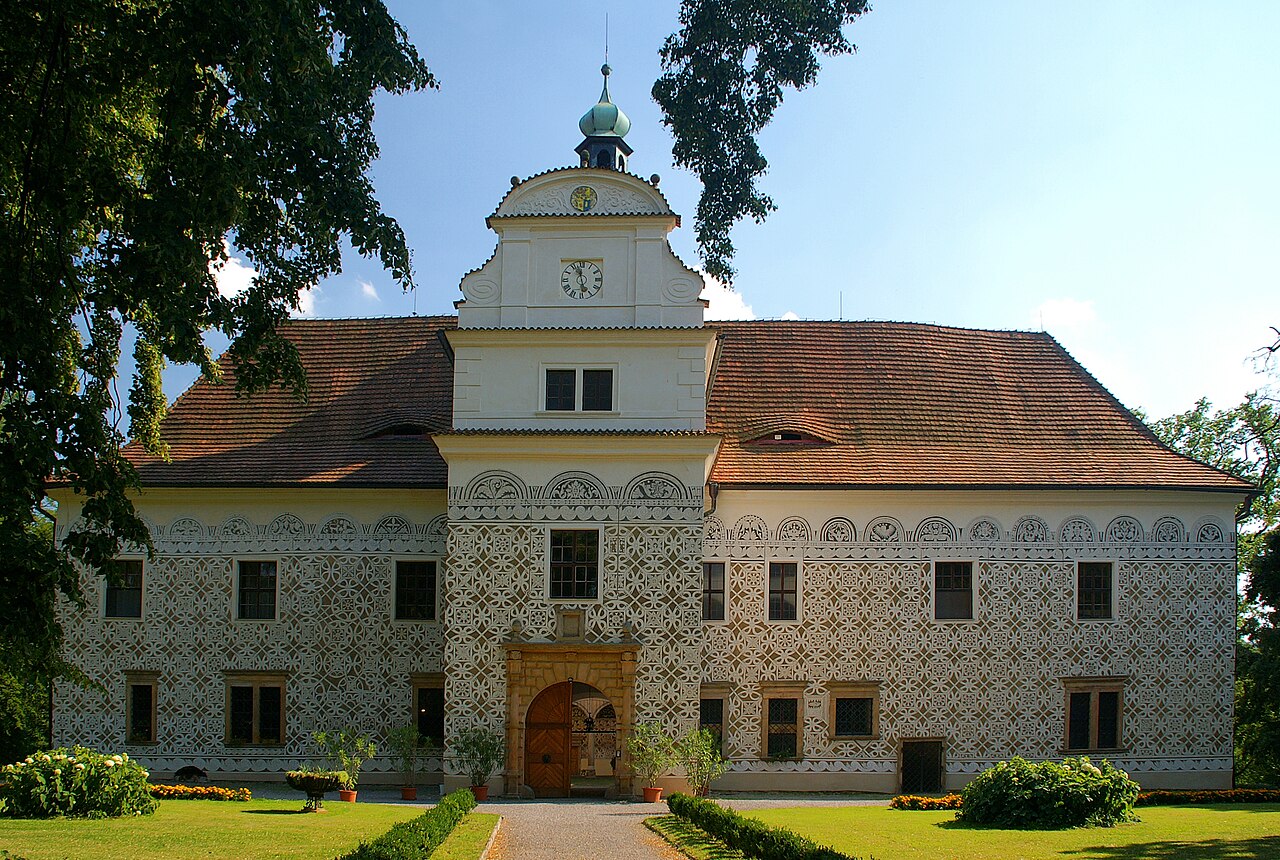
Chateaux and monuments in the foothills
When the ridge is in cloud or it is raining, move the programme downhill. The four most interesting targets lie close together and make one good day.
- Častolovice chateau. A Renaissance house with its original furnishings, still owned by the family it belonged to before the war. There is a fallow-deer park and chateau gardens in the grounds, so it works with children.
- Opočno chateau. A Renaissance seat with an arcaded courtyard and a picture gallery counted among the finest chateau collections in Bohemia. Extended gallery tours only run on selected dates, so check the programme in advance.
- Nové Město nad Metují. A Renaissance square with arcades and a chateau whose gardens were designed by Dušan Jurkovič. It is often called one of the prettiest squares in Bohemia.
- Potštejn. A castle ruin above the Divoká Orlice valley with a chateau below it, and a legend about buried treasure that drew searchers here for centuries.
Mountain huts and chalets
The Orlické Mountains have a dense network of mountain huts that work both as a lunch stop and as a bed for the night. Most stand right on the ridge trail, so a multi-day traverse without dropping into the valleys is entirely doable. Out of season their opening hours shrink and many close on weekdays, so it pays to call ahead.
The Orlické Mountains with kids and in winter
With children, stick to shorter, legible routes. Pěticestí and the flat forest around it work well, as does the walk up to the Masaryk Chalet, the lookout tower on Vrchmezí along the surfaced track from Šerlišský mlýn, or a day at the Pastviny reservoir. When it rains, a tour of the Hanička, Bouda or Dobrošov forts saves the day, or the Sýpka Museum of the Orlické Mountains. Kids usually enjoy the nature trails with their tasks, too.
In winter the range is mostly about skis. Downhill slopes are in Říčky, Deštné and Čenkovice, the ridge track counts among the best cross-country routes in Czechia and is groomed regularly. The Masaryk Chalet and its surroundings under rime ice are worth a winter walk on their own. Be aware that the frost hollow of Orlické Záhoří is regularly the coldest place in the country — dress in layers.
Where next
- The Highest Mountains in the Czech Republic
- Ore Mountains, Czech Republic: 21 Trips and Hikes
- 30 Most Beautiful Places in the Czech Republic
- Via Ferrata in the Czech Republic
Frequently asked questions
What should you see in the Orlické Mountains on a first visit? Start with the trio of Velká Deštná (1,115 m), the Masaryk Chalet at Šerlich and the Zemská brána gorge — that covers the highest summit, the heart of the ridge and the wildest valley. If time allows, add Neratov with its glass-roofed church.
What is the highest peak of the Orlické Mountains? Velká Deštná at 1,115 metres. There is a lookout tower on the summit and an easy marked trail leads up from Šerlišský mlýn or from the Masaryk Chalet.
How do you get to the Orlické Mountains from Prague? By car it is roughly 165 km to Deštné v Orlických horách, a little over two hours via Hradec Králové. Trains reach Hradec Králové and Náchod, and buses run on from there to the mountain villages, but not often — a car makes the whole region far easier.
What is there to do in the Orlické Mountains when it rains? The obvious wet-weather plan is a guided tour of the Hanička, Bouda or Dobrošov artillery forts, the Sýpka Museum of the Orlické Mountains in Rokytnice, or the chateaux in the foothills — Opočno, Častolovice and Doudleby nad Orlicí.
Are the Orlické Mountains good with children? Yes, if you keep the routes short. Pěticestí, the lookout tower on Vrchmezí along the surfaced track from Šerlišský mlýn, the Anna tower on Anenský vrch (free and open all year) or a summer day at the Pastviny reservoir all work well, as do the nature trails with tasks for kids.
Can you walk into Poland from the ridge? Yes. The range straddles the Czech–Polish border and both countries are in the Schengen area, so there are no checks. The lookout tower on Vrchmezí (Orlica in Polish) stands just over the line, and the Polish ski village of Zieleniec lies on the other side of the ridge.
What is Zemská brána? Zemská brána, the Land Gate, is the wildest gorge of the Orlické Mountains, where the Divoká Orlice pushes through a boulder-filled bed between rock walls. An easy nature trail of about 3 km runs through it from Klášterec nad Orlicí, always beside the water.
How many days do you need for the Orlické Mountains? A long weekend (two to three days) covers the highlights. Give one day to the ridge (Velká Deštná, Šerlich, Vrchmezí), one to the forts and Zemská brána, and a third to Neratov and the chateaux in the foothills.
When is the best time to visit the Orlické Mountains? May to October for hiking, with the finest colours in September and October. January to March for downhill and cross-country skiing. Midsummer is warmest, but the best known spots get busy at weekends.
Potřebujete pomoct s cestováním?
-
Ubytování 🏨
Vyberte si to nejlepší ubytování, ať už jste kdekoliv, přes Booking.com. -
Půjčení auta 🚗
Auto si snadno najdete přes Booking.com, kde máte často slevu díky ubytování, nebo Rentalcars.com, kde porovnáte nabídky většiny půjčoven. -
Zážitky 🎟️
Přes GetYourGuide.com si vyberete z nejrůznějších výletů i zážitků po celém světě, navíc se zrušením zdarma do 24 h předem.