Last updated 14.11.2026
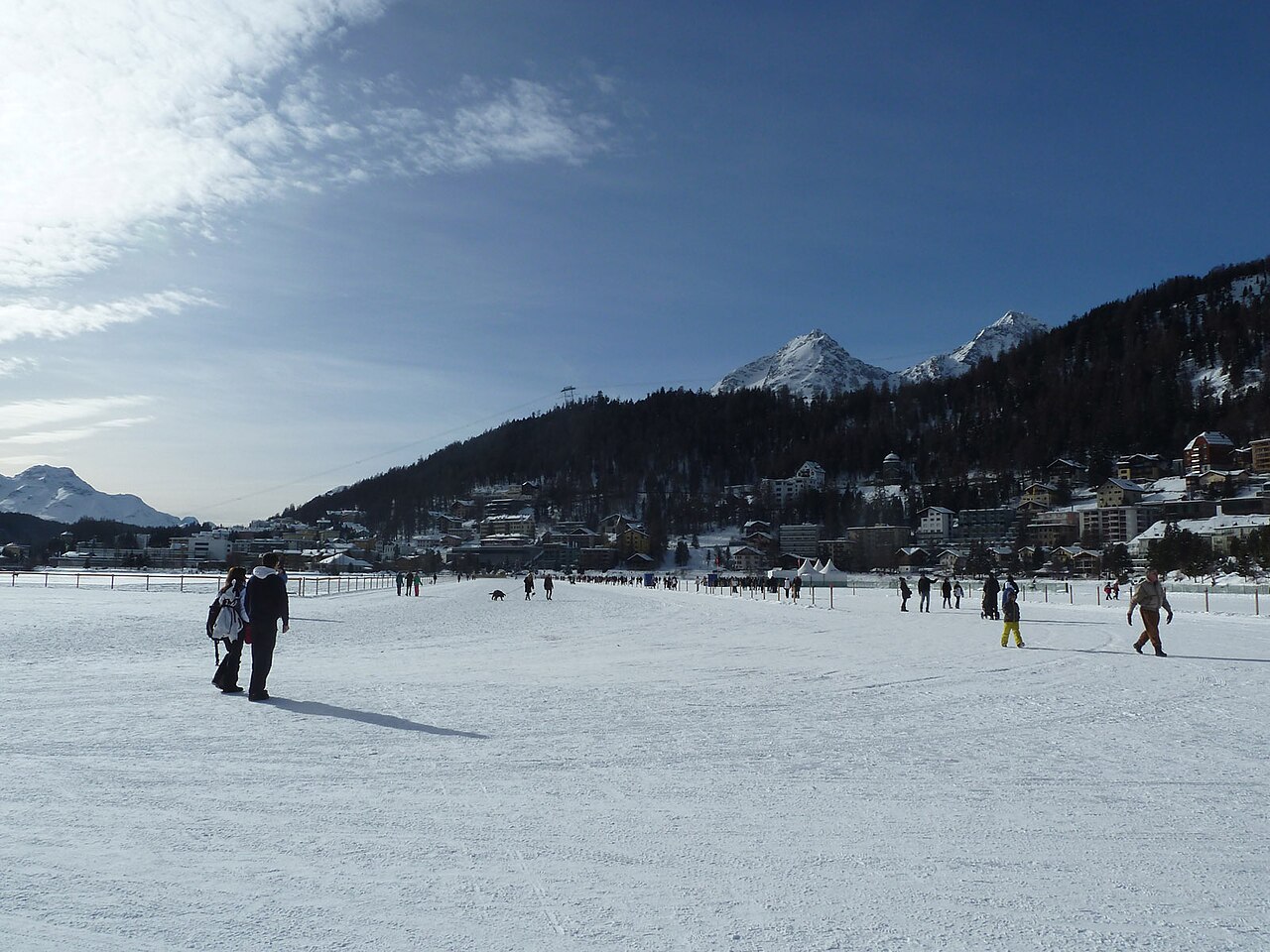
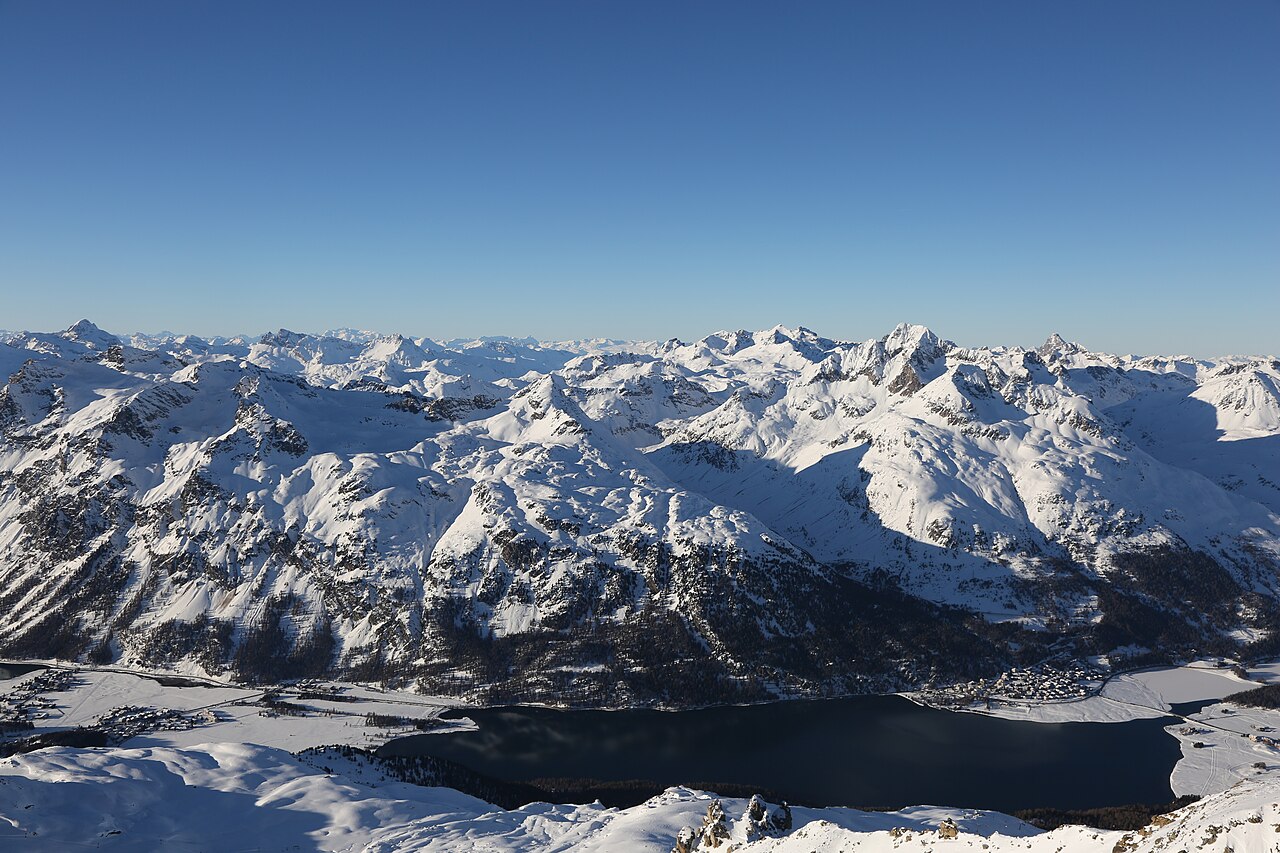
St. Moritz has a reputation as the place where people come to show off their fur coats and watches. Walk down Via Serlas and you will see why. But take a lift a thousand metres up and the picture changes: wide pistes above frozen lakes, sunshine almost every day and, from the chairlift, a view of Piz Bernina, a peak of over 4,000 metres. That is what has been bringing visitors here for more than 160 years. St. Moritz in Switzerland sits at 1,822 metres in the Engadine valley in the canton of Graubünden, and it is where winter tourism in the Alps began.
This guide covers 14 things to do in St. Moritz in winter and summer: the three ski mountains of Corviglia, Corvatsch and Diavolezza, night skiing, cross-country trails across the lakes, the bob run and the Cresta Run, the Bernina Express and the Glacier Express, lakes and hikes. You will also find ski pass prices in Swiss francs with a rough conversion to pounds, how to get here from the UK, where to sleep without spending the price of a small car, and a little history.
Things to do in St. Moritz: the essentials
- Where it is: the Upper Engadine in south-east Switzerland, canton of Graubünden, 1,822 m above sea level. Italy is a short drive away over the Bernina or Maloja pass.
- Skiing: the whole Upper Engadine has around 350 km of pistes. The biggest area is Corviglia right above the village (155 km), followed by Corvatsch with Furtschellas (120 km) and Diavolezza with Lagalb.
- Ski pass: prices are dynamic, so the earlier you buy online, the less you pay. At hotels taking part in the Sleep + Ski offer, the pass costs a fixed 55 CHF a day (roughly £50).
- Night skiing: on Corvatsch every Friday from 7 pm to 1 am, on a 4.2 km floodlit run.
- Season: on Corviglia roughly from late November to early April; on Corvatsch and Diavolezza the season runs longer.
- From the UK: fly to Zurich, then take the train via Chur, which takes about three and a half hours.
- Cheaper beds are in St. Moritz Bad, Celerina, Pontresina or Samedan, all linked by train and bus.
- In summer most lifts run and the lakes are good for swimming, windsurfing and kitesurfing. Guests at selected hotels ride the lifts free from their second night.
Skiing in St. Moritz: three mountains, one ski pass
St. Moritz is not a single ski resort but the whole ski region of the Upper Engadine. The mountains sit on both sides of the valley and are not linked by lifts or pistes, so you get between them by bus or train. That sounds like a hassle, but it works in your favour: every morning you pick the mountain to suit the weather and your mood. Sunny Corviglia in the morning, the shadier slopes of Corvatsch in the afternoon, and on a clear day the glaciers below Diavolezza.
Multi-day passes are only sold for the whole Upper Engadine (Corviglia, Corvatsch/Furtschellas, Diavolezza/Lagalb, Zuoz and the smaller hills around Pontresina, Samedan and Maloja). A one-day pass can be bought either for a single mountain or for the whole region.
| Mountain | Altitude | Pistes | Best for |
|---|---|---|---|
| Corviglia and Piz Nair | approx. 1,730–3,057 m | 155 km (42 blue, 79 red, 34 black), 24 lifts | everyone: wide carving runs, snow park, children |
| Corvatsch and Furtschellas | approx. 1,800–3,303 m | 120 km | confident skiers, freeride, night skiing, the long Hahnensee run |
| Diavolezza and Lagalb | approx. 2,000–3,000 m | smaller, mostly red and black | glacier views, the glacier descent to Morteratsch |
| Zuoz | approx. 1,700–2,460 m | small resort | quieter days, families |
The figures for Corviglia and Corvatsch come from the operators’ websites (mountains.ch, corvatsch-diavolezza.ch); altitudes are rounded. Diavolezza only has a handful of lifts, but from the top station runs one of the most beautiful descents in the Alps.
St. Moritz ski pass prices
The Upper Engadine sells ski passes through a dynamic pricing system called Snow-Deal. The price depends on the date, the weather and how far ahead you buy, and it is lowest when you book online well in advance in the booking.engadin.ch shop. So there is no fixed price list for the whole season. To give you an idea, here is what we could find for the 2026/27 season:
| Ski pass or ticket (2026/27 season) | Price | Approx. in GBP |
|---|---|---|
| Corviglia day pass, adult (dynamic price) | roughly 54–100 CHF | £48–90 |
| Corviglia day pass, youth 13–17 / children 6–12 | roughly 36–66 CHF / 18–34 CHF | £32–60 / £16–31 |
| Sleep + Ski hotel pass (for your whole stay at a participating hotel) | 55 CHF per day | £50 |
| ENGADINcard 365, season pass for guests (adult / 13–17 / 6–12) | 1,285 / 857 / 428 CHF | £1,160 / £770 / £385 |
| Snow Night on Corvatsch (Friday night skiing) | 28 CHF | £25 |
| Pedestrian day ticket Corviglia up to Piz Nair, adult | 84.60 CHF | £76 |
| Pedestrian day ticket Corviglia up to 2,500 m, adult | 56.40 CHF | £51 |
The day pass range comes from a 2026/27 pre-sale overview (snowstash.com, which draws on the official shop); the other prices are from engadin.ch, mountains.ch and corvatsch-diavolezza.ch. Season passes and the Ikon Pass are not valid for Snow Night, and the ticket is only sold at the valley station in Surlej.
A few rules that save the most money:
- Sleep + Ski is almost always the cheapest option for a longer stay. You only get the 55 CHF daily pass when you book a participating hotel, and only for the full length of your stay. engadin.ch has a ski pass calculator that compares both options.
- Families: parents pay the full price, the oldest child up to 17 pays the child or youth rate, the second child gets 30% off and any further children ski free. The family offer applies from two children and to passes of 3 to 15 days. Children under 6 ski free with a parent.
- Multi-day passes are only valid on consecutive days and always cover the whole Upper Engadine. If you only want to ski on selected days across the season, there is a 10-day flexible pass.
- Swiss travel cards (GA, Half Fare) are not valid on the Corviglia lifts.
💡 Tip: On Corviglia you can be on the slopes from 7.45 am thanks to the White Carpet early-skiing offer, when the pistes are freshly groomed and almost empty. The south-facing slopes of Corviglia have the best snow in the morning and turn slushy in the afternoon sun. Our plan would be Corviglia first thing and Corvatsch after lunch, where the slopes face more to the north.
Things to do in St. Moritz: 14 ideas for winter and summer
The first eight are mostly for winter; the rest work in summer or all year round. You can easily spend a winter week in St. Moritz without skiing every single day, and in our view that is the best way to enjoy it. So what is there to do in St. Moritz?
1. Corviglia and Piz Nair
This is the home mountain of St. Moritz. From St. Moritz Dorf a funicular takes you up to Chantarella, and a second one continues to Corviglia (2,486 m). From St. Moritz Bad a cable car goes up to Signal, from Celerina a gondola runs to Marguns, and from Corviglia a cable car climbs to the summit of Piz Nair (3,057 m), where the whole valley and its lakes lie below you. Corviglia has 155 km of pistes, many of them wide, long reds used for World Cup races. Up here you will also find the Crowland snow park by the Corviglia top station (roughly mid-December to early April), a 600-metre skicross course below Salastrains, the 400-metre timed slalom course Ski Run and a speed track with a radar that clocks how fast you go.
For children there is Mountys Land, a fenced practice area at Marguns, and an “adventure” route runs from Trais Fluors down to Celerina: the blue Princess run to Marguns and then the red Saluver all the way down. We would happily take a child who is still finding their feet on the Princess run.
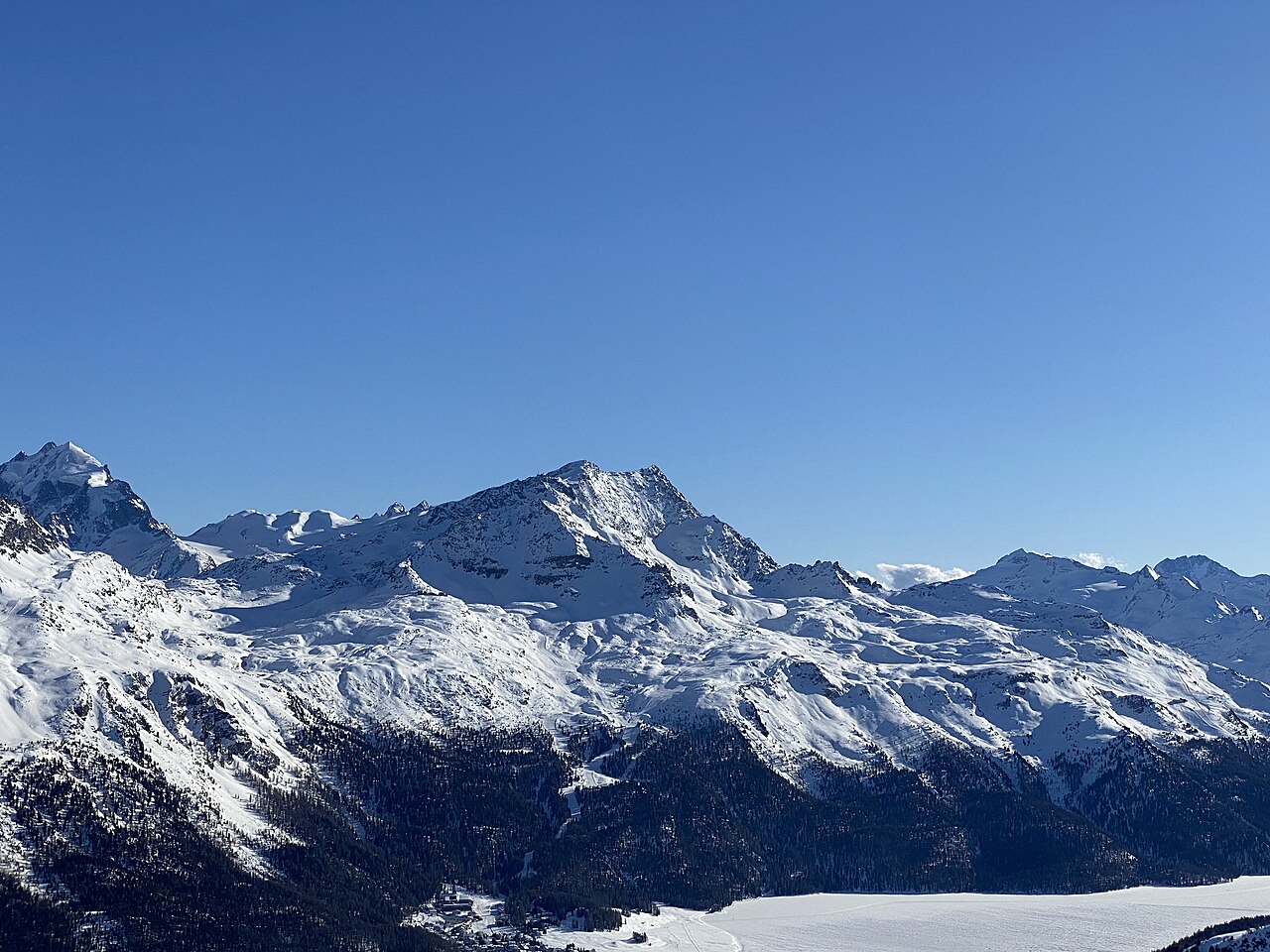
2. Corvatsch, Furtschellas and night skiing
Corvatsch rises above Silvaplana and Surlej on the other side of the valley, and its top station at 3,303 m is the highest in the whole canton of Graubünden. Together with neighbouring Furtschellas above Sils it has 120 km of pistes, and it is the mountain for anyone after steeper terrain and freeride. The Hahnensee run is legendary: it leads from the mountain through the forest all the way down to St. Moritz Bad, so you can ski “home”.
Corvatsch is also the answer if you are wondering whether St. Moritz has night skiing. Snow Night runs every Friday from 4 December 2026 to 9 April 2027, from 7 pm to 1 am. The floodlit run goes from the Murtèl mid-station down to Surlej, and at 4.2 km it is the longest floodlit piste in Switzerland. A ticket costs 28 CHF (about £25).
3. Diavolezza and Lagalb
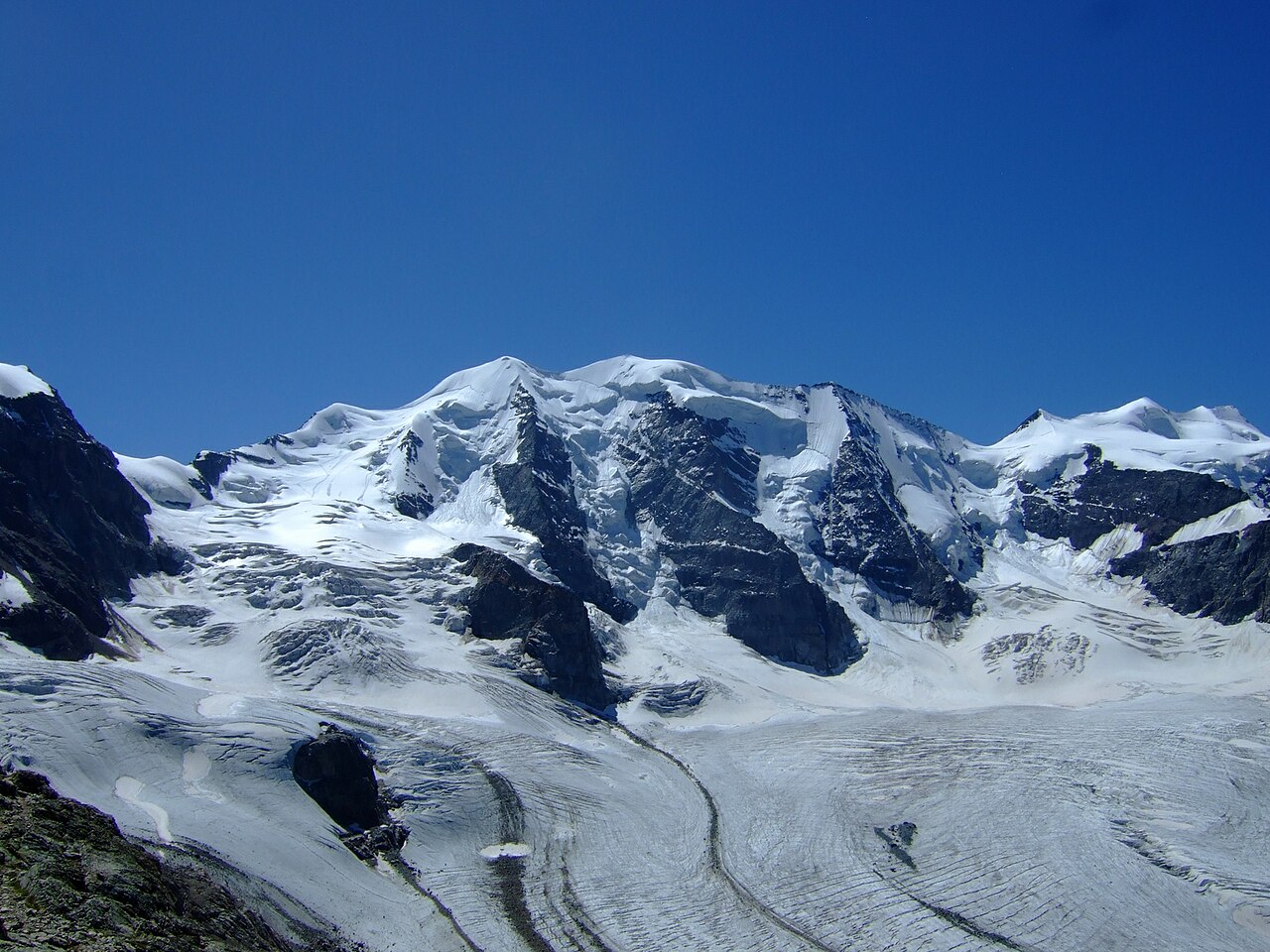
Diavolezza is near the Bernina Pass, about half an hour by train from St. Moritz (stop: Bernina Diavolezza). A cable car lifts you to the Berghaus Diavolezza at almost 3,000 metres, which looks straight out at Piz Palü, Piz Bernina and the Pers and Morteratsch glaciers. In good conditions you can ski roughly 8 km down the glacier to Morteratsch station. It is not a groomed piste but a glacier route, so check whether it is open. The mountain hut also has an outdoor hot tub facing the glaciers.
Across the road stands Lagalb, with shorter but steep runs. Diavolezza is open from mid-October to early May, and once a month at full moon it hosts Glüna Plaina, night skiing by moonlight alone. Whether it goes ahead is announced on the Diavolezza website from 3 pm on the day.
4. Cross-country skiing on the frozen lakes and the Engadin Skimarathon
For cross-country skiers the Engadine may be even better than for downhill skiers. Between Maloja and Zernez there are more than 230 km of groomed classic trails and around 250 km for skating, the largest network in Switzerland. The most beautiful stretches run right across the frozen lakes of Sils, Silvaplana and St. Moritz, and some trails are floodlit in the evening. If you want a taste of the legend, sign up for the Engadin Skimarathon: 42 km from Maloja to S-chanf, in 2027 on Sunday 14 March, with a whole marathon week from 6 March.
We could not find trail conditions or any trail fees for winter 2026/27 on the official websites, so ask at the tourist office. You can hire cross-country skis in every larger village in the valley. Even as downhill skiers, we would spend one day on cross-country skis, simply out onto the lake and back.
5. Lake St. Moritz and events on the ice
Once the lake is properly frozen, it becomes a sports ground. People walk across it, in January it hosts Snow Polo (polo on horseback on snow, held since 1985), and in February comes the White Turf horse racing, which includes skijoring, where a rider on skis is pulled by a horse. Skijoring on the ice was even a demonstration event at the 1928 Olympics. Vintage car meets take place here too, and the Alpine Skiing World Cup is coming back to St. Moritz: the calendar lists a Super-G on 18 and 19 December 2026 and a giant slalom on 20 December 2026.
Even if you are not here for an event, at least take a walk on the ice. Standing in the middle of the lake and looking up at a village that seems to have stepped out of a 1930s poster is strangely calming.
6. The Olympic bob run St. Moritz–Celerina
This is the only bobsleigh track in the world made of natural ice. It is rebuilt from water and snow every winter, is 1,722 metres long, has 19 bends and drops 130 m. Olympic races were held here in 1928 and 1948. As a guest you can ride in a four-man bob with a pilot and a brakeman: a run costs 269 CHF per person (about £240), two guests ride in each bob, and the minimum age is 16 with a parent’s or guardian’s signature. The season starts on 22 December 2026 and runs until early or mid-March. You book online at olympia-bobrun.ch. It is an expensive minute, but if you have ever wanted to try a bobsleigh experience, nowhere else is it quite this real.
7. The Cresta Run
The Cresta Run is a skeleton track that you ride head-first on a sled called a toboggan. It has been built every winter since 1884/85 and is still run by the private St. Moritz Tobogganing Club. It is about 1,212 metres long with a drop of 157 m, is rebuilt from snow and ice each year and opens for the 2026/27 season on 17 December. Beginners start from Junction, roughly a third of the way down, and have to sign up for a course. The club does not publish its current prices, so we do not quote any. Watching is free: stand by the famous Shuttlecock bend in the morning and you will see why riders fear it.
8. Tobogganing at Muottas Muragl
From Punt Muragl near Samedan, close to Pontresina, a funicular climbs to Muottas Muragl, where a toboggan run of more than 4 km starts, with 20 bends and a drop of 718 metres. It is open daily from December to March, 9.30 am to 4 pm, snow permitting. The run is fast and not suitable for small children; a helmet is recommended, and plastic bobs and racing sleds are not allowed. For little ones there is a playground by the hotel at the top and winter walking trails. The top also has one of the best views of the whole valley and its lakes, so it is worth the trip even without a toboggan.
9. St. Moritz Dorf: the leaning tower, Via Serlas and Hanselmann
The village has two main parts: St. Moritz Dorf on the slope above the lake, with the hotels, shops and the funicular to Corviglia, and St. Moritz Bad down by the lake, the old spa quarter, which today has more ordinary houses and cheaper hotels. From the station by the lake, escalators and a lift take you up into Dorf.
In Dorf, have a look at the leaning tower (Schiefer Turm) of the demolished church of St. Maurice, 33 metres tall and tilting by 5.5 degrees, and stroll along Via Serlas, home to the big fashion labels. Look at the window displays, not the price tags. Then have a coffee or something sweet at the Hanselmann café and patisserie, whose building is a listed monument. Up the hill stands Chesa Veglia, one of the oldest Engadine farmhouses, now a restaurant.
10. Segantini Museum
This small museum with its stone dome is dedicated to the painter Giovanni Segantini, who lived in the Engadine and painted the Alpine landscape and the lives of mountain people. The centrepiece is the triptych Becoming, Being, Passing Away (Werden, Sein, Vergehen). When it is snowing or raining, this is the best hour you can spend indoors in St. Moritz. The town also has the house of the painter Mili Weber, now a small museum, but that one is for connoisseurs.
11. The Bernina Express to Tirano
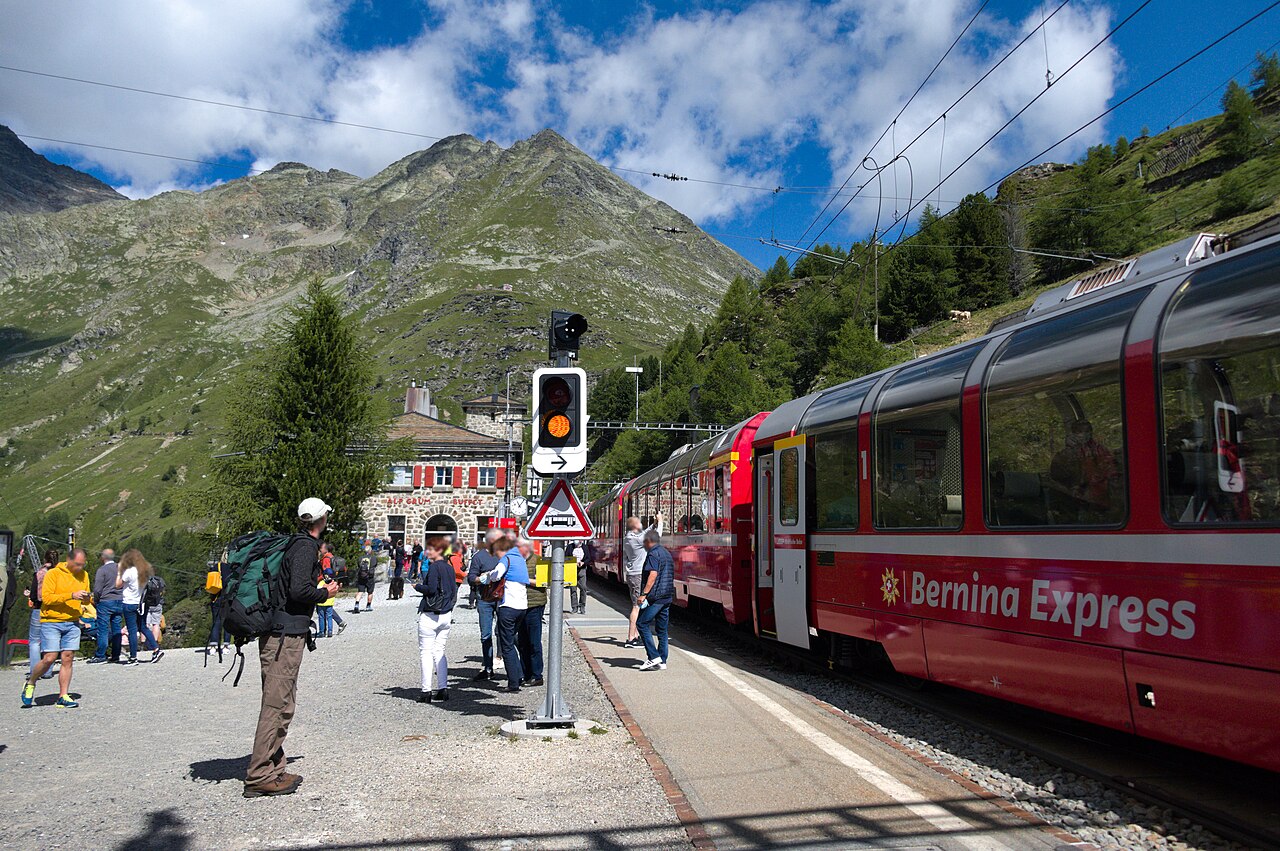
The Bernina line from St. Moritz to Tirano in Italy is the only railway that crosses the Alps without a summit tunnel, and it does so without a rack. Between the Ospizio Bernina pass (2,253 m) and Tirano (429 m) it descends 1,824 metres on gradients of up to 70 per mille, passing the Morteratsch glacier, the Lago Bianco lake and Alp Grüm station with its view of the Palü glacier, and finishing with the spiral viaduct at Brusio. Together with the Albula line it has been a UNESCO World Heritage Site since 2008.
The panoramic carriages of the Bernina Express need a compulsory seat reservation on top of the ticket. But ordinary regional trains of the Rhaetian Railway run on the same line, need no reservation and cost you less. We would go out on a regional train with a stop at Alp Grüm and happily come back on the “Express”.
12. The Glacier Express to Zermatt
St. Moritz is one of the two termini of the Glacier Express, which has been crossing the Alps since 1930 via Chur, Disentis and Brig to Zermatt. The journey takes about 7.5 hours and the train crosses 291 bridges and runs through 91 tunnels. It is more a day-long experience than a way of getting around, and if it appeals, combine it with a few days below the Matterhorn. What to do at the other end is in our guide to Zermatt. As with the Bernina Express, a seat reservation is compulsory, and sections of the route can also be done on ordinary trains.
13. The Upper Engadine lakes in summer
From St. Moritz towards the Maloja Pass, the lakes of St. Moritz, Champfèr, Silvaplana and Sils lie in a row, and over those 15 kilometres the height difference is only 50 metres. On Lake Silvaplana the Maloja wind blows almost every summer afternoon, which makes it one of the best-known spots for windsurfing and kitesurfing in the Alps. The water is cold for swimming, so people tend to go to the smaller lakes instead: Lej Marsch at the edge of the forest with a little beach on its north shore, Lej da Staz in the woods between St. Moritz and Pontresina, or Lej Nair, which you can only reach on foot. A flat path runs along the lakes, so you can walk or cycle all the way to Maloja, and in Sils a walk into the Val Fex valley begins.
14. Hikes: from Muottas Muragl to Alp Languard and to the Morteratsch glacier
The classic summer walk is the panoramic trail from Muottas Muragl to Alp Languard above Pontresina. It follows the contour line with views of the Bernina range and the lakes, and you get down to Pontresina by chairlift or on foot. The second easy and very instructive hike leads from Morteratsch station on the Bernina line to the snout of the Morteratsch glacier. Signs along the path mark the years and where the glacier ended at the time, showing how many kilometres it has retreated since the late 19th century. Stronger hikers can ride up to Piz Nair, Corvatsch or Diavolezza and set off from the top stations.
In summer most lifts in the Upper Engadine are running, and guests at hotels and holiday flats that take part in the “lifts included” offer (Bergbahnen inklusive) ride them free from the second night. It is worth asking about when you book, because you will save more on that than on the room itself.
How to get to St. Moritz from the UK
By plane and train
The easiest way is to fly to Zurich, which has direct flights from London and several other UK airports, and take the train from there. From Zürich HB you travel to Chur and then on the Rhaetian Railway over the Albula line (with the Landwasser Viaduct) to St. Moritz, about three and a half hours in total. The other route runs from Landquart via Klosters and through the Vereina tunnel. With the Fly Rail Baggage service you can send your luggage from Zurich or Geneva airport straight to a station in the Engadine. There is no through train from the UK, but you can go overland: Eurostar to Paris, a TGV Lyria to Zurich and then the route above. Count on a full day. For more on Zurich itself and the journey from the airport, see our guide to things to do in Zurich.
St. Moritz station, at 1,775 metres, is the highest town railway station in Europe and sits right by the lake. From the platform it is two minutes to the escalators up to Dorf and a short walk to the bus for Bad.
By car
Most visitors from the UK who want a car hire one at the airport. From Zurich it is 200 km and about 3 hours, via Chur and over the Julier Pass. From Munich it is 300 km and 4 hours, usually via Landeck in Austria into the Lower Engadine (Scuol, Zernez) and then up the Inn valley to St. Moritz. Milan is 175 km and 3 hours away (mountains.ch).
- Motorway vignettes: Switzerland charges 40 CHF (about £36) for a vignette valid for the whole year if you use the motorways. In Austria a 10-day vignette costs €12.80 (about £11) and from 2027 it will only be available in digital form. In Germany, motorways are free for cars.
- Mountain passes in winter: the Julier and Maloja passes are open all year, the Albula is closed in winter, and the Bernina and Flüela are sometimes closed during snowfall. The alternative is the Vereina car train from Klosters to Sagliains near Zernez. Check road conditions before you set off and expect snow in the Engadine in winter.
- Parking: the village has two main multi-storey car parks. At Serletta (603 spaces) the first 30 minutes are free; in season it costs 1.50 CHF per half hour with a daily maximum of 30 CHF (about £27) and a weekly card for 140 CHF. Quadrellas is more expensive, with a daily maximum of 40 CHF (according to parking.ch). The weekly card has to be collected in advance from the municipal police. Parking at the lifts is paid.
Getting around the Engadine
Engadin Bus services and Rhaetian Railway trains link the villages and the lifts. With a regional ski pass for the whole Upper Engadine, local public transport is included on your ski days, so you can leave the car parked all day. In season the Palm Express post bus also runs from St. Moritz over the Maloja Pass to Lugano.
Is St. Moritz expensive? How to save money
We will not sugar-coat it: St. Moritz is expensive even by Swiss standards. A four-star hotel in season normally costs several hundred francs a night, and five-star hotels start at several hundred pounds a night. You can do it for less, though, if you know where to look:
- Stay in Bad, Celerina, Pontresina or Samedan. They are a few minutes away by train or bus and prices are usually lower than in Dorf.
- Sleep + Ski or a flat with a kitchen. A 55 CHF daily ski pass at a participating hotel and dinner from the supermarket save you more than any lift discount.
- Food on the slopes: the mountain restaurants on Corviglia are among the most expensive in the Alps. A packed lunch and hot tea from a flask are completely normal here, and nobody will give you a funny look.
- Shop at the supermarket (there is a Coop in the village) and drink tap water and water from the fountains, which is drinkable all over Switzerland.
- In summer choose accommodation with the lifts-included offer and almost every viewpoint costs you nothing.
Accommodation and the ski pass are the two big costs; you can save on everything else. For comparison, our guide to the best ski resorts in Austria covers areas where a ski trip costs less, and if the Italian side of the Alps tempts you, read our guide to skiing in Italy.
Where to stay in St. Moritz
For skiing, Dorf is the most practical base because of the funicular to Corviglia, but also the most expensive. St. Moritz Bad by the lake is quieter and cheaper, and close to both the Signal cable car and the bus to Corvatsch. We picked hotels at different price levels and checked them all on Booking.com:
- St. Moritz Youth Hostel: a Swiss youth hostel in Bad, at the edge of the forest near the lake. The cheapest sensible bed in town, although “cheap” is a relative term here. Swiss hostels are clean and quiet, so they work for couples and families too.
- Hotel Sonne St. Moritz: a three-star hotel in Bad. A good choice if you want a hotel rather than a hostel but do not want to pay for a Dorf address.
- Hotel Waldhaus am See: a three-star hotel right on the lakeshore between Bad and the station. The lake-facing rooms have the kind of view that costs twice as much elsewhere in St. Moritz.
- Hotel Laudinella: a large four-star hotel in Bad with several restaurants and a spa. Good for families and longer ski stays, when you want a spa after a day on the mountain and do not want to think about where to eat.
- Badrutt’s Palace Hotel: the five-star legend from 1896 above the lake in Dorf, built by the Badrutt family, the same family that brought the first winter guests here in 1864. For a special occasion, or at least for a drink in the hotel bar so you know what everyone is talking about.
For more options, use our accommodation search for St. Moritz. The neighbouring villages are often cheaper: Pontresina is close to Diavolezza and Muottas Muragl, Celerina has the gondola to Marguns and therefore direct access to Corviglia, and Samedan is the valley’s transport hub. Before you book, ask whether the hotel takes part in Sleep + Ski; in winter it is the cheapest way to get a ski pass.
💡 Tip: Accommodation is most expensive at Christmas, New Year, in February during White Turf and during school holidays. The cheapest skiing is from late November to mid-December and in the second half of March, when there is still plenty of snow up high and the sun is already warm.
A little history
People came here for the water long before they came for the snow. The timber from a prehistoric enclosure around a mineral spring in St. Moritz Bad is more than 3,400 years old, so Bronze Age people already knew the iron-rich, sparkling springs. The village first appears in writing as ad sanctum Mauricium in 1137–1139, named after St. Maurice, a Roman soldier and commander of the Theban Legion. In 1519 Pope Leo X promised an indulgence to everyone who made it to the springs and the church, and in 1535 Paracelsus stayed here.
The turning point came in the mid-19th century. The first hotel, the Kulm, opened in 1856, and in September 1864 the hotelier Johannes Badrutt made a famous bet with four Englishmen: he invited them to come for the winter free of charge, and if they came and did not enjoy it, he would pay their journey from London and back. The Englishmen stayed from Christmas to Easter, told everyone at home about it, and that was the start of winter tourism, not just in St. Moritz but across the Alps. The same year saw the opening of the first tourist office in Switzerland.
After that, things moved fast. At Christmas 1878 the first electric light in Switzerland was switched on here, in the winter of 1884/85 the British built the Cresta Run, Badrutt’s Palace opened in 1896 and the Albula railway arrived in 1904. In 1928 St. Moritz hosted only the second Winter Olympics in history, a year later Switzerland’s first ski school opened here, followed by the first ski lift in 1935, and in 1948 the Olympics returned. Switzerland has not hosted any other Winter Games to this day. The sun logo has been a registered trademark since 1930, and the slogan “Top of the World” since 1986.
When to go to St. Moritz
The Engadine is one of the sunniest places in the Alps, and locals quote around 322 sunny days a year. The winters are genuinely cold, though: the average January temperature is around minus 7 °C. The dry, frosty air here is known as the “champagne climate”.
- December to March: skiing, with the lakes frozen from roughly January. January and February are the coldest months and have the most events on the ice.
- Late March and April: spring skiing with long days. Corviglia closes around early April; Corvatsch and Diavolezza stay open longer.
- June to September: hiking, cycling, windsurfing on Lake Silvaplana, swimming in the smaller lakes. The July average is only around 13 °C, so pack layers.
- October and November: the golden larches in October are beautiful, but November is off-season, when many hotels, restaurants and lifts close.
What we would do differently
St. Moritz tempts you to cram all three mountains, the bob, the Cresta Run, the Bernina line and Muottas Muragl into five days. It can be done, but it would not be the same. Next time we would skip at least one ski day and spend it down in the valley: on cross-country skis across the lake to Sils, lunch at an inn we had never heard of, and a slow bus ride back.
Try the things that are not on the posters, too. Engadine food such as pizokel or capuns, an Engadiner Nusstorte nut tart from a local bakery instead of cake at the hotel, a glass of Valtellina wine brought over the Bernina Pass. Turn off Via Serlas into the lanes above it in Dorf, where old Engadine houses with sgraffito decoration still stand, and take a trip to Celerina or Zuoz to see what the valley looks like without the fur coats.
And when you are standing on Piz Nair or on the terrace at Diavolezza, leave your phone in your pocket for a moment. No photo will give you that view of the glaciers back anyway. St. Moritz is not something to tick off a list; it is something to enjoy.
FAQ
How much is a ski pass in St. Moritz?
Prices are dynamic and change with the date and how early you buy. An adult day pass for Corviglia costs roughly 54 to 100 CHF in the 2026/27 season (about £48 to £90). Guests at hotels taking part in Sleep + Ski get a fixed price of 55 CHF a day. The ENGADINcard 365 season pass costs 1,285 CHF. Children under 6 ski free with a parent.
How many kilometres of pistes does St. Moritz have?
The whole Upper Engadine has around 350 km of pistes. The biggest area is Corviglia above the village with 155 km (42 km blue, 79 km red and 34 km black), Corvatsch with Furtschellas has 120 km, and Diavolezza, Lagalb and Zuoz are smaller. The mountains are not linked on skis; you travel between them by bus or train.
Does St. Moritz have night skiing?
Yes, on Corvatsch. Snow Night runs every Friday from 4 December 2026 to 9 April 2027, from 7 pm to 1 am, on a 4.2 km floodlit run from Murtèl station down to Surlej. A ticket costs 28 CHF and is only sold at the valley station. On Diavolezza there is skiing by moonlight once a month at full moon.
How do I get to St. Moritz from the UK?
The easiest way is to fly to Zurich, which has direct flights from London and other UK airports, and take the train via Chur, about three and a half hours. If you hire a car, it is 200 km and around 3 hours from Zurich via Chur and the Julier Pass; on Swiss motorways you need a 40 CHF vignette. Milan is another option at 175 km by road.
Is St. Moritz expensive?
Yes, even by Swiss standards. Accommodation and the ski pass cost the most. You can save by staying in St. Moritz Bad or in nearby villages such as Celerina, Pontresina and Samedan, using Sleep + Ski for a 55 CHF daily pass, buying food at the supermarket and taking a packed lunch onto the slopes. In summer, guests at participating hotels ride the lifts free from their second night.
What are the best things to do in St. Moritz in summer?
Hike from Muottas Muragl to Alp Languard or to the Morteratsch glacier, ride up Piz Nair, Corvatsch or Diavolezza, go windsurfing or kitesurfing on Lake Silvaplana, swim in Lej Marsch or Lej da Staz, cycle along the lakes to Maloja and take the Bernina Express to Tirano in Italy. Most lifts run in summer.
When did St. Moritz host the Winter Olympics?
Twice, in 1928 and 1948. The 1928 Games were only the second Winter Olympics in history, and Switzerland has not hosted any other Winter Games to this day. The Olympic bob run made of natural ice survives from that era, and you can ride it as a guest.
What is the weather like in St. Moritz?
Sunny and cold. Locals quote around 322 sunny days a year; the average temperature is around minus 7 °C in January and around 13 °C in July. December to March is best for skiing, June to September for hiking. November and May are off-season, when many places close.
Where next
- Zermatt: the other end of the Glacier Express, a car-free village below the Matterhorn.
- Things to do in Zurich: the gateway to the Engadine from the airport, and what to fit in on the way.
- Things to do in Lucerne: the Chapel Bridge, Pilatus and Rigi, if you want to add a city to your ski trip.
- Best ski resorts in Austria: the top areas from the Arlberg to Hochficht and what ski passes cost.
- Skiing in Italy: Livigno and Bormio are just across the border from St. Moritz.
Potřebujete pomoct s cestováním?
-
Ubytování 🏨
Vyberte si to nejlepší ubytování, ať už jste kdekoliv, přes Booking.com. -
Půjčení auta 🚗
Auto si snadno najdete přes Booking.com, kde máte často slevu díky ubytování, nebo Rentalcars.com, kde porovnáte nabídky většiny půjčoven. -
Zážitky 🎟️
Přes GetYourGuide.com si vyberete z nejrůznějších výletů i zážitků po celém světě, navíc se zrušením zdarma do 24 h předem.