Last updated 29.8.2026
Few cities let you walk out of a medieval alley, past a house that looks poured rather than built, and onto a beach with a cold beer in your hand, all in one afternoon. That is why the question of what to see in Barcelona is genuinely hard to answer: the Catalan capital stacks Roman walls, Gothic naves, Gaudí’s melting facades and a working seafront into a city you can cross on foot in a couple of hours. Spend a week here and you will still leave with a list.
This guide lays out 34 things to see and do in Barcelona, ordered so you can build your own route rather than tick off someone else’s. Each entry tells you the admission price in euros (with a rough figure in pounds), whether you need to book a timed slot in advance, and when to turn up if you would rather not queue. The famous five are here, and so are the places the tour groups skip: a mosaic-roofed market by the cathedral, a maze garden on the city’s edge, an air-raid bunker with the best free view in Barcelona.
What to see in Barcelona in short
- Do not miss: Sagrada Família, Park Güell, Casa Batlló, the Gothic Quarter and the panorama from Bunkers del Carmel.
- Book ahead: Sagrada Família, Park Güell, Casa Batlló and La Pedrera. Walk-up tickets are basically not a thing any more.
- How many days: three to four is the sweet spot; a long weekend covers the headline sights.
- Getting around: metro or Aerobús from the airport, then the metro everywhere else. Buy a T-casual travel card.
- Best time to visit: April to June and September to October. July and August mean heat and crowds.
- Budget: from roughly 70 € a day (around £60) backpacker style, including one paid attraction.
Best time to visit Barcelona, and getting around with a T-casual
Barcelona works all year, which is unusual for a European city break. Even January averages around 14 °C, so nothing shuts down for winter. The catch is comfort. April to June and September to October are the months when the weather suits long days on your feet, the terraces are open, the sea is still swimmable at the tail end of summer and hotel prices have not gone silly. July and August are the opposite: the hottest, busiest, most expensive weeks of the year, with queues at Sagrada Família and towels packed edge to edge on Barceloneta. November to March is cheap and calm, ideal if you came for architecture and tapas rather than swimming.
Getting there is the easy part. Direct flights run to Barcelona El Prat from London, Manchester, Bristol, Edinburgh and a long list of other UK airports, on both full-service and budget carriers. Routes and frequencies change by season, so check current schedules before you fix your dates. The airport sits only about 13 km from the centre, and there are three sensible ways in: the metro (line L9 Sud), the Aerobús at roughly 7.25 € one way (around £6) straight to Plaça de Catalunya, or a Rodalies commuter train. Reckon on 30 to 40 minutes door to door. Compare flights and routes to Barcelona here →
Once you are in the city, the metro does almost everything. It is fast, the network is dense and the stations sit close to the sights. A single ride costs 2.65 € (about £2.25), but the ticket worth buying is the T-casual: 10 journeys for one person across metro, buses and trams in zone 1 for roughly 12.55 € (around £11). For a couple of days of sightseeing solo, nothing beats it. Bear in mind that much of the old centre is walkable anyway, so you may use fewer rides than you expect.
💡 Tip: Download the official TMB app for routes and live departures. And keep your bag in front of you on La Rambla and in the metro. Violent crime here is low, but pickpockets are among the most persistent in Europe.
Where to stay in Barcelona
For a first visit, pick a neighbourhood you can walk out of straight into the sights. Eixample puts you in the middle of the modernista grid, with Casa Batlló and La Pedrera on your doorstep, quiet residential streets and a metro stop every few blocks. El Born and the Gothic Quarter are for people who want to be inside the old city, among the bars, the tapas counters and the alleys. Gràcia is the bohemian option, lower on tourists, handy for Park Güell and full of small squares where locals actually eat. Backpackers tend to end up in the hostels around Plaça de Catalunya, which is central and well connected if noisier.
💡 Tip: Do not book a room directly on La Rambla. One block away is quieter, cheaper and you will actually sleep. Find places to stay in Barcelona →
What to see in Barcelona: 34 sights and experiences
The list runs from the sights that fill every guidebook to a handful that stay quiet even in August. Prices are indicative, they creep up most years, and where a timed slot matters we say so.
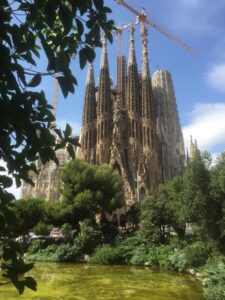
1. Sagrada Família, Gaudí’s unfinished basilica
The symbol of the city and its most visited building. Gaudí worked on it for more than 40 years and construction is still going: the great central tower, 170 m tall, is due for completion around 2026, the centenary of the architect’s death. Inside, the columns branch like a stone forest and the stained glass throws colour across the floor in a way photographs never quite catch.
Tickets: 26 € for the basilica (about £22), 36 € with tower access (about £31). Booking is compulsory, there is no ticket office selling for same-day entry and every ticket is tied to a time slot. Book tickets and guided tours in advance →
💡 Tip: For the best light, go early in the morning for the eastern windows or late afternoon for the western ones. Book two to three weeks ahead; in high season the good slots go first.
2. Park Güell, the mosaic garden above the city
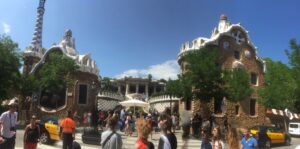
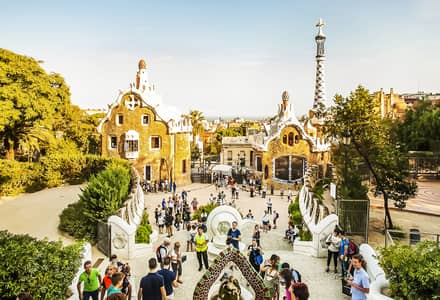
Gaudí’s hillside park is the playful end of his work: a serpentine bench tiled in broken ceramic, gatehouses that look like gingerbread, and a terrace with a view down to the sea. It was meant to be a luxury housing estate and failed as one, which is why it ended up a park and later a UNESCO site.
Tickets to the Monumental Zone cost around 18 € (about £15); the wooded rest of the park is free. A timed slot is compulsory.
💡 Tip: Take the first slot of the day, around 9.30, and you get soft light on the mosaics without the heat or the crowds. The approach is uphill, so use the outdoor escalators from Vallcarca metro station.
3. Casa Batlló, the house of bones and the dragon
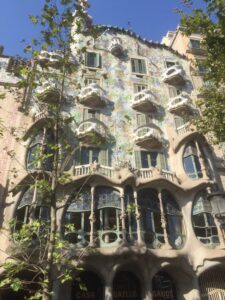
Probably the most photographed facade in the city, halfway up Passeig de Gràcia. The balconies read as masks, the scaled roof as a dragon’s back, and inside there is not a straight line to be found. The audiovisual tour has turned the visit into a piece of theatre in its own right, which divides opinion but does keep children interested.
Tickets from around 29 € (about £25), often more depending on the time slot and the type of ticket. Booking recommended.
4. Casa Milà, better known as La Pedrera
A few minutes’ walk from Casa Batlló stands Gaudí’s other apartment block, a wave of pale stone that earned the nickname “the quarry”. The star is the roof terrace, where the chimneys and stairwell vents look like a gathering of armoured sentries, with Eixample laid out below.
Tickets from around 25 € (about £21); the evening visit with a light show costs about 35 € (around £30). Booking recommended.
5. Casa Vicens, Gaudí’s first house
Less known and worth the detour: Gaudí’s first major commission, built between 1883 and 1889 in Gràcia. The tiled facade in a Moorish key already hints at where he was heading, but the scale is domestic and the queues are short.
Tickets around 18 to 22 € (roughly £15 to £19).
6. Palau Güell, a palace in a side street off La Rambla
The town palace Gaudí built for his patron Eusebi Güell, squeezed into a narrow street just off La Rambla. The brick-columned basement stables and the roof terrace with its tiled chimneys are the highlights. A good choice when you want Gaudí without the crowd management.
Tickets around 12 to 15 € (roughly £10 to £13).
7. La Rambla, the famous pedestrian boulevard
The 1.2 km promenade runs from Plaça de Catalunya down to the harbour: flower stalls, street performers, cafés with prices to match the address. It is touristy and it is expensive, and it is still worth walking once, ideally early in the morning when the deliveries are on and the crowds are not. Free.
💡 Tip: Do not eat on La Rambla itself. Turn off into the Gothic Quarter or El Raval and you will pay a fraction for better tapas.
8. The Gothic Quarter (Barri Gòtic), the medieval core
A knot of narrow stone lanes, hidden squares and fragments of Roman wall. The best way to see it is to put the map away: you will come out at the cathedral, at Plaça Reial with its Gaudí lamp posts, or under the much-photographed bridge on Carrer del Bisbe. Free.
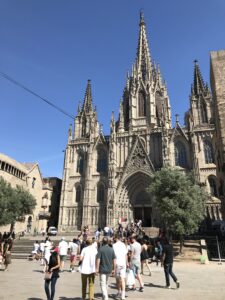
9. Barcelona Cathedral (Santa Eulàlia), the Gothic one
The city’s cathedral, in the middle of the Gothic Quarter, with a cloister where 13 geese live, one for each year of Saint Eulàlia’s life according to the legend. Do not confuse it with Sagrada Família: this is classical Gothic, dark and cool and vertical.
Tickets for visitors run around 9 to 16 € (roughly £8 to £14), usually including the lift to the roof terrace.
10. Mercat de la Boqueria, the market off La Rambla
The city’s best-known food market: fruit stacked like jewellery, whole jamón legs, seafood on ice, fresh juices in plastic cups. Even if you buy nothing it is worth ten minutes of your morning. Come early, because by lunchtime it is shoulder to shoulder. Free.
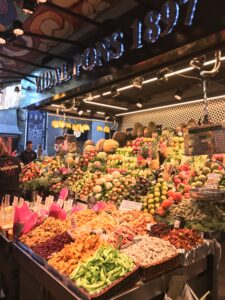
💡 Tip: The stalls by the entrance charge the most. Walk deeper in, where locals do their shopping, and eat at one of the bar counters at the back.
11. El Born and Santa Maria del Mar
A neighbourhood of galleries, small shops and bars wrapped around the basilica of Santa Maria del Mar, built in the 14th century and about as pure as Catalan Gothic gets. It is the church behind the novel Cathedral of the Sea, and it is worth seeing from inside and from the roof.
Entry to the basilica is usually free outside the tourist visiting window; the guided visit including the roof costs around 10 € (about £8.50).
12. Palau de la Música Catalana, the modernista concert hall
A UNESCO-listed concert hall where the ceiling opens into an inverted stained-glass sun, one of the most extraordinary interiors in the city. It is the work of Lluís Domènech i Montaner, Gaudí’s great rival for the modernista crown.
Guided tours from around 20 € (about £17); concert tickets often start near 15 € (about £13), which is the better deal if the programme suits you. Booking recommended.
13. Hospital de Sant Pau, a campus of modernista pavilions
The most beautiful former hospital you will ever walk through: a walled complex of pavilions with mosaics, domes and tiled towers, a short walk from Sagrada Família. Also UNESCO-listed, and still oddly overlooked.
Tickets around 16 to 18 € (roughly £14 to £15).
14. Montjuïc, the hill with the castle and the cable car
The green hill above the port can absorb a whole day: botanical gardens, the 1992 Olympic complex, several museums and Castell de Montjuïc on the summit, with a walk round the ramparts and views over the city and the sea. The Telefèric de Montjuïc takes you up for around 16.30 € return (about £14).
Entry to the castle costs around 12 € (about £10); the parks and viewpoints are free.
15. The Magic Fountain (Font Màgica), the evening water show
Below the Palau Nacional, the fountain runs to music and coloured light after dark, and it costs nothing to watch. One caveat: during recent drought years the show has been suspended or cut back, so check the current schedule before you make the trip.
16. MNAC in the Palau Nacional, Catalan art and a free view
The monumental palace on the flank of Montjuïc holds the National Art Museum of Catalonia, home to one of the world’s finest collections of Romanesque painting. Even if you skip the galleries, the steps outside give you the classic view back over the city.
Tickets around 12 € (about £10).
17. Fundació Joan Miró, surrealism on the hill
A bright, low building on Montjuïc devoted to the Catalan painter Joan Miró. A good stop for anyone who likes modern art, with a roof terrace thrown in.
Tickets around 15 € (about £13).
18. Camp Nou (Spotify Camp Nou), the FC Barcelona ground
Europe’s largest football stadium and a pilgrimage for any Barça supporter. The ground has been through a major rebuild, so check what is currently open before you go, whether that is the tour, the museum or a match.
Tickets for the museum and tour vary with the stage of the redevelopment, so the official site is the only reliable source.
19. Barceloneta and the city beaches
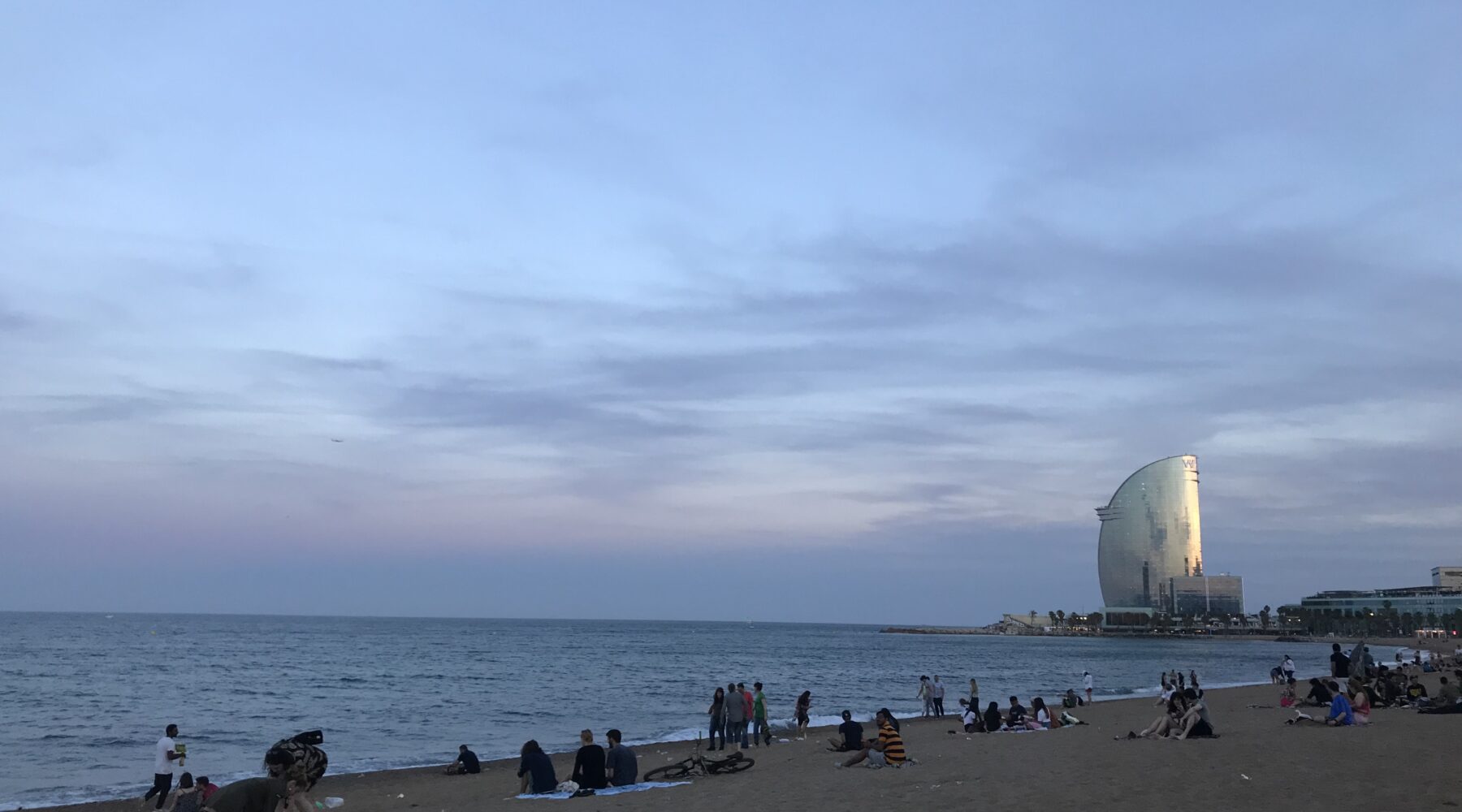
The old fishing quarter now fronts the city’s best-known beach: sand, a long promenade, beach bars (chiringuitos) and seafood restaurants where you eat with your feet more or less in the sand. Quieter and frankly nicer are the beaches heading north, Bogatell, Nova Icària and Mar Bella. Free.
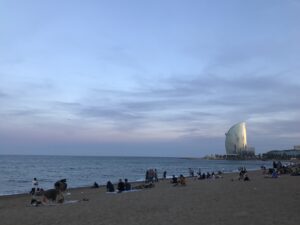
💡 Tip: Barceloneta is the most crowded stretch by a distance. Walk a few hundred metres up to Bogatell for more space, cleaner water and fewer people trying to sell you a beer.
20. Tibidabo, the widest view in the city
The highest hill above Barcelona at 512 m, topped by the neo-Gothic church of Sagrat Cor and a nostalgic funfair, one of the oldest in Europe. The panorama from here takes in the whole city, the widest view you will get anywhere in Barcelona.
Tickets for the amusement park run roughly 12 to 35 € (about £10 to £30) depending on which ride package you buy; the church and the viewpoint are reachable without one.
21. Museu Picasso, the early years
Five medieval palaces in El Born, knocked together to hold the collection of Pablo Picasso’s early work, from the academic studies of a teenager to the work of a painter finding his own language. It is one of the most visited museums in the city, so a timed ticket saves you standing in Carrer Montcada.
Tickets around 14 € (about £12); entry is free on one day a month and on some Thursday evenings, though the terms change, so check first.
22. Arc de Triomf, the brick triumphal arch
Built in 1888 in neo-Mudéjar brick as the gateway to the World Exposition, which makes it a triumphal arch commemorating no battle at all. A wide palm-lined promenade runs from it down to Parc de la Ciutadella, busy with skaters and street performers. Free.
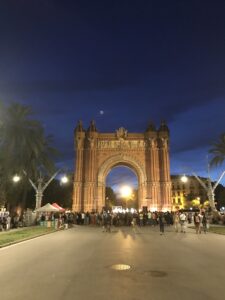
23. Parc de la Ciutadella, the green space in the centre
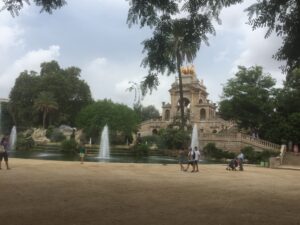
The largest park in central Barcelona, with a theatrical cascade fountain that a young Gaudí had a hand in, a boating lake and the Catalan parliament in the middle of it. The obvious spot for a picnic and an hour off your feet between museums. Free.
24. Bunkers del Carmel, the best free view in Barcelona
Our pick of the viewpoints. The anti-aircraft battery on the El Carmel ridge, built during the Civil War, gives you a 360-degree panorama of the whole city and costs nothing. Locals come up with a bottle of wine for sunset. Take a bus most of the way, then walk the last stretch uphill.
💡 Tip: Arrive an hour before sunset, claim a spot on the concrete and watch the lights come on all the way to the sea. Bring water and something to eat, there is nothing to buy at the top.
25. Port Vell, the aquarium and the harbour cable car
The old port was rebuilt for the 1992 Olympics and is now a promenade: the Rambla del Mar boardwalk, moored yachts and the Maremàgnum shopping centre. L’Aquàrium here is one of Europe’s largest, with a walk-through underwater tunnel, from around 25 € (about £21). The red Telefèric del Port strings across the harbour to Montjuïc for about 20 € (roughly £17) and is worth it for the view alone.
26. Poble Espanyol, Spain in miniature
An open-air village built for the 1929 exposition on Montjuïc, with replicas of buildings from across Spain, craft workshops and a couple of small galleries. It sounds like a theme park and partly is, but it works well with children and on a hot afternoon.
Tickets around 14 € (about £12).
27. Torre Glòries, the city’s glowing tower
Jean Nouvel’s 144 m tower, formerly Torre Agbar, lit at night by thousands of LEDs. The Mirador viewing deck under its glass dome has opened to the public, a modern counterweight to all those Gothic bell towers.
Tickets for the viewing deck around 18 € (about £15).
28. Columbus Monument, the view over the harbour
The 60 m column at the bottom of La Rambla, with Columbus pointing out to sea. A small lift inside takes you up to the viewing platform at the top, which looks back over the port and the old city.
Tickets for the viewpoint around 7.50 € (roughly £6.50).
29. MACBA and El Raval, contemporary art and another side of the city
Richard Meier’s brilliant white building sits in the middle of El Raval and holds the Museum of Contemporary Art, with Catalan and international work from the 1950s onward. The plaza in front of it is legendary among skaters worldwide, which tells you as much about the place as the collection does. El Raval itself, once a hard working-class quarter, is now multicultural, busy and noticeably less touristed than the Gothic Quarter next door.
Tickets around 12 € (about £10); free on Saturdays from 4 pm and on the first Sunday of the month, though check the current terms before you rely on it.
30. Mies van der Rohe Pavilion, a landmark of modern architecture
A short walk from the Magic Fountain stands the reconstruction of the legendary pavilion Ludwig Mies van der Rohe designed for the 1929 exposition. Glass, steel, travertine and polished onyx, with a reflecting pool and a single sculpture: minimalism before anyone called it that, and a fixture in every 20th-century architecture course. Easy to combine with a Montjuïc afternoon.
Tickets around 9 € (about £7.50); free on the first Sunday of the month.
31. Mercat de Santa Caterina, the wave-roofed market
The city’s oldest covered market, minutes from the cathedral, now known mainly for the undulating roof of coloured ceramic tiles by the architect Enric Miralles. It is the calmer, more workaday alternative to the Boqueria: more locals than visitors, and a decent bistro inside if you want lunch where you shop. Free.
💡 Tip: Fit this in right after the cathedral, the two are a few minutes apart. The roof reads best from the surrounding streets or from above, for instance the terrace of a nearby bar.
32. CosmoCaixa, the science museum for all ages
A large modern science museum in the foothills below Tibidabo where the exhibits are meant to be touched: physics, geology, space. The centrepiece is a flooded slice of Amazon rainforest under a glass roof, with real plants and live animals. The obvious plan for a wet day or a trip with children.
Tickets around 8 € (about £7), free for under-16s. Allow half a day.
33. Museu Marítim and the Drassanes shipyards
Near the Columbus Monument stand the Drassanes Reials, among the best-preserved medieval shipyards anywhere, vast stone naves built to construct galleys under cover. Inside is the Maritime Museum, with a full-size replica of a galley from the Battle of Lepanto and the story of Barcelona as a naval power. The building alone justifies the ticket.
Tickets around 10 € (about £8.50); there are often reduced late-afternoon rates, so check the current list.
34. Parc del Laberint d’Horta, the oldest garden in the city
Barcelona’s oldest surviving garden, out on the edge of the city: a late 18th-century romantic park whose cypress hedges form a genuine maze you can get lost in. Around it are pavilions, ponds, statues and almost nobody, because the coaches do not come here. The quietest hour you will spend in Barcelona.
Tickets around 2.50 € (roughly £2); free on Wednesdays and Sundays. Numbers are capped to keep the park calm, which is exactly why it stays that way.
Day trips from Barcelona
If you have a spare day, the trains out of the city are cheap and quick, and the contrast with the coast is worth having:
- Montserrat (about 50 km): a Benedictine monastery wedged into a massif of rock pillars, reached by train plus rack railway or cable car. The most popular day trip from Barcelona, and busiest in the middle of the day.
- Sitges (about 40 km): an elegant seaside town with good beaches and a long-standing bohemian streak, half an hour away on the train.
- Girona (about 100 km): a medieval city of coloured houses above the river, with a cathedral that Game of Thrones fans will recognise. Under an hour by high-speed train.
- Figueres (about 140 km): Salvador Dalí’s birthplace and his gleefully odd Theatre-Museum, best combined with Girona in one long day.
💡 Tip: For Montserrat there is a combined ticket covering the train and the ride up the mountain. Buy it at Plaça Espanya station and you pay less than for the separate legs.
Gaudí in Barcelona: what to see in one day
Antoni Gaudí shaped this city more than any planner did, and for a good number of visitors his buildings are the entire reason for the trip. Seven of his works are on the UNESCO list, and if architecture is your thing you can spend a full day on nothing else, with the caveat that every interior needs a timed ticket.
- Sagrada Família, the life’s work, still unfinished.
- Park Güell, the mosaic garden above the city.
- Casa Batlló and Casa Milà (La Pedrera), neighbours on Passeig de Gràcia.
- Casa Vicens, the colourful first commission in Gràcia.
- Palau Güell, the town palace off La Rambla.
💡 Tip: To fit several Gaudí interiors into one day, buy the tickets first and then build the day around the time slots. Casa Batlló and La Pedrera are a few minutes apart, so pair those two and keep Park Güell for a morning. Tickets for the Gaudí sights →
Beaches and where to eat tapas
Barcelona is one of very few big cities where you can walk out of a cathedral and be swimming within half an hour. Barceloneta is the closest beach to the centre and the busiest; Bogatell, Nova Icària and Mar Bella, a short way north along the seafront, are calmer and better kept. The Mediterranean here is at its warmest from July to September, and swimmable either side of that if you are not fussy.
Then there is the food, which in Barcelona is a discipline of its own. Skip the restaurants with photo menus on La Rambla and head for the tapas bars in the Gothic Quarter, El Born or Gràcia, where you order at the counter and pay by the plate. Things worth ordering:
- Pa amb tomàquet, bread rubbed with tomato and olive oil. The foundation of everything else.
- Patatas bravas, fried potatoes with a spicy sauce, the standard thing to eat with a beer.
- Jamón ibérico and croquetas, cured ham and fried béchamel croquettes.
- Pulpo a la gallega, octopus with paprika and oil, plus whatever seafood is fresh.
- Vermut, the local vermouth that Barcelonans drink before lunch, usually with olives.
💡 Tip: The rule of thumb for authenticity is simple: the further from La Rambla, the better and cheaper. A menú del día, the multi-course set lunch, runs 12 to 18 € (roughly £10 to £15) and costs a fraction of the same food in the evening. Locals eat lunch between 1 and 3 pm.
Barcelona on a budget: what a day costs
Barcelona is not a cheap city, but it is entirely doable on a backpacker budget. Indicative daily spend per person, from frugal to comfortable:
| Item | Frugal | Comfortable |
|---|---|---|
| Accommodation (hostel / guesthouse) | 30–45 € (around £26–38) | 70–120 € (around £60–102) |
| Food (menú del día, tapas) | 15–25 € (around £13–21) | 35–60 € (around £30–51) |
| Transport (T-casual) | about 12.55 € / 10 rides | about 12.55 € / 10 rides |
| Admissions (1–2 sights) | 0–26 € (around £0–22) | 40–70 € (around £34–60) |
| Total per day | about 70 € (around £60) | about 160 € (around £136) |
The biggest savings come from pairing one paid icon with free viewpoints (Bunkers del Carmel, the Gothic Quarter, the beaches, the Magic Fountain) and eating the set lunch instead of dinner in the centre. Free museum days are the other lever: several of the city’s museums waive admission on the first Sunday of the month.
Where to next
- Valencia landmarks: what to see in the city
- The best beaches in Valencia
- What to see in Mallorca
- What to see in Venice (2026)
- What to see in Portugal (2026)
Frequently asked questions about what to see in Barcelona
Tours and tickets in Barcelona
traveller-tested · GetYourGuide

Barcelona: Sagrada Família entry ticket with audio guide
★ 4.6 · 114,791 reviews
from 33 €

Prices and ratings are indicative (source: GetYourGuide), you will see the current ones after clicking through.
What to see in Barcelona in one day?
Do the icons in order and keep the walking short: Sagrada Família first thing (with a booked slot), then the Gaudí houses on Passeig de Gràcia (Casa Batlló, La Pedrera), a walk down La Rambla into the Gothic Quarter, and sunset from Bunkers del Carmel. Leave Park Güell for another day, it is far enough out to eat an hour of travel.
What to see in Barcelona in 3 days?
Day one for the Gothic Quarter, the cathedral, the Boqueria and El Born. Day two for Gaudí: Sagrada Família in the morning, Passeig de Gràcia after lunch, Park Güell late afternoon. Day three for Montjuïc, the MNAC steps and the beaches, or swap it for a day trip to Montserrat. That leaves the Magic Fountain and a tapas crawl for the evenings.
How many days in Barcelona is enough?
Three to four. A long weekend covers the headline sights, but four days lets you add a beach afternoon, one museum you actually want to see and a slower pace. Five days makes a day trip to Montserrat or Sitges easy.
Do you need to book Barcelona attractions in advance?
For Sagrada Família and Park Güell, yes: tickets are sold online for a specific time slot and you will not get in on the day. Casa Batlló and La Pedrera are strongly recommended too, especially between June and September. Everything else you can generally turn up for.
How much are Sagrada Família tickets?
The basilica costs 26 € (about £22), and 36 € (about £31) with tower access. Children under 11 go free. Tickets are sold online in advance only.
What can you see in Barcelona for free?
Plenty: the Gothic Quarter, La Rambla, the Boqueria market, the city beaches, Bunkers del Carmel, the Magic Fountain, the Arc de Triomf, Parc de la Ciutadella and the parks on Montjuïc. Several museums, the Picasso and MACBA among them, also have free days or free evenings, so check the current terms.
When is the best time to visit Barcelona?
April to June and September to October: warm enough for the beach, cool enough to walk all day, with prices and crowds still reasonable. Summer is hot and packed, winter is cheap and quiet but not for swimming.
How do you get from Barcelona airport to the city centre?
Cheapest is the metro (line L9 Sud) or the Rodalies commuter train; fastest is the Aerobús at around 7.25 € (about £6) straight to Plaça de Catalunya. Any of them takes roughly 30 to 40 minutes.
Which Barcelona travel card is worth buying?
For one person over a few days, the T-casual: 10 journeys on the metro, buses and trams in zone 1 for about 12.55 € (around £11). A single ride costs 2.65 €, so the card pays for itself after five trips. Note that the T-casual cannot be shared between two people.
Do you need a car in Barcelona?
No. Parking is expensive and awkward, the centre is walkable and the metro covers the rest. A car only makes sense for exploring the coast or inland Catalonia, and even then pick it up on the way out of the city.
Is Barcelona safe for tourists?
Yes, violent crime is low, but pickpocketing is a genuine and organised problem, particularly on La Rambla, in the metro and around the big sights. Wear your bag in front of you, keep your phone off the café table and leave your passport at the hotel.
Where should you eat tapas without falling into a tourist trap?
Avoid anywhere on La Rambla with a photo menu outside. Walk into the back streets of the Gothic Quarter, El Born or Gràcia and order at the bar; a menú del día costs 12 to 18 € (roughly £10 to £15). Locals eat lunch between 1 and 3 pm.
Are day trips from Barcelona worth it?
Yes, and they are easy by train. The favourites are the monastery of Montserrat (about 50 km) in its rock massif, the beach town of Sitges and medieval Girona. All three work as a single day out without a car.
Potřebujete pomoct s cestováním?
-
Ubytování 🏨
Vyberte si to nejlepší ubytování, ať už jste kdekoliv, přes Booking.com. -
Půjčení auta 🚗
Auto si snadno najdete přes Booking.com, kde máte často slevu díky ubytování, nebo Rentalcars.com, kde porovnáte nabídky většiny půjčoven. -
Zážitky 🎟️
Přes GetYourGuide.com si vyberete z nejrůznějších výletů i zážitků po celém světě, navíc se zrušením zdarma do 24 h předem.