Last updated 7.10.2026
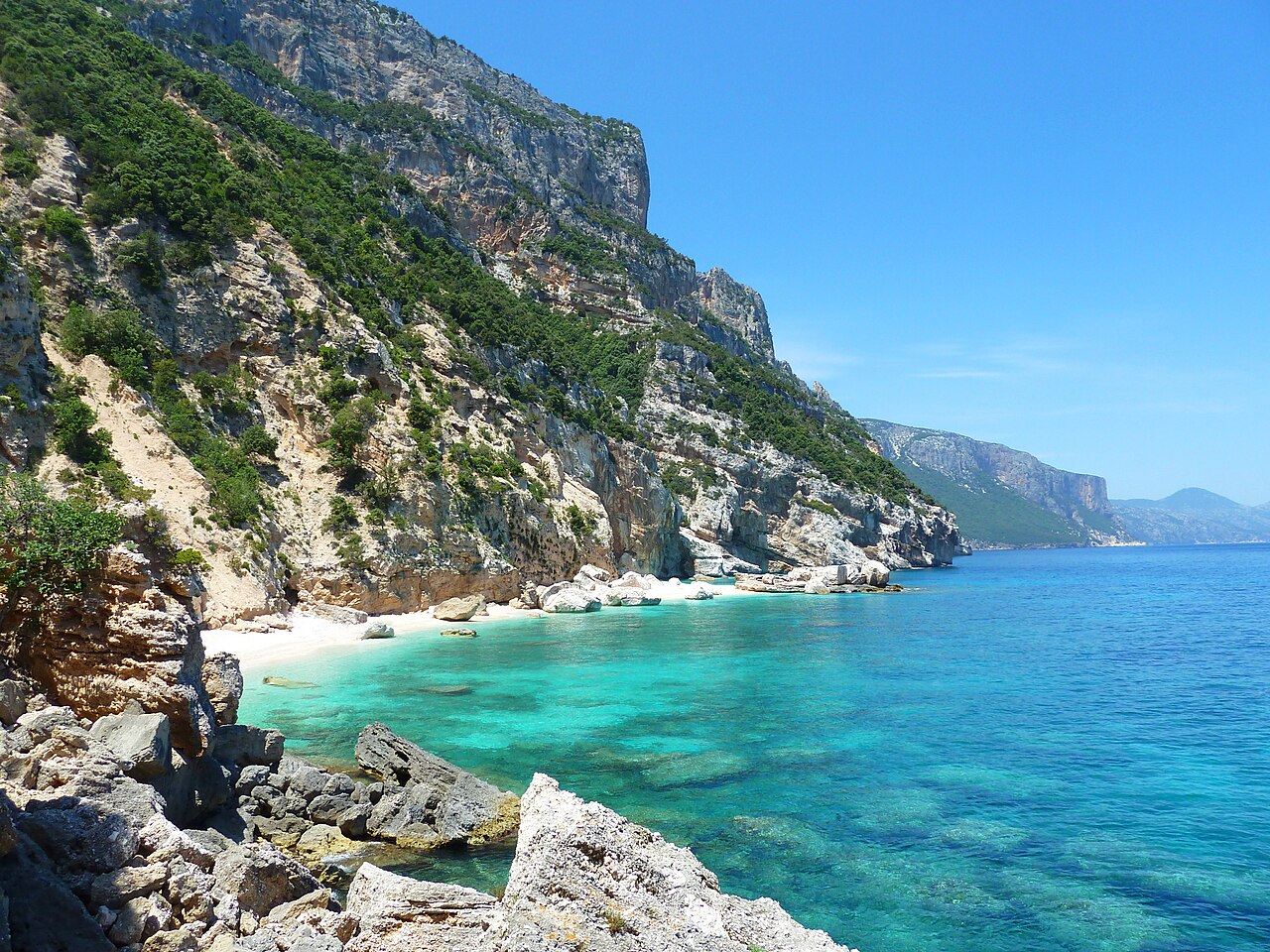
The Gulf of Orosei (Golfo di Orosei in Italian) works differently from most famous Mediterranean beaches. There is no pulling up in the car park and lying on your towel five minutes later. Between Orosei and Santa Maria Navarrese, the limestone cliffs of the Supramonte drop hundreds of metres straight into the sea, no road follows the coast, and the best-known coves on Sardinia’s east coast are cut off from the land behind them. You either arrive by boat, or you walk down a rocky path and then climb all the way back up. There is nothing in between, and that is exactly why the beaches are emptier and the scenery is wilder than almost anywhere else on the island.
We have picked the fourteen places that make the trip worthwhile and added the practical part to each one: how to get there, what it costs and what you need to book in advance. The most beautiful spots now come with visitor caps, QR codes and fees, and anyone who does not know about them can end up turning round at a car park at eight in the morning.
Gulf of Orosei, Sardinia: the short version
- Where it is: on the east coast of Sardinia, roughly 40 km of coastline between Capo Comino in the north and Capo Monte Santu in the south.
- Most of the famous coves can only be reached by boat or on foot. You can drive to Cala Fuili, Oasi di Bidderosa, Pedra Longa and the Golgo plateau, where the footpaths down to the sea begin.
- Cala Goloritzé: on foot only, from the Golgo plateau. The ticket costs €7 (about £6) and bookings open 72 hours ahead on Heart of Sardinia.
- Landing on the Baunei beaches (Cala Mariolu, Biriola, Gabbiani, Sisine) comes with an environmental fee in the 2026 season, and Cala Mariolu is capped at 700 people a day. On boat trips the operator usually sorts this out for you.
- Boats leave mainly from Cala Gonone, and also from Santa Maria Navarrese, Arbatax, La Caletta and Orosei. A trip to a single cove starts at €35, a full-day tour costs €55–80 (about £47–68).
- A self-drive boat without a licence can be hired in Cala Gonone from the age of 18, from €100 (about £85) a day plus fuel, and around €250 in high season.
- Grotta del Bue Marino: by boat from Cala Gonone only, €12 entry from June to September, plus the boat.
How the Gulf of Orosei works
The gulf has two halves that could hardly be more different. The northern part, around the small town of Orosei, is low-lying: pine woods, dunes, lagoons and long sandy beaches you can drive to, although you pay for parking and in places for the access road too. The southern part, from Cala Gonone to Santa Maria Navarrese, is where the Supramonte limestone plateau ends at the sea. The stretch from Cala Luna down to Santa Maria Navarrese belongs to the municipality of Baunei, which is why you will also see it called the Costa di Baunei.
Almost the whole coast lies inside the Golfo di Orosei e del Gennargentu National Park. From the water you will not spot any signs telling you so, but you will notice that there is not a single hotel. Baunei controls access to its beaches through bookings and QR codes, so “go whenever you like” has turned into “go when you have a ticket”.
14 best places in the Gulf of Orosei
We have just come back from Sardinia and we are still buzzing about that sea and the beaches that look straight out of a holiday brochure, so we are writing it all down while it is fresh. We list the beaches and coves of the Gulf of Orosei roughly from north to south, in the order you will see them from a boat. The first two places can be reached by car, and the list ends with a plateau and a viewpoint high above the coast.
1. Oasi di Bidderosa
A protected nature reserve about 13 km north of Orosei, where five small beaches of fine white sand hide among pines and junipers. It is one of the few places in the gulf where you can have an ordinary beach day without a boat and without a five-hour trek.
In season, access is limited to 100 cars, 30 motorbikes and 100 bicycles. The park is open from 8:00 to 17:00 and you have to be out by 19:30 at the latest. Buy your ticket online at oasibiderosa.it (date, type of vehicle, number of people and number plate). Inside you can hire a kayak and paddle to the Stagno di Cucurica lagoon. We like Bidderosa as a lazy day between two boat trips.
2. Grotta di Ispinigoli
A karst cave inland near Dorgali, about 9 km from Orosei. You go down roughly 280 steps into a chamber about 80 metres across. In the middle stands a stalagmite column joining the floor to the ceiling. It measures 38 metres and is described as the tallest in Europe. The temperature inside stays at around 15 °C and the visit takes about 45 minutes. Ispinigoli is a good plan B for a windy day when the boats are not going out, because underground the wind cannot touch you.
3. Grotta del Bue Marino
The largest and best-known sea cave in the gulf, about fifteen to twenty minutes by boat south of Cala Gonone. Its name, “sea ox”, is what fishermen used to call the Mediterranean monk seals, which until fairly recently came here to give birth.
The tour follows a walkway about 900 metres long (there and back) through several chambers with stalactites and pools, and takes about an hour. It is around 18 °C inside, so bring a long-sleeved top even in August. An hour in damp, cool air in your swimsuit stops being fun quite quickly.
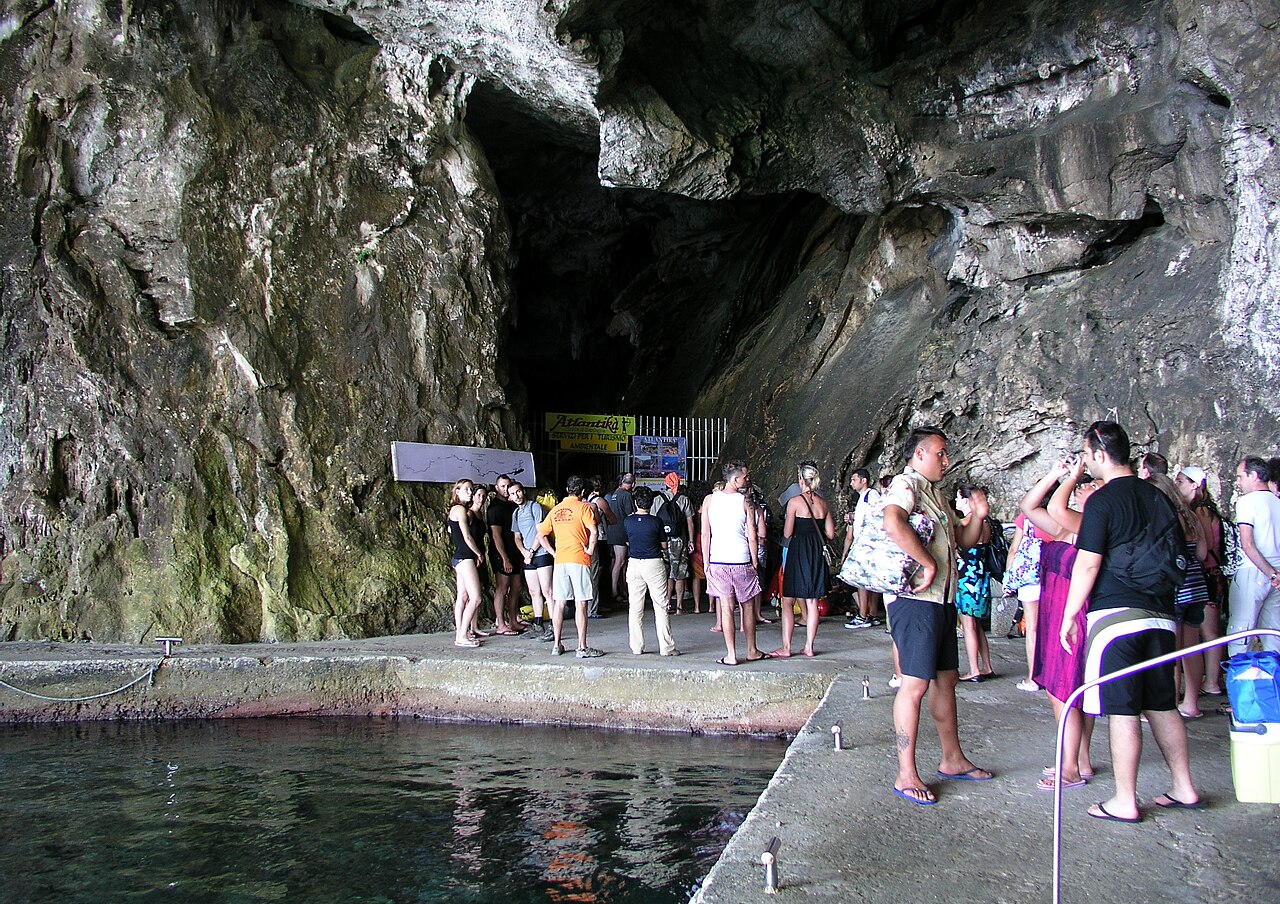
How to get there. According to the official website, the cave can only be reached from the sea. The footpath from Cala Fuili is closed. Boats run from the harbour in Cala Gonone, and private boats may come in after arranging it by phone.
Tickets and tour times in 2026:
| Period | Tours (departures) | Adults | Children 5–10 and over-70s |
|---|---|---|---|
| January, February, December | closed | – | – |
| 29 March to May | 11:00, 12:00, 15:00 | €10 (about £8.50) | €5 |
| June to September | 9:00, 10:00, 11:00, 12:00, 14:00, 15:00, 16:00 | €12 (about £10) | €6 |
| October and 1 November (then on request only in November) | 10:00, 11:00, 15:00 | €10 | €5 |
The boat ticket to the cave (€30 with the boat consortium in Cala Gonone) does not include entry, so in summer budget €42 (about £36) in total per adult. When the sea is rough, the boat to the cave does not run at all.

Guided tour of the Grotta del Bue Marino + stop at Cala Luna beach

Cala Gonone: boat trip to the Bue Marino cave and Cala Luna beach
4. Cala Luna
The most famous cove in the northern half of the gulf, right on the border between the municipalities of Dorgali and Baunei. The beach is about 800 metres long, sandy and curved like a crescent, which is where the name comes from. On its northern side five large caves open into the rock, and at midday they give you somewhere to hide in the shade, while behind the beach lies a freshwater pond ringed with oleanders. In 1974 Lina Wertmüller filmed “Travolti da un insolito destino nell’azzurro mare d’agosto” here (released in English as “Swept Away”), and in 2002 Madonna came for the remake of the same name. Behind the pond there is a kiosk and a bar with a restaurant, so this is one of the few coves where you do not have to carry everything in with you.
How to get there: by boat from Cala Gonone (five kilometres, several sailings a day, €35 return) or on foot from the Cala Fuili cove, roughly 1.5 to 2 hours each way, with a few technical sections. A popular combination is to walk there and take an afternoon boat back. We like Cala Luna best early in the morning or after five, once the big boats have gone and the beach is left with its best features: the quiet and the caves.
5. Cala Sisine
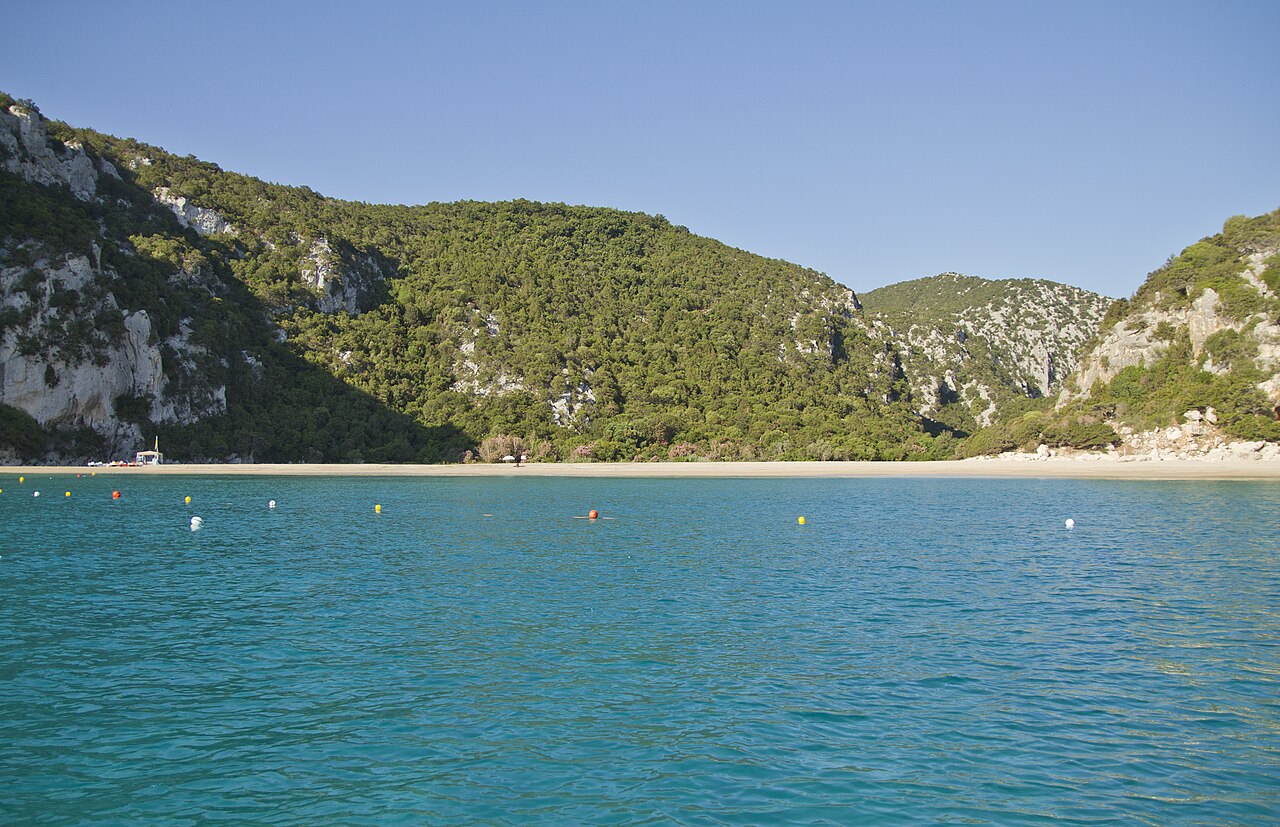
The widest beach in the gulf, at the mouth of a deep valley with cliffs over 400 metres high rising on both sides. The beach is made of small pale pebbles, and even in high season it tends to be less crowded than Mariolu. A few metres from the shore there is a restaurant, which on this part of the coast counts as luxury. This is also where the Selvaggio Blu trek ends.
Sisine is a stop on almost every full-day boat tour from Cala Gonone and from Santa Maria Navarrese. You can walk down from the Golgo plateau, and if you have a 4×4, you can drive along a gravel track to a small car park about 2 km from the beach and walk the rest.
6. Piscine di Venere
The Pools of Venus are not a beach but shallow rock pools between Cala Sisine and Cala Biriola, where underground freshwater springs flow into the sea. The bottom is pale and shallow, so the water turns a colour you would take for heavy editing if you saw it in a photo.
It is mostly the smaller rigid inflatables that stop here. The big hop-on hop-off boats usually do not. On foot you can only get here with a guide, as the path is not marked. The pools look their best in the morning, and there are so many boats around that you really do have to watch out when you swim.
7. Cala Biriola
A small cove of tiny white pebbles below a rock face covered in juniper and oak. There is no kiosk and no shade on the beach, only water so clear that you can see every stone on the bottom from the boat. It is one of the best snorkelling spots in the gulf. In Italian sources you will also find it spelt Cala Biriala.
Most people arrive by boat and spend about an hour here. The walk down from the Golgo plateau is one of the hardest on the island, over rock steps, through narrow gaps and down metal ladders with ropes. Do not attempt it without experience of exposed terrain.
8. Cala Mariolu
Together with Goloritzé the most famous beach in the gulf, and in our view the most colourful. It is made of tiny white and pink pebbles that look like snow, which is why locals call it “is puligi de nie”, the snowflakes. The seabed drops off quickly and is full of fish, so you will want your snorkel within the first few metres.
In 2026, landings from the sea are capped at 700 people a day, with entry by QR code. According to the Heart of Sardinia portal, bookings run from 1 May to 20 October 2026, usually for the same day from 7:00, and the fee is €2 for one cove or €3 for several coves on the same day. On a boat trip or a skippered inflatable the operator handles it, but with a hired boat without crew you sort out the QR code yourself. On foot it is a long and demanding trek from the Golgo plateau.
In August Mariolu is full by nine in the morning and the anchorage in front of it looks like a shopping centre car park. Your best bet is a boat that leaves early and makes Mariolu its first stop.
9. Cala dei Gabbiani
Seagull Cove takes its name from the colony of gulls that flock here every evening as soon as the last boat has left. The sea has a particularly deep blue shade here, and there are fewer people than at its more famous neighbours, although you should not expect it to be empty in summer.
You can only get here by boat. Some boats from Cala Gonone drop you here for lunch and pick you up again on the way back. If you want peace and quiet and do not insist on a photo from the most famous beach, Gabbiani is in our view a better choice than Mariolu.
10. Cala Goloritzé
The most photographed beach in Sardinia and, since 2025, officially the best beach in the world: it came first in the World’s 50 Best Beaches ranking, the first Italian beach ever to do so. Above a small strip of white pebbles rises the Aguglia, a pyramid-shaped rock spire 143 metres above the sea and one of the most famous climbing routes in the Mediterranean. At the southern end a rock arch curves out over the water. The beach itself is young: it was formed by a rockslide in 1962.
The rules for 2026, according to the Baunei council’s official booking portal:
- On foot only. Boats must stay 300 metres from the shore and you cannot land on the beach. Boats can moor at the buoys and you can swim in from there.
- Tickets cost €7 (about £6). Children up to and including 5 years old and Baunei residents go free. Tickets are non-refundable.
- Booking opens 72 hours in advance at the earliest, through the Heart of Sardinia app (iOS and Android) or the heartofsardinia.com website. In high season the slots go within minutes, so it pays to be online the moment your date opens.
- Capacity is 250 people at any one time.
- The path is open 7:30–17:00, and arriving by 10:00 is recommended. If the afternoon slot is active, it runs 12:00–17:00 with entry between 12:00 and 13:30.
- Dogs are allowed on the path but not on the beach. Sturdy closed-toe shoes are compulsory, and you must carry at least 2 litres of water per person. Jumping off the arch is forbidden.
The path. It starts at the Su Porteddu car park on the Golgo plateau and follows the Bacu Goloritzé gorge. It is about 3.6 km long with around 500 metres of descent. Going down takes an hour to an hour and a half, and the last stretch is steep and stony. Allow two hours for the climb back up. That return climb in the afternoon heat is the real price of the ticket, and the seven euros are small change by comparison.
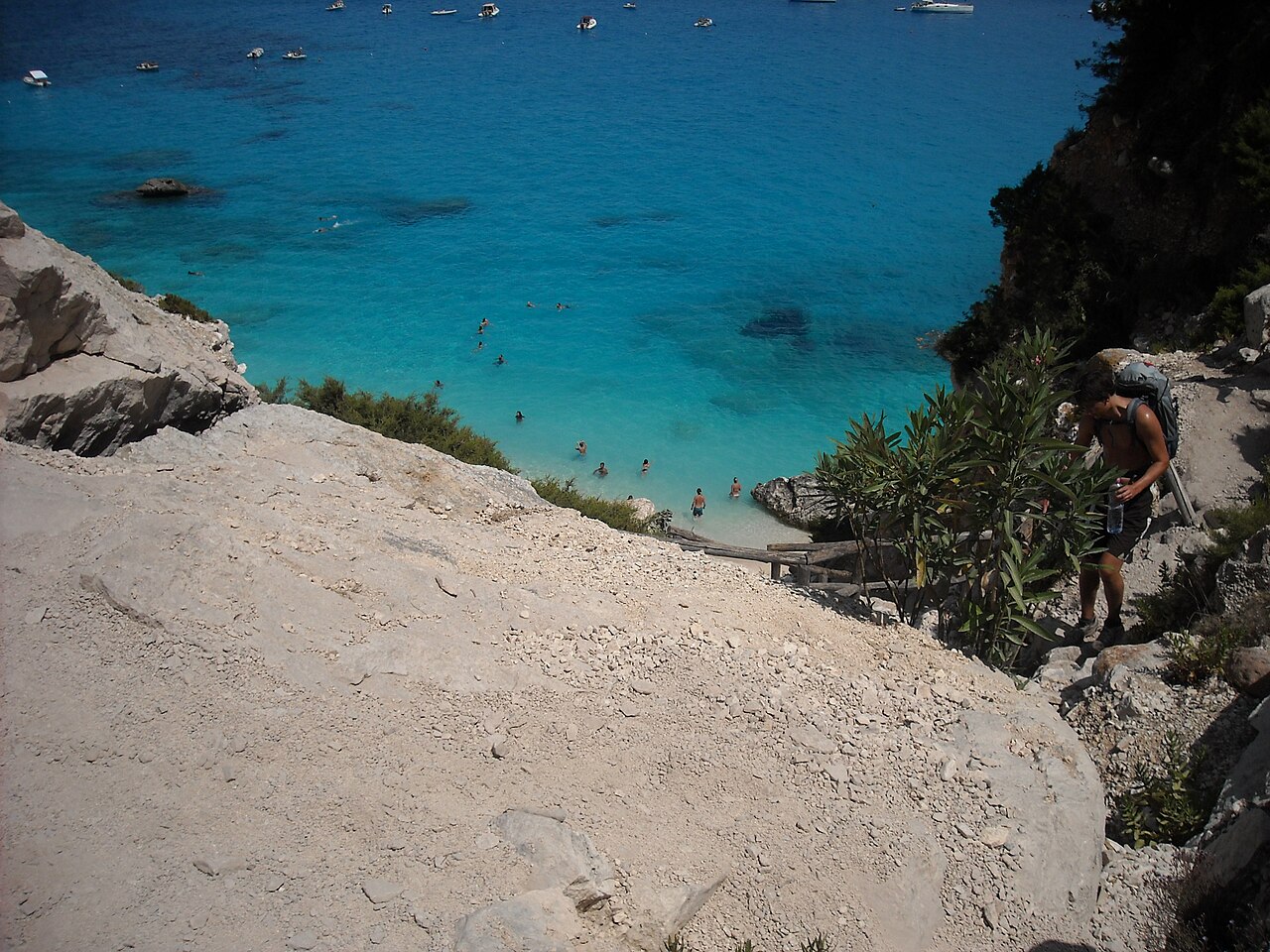
💡 Do not try to fit Goloritzé and Mariolu into one trip. Goloritzé has to be done on foot and Mariolu by boat, so you need two days. We would walk to Goloritzé first thing in the morning on the day you arrive in the south of the gulf, and the next day take a boat from Santa Maria Navarrese that stops off Goloritzé for a swim from the moorings and then carries on to Mariolu, Biriola and Sisine.

Guided cruise to Cala Goloritzè, Cala Mariolu, Gabbiani or Biriala and Sisine

From Arbatax: inflatable boat trip to Cala Mariolu and Cala Goloritzè

Arbatax: Gulf of Orosei cruise with optional visit to the Grotta del Fico
11. Grotta del Fico
The lesser-known neighbour of Bue Marino on the rocky Baunei coast, and also reachable only by boat. Trips from Cala Gonone, Arbatax and Orosei often stop here, but entry is not included in the price. You buy your ticket on the spot and only in cash, because there is no internet in the cave. In 2026 it costs €12 for adults and €6 for children aged 6 to 12. The tour is led by a local guide and it is noticeably colder inside than out.
12. Pedra Longa
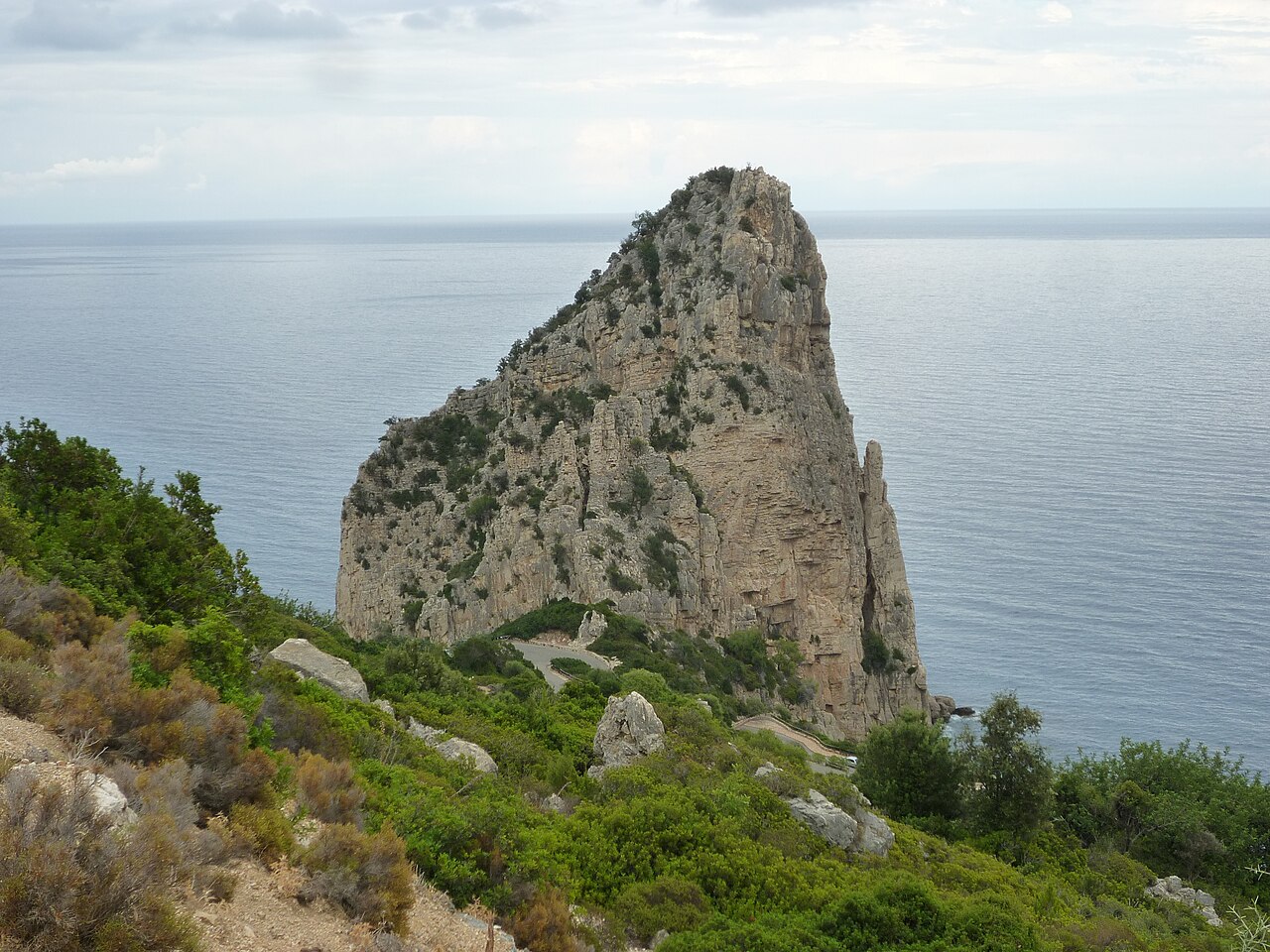
A rock spire about 128 metres high at the southern end of the gulf, just north of Santa Maria Navarrese, and the symbol of the Baunei coast. Its traditional name, Agugliastra, gave its name to the whole Ogliastra region.
It is one of the few places in the gulf you can drive to, and there is a restaurant by the road. There is no beach here, only rocks to jump into the water from and a stony seabed full of fish, great for snorkelling. The Selvaggio Blu trek starts here. The best view of the spire is from the road that winds down to it from Baunei.
13. Golgo plateau and the Su Sterru sinkhole
The Golgo plateau lies about 8 km above Baunei and is the starting point for almost every footpath down to the sea: to Goloritzé, Mariolu, Biriola and Sisine. It is worth a stop in its own right, even without a trek. The best-known sight is the Su Sterru sinkhole, a hole in the ground 270 metres deep. Legend has it that Saint Peter opened it when he hurled to the ground a basilisk that turned people to stone, and if you listen carefully, they say you can still hear it grumbling. A little further on stands the small church of San Pietro, and prehistoric remains are scattered across the plateau: domus de janas rock-cut tombs, nuraghi and the Piscinas, natural basins that collect rainwater.
14. Nuraghe Mannu above Cala Gonone
A Nuragic tower built of large basalt blocks on a headland about 200 metres above the sea, on the edge of the cliff above the Codula di Fuili gorge. Around it are the remains of a Nuragic and Roman village. For us, though, it is above all the best viewpoint over the whole gulf that you can drive to: on one side the houses of Cala Gonone and the curve of the bay to the north, on the other the rocky coast all the way to the coves below Baunei.
The turn-off is at about the fourth kilometre of the road from Dorgali to Cala Gonone. From there it is two kilometres to the nuraghe, and the last 800 metres or so are on foot. It is at its best in the evening, when the sun lights up the cliffs to the south.
Cala Gonone and the beaches by the village
Cala Gonone is the seaside part of the Dorgali municipality and the only proper harbour in the gulf. A single road leads into it, through a tunnel from Dorgali. In August, finding a parking space by the harbour is a lottery, but in summer a €1 shuttle bus runs from the village entrance down to the port. We cover the beaches near the village (Palmasera, Cala Fuili, Cala Cartoe, Osalla), where to stay and where to eat in our guide to Cala Gonone.
Gulf of Orosei boat tours: where from, where to and how much
In the Gulf of Orosei a boat is the basic way of getting around, not an attraction. You choose between three types:
- Scheduled boats (motonave). Large boats with shade and a toilet. You get off at a cove, swim, and get on the next boat or the return one. The cheapest and most comfortable option for families with children, but they cannot get into the Piscine di Venere or the narrow caves.
- Rigid inflatables with a skipper (gommone). Groups of around 12 people, faster, more stops, swimming from the moorings off Goloritzé and in the Piscine di Venere. No toilet and only limited shade.
- A boat without crew that you drive yourself, wherever you like.
The key is choosing the right harbour. From Cala Gonone you are closest to Bue Marino and Cala Luna. The southern coves are within reach too, but some of the shorter trips do not go as far as Goloritzé. From Santa Maria Navarrese and Arbatax you are closest to Goloritzé, Mariolu and Biriola, while most trips from the south do not get as far as Bue Marino and Cala Luna.
Boat prices in the 2026 season (per adult, from the operators’ price lists):
| From | Trip | Price | Note |
|---|---|---|---|
| Cala Gonone | Bue Marino (boat only) / Cala Luna / Cala Sisine | €30 / €35 / €40 (about £26–34) | children €15 (3–8 years) / €20 / €25 |
| Cala Gonone | Bue Marino + Cala Luna, with Cala Sisine | €40 (about £34), €55 (about £47) | cave entry extra |
| Cala Gonone | Minicrociera around the gulf | €80 (about £68), with the cave €90 | exclusive version 15 June to 30 September for €110 |
| La Caletta, Orosei | Minicrociera on the Imperatrice | €68 (about £58), in August €73 | children €39, in August €42 |
| Arbatax, Santa Maria Navarrese | MareOgliastra, full-day red line | €65 (about £55), 10–23 August €70 | as far as Bue Marino and Cala Luna, Baunei and Dorgali fees included |
| Arbatax, Santa Maria Navarrese | MareOgliastra, green, yellow and blue lines | €55, €45 and €37 (about £31–47) | shorter routes, summer only, Baunei fee included |
| Santa Maria Navarrese, Arbatax | Tortuga: boat to Mariolu, Biriola and Sisine / inflatable as far as Cala Luna | from €50 (about £43) / from €60 (about £51) | boat about 9 hours, €3 fee paid at the kiosk; inflatable max. 12 people, from Santa Maria Navarrese only |
According to the boat consortium’s price list, prices in Cala Gonone stay the same from the end of March to the end of October and cover the boat only. MareOgliastra prices include the Baunei environmental fee (€3), and the red line also includes the Dorgali fee (€2.50). Tortuga collects the Baunei fee separately, €1 for each beach you visit. Lunch is usually not included.
For July and August, buy tickets at least three days ahead. Outside the peak season a day or two is enough. Be at the boat twenty minutes before departure and keep your ticket on you until the last boarding, because the crew check it when you switch boats between coves.

Cala Gonone: boat excursion to Cala Mariolu and Cala Goloritzè

Cala Gonone: Gulf of Orosei boat cruise with swimming stops
Gulf of Orosei boat hire without a licence
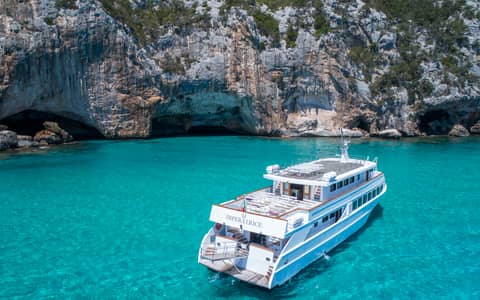
In our view this is the best way to experience the Gulf of Orosei, as long as you are comfortable on the water and the sea is calm. In both Cala Gonone and Santa Maria Navarrese several companies hire out 5 to 6-metre rigid inflatables with 40 hp engines, which under Italian rules do not require a boating licence. You have to be 18 or over, and before you set off the rental company explains how to handle the boat, the route and the places you are not allowed to go.
- Capacity: a five-metre boat takes 4 adults and 2 children under 5. Six-metre boats are usually for 6 people, some for up to 10.
- Times: departures from 8:30, back by 17:30 at the latest, or earlier depending on the weather.
- Price: from €100 (about £85) a day, around €250 (about £215) in high season, always plus fuel, which you pay for according to how much you use. For two couples, a boat works out cheaper than four tickets for a minicrociera. A sunshade and sunbed cushions are usually included, sometimes a cool box too, and some rental companies want the deposit in cash.
Things to bear in mind: with your own boat, you get the QR code for the Baunei beaches yourself, and you may not go closer than 300 metres to Goloritzé. Above all, watch the wind: once it picks up, the rental companies will not let boats out, even in August. Book two days ahead and keep a spare day in your itinerary.
💡 Set off first and do the coves in reverse. The big boats from Cala Gonone usually head for Cala Luna first and then go south. With your own boat you can leave at half past eight, go straight to the furthest coves, Mariolu and Gabbiani, and come back to Cala Luna in the afternoon when the big boats are already leaving. You avoid the queues at the moorings and have more room on the pebbles.
Kayak. If you want to see the coast in complete silence, you can hire a sea kayak on Palmasera beach in Cala Gonone or in the Oasi di Bidderosa. By kayak you can even get into caves the motorboats cannot enter, but strong currents can build up along the cliffs.

Cala Gonone: 6-metre boat hire without a licence (groups of up to 10)


Hiking down to the sea
The southern paths start on the Golgo plateau above Baunei, the northern ones at Cala Fuili above Cala Gonone.
| Trek | Starting point | Distance and time | Difficulty |
|---|---|---|---|
| Cala Goloritzé | Su Porteddu, Golgo plateau | 3.6 km, down 1–1.5 h, up about 2 h | moderate, booking and ticket required |
| Cala Luna | Cala Fuili near Cala Gonone | 1.5–2 h each way | moderate, a few technical sections |
| Cala Mariolu | Golgo plateau | 13 km return, down about 3 h, up 3–4 h | hard |
| Cala Biriola | Golgo plateau | down about 2.5 h, up about 2 h | very hard, ladders and ropes |
| Selvaggio Blu | Pedra Longa, finishing at Cala Luna (some versions end at Cala Sisine) | over 40 km, 5–6 days | expert, abseiling and climbing |
Selvaggio Blu has a reputation as the toughest trek in Italy. It follows old shepherds’ paths along the cliffs, the trail often disappears into the scrub, there are no huts and no water on the route, and several sections involve abseiling. In practice almost everyone does it with local guides, who also arrange water supplies along the way. You will find organised trips on the official Baunei tourism website.
And a warning every local repeats: do not walk from Cala Gonone to Cala Goloritzé without a guide. There is no water and no phone signal on the way, and the paths peter out. In summer, set off on every trek early in the morning and in sturdy boots. Sandals will not do here.
Further inland there are more famous hikes, above all into the Gorropu gorge, with walls up to 500 metres high (routes and tickets in our guide to Gola su Gorropu), and to the Nuragic village of Tiscali, hidden inside a collapsed cave at the top of Monte Tiscali.
When to go and how many days you need
The main boat season runs from June to September. MareOgliastra boats operate from 1 May to mid-October, and the scheduled boats in Cala Gonone from the end of March to the end of October. In our view June and September are the best months: the sea is warm, the boats run a full timetable and there are noticeably fewer people than in August around the Ferragosto holiday. May and October are excellent for hiking, but the water is still or already cold. Air and sea temperatures month by month are in our guide to the weather in Sardinia.
The east coast is better sheltered from the mistral than the west, but not completely, and when the waves are up the captains cancel sailings. So do not plan a boat trip for your last day before your flight home.
How many days: three days is the minimum to fit in one boat trip, one hike and one cave. A week is comfortable and allows for one day when nothing sails because of the wind.
How to get to the Gulf of Orosei
Without a car it is hard work. Cala Gonone, Orosei, Baunei, Santa Maria Navarrese and Arbatax all lie on the SS125 Orientale Sarda, the road that runs the length of the east coast. From Olbia airport it is about an hour and a half by car to Cala Gonone, and from Cagliari roughly two and a half hours on a road with plenty of bends. By bus from Olbia it takes over four hours with changes. Orosei is 83 km from Olbia. Flights from the UK, ferries and car hire are covered in our Sardinia holiday planner. Summer routes to Olbia change from year to year, so check what flies from your airport before you book.
A little history of the gulf
For centuries, people only came down to the coast between Cala Gonone and Santa Maria Navarrese to work. Shepherds from Baunei and Dorgali grazed goats on the limestone plateaus and built stone pens and huts, and where the rock was too steep to climb, they wedged juniper trunks against it as ladders. Locals call them scalones, and several are still in use. The same slopes carried the mule tracks of the charcoal burners, who made charcoal in the woods above the sea and hauled it down to the boats. In 1987 and 1988 the climbers Mario Verin and Peppino Cicalò walked the coast, linked the old shepherds’ and charcoal burners’ paths into a single route and named it Selvaggio Blu. In 1989 they published the booklet “Baunei Sentieri”, the first walking guide to the local paths.
The Golgo plateau has been inhabited for much longer. Its meadows are scattered with domus de janas rock-cut tombs, the remains of Bronze Age Nuragic buildings and the basalt basins of As Piscinas, which hold rainwater all year round. The little church of San Pietro, with its white facade and shelters for pilgrims, dates from the 16th or 17th century; sources disagree on the date. The Su Sterru sinkhole has its own legend, “San Pietro e sa serpente”, about Saint Peter and a serpent that other versions call a basilisk. Until the 1950s, military maps marked it as an “old crater” of a volcano. It was only on 25 July 1957 that the speleologist Umberto Pintori lowered himself all the way to the bottom, and it turned out to be a karst shaft 270 to 295 metres deep (figures vary by source). It has been a protected natural monument since 1993.
The Bue Marino cave, the “sea ox”, carries the old fishermen’s name for the Mediterranean monk seal. The seals used to give birth here, and the last reliably recorded sightings in the gulf date from the early 1980s. The Golfo di Orosei e del Gennargentu National Park was established in 1998 and covers some 74,000 hectares across 27 municipalities. Because of disputes between the state, the region and the municipalities, however, it has never fully got off the ground, so the councils largely look after their own stretch of coast. That is why the Baunei beaches today have bookings and fees collected by the municipality.
Where to stay in the Gulf of Orosei
The most important decision is whether to base yourself in the north or the south of the gulf. The drive between Cala Gonone and Santa Maria Navarrese goes over the mountains and takes more than an hour.
- Cala Gonone is the best base for most people: the most boats, rental companies and restaurants, and close to Bue Marino, Cala Luna and the inland sights. Browse places to stay in Cala Gonone.
- Santa Maria Navarrese is smaller and quieter, and closest to Goloritzé, Pedra Longa and the boats to the southern coves, with its own beach backed by pine woods. Here you can find places to stay in Santa Maria Navarrese.
- Baunei is a mountain village above the coast, cheaper and more authentic, with the shortest drive to the Golgo plateau and the trailheads. Have a look at places to stay in Baunei.
- Arbatax and Tortolì are bigger and open all year. Both MareOgliastra and Tortuga boats leave from Arbatax. See what is available under places to stay in Arbatax.
- Orosei and Cala Liberotto in the north suit families best: long sandy beaches and no need to get on a boat every day. The Marina di Orosei and Su Barone beaches together make up more than 6 km of sand below the pines. Take a look at places to stay in Orosei.
- Dorgali is a small inland town above Cala Gonone with agriturismi (farm stays). It works well if you want to combine the sea with Gorropu and Tiscali. Here are places to stay in Dorgali.
Hotels we recommend, base by base
We checked all the places below on Booking.com, and the review scores are from Booking.com as of September 2026.
Cala Gonone
- Hotel Caramare (Cala Gonone): a three-star hotel on the Lungomare dell’Acqua Dolce seafront, 200 metres from the main beach. Every room has a balcony, and the terraces look out to sea. It scores 9.1 on Booking.com from more than 800 reviews, so for summer it pays to book early.
- Hotel Resort Nuraghe Arvu (Cala Gonone): a resort on Viale Bue Marino below a rocky hill, about 500 metres from the beach. An outdoor pool in the garden, a children’s playground and free parking make it a good choice for families with a car. Score 8.4.
- Hotel Brancamaria (Cala Gonone): a hotel on the edge of the village with an outdoor pool, a restaurant serving Sardinian food and private parking. Reception can arrange boat trips. 8.5 on Booking.com.
Dorgali
- Hotel Il Querceto (Dorgali): a hotel set in an oak park in Dorgali, 8 km from Cala Gonone. It has an indoor pool, a restaurant with local cooking and free parking, and most rooms have a balcony with mountain views. Score 9.1, and well placed for both Gorropu and the boats.
- Agriturismo Canales (Dorgali): a farm stay in the Canales area off the SP38 road, in the countryside of the Dorgali municipality rather than in the town itself. The main reason to stay is its own restaurant, and it scores 9.3 from 400 reviews. You will not get anywhere from here without a car.
Orosei and Cala Liberotto
- Hotel Gli Ulivi (Orosei): a smaller hotel with a garden in Orosei, about 3 km from the beach. Every room has a balcony, guests praise the breakfast, and its score of 9.0 from more than 1,300 reviews is one of the best in the area.
- Hotel Maria Rosaria (Orosei): a hotel complex with two pools and a restaurant, about 100 metres from the old town. Handy if you want to walk into the centre in the evening and drive to the beaches during the day. Score 8.1.
- I Giardini di Cala Ginepro Hotel Resort (Cala Liberotto): a four-star resort with a pool, hot tub, entertainment team and a private beach, 600 metres from Sa Curcurica beach. The classic pick for families who want sand and do not need a boat every day. Score 8.1.
Santa Maria Navarrese
- Hotel Nicoletta (Santa Maria Navarrese): a small three-star hotel on the seafront promenade, 50 metres from the beach, with free garage parking and a roof terrace. The rooms are simple, but it scores 9.1 and the harbour where the boats to the southern coves leave is within walking distance.
- Hotel Santa Maria (Santa Maria Navarrese): a hotel with a restaurant and garden, 200 metres from its own private beach. Every room has a balcony and breakfast is served on a covered veranda. Score 8.9.
- Hotel Agugliastra (Santa Maria Navarrese): a three-star hotel on the main square, 100 metres from the beach, with breakfast and a sunny terrace. Practical if you want restaurants and the harbour right outside the door. Score 8.9.
Baunei and the Golgo plateau
- Hotel Bia Maore (Baunei): a small hotel close to the main square in Baunei, with Sardinian-style rooms, many of them looking out over the bay at Arbatax and the mountains. Free parking, score 9.1. From Baunei you are closest to the Golgo plateau.
- B&B I Cinque Mori (Baunei): a bed and breakfast in the village with a terrace and a breakfast guests rate as exceptional. An overall score of 9.6 from nearly 400 reviews, and a good choice if you are setting off early for a hike.
- Su Barraccu Del Golgo (Golgo plateau): accommodation right on the Golgo plateau, with a garden, terrace, Italian breakfast and free parking. You sleep where the paths to Goloritzé and Mariolu begin and skip the early-morning drive up the hairpins from Baunei. Score 8.7.
Arbatax and Tortolì
- Hotel La Bitta (Arbatax): a hotel right on the Porto Frailis cove, with a private beach, an outdoor pool, a spa and two restaurants. It scores 9.4 from more than a thousand reviews and in September 2026 cost from around €300 (about £260) a night for two. One for a special occasion.
- Hotel Il Vecchio Mulino (Arbatax): a quiet hotel with a garden, ten minutes’ walk from the Porto Frailis cove. The rooms have wooden beams, guests rate the breakfast of Sardinian produce and home-made pastries as exceptional, and parking is free. Score 9.4 overall.
- Campeggio Villaggio Sos Flores (Tortolì): a campsite opposite the beach in Tortolì, 4 km from Arbatax harbour, with simple units that have a kitchenette and terrace, plus a restaurant and barbecue. A cheaper option if you want to stay by the sea and cook for yourself. Score 8.0.
For July and August, the best addresses by the sea sell out months in advance, so book early and with free cancellation. A comparison of areas across the whole island and more hotel tips are in our guide to where to stay in Sardinia.
What to take for a full day in the coves
Most beaches in the gulf have no shade, no water and no toilets, and only Cala Luna and Cala Sisine have restaurants. Bring at least 2 litres of water per person (more on hikes), water shoes, a snorkel, something long-sleeved for the boat and the caves, a packed lunch and cash for cave tickets and the environmental fees. What to watch out for on the island, from fines for taking pebbles home to thefts from cars, is in our article Sardinia: what to watch out for.
Gulf of Orosei FAQ
Where is the Gulf of Orosei?
On the east coast of Sardinia, in the province of Nuoro, with the southern part belonging to the Ogliastra area. The gulf stretches for about 40 km from Orosei in the north via Cala Gonone to Santa Maria Navarrese and Arbatax in the south. The nearest airport is Olbia, about an hour and a half by car from Cala Gonone.
How do you get to Cala Goloritzé?
Only on foot, from the Su Porteddu car park on the Golgo plateau above Baunei. The path is about 3.6 km long and the climb back up takes around two hours. The ticket costs €7 and can be booked no earlier than 72 hours ahead through Heart of Sardinia. Boats must stay 300 metres from the shore.
Do I need a boat to see the Gulf of Orosei beaches?
For most of the famous coves, yes: Cala Mariolu, Biriola, Gabbiani, the Piscine di Venere and Bue Marino are in practice only reachable from the sea. Without a boat you can get to Cala Goloritzé and Cala Luna (on foot), Cala Sisine (by 4×4 and on foot), Pedra Longa, the Oasi di Bidderosa and the beaches around Cala Gonone and Orosei.
How much is a Gulf of Orosei boat tour?
In the 2026 season, from Cala Gonone it costs from €35 (Cala Luna) to €80 (full-day minicrociera), from Santa Maria Navarrese and Arbatax €37 to €70 depending on the route, and skippered inflatables start at €60. Cave entry is paid separately.
Can you hire a boat in Cala Gonone without a licence?
Yes. Rigid inflatables of 5 to 6 metres with 40 hp engines can be hired without a boating licence, as long as you are 18 or over. They cost from €100 a day, around €250 in high season, always plus fuel.
How much are Grotta del Bue Marino tickets?
In 2026 entry costs €12 from June to September and €10 in the other months, and children aged 5 to 10 and people over 70 pay half. On top of that comes the €30 boat ticket from Cala Gonone.
Do I need to book Cala Mariolu?
If you are landing from the sea, yes: from 1 May to 20 October 2026 there is a cap of 700 people a day and a QR code costing €2 to €3. On a boat trip the operator usually arranges it, but with a hired boat without crew you get the QR code yourself through Heart of Sardinia.
What is the best time to visit the Gulf of Orosei?
For swimming and boat trips, June and September. For hiking, April, May and October. From November to April most boats, hotels and restaurants are closed.
Where next
- Cala Gonone: the village where most of the boats leave from.
- Gola su Gorropu: the gorge inland above the gulf.
- Sardinia holiday planner: how to plan the whole trip.
- Things to do in Sardinia: the best places across the island.
- Sardinia: what to watch out for: fines, bookings and traps.
- Best beach campsites in Italy: if Sardinia is not your only option.
Potřebujete pomoct s cestováním?
-
Ubytování 🏨
Vyberte si to nejlepší ubytování, ať už jste kdekoliv, přes Booking.com. -
Půjčení auta 🚗
Auto si snadno najdete přes Booking.com, kde máte často slevu díky ubytování, nebo Rentalcars.com, kde porovnáte nabídky většiny půjčoven. -
Zážitky 🎟️
Přes GetYourGuide.com si vyberete z nejrůznějších výletů i zážitků po celém světě, navíc se zrušením zdarma do 24 h předem.