Last updated 7.10.2026
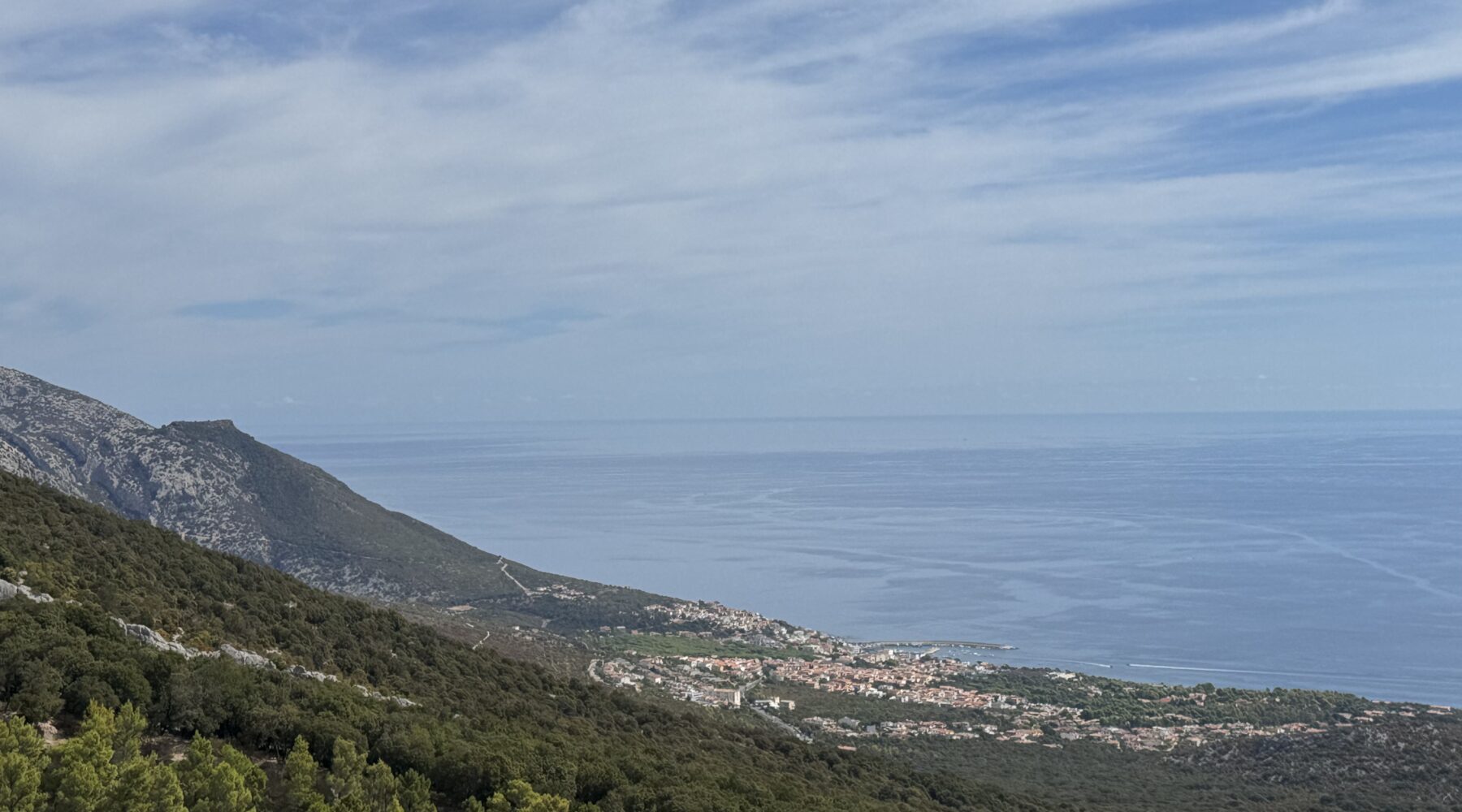
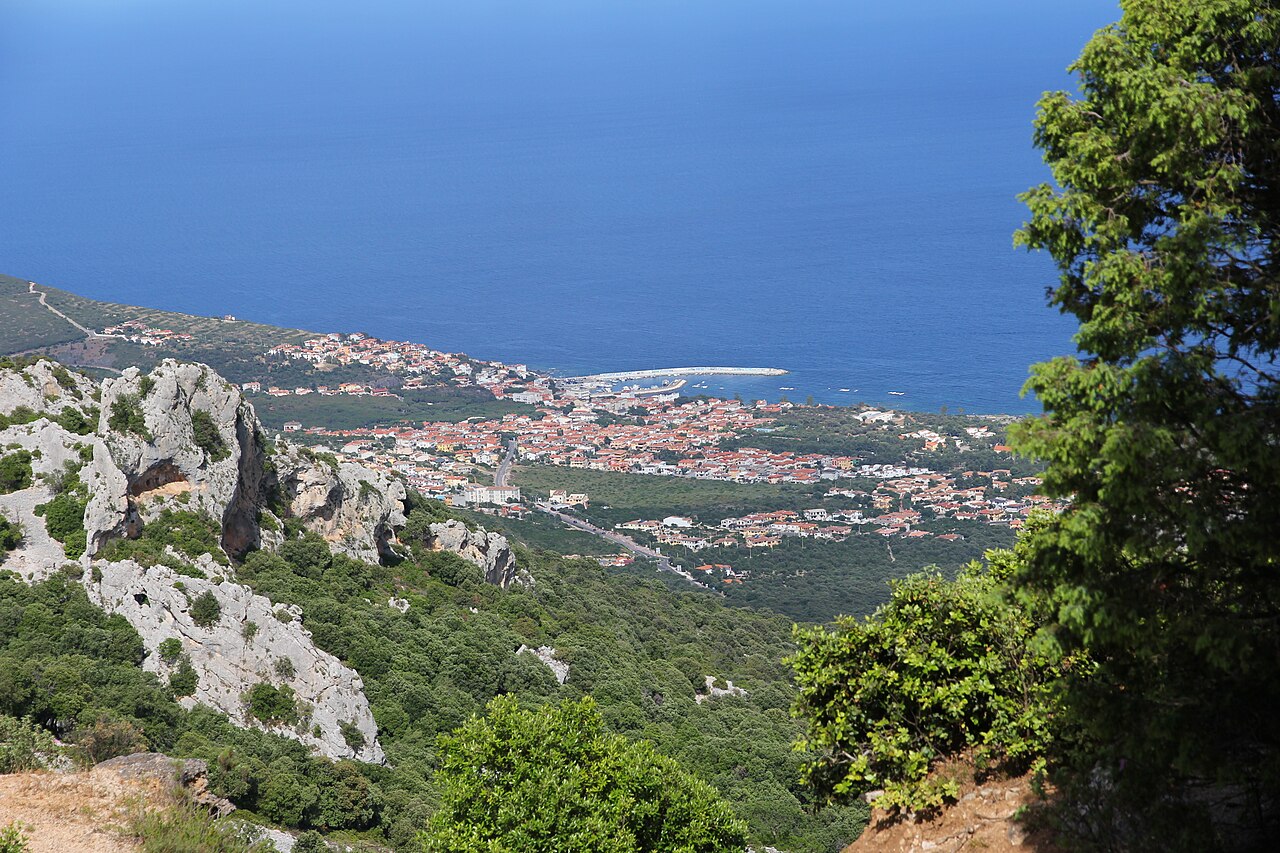
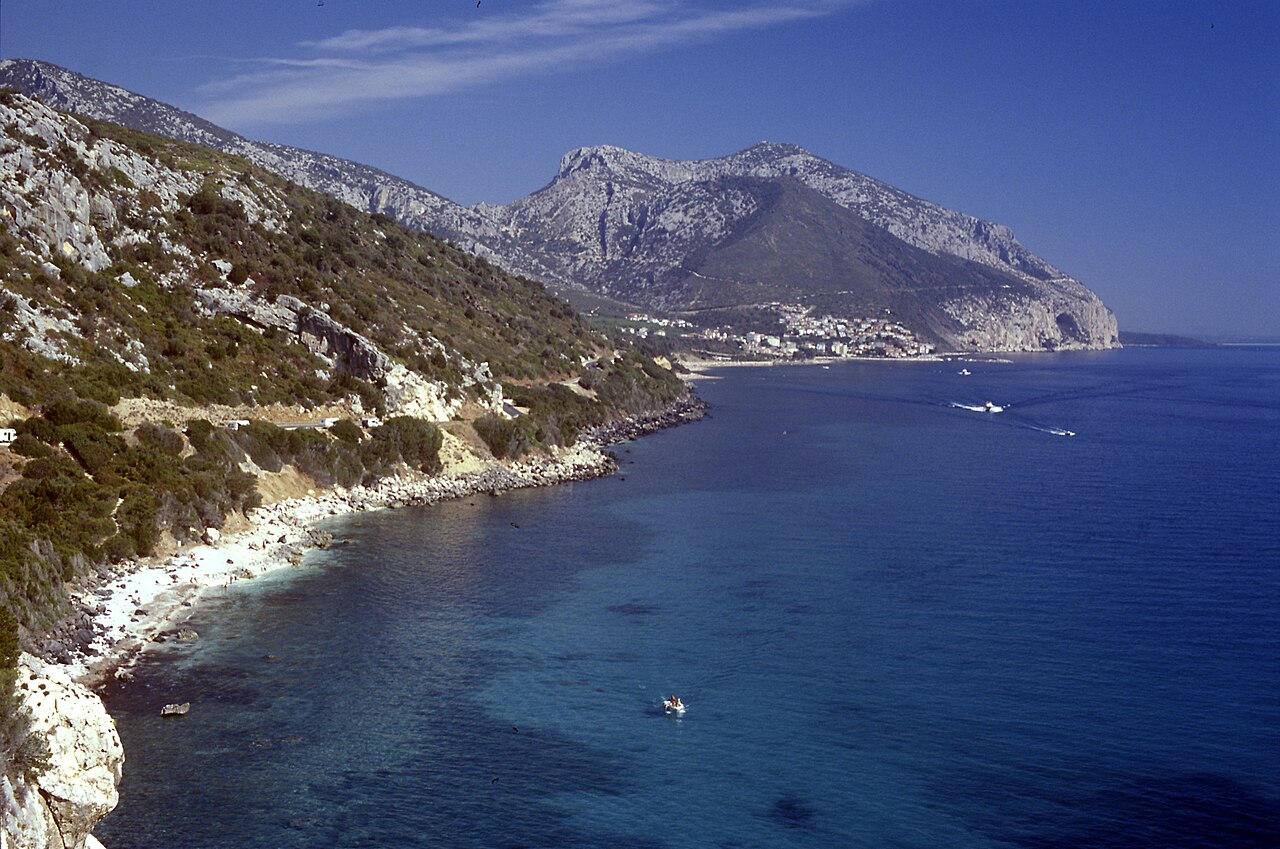
Look up where to stay on Sardinia’s east coast and one name keeps coming back: Cala Gonone. There are good reasons for that, and most of the things to do in Cala Gonone start right at its little harbour. This is where the boats leave for the coves that end up on every postcard of Sardinia, where the coastal path to Cala Luna begins, and where you are closest to the Gorropu gorge and the hidden Nuragic village of Tiscali. Base yourself here for a week and you get sea, mountains and archaeology within half an hour, with an ice cream on the seafront to finish the day. Nobody ends up in Cala Gonone by accident. From the inland town of Dorgali the road dives into a tunnel through the mountain, and when you come out the whole Golfo di Orosei is suddenly spread out in front of you. Then it zigzags down to the water, to a village with a harbour, a promenade and Monte Irveri rising behind it. It is only about ten minutes’ drive from the interior, yet it feels like a different world.
Cala Gonone, Sardinia: the essentials
- It is the seaside part of the Dorgali municipality, in the middle of the Golfo di Orosei on Sardinia’s east coast. Dorgali is about 9 km away, through a tunnel and down a string of hairpins.
- You can manage without a car, but it is hard work. ARST bus 520 runs here from Nuoro, and in summer there is also a connection from Olbia airport. By car, Olbia is roughly an hour and a half to two hours away.
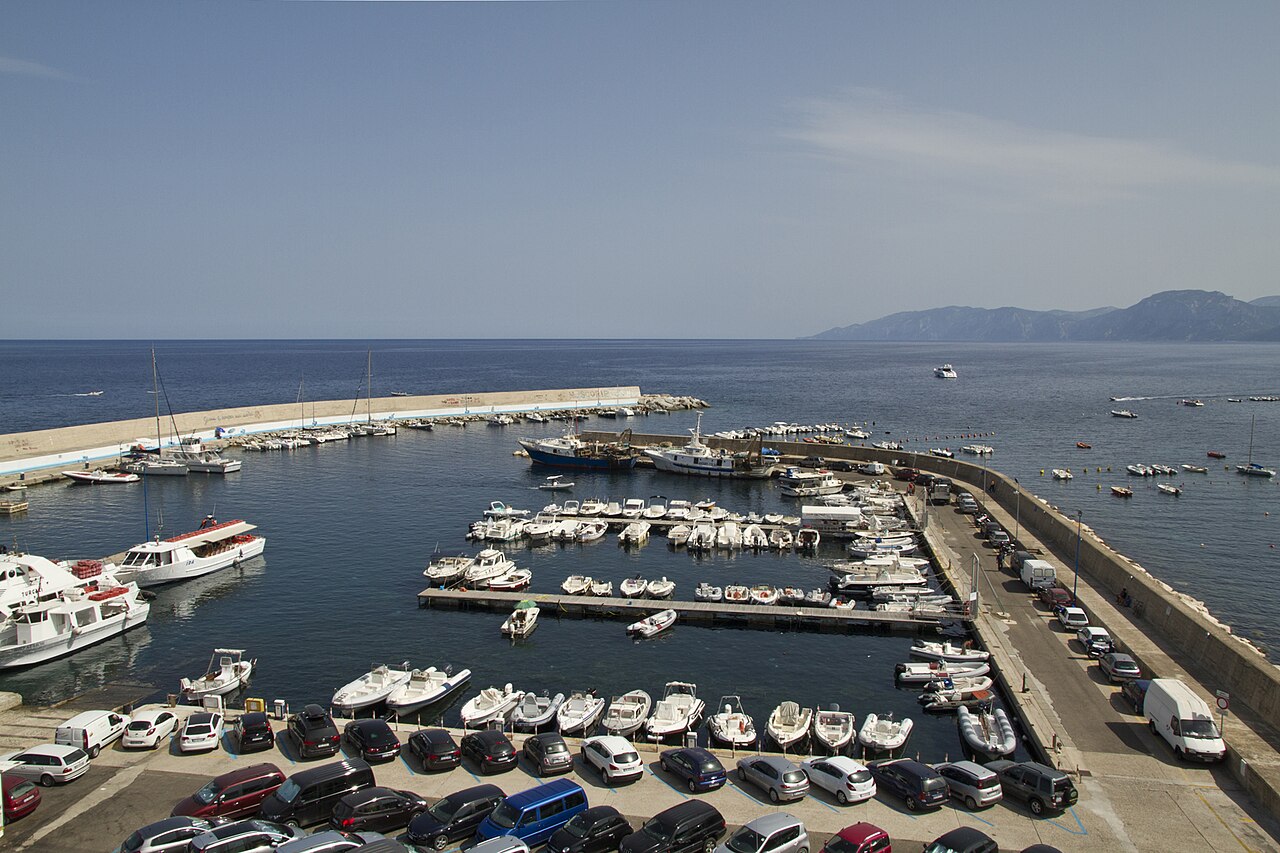
- Parking near the sea costs money (blue lines, pay at the machine or with the EasyPark app). From June to September a free shuttle runs from the Iskrittiorè car park to the harbour.
- Beaches in the village itself: Spiaggia Centrale, Palmasera, Sos Dorroles and S’Abba Meica. By car you can reach Cala Fuili to the south, and Cartoe and Osalla to the north.
- The famous coves can only be reached by boat or on foot. In the 2026 season a boat to Cala Luna costs from €35 (about £30) and a full-day cruise along the gulf €80 (about £68).
- The aquarium is a few minutes from the centre. Adults pay €14 (about £12), children aged 4 to 12 pay €10.
- Tourist tax is €1 to €2 per person per night depending on where you stay, paid directly to your host.
- Nearby: Grotta del Bue Marino, Nuraghe Mannu, the Ispinigoli cave, Tiscali and the Gorropu gorge.
Why Cala Gonone?
Officially Cala Gonone is a frazione, an outlying village of Dorgali in the province of Nuoro, with just under 1,300 permanent residents (a 2007 figure). It is young by Sardinian standards. Fishermen settled here at the end of the 19th century, the road tunnel from Dorgali was blasted through in the 1920s, and tourism on any real scale only arrived after the Second World War.
So do not expect an old town, a cathedral or lanes like those in Alghero. Cala Gonone is a resort: harbour, promenade, hotels and a handful of beaches. What makes it special is the setting. To the south lies the wildest stretch of coastline in Sardinia, with coves no road has ever reached. To the west rises the Supramonte, a limestone upland riddled with gorges and caves. All of it falls within the Golfo di Orosei e del Gennargentu National Park.
In our view, Cala Gonone is the best base on the east of the island if you want to mix the sea with hiking. If what you really want is long sandy beaches you can walk straight onto, you will be happier elsewhere, around Orosei, for example, or in the south of the island.
How to get to Cala Gonone
By car
From Olbia, take the SS131 towards Nuoro, then the SP38 and SS125 to Dorgali. The longer, twistier option, with the best views on the island, is the SS125, known as the Orientale Sarda, which follows the whole east coast. It is also the road you will use if you come off the ferry at Arbatax.
Only one road, the SP26, links Dorgali with Cala Gonone: the tunnel, a viewpoint and then the hairpins down to the sea. An ordinary hire car copes fine, just take it slowly. The odd bus comes the other way and passing places on the bends are tight. Our favourite moment is pulling over at the viewpoint just past the tunnel for the first look at the whole gulf.
| From | Distance | Driving time |
|---|---|---|
| Dorgali | about 9 km | 15 minutes |
| Orosei | about 30 km | 35 to 40 minutes |
| Nuoro | about 41 km | just under an hour |
| Olbia (airport) | 110 to 130 km | 1.5 to 2 hours |
| Alghero | about 190 km | 2 hours 45 minutes to 3 hours 15 minutes |
| Cagliari | 220 to 230 km | 2 hours 45 minutes to 3 hours |
By bus
It is possible, but without a car you will be quite limited for day trips. From the ports and airports you first need to get to Nuoro. From there ARST bus 520 runs via Oliena and Dorgali to Cala Gonone about five times a day, and the journey takes around an hour. Check the timetable for your exact date on the ARST website, as services differ on weekdays, public holidays and outside the school year.
In high season the private operator Deplano also runs a service from Olbia airport with a change in Siniscola. It takes more than three hours and a new timetable comes out every summer. The Pro Loco office in Dorgali can help with taxis and private drivers (NCC). Flights from the UK, ferries and car hire are covered in our Sardinia holiday guide.
Parking in Cala Gonone
In July and August parking is the biggest headache in the village. According to the municipality’s website, this is how it works:
- Blue lines mean paid parking, mainly on the stretch from the post office past the harbour to the end of the Palmasera promenade. Pay at the machine or with the EasyPark app: €0.50 for half an hour, €1 for an hour, and sources quote a daily rate of €6 to €8. White lines are free, but in summer they are long gone by the time you arrive.
- The Iskrittiorè car park on the edge of the village has reduced rates (from 1 July), and from 1 June to 30 September a free shuttle runs from there to the harbour. In July and August extra routes run from the harbour to Palmasera and up to Gustui.
- The road to Cala Fuili. Parking along the road is not allowed, and from the junction of Viale Bue Marino and Via Laconi down to the beach there is no parking in the evening. The council’s advice: drop off your things, turn round and find a legal space.
- Motorhomes have dedicated service areas and are banned from some streets in the centre of both Cala Gonone and Dorgali.
Your wheels must not cross the line marking the edge of the carriageway, or you risk a fine.
💡 Taking a morning boat? Leave the car at Iskrittiorè. The first boats leave between 7.30 and 9 am, which is exactly when finding a space by the harbour is hardest. The shuttle goes straight to the harbour and costs nothing, so there is no point circling the promenade and risking a ticket.
12 things to do in Cala Gonone and nearby
We have put them in order, starting with what is in the village and within flip-flop distance, and ending with trips inland that need a car, proper boots and a whole day.
1. The promenade, Spiaggia Centrale and the village beaches
The promenade (lungomare) runs about a kilometre south from the harbour to Palmasera park, lined with restaurants, cafés and gelaterias. It is at its best in the evening, when the whole village comes out for a stroll, and early in the morning, because here the sun rises straight out of the sea. For a longer walk, carry on along the long pier on the other side of the harbour.
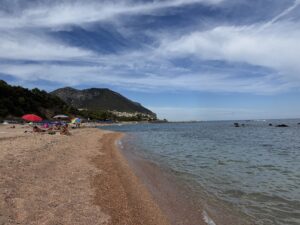
- Spiaggia Centrale, right by the harbour: coarse pale sand mixed with pebbles, a gentle slope into calm water, and wheelchair access.
- Palmasera, the longest beach in the village: sand mixed with red gravel and pebbles. The northern, artificially topped-up part shelves quickly, the southern end slopes gently. You can hire kayaks and sunloungers here, and the nicer sandy stretch is at the far end of the promenade.
- Sos Dorroles, a little beyond Palmasera beneath an orange rock face: sand and pebbles, a gradual slope, no facilities and noticeably fewer people.
- S’Abba Meica, just past it: pebbles, a steep drop-off and a sulphur spring. Dogs are allowed here all year round.
- S’Abba Durche, a short way north of the centre: dark volcanic pebbles and one of the richest seabeds in the area for snorkellers and divers.
For us, Sos Dorroles was the most pleasant beach in the village: you can walk there, yet it is free of the bustle around the harbour.
2. Cala Fuili and Ziu Martine
Cala Fuili is the last beach to the south that you can reach by car from Cala Gonone. Viale Bue Marino ends above the cove and stone steps lead down: about a hundred of them according to the council (some guides say as many as 250), and climbing back up at midday is harder work than you would expect. At the bottom is a small beach of pale shingle, sand and pebbles between two rocky headlands, with turquoise water and sea caves within swimming distance. There are no facilities at all. Behind the beach, the dry gorge of Codula di Fuili cuts inland and is popular with climbers. Come early in the morning, or walk along the coast. It is not ideal for small children: the water gets deep straight away and the bottom is rocky.
A little closer to the village is Ziu Martine, a quiet cove with sand, white pebbles and volcanic stones, where the seabed drops away quickly. You park by the road, there is a bar at the top of the path down, and the council recommends it as a launch spot for kayaks and paddleboards heading south.
3. Cala Cartoe and Osalla to the north
North of the village the coast changes completely: wide sandy beaches, shallow water and plenty of green. The council recommends both of these beaches for families with young children, and we think they are right.
Cala Cartoe is the first beach heading north, roughly 20 to 25 minutes by car over green hillsides. Fine white sand, a gently shelving, shallow seabed with no currents and good snorkelling. There is a large car park, a boardwalk for wheelchairs, a lifeguard in season, a bar and pedalo and kayak hire. You can also walk here on the waymarked B210 trail over the slopes of Monte Irveri (wear proper shoes).
Osalla is further north again, a long, wide beach of golden sand at the mouth of the Cedrino river, next to a lagoon full of birds. It has everything: parking, lifeguards, bars, sunloungers, pedalos and kayaks, and part of the beach is set aside for dogs. Both beaches are sheltered from the north wind, so when it blows, windsurfers and wing foilers head here.
Boats hardly ever come this way, and in our view this is the best choice for a day when you do not want to plan anything and just want to laze around in shallow water with the kids.
4. Hike from Cala Gonone to Cala Luna
The best-known walk from the village. The path starts by the steps down to Cala Fuili and follows the coast up and down through the macchia scrub, with very little shade. One way takes roughly an hour and a half to two hours, or a good three in summer heat with breaks. Cala Luna is a long, crescent-shaped sandy beach with huge caves at its northern end, a bar and, in season, sunshade hire. After about an hour’s walking there is a turn-off to Ziu Santoru, a small white-sand cove that motorboats are not allowed into.
Walk there in the morning while it is still cool and take the boat back in the afternoon. Slogging back over the hills in the midday sun is exactly the moment you start questioning your holiday choices. Just check when the last boat leaves. We describe this path and the other coastal treks in detail in our Golfo di Orosei guide.
5. Cala Gonone boat trips to the coves
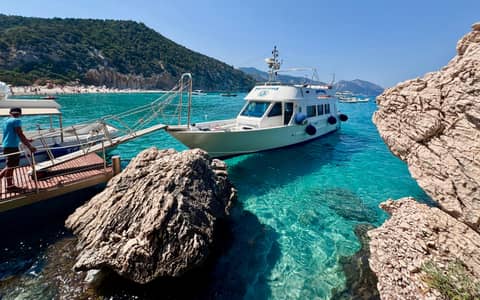
This is the main reason people come to Cala Gonone. The famous coves south of the village (Cala Luna, Cala Sisine, Cala Biriola, Cala Mariolu, Cala Goloritzé) have no road access. A whole row of companies have kiosks at the harbour. The big boats are the cheapest and most stable option (fine for small children too). Smaller RIBs with a skipper for around twelve people can nose into caves and reach the Piscine di Venere. And you can hire a boat that needs no licence (with a deposit, and booked in advance in high season).
Prices from the NCTM consortium (eight local companies running the big boats) for the 2026 season. Children aged 9 and over pay the adult fare, under-3s travel free:
| Route from Cala Gonone | Adults | Children 3–8 |
|---|---|---|
| Grotta del Bue Marino (boat only) | €30 (about £26) | €15 |
| Cala Luna | €35 (about £30) | €20 |
| Cala Luna and Cala Sisine | €45 (about £38) | €25 |
| Full-day cruise along the gulf (minicrociera) | €80 (about £68) | €40 |
| Full-day cruise plus Bue Marino cave | €90 (about £77) | €40 |
Source: NCTM consortium price list, season 27 March to 31 October 2026. The cave entry ticket is not included, and trips are cancelled when it is windy. The full price list, how to choose a trip and why boats are not allowed to land at Cala Goloritzé are all in our Golfo di Orosei guide.

Cala Gonone: RIB excursion to Cala Mariolu and Cala Goloritzè

Cala Gonone: Gulf of Orosei boat cruise with swimming stops

6. Grotta del Bue Marino
The cave is just south of the village, but the only way in is by boat (15 to 20 minutes). Its name, “cave of the sea ox”, refers to the Mediterranean monk seals that still raised their pups here in the mid-20th century. A guide leads you through the southern branch along a lit walkway. The tour takes about an hour and it is around 18 °C inside, so bring something with sleeves.
Tickets for 2026 cost €10 for adults, €12 from June to September (about £10), and half price for children aged 5 to 10 and over-70s. Buy them at the Dorgali council ticket office at the harbour or online at dorgaligonone.it. The boat is paid for separately. The cave is open from late March to October. More about it in our Golfo di Orosei guide.

Guided tour of the Grotta del Bue Marino + stop at Cala Luna beach

Cala Gonone: boat trip to the Bue Marino cave and Cala Luna beach
7. Kayaking, diving, climbing and mountain biking
Almost any outdoor sport you can think of is on offer around Cala Gonone, from paragliding to caving.
- Kayaking and paddleboarding. Heading north towards Cartoe and Osalla the sea is calmer and there are few boats. To the south you can paddle to Bue Marino or Ziu Santoru, but only when the sea is flat. Kayaks are for hire at Palmasera, Cartoe and Osalla.
- Diving. The dive centres at the harbour take both beginners and experienced divers, who can visit Second World War wrecks: the Italian ship Nasello and the German KT12.
- Climbing. The crags around Cala Fuili, in Codula di Fuili and by Cala Luna are among the most sought-after climbing areas in Sardinia.
- Mountain biking. One example is a tough loop of about 32 km over the Littu pass to Cala Cartoe and back via Dorgali.
- A treetop adventure park in the upper pine wood above Viale Bue Marino, for kids and adults, with all gear included.
8. Cala Gonone Aquarium
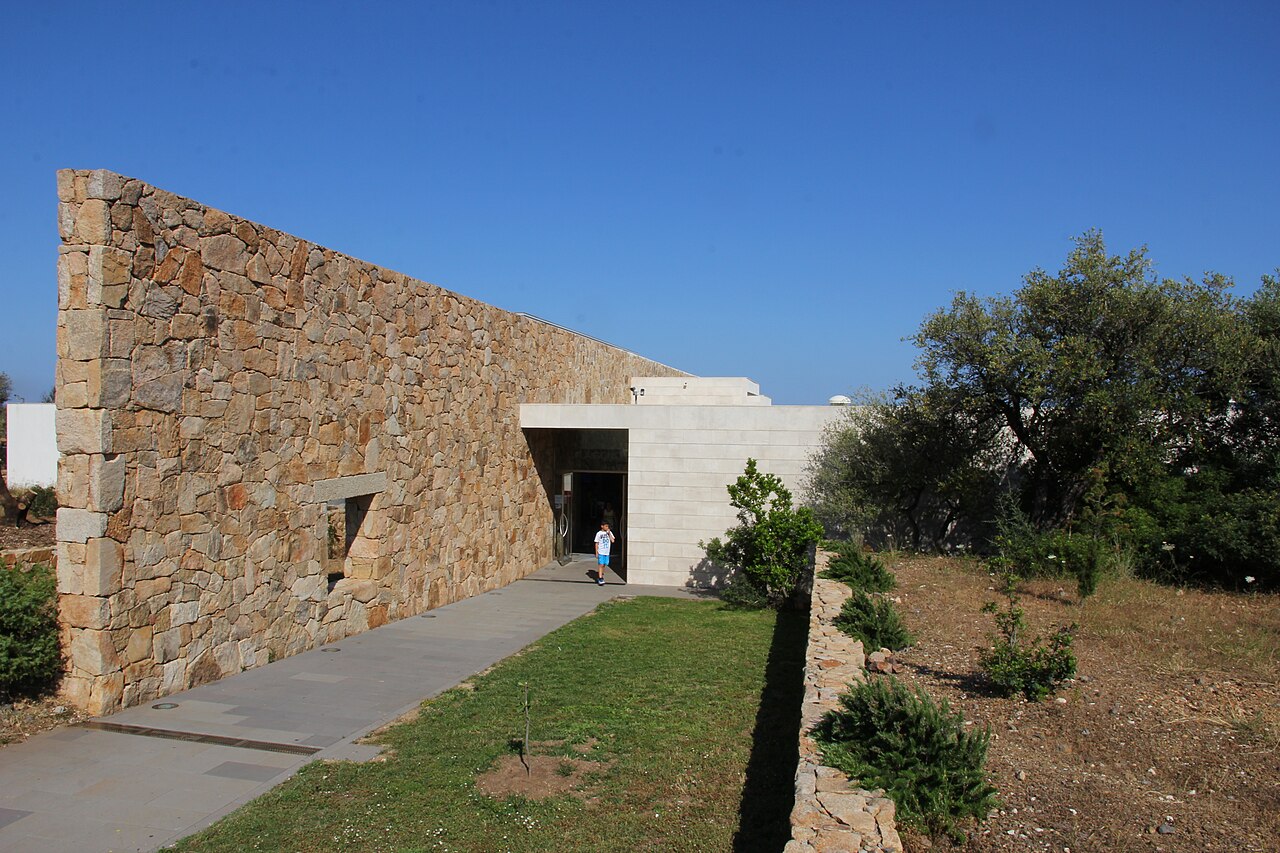
A modern stone building just above the village (Via La Favorita) and, in our view, the best plan for a day when it is windy or raining, or when the kids have had enough of the beach. The tanks are mostly home to Mediterranean sea life, but there are also turtles, clownfish, sharks and piranhas. Allow about an hour.
Prices on the official website in September 2026: adults €14 (about £12), children aged 4 to 12 €10 (about £9), under-3s free, over-65s €9, visitors with disabilities €6.50 and their companion free. An annual pass costs €23 for adults. Opening hours are usually 10 am to 6 pm, last entry at 5 pm. The aquarium closes in winter, and exact opening days are in the calendar on its website.
9. Nuraghe Mannu
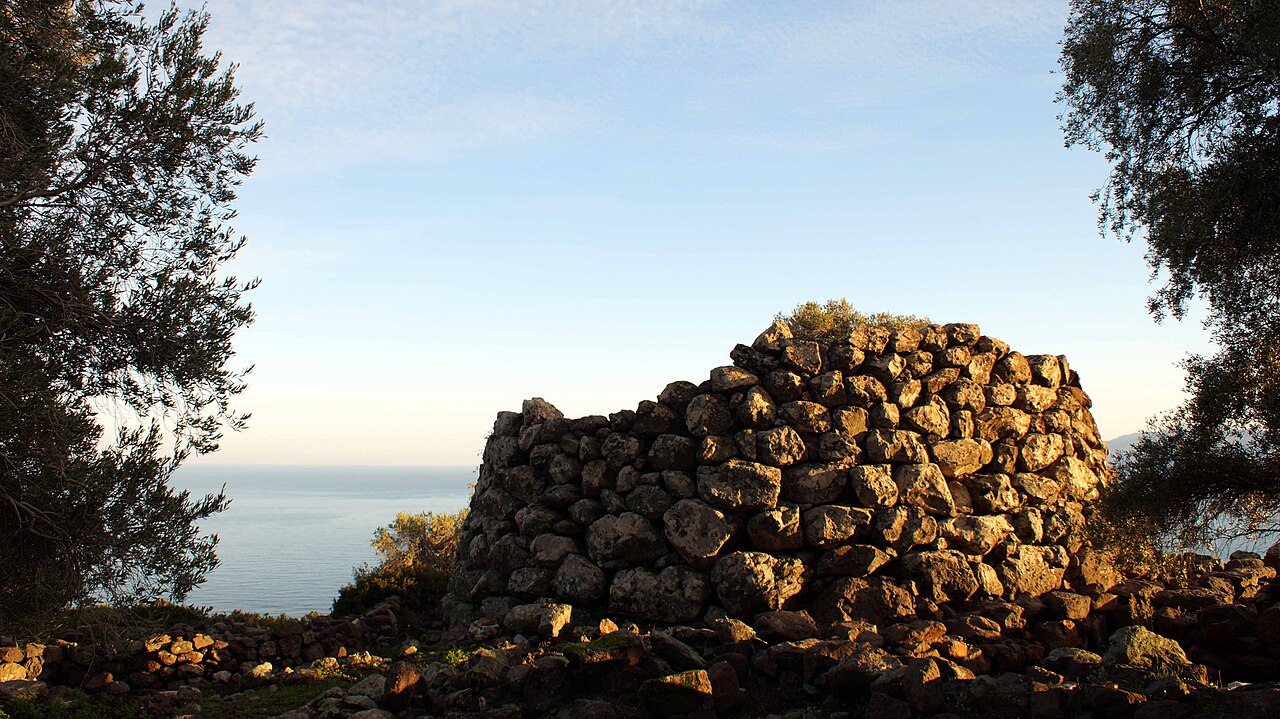
A Nuragic tower on a lookout headland about 200 metres above the sea, a few minutes’ drive from the village or roughly half an hour on foot. Around it are the remains of a Nuragic village with round huts, inhabited from the 15th century BC and later taken over by the Romans. You can see the site in half an hour, but the view across the whole gulf is one of the best in the area, ideally at sunset. There is parking by the ticket office, visits are booked through dorgaligonone.it, and entry costs around €5 for adults and €3 for children.
10. Dorgali, the Ispinigoli cave and Nuragic villages
Dorgali, the town Cala Gonone belongs to, is fifteen minutes’ drive back up through the tunnel. It is an ordinary Sardinian town that carries on living outside the season, with craftspeople (it is known for gold filigree jewellery), wineries making the local Cannonau, and an archaeological museum full of finds from the surrounding area.
Grotta di Ispinigoli, a few kilometres from Dorgali, is in our opinion the most impressive inland sight that does not require hiking boots. A guide takes you down a staircase into a vast chamber (about 35 metres deep and up to 80 wide), where one of the tallest stalagmite columns in Europe rises 38 metres. Now and then it hosts evening concerts of Sardinian a tenore singing.
Between Dorgali and Cala Gonone you will also find Parco Museo S’Abba Frisca, a small open-air museum around a natural spring. If you want more archaeology, the Nuragic village of Serra Orrios, with almost fifty round huts and two temples, is close by, as is the giants’ tomb of S’Ena ‘e Thomes about 17 km from Dorgali, with a granite stele almost four metres high. Both are easy walks, even with children.
11. Tiscali, the village hidden in a sinkhole
The Nuragic village of Tiscali sits on top of Monte Tiscali in the Supramonte, inside a collapsed karst sinkhole, so you cannot see it at all from outside. Around 70 structures survive, lived in from the Nuragic period right up to the early Middle Ages.
The only way there is on foot. From the Dorgali side, the route starts at the Ponte Sa Barva bridge and follows the Flumineddu river to the rock staircase of Scala di Surtana. From the Oliena side, a steep path climbs up from the Lanaittu valley, in places along a narrow ledge. The ascent takes around an hour and a half each way, with about 300 metres of climbing and almost no shade at midday. According to the council, the site can only be visited with a licensed guide, and the entrance fee (around €5) is paid on site in cash, because there is no phone signal. Most guided trips include pick-up from Cala Gonone. Tiscali and Gorropu share the same starting bridge, but we would give each one a day of its own.
12. The Gorropu gorge
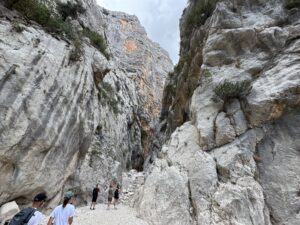
Gola su Gorropu is one of the deepest gorges in Europe, with walls up to around 500 metres high. From Cala Gonone it is about 20 km via Dorgali to the trailheads. Most people start from the Sa Barva bridge or from the Genna Silana car park on the SS125. Agencies in Cala Gonone also run 4×4 trips with lunch at a shepherds’ camp. The deeper into the gorge you go, the more technical the terrain, so if you lack experience, go with a guide. Routes, tickets and closures are in our Gola su Gorropu guide.


Where to stay in Cala Gonone
The village is small and sells out in the last two weeks of July and the first two weeks of August, so for those dates book at least two to three months ahead. You will find resorts with entertainment programmes, family-run hotels, B&Bs, apartments, agriturismi in the hills and a campsite on the northern edge of the village. Older guides quote from about €100 (about £85) a night for two in high season, or under €90 if you book five to seven months in advance. For 2026, treat that as the bottom of the range.
- By the harbour and Spiaggia Centrale you have the boats, restaurants and promenade on your doorstep, but expect noise until late.
- Around Palmasera it is quieter, and you can still walk to the beach and the centre.
- On the slopes below Monte Irveri (Gustui) there are hotels with pools and views over the gulf. Getting to the centre means an uphill walk back, though a shuttle runs in July and August.
- Dorgali and the agriturismi around it work out cheaper and are closer to Tiscali and Gorropu, but you pay for the sea every day with the drive through the tunnel and the hunt for a parking space.
Cala Gonone hotels
From a budget guesthouse on the promenade to an adults-only hotel. We checked ratings and facilities on Booking.com in September 2026.
- Hotel Brancamaria, in the centre, with a pool that guidebooks recommend for families.
- Hotel Villa Gustui Maris, at the foot of Monte Irveri, with a pool and a view over the gulf.
- Margaida Boutique Hotel & SPA, an adults-only hotel about 200 metres from Spiaggia Centrale, with contemporary design and a spa.
- Hotel Resort Nuraghe Arvu, set in private parkland about 500 metres from the beach, with a large pool and a restaurant serving Sardinian food.
- Guest House Dolce Vita (Cala Gonone): a guesthouse right on the Palmasera promenade, 200 metres from Spiaggia Centrale, with balconies, sea views and a bar. Guests rate it 8.8 out of 10, and for a night for two in June 2027 Booking.com was asking around €100 (about £85). A cheaper, simpler choice if you will be out all day anyway.
- Camping Car Palmasera (Cala Gonone): a site on Viale Bue Marino about 700 metres from Palmasera beach, with a restaurant, bar, garden and private parking. Through Booking.com you can reserve units with air conditioning, a bathroom and a kitchenette, rated 8.6 from more than 700 reviews. Good for families who want to cook for themselves and keep an eye on the car.
Hotels in Dorgali and the surrounding area
In Dorgali, nights are usually cheaper and in the morning you are quicker to Tiscali, Gorropu or the Ispinigoli cave. The sea is about a quarter of an hour away through the tunnel.
- Hotel Il Querceto (Dorgali): a hotel in an oak grove on the edge of town, with an indoor pool, a restaurant serving local dishes and free parking. Most rooms have balconies with mountain views, and it scores 9.1 out of 10 on Booking.com.
- Agriturismo Conca’ e Janas (Dorgali): a farm stay by the SS125 about 7 km from the centre of Dorgali, with a restaurant serving local food, a garden and a terrace. Rated 9.0, and in June 2027 roughly €90 (about £77) a night for two. The cheapest of our picks and a good choice if you like to have dinner where you sleep.
- Hotel Ispinigoli (Dorgali): a three-star hotel at Ispinigoli, next to the cave of the same name, with a restaurant, a children’s playground and free parking. Guests praise the breakfasts, and it scores 8.9 out of 10 overall. To get to Cala Gonone you drive via Dorgali and the tunnel.
You can browse everything available under accommodation in Cala Gonone, and if you would rather stay inland for less, try accommodation in Dorgali. Travelling with a campervan or a tent? See our guides to camping in Italy and the best beach campsites in Italy. For which part of Sardinia to base yourself in, read our guide to where to stay in Sardinia.
The tourist tax is paid directly to your host:
| Type of accommodation | Tax per person per night |
|---|---|
| 4- and 5-star hotels and resorts | €2 |
| 1- to 3-star hotels, B&Bs, holiday homes, agriturismi, campsite bungalows, apartments | €1.50 |
| Hostels, campsites with a tent or caravan, motorhome pitches | €1 |
There are exemptions and reductions for children, people with disabilities and those accompanying them. Among other things, the council uses the tax to pay for the free shuttles and for cleaning the beaches in summer.
Where and what to eat in Cala Gonone
There are plenty of restaurants, from pizzerias on the promenade to seafood places. Menus feature fish and seafood from the gulf, carasau flatbread, pecorino and pork, washed down with Cannonau wine from around Dorgali. Places recommended by guidebooks:
- Il Pescatore (Da Graziano), a seafood restaurant. Not cheap, but the seafood starters are worth it.
- Ristorante Pizzeria San Francisco on Via Magellano, a family-run place serving pizza, pasta and fish.
- Gelateria Fancello for ice cream.
- Just outside the village, the restaurants of agriturismi and country hotels, cooking with Sardinian produce.
When to visit Cala Gonone and what’s on
The season runs from late March to October. From November to February the village is half empty and many hotels and restaurants are closed.
August is the worst month for boat trips: the first boats reach the most famous coves before 9 am, and by around 11 they look nothing like the photos. The best balance of weather and quiet comes in June, early July and September. Air and sea temperatures month by month are in our guide to the weather in Sardinia.
Events in the 2026 season, according to the council’s calendar:
- June: Sagra del pesce, a fish festival in the square by the harbour.
- July: Cala Gonone Jazz Festival.
- Early August: Calici di Stelle, an evening of wine.
- 15 August: Ferragosto Dorgalese, with a parade of horses and traditional costume.
- Late September: the Autunno in Barbagia autumn festival.
Cala Gonone with kids and dogs
With children, the best bets are the shallow beaches of Cartoe and Osalla, the southern part of Palmasera and Spiaggia Centrale in the village, and for days at sea, the big excursion boats, which are steadier than RIBs. The council also recommends the shady playground in the lower pine wood, the car-free Palmasera park and the playground on Piazza del Sole.
With a dog, you can go on any beach before 8 am and after 8 pm. During the day, three stretches are reserved for dogs: S’Abba Meica, part of northern Palmasera and part of Osalla. In public places dogs must be on a lead, and there is drinking water at the harbour.
Taking sand, pebbles, shells or driftwood from beaches and trails is forbidden, and in Sardinia taking sand can land you a hefty fine. More on that in Sardinia: what to watch out for.
💡 Stock up on water and food in the village before any trip. There are no facilities at Cala Fuili, Sos Dorroles or Ziu Santoru, and nowhere to refill your bottle on the path to Cala Luna. Summers in Sardinia tend to be dry, so the council asks visitors to go easy on water at their accommodation too.
What we would do differently
We would not take a boat every day. One full-day trip to the coves is a must, but a second day on the water does not add much. Instead, head north to Cartoe, where nobody is in a hurry, or up to Dorgali, where you see a Sardinia that does not live off tourists.
We would eat and drink more of the local stuff. Cannonau from Dorgali, cheese from the agriturismi, fish that was pulled out of the gulf that morning. In our experience the best dinners here are not on the promenade but a few kilometres uphill, where dogs run around the tables and the wine comes in a jug.
And we would spend more time just looking. From the viewpoint past the tunnel, from Nuraghe Mannu at sunset, or from the pier at the end of the harbour. You do not have to tick off every cove or climb into every cave. Leave some of it for next time.
Cala Gonone FAQ
How do you get to Cala Gonone without a car?
ARST bus 520 runs from Nuoro about five times a day and takes around an hour. In high season Deplano also runs a service from Olbia airport with a change in Siniscola, which takes more than three hours. For day trips around the area, though, a car is close to essential.
How much is parking in Cala Gonone?
Paid spaces with blue lines cost around €1 an hour and €6 to €8 a day, payable at the machine or through EasyPark. The Iskrittiorè car park is cheaper, and from June to September a free shuttle runs from there to the harbour.
What are the best beaches in Cala Gonone?
In the village itself there is Spiaggia Centrale by the harbour, the long Palmasera beach, quieter Sos Dorroles and the dog-friendly S’Abba Meica. To the south you can drive to Ziu Martine and Cala Fuili, to the north to the sandy, shallow beaches of Cala Cartoe and Osalla. Cala Luna and the other famous coves can only be reached by boat or on foot.
How much does the Cala Gonone aquarium cost?
In September 2026 adults paid €14, children aged 4 to 12 €10, over-65s €9 and under-3s nothing. It is usually open from 10 am to 6 pm with last entry at 5 pm, and closes in winter.
How do you get from Cala Gonone to Cala Luna?
By boat from the harbour for €35 return (NCTM, 2026 season), or on foot along the coastal path from Cala Fuili, which takes roughly an hour and a half to two hours each way with very little shade. The best plan is to walk there in the morning and take the boat back.
Is there a campsite in Cala Gonone?
Yes, there is a campsite on the northern edge of the village and more in the area, for example near Osalla beach. Motorhomes have dedicated service areas, and the tourist tax at campsites is €1 per person per night.
Is Cala Gonone worth visiting?
If you want to combine the sea, boat trips and hiking, then yes. The village is more practical than pretty, but the boats from here go to Sardinia’s most famous coves, and Gorropu, Tiscali and Ispinigoli are all close by. If all you want is a long sandy beach, there are better places elsewhere.
Where to next
- Golfo di Orosei: every cove in the gulf, boat trips, licence-free boat hire and the treks to Cala Luna and Cala Goloritzé.
- Gola su Gorropu: routes into the gorge, tickets, difficulty and when it is closed.
- Sardinia holiday guide: planning the whole trip, flights, ferries, car hire and itineraries.
- Things to do in Sardinia: the most interesting places across the whole island.
- Where to stay in Sardinia: which part of the island to choose and what kind of accommodation you will find there.
Potřebujete pomoct s cestováním?
-
Ubytování 🏨
Vyberte si to nejlepší ubytování, ať už jste kdekoliv, přes Booking.com. -
Půjčení auta 🚗
Auto si snadno najdete přes Booking.com, kde máte často slevu díky ubytování, nebo Rentalcars.com, kde porovnáte nabídky většiny půjčoven. -
Zážitky 🎟️
Přes GetYourGuide.com si vyberete z nejrůznějších výletů i zážitků po celém světě, navíc se zrušením zdarma do 24 h předem.