Last updated 7.10.2026
In Alghero the baker greets you with “bon dia” rather than “buongiorno”, and the street signs come in two languages, Italian and Catalan. The Crown of Aragon took the town in the mid-14th century, expelled its inhabitants and resettled it with families from Catalonia, Valencia, Majorca and Aragon. They stayed, so did their language, and Italians still call the place Barceloneta, little Barcelona. That history is why the list of things to do in Alghero starts with a walk rather than a beach.
The old town sits on a headland surrounded by sea walls, and in the evening half the town walks along them to watch the sunset. Beaches are within walking distance or a €1 city bus ride away. Then there is everything around: the limestone cape of Capo Caccia, Porto Conte nature park, a Nuragic village older than Rome, prehistoric tombs on the UNESCO list and one of the biggest wineries on the island. We have put together 25 tips, deliberately more than you can fit into a week, so you can pick what suits you.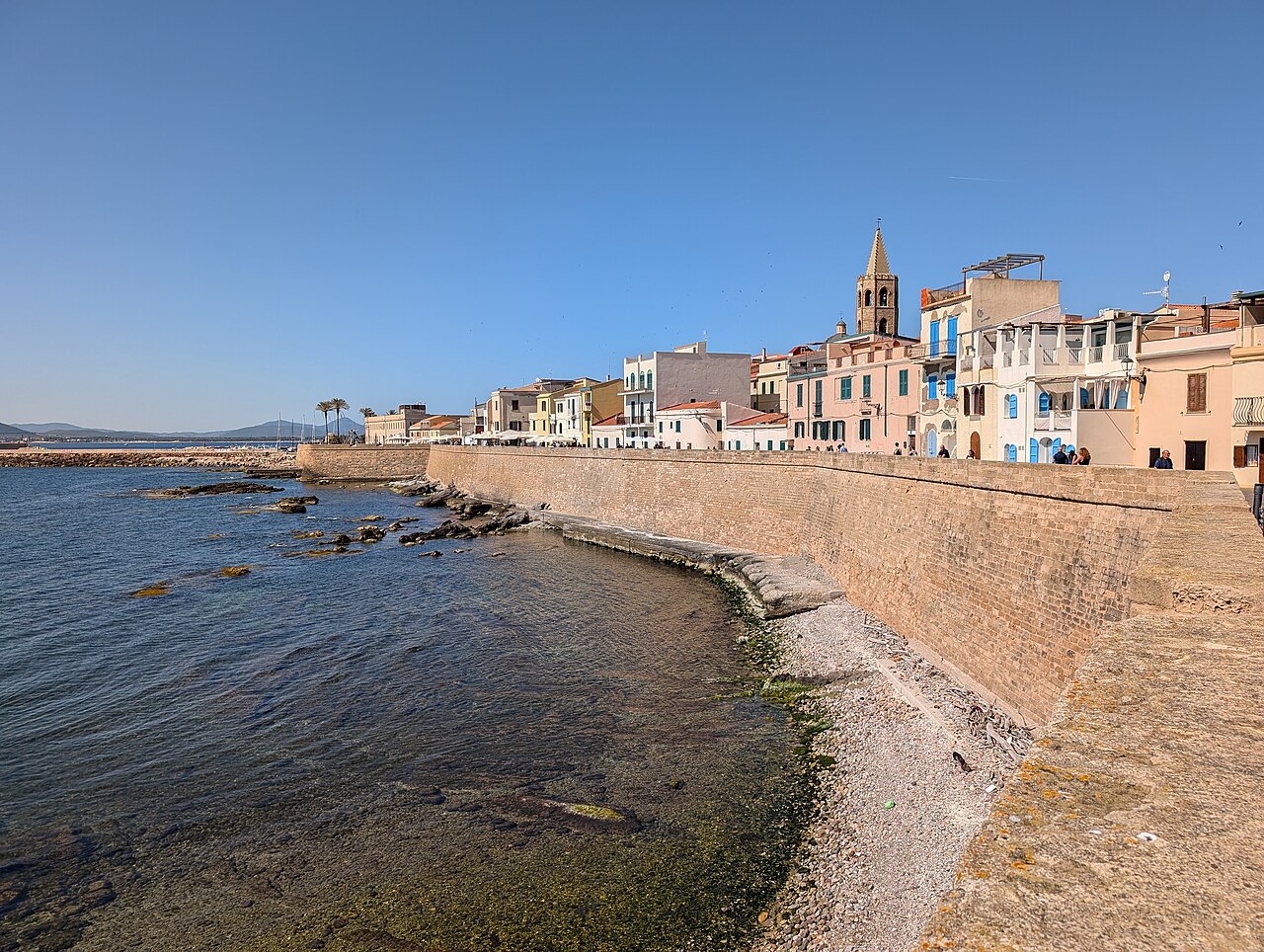
Things to do in Alghero, Sardinia: the short version
- Where it is: on the north-west coast of Sardinia, in the province of Sassari. Around 42,000 people live here, which makes it the island’s fifth-largest town.
- Alghero-Fertilia airport is about 10 km from the centre. The ARST ALFA bus costs €1 and in summer 2026 ran every 30 minutes.
- The old town is a ZTL zone: you cannot drive into it without a permit.
- There are two town beaches, Lido San Giovanni and Maria Pia. Le Bombarde, Lazzaretto and Mugoni are a bus ride away.
- The Alghero Ticket costs €35 (about £30) and covers Neptune’s Grotto, both archaeological sites and the town museums. The cave alone is €18.
- One day is enough for the town, give the surroundings two or three. Add Bosa, La Pelosa and Asinara and you have a week.
- The best months are June and September. The sea is warm and there are noticeably fewer people than in August.
25 things to do in Alghero and around
We have ordered the tips from the walls outwards: first the old town, then the beaches and nature you can reach by city bus, then places where a car helps, and finally full-day trips.
Alghero old town and harbour
You can walk the historic centre in an hour. The smooth stone paving is slippery when dry and worse when wet, so keep the thin-soled sandals for the beach.
1. The sea walls and bastions at sunset
If you only do one thing in Alghero, make it this. The walls (bastioni in Italian) wrap around the seaward side of the old town, and a footpath runs along the top from Porta a Mare all the way to the Sulis tower. Alghero is on the west coast, so the sun sets straight into the sea, with the outline of Capo Caccia on the horizon.
Bastioni Marco Polo is lined with restaurants and gets packed in the evening. We prefer to buy an ice cream or a takeaway glass of wine and sit on the wall a little further along, where nobody is queuing for a table.
2. The Catalan lanes of the old town
Street name plates come in two versions, Italian and Catalan. According to the most recent language survey, roughly a quarter of residents speak Alghero Catalan as their mother tongue and just under a fifth use it day to day, yet almost nine in ten understand it. It has been officially recognised since 1997. The town itself looks Catalan too: Gothic doorways, narrow cobbled lanes and honey-coloured houses.
The prettiest lanes are between Via Principe Umberto and the walls, where washing hangs out to dry and in the morning all you hear is a broom and a radio through an open window.
3. Santa Maria cathedral and its bell tower
Building the cathedral of Santa Maria Immacolata took more than 150 years, so it has a Gothic presbytery, a Renaissance nave and a neoclassical façade. The highlight is the octagonal bell tower with its pyramid roof covered in coloured majolica tiles. From the gallery you look out over the old town roofs and the sea. Opening hours change with the season.
4. San Francesco church and its cloister
In our view the most beautiful church in town, even if it does not look like it at first. The Franciscan complex was built in Catalan Gothic style at the end of the 14th century and got a Renaissance façade after part of it collapsed in 1593. The real reason to come is the cloister, where chamber concerts are held in summer.
Look out for the statue of Christ at the column, which locals carry in procession during Holy Week. People in Alghero call it lo rosegat, “the gnawed one”. Entry to the complex costs €6 (about £5).
5. San Michele church and its tiled dome
You will see this dome on every other postcard from Alghero. It is covered in glossy coloured majolica tiles and from the walls it glows like a giant mosaic. The church is dedicated to St Michael, the town’s patron saint.
Two more historic churches are worth a short stop: Santa Barbara, the oldest church in town, and Nostra Signora del Carmelo by the San Giacomo tower, with a gilded altarpiece.
6. Piazza Civica, Porta a Mare and Caffè Costantino
The main square of the old town, which you enter from the harbour through the Porta a Mare gate. On it stands the 16th-century Palazzo d’Albis, where by tradition Emperor Charles V stayed in 1541, and on its ground floor Caffè Costantino, the best-known café in town.
Coffee on Piazza Civica costs more than two streets away. We have one here for the square and after that head to the bars where locals stand at the counter.
7. Torre di Porta Terra
This 23-metre tower from the 14th century was one of the two main gates into the town, the one on the land side. Today it houses a tourist information point with a small exhibition and a terrace overlooking the rooftops, and it also sells the Alghero Ticket. If you arrive by bus, it is the natural starting point for a walk.
8. The seafront towers: Sulis, San Giacomo and Sant’Elmo
Torre di Sulis at the southern end of the promenade is named after Vincenzo Sulis, a 19th-century revolutionary who spent twenty-two years imprisoned in it. Further along the seafront stand Torre di San Giacomo and Torre di Sant’Elmo.
We recommend walking the full length of the walls, from the harbour past Bastione Magellano to the Sulis tower, and coming back through the lanes. It takes about an hour at a slow pace and you see almost everything the old town has.
9. The Coral Museum and coral jewellery
Alghero lies on the Coral Riviera, Riviera del Corallo, and red coral has been harvested here since antiquity. Local coral from the depths off Capo Caccia is among the finest in the Mediterranean, and harvesting it is strictly regulated. Its story is told by the MACOR museum (Museo del Corallo) in an Art Nouveau villa at Via XX Settembre 8. Entry is €7 (about £6).
Genuine Sardinian coral is expensive and is sold with a certificate; cheap coral from a market stall is almost certainly not the real thing. For a souvenir without a guilty conscience, look for Sardinian filigree jewellery in gold and silver.
10. The archaeological museum and other town museums
If you are not planning to visit the nuraghi and tombs around town, or want to see what was found in them, go to the MUSA archaeological museum a short walk from the cathedral. It has finds from Anghelu Ruju, Palmavera and the Roman villa of Sant’Imbenia. Entry is €7 (about £6).
11. The harbour, Maddalena fort and the fish market
The harbour lies below the walls on the north side of the old town. From here boats leave for Neptune’s Grotto, along with catamarans that stop for swims in the coves below Capo Caccia and dolphin-watching trips. Next to the harbour stands Forte della Maddalena, a fortress of the Genoese Doria family, who founded Alghero as a fortified port at the beginning of the 12th century.
For fresh fish, vegetables and local cheese, head to the covered market, Mercato Civico. If your apartment has a kitchen, you will shop for dinner better here than in a supermarket.


12. The town beaches: Lido San Giovanni and Maria Pia
From the harbour, Via Garibaldi runs north, and just past it begins Lido San Giovanni, the main town beach: pale sand, more than a kilometre long. It is fully equipped, with bars and places renting sunloungers, paddleboards and kayaks. Two loungers and an umbrella cost roughly €20 to €25 a day (about £17 to £21).
Further north, towards Fertilia, the beach continues as Maria Pia, about 1.2 kilometres long. It is quieter and wilder, with juniper-covered dunes and a pine wood behind the sand, the water gets deep gradually and the beach has step-free access. We prefer Maria Pia, because in the shade of the pines you can sit out even the midday heat.
Alghero beaches and nature you can reach by city bus
North of town the coast curves round into the bay of Porto Conte. You can do everything in this part without a car: since June 2026 city line 5 (formerly regional route 9321) has run to Porto Conte and Capo Caccia at the city fare, and from May to September it is joined by the seasonal Beach Bus.
13. Le Bombarde and Lazzaretto
The two most popular beaches near Alghero, about ten kilometres from the centre, right next to each other and sharing a car park. Le Bombarde is one continuous stretch of fine pale sand with a gently shelving seabed and full facilities, so it works well for families. Lazzaretto is more a string of small coves with clear water, overlooked by an old watchtower.
The sea here is usually noticeably cooler than at the town beaches, which in August is more of a bonus than a drawback. In July and August the car park fills up by mid-morning, so it pays to arrive early.
14. Mugoni beach in the bay of Porto Conte
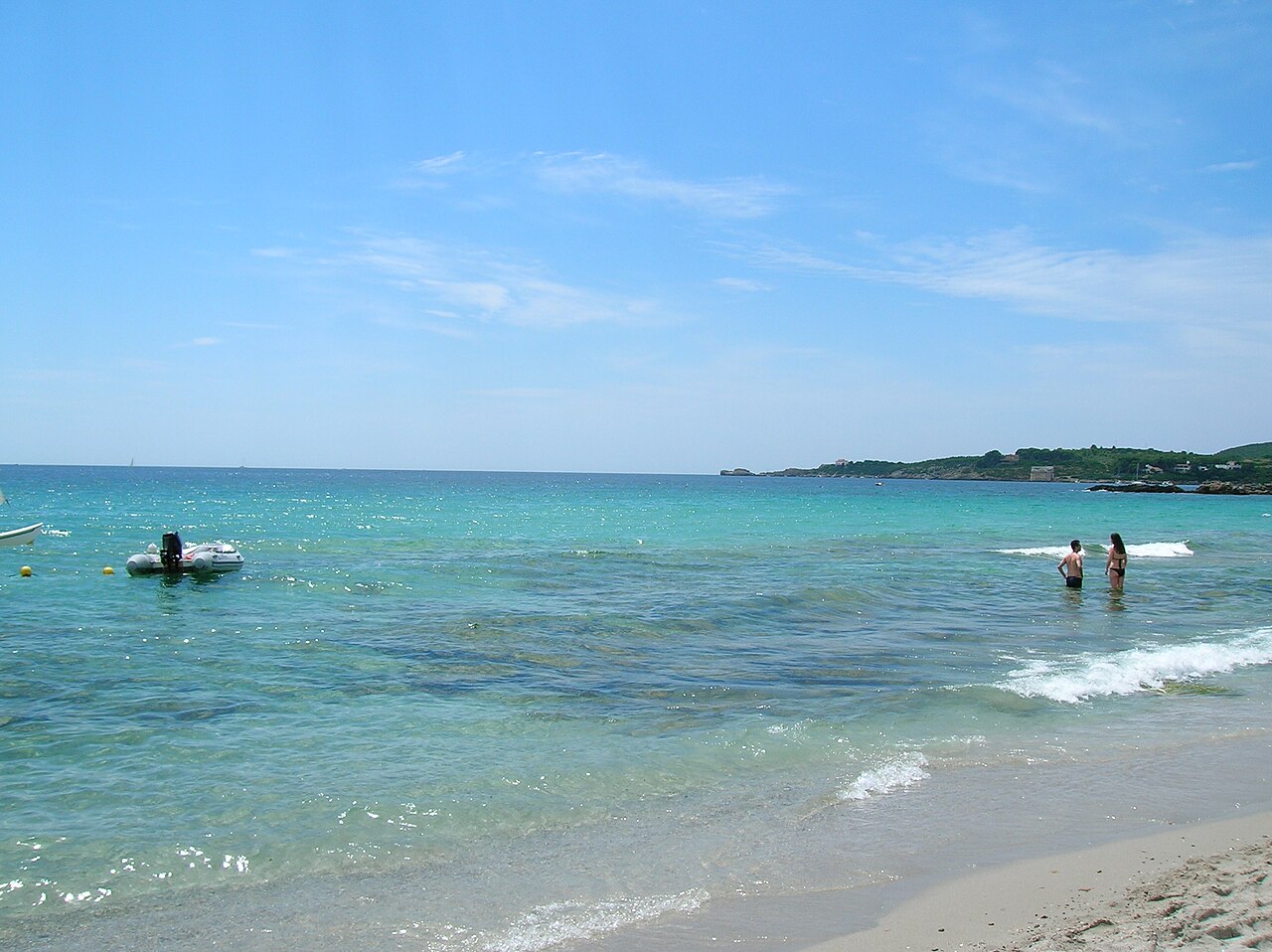
Roughly a kilometre of fine sand at the far end of a sheltered bay, about ten kilometres from Alghero. The sea is shallow and nearly always calm because the bay is protected on three sides, and Capo Caccia rises on the opposite shore. There are a few bars and lounger rentals, but it feels more local than Le Bombarde.
Not every bus stops here, so ask the driver when you get on whether it stops at “Spiaggia Mugoni”. Of all the beaches around Alghero this is our favourite, especially on days when the wind is blowing on the open coast and the water here is still as flat as a pond.
15. Porto Conte nature park and the Le Prigionette forest
The bay of Porto Conte and the hills around it are protected as a regional nature park. At its heart is the Le Prigionette state forest: pines, maquis, views of Capo Caccia and paths for walkers and cyclists, where you will come across wild donkeys, deer and plenty of birds. At the entrance there is a visitor centre and bike hire.
You buy entry to the park as a ticket to the Porto Conte ecomuseum, which also covers the museums at Casa Gioiosa and the Roman villa of Sant’Imbenia. A monthly ticket costs €9 (about £8), a family ticket for one adult and two children €15, and if you want to drive through the park there is a €2 supplement per adult. It is open roughly from April to October, Tuesday to Sunday.
For a shorter walk, try the Punta Giglio headland on the other side of the bay, with the remains of a Second World War gun battery and a view straight across to the cliffs of Capo Caccia.
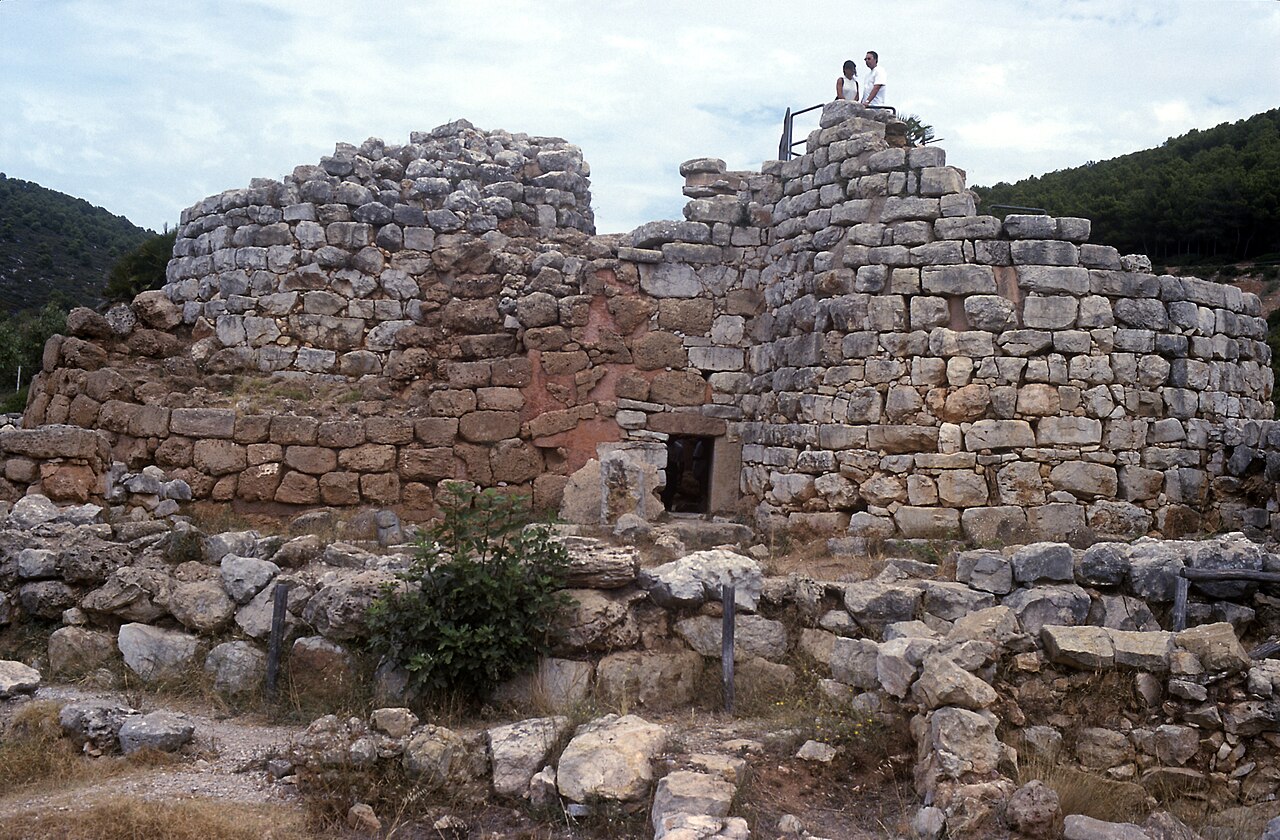
16. Nuraghe Palmavera
Nuraghi are Bronze Age stone towers built by the Nuragic civilisation roughly between 1800 and 1100 BC, and you will not find them anywhere else in the world. Palmavera lies in Porto Conte park by the SS127bis road, about ten kilometres from Alghero, and is one of the best preserved in the north of the island. Around its two towers and outer wall are dozens of round huts.
The basic visit costs €7 (about £6), or €12 (about £10) combined with the Anghelu Ruju necropolis. It is open from May to September from 10am to 7pm, in April and October until 6pm, and in winter mornings only. You can get here on the Porto Conte bus. The best plan is to arrive right at opening time, because at midday there is not a scrap of shade.
17. Capo Caccia and sunset over Foradada island
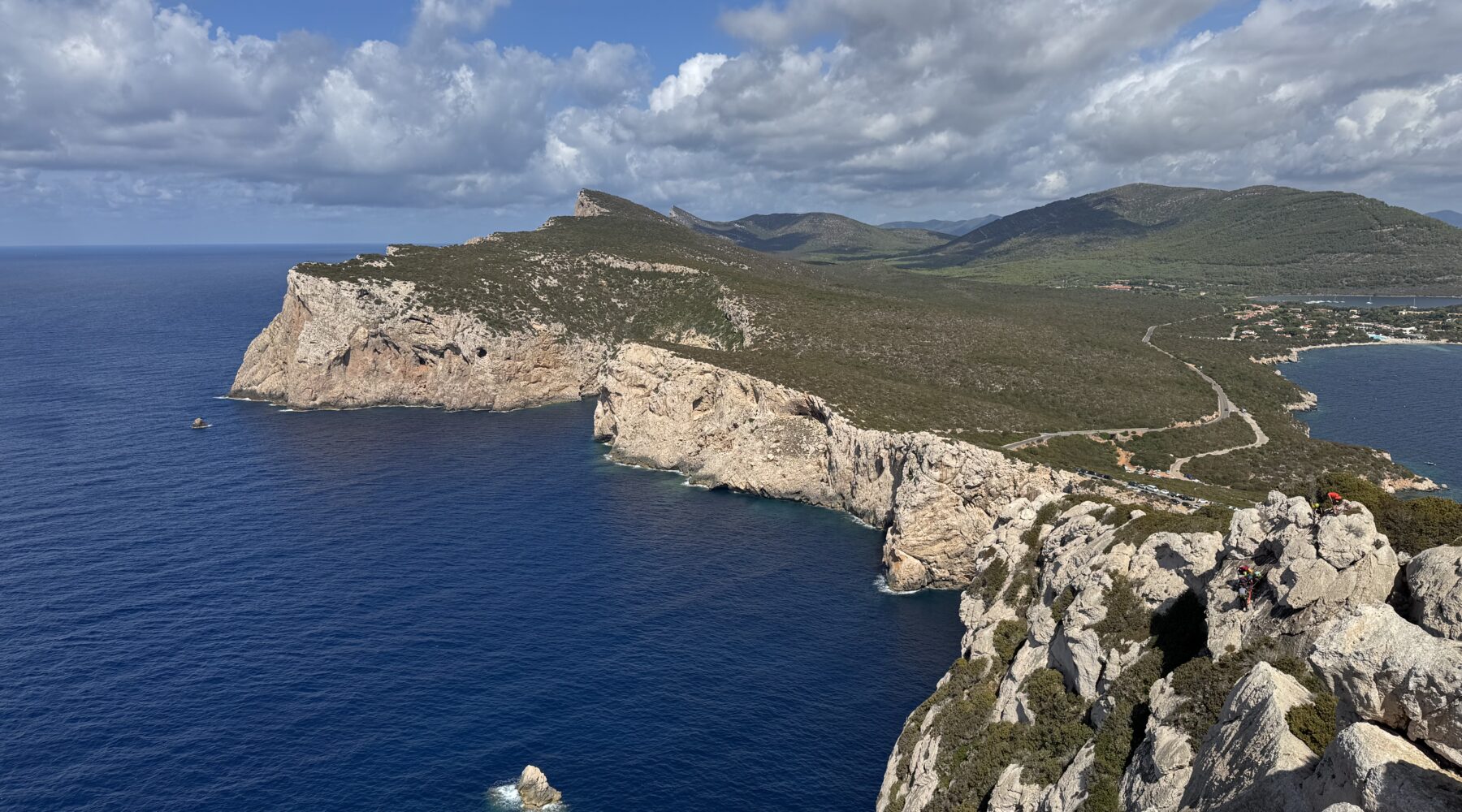
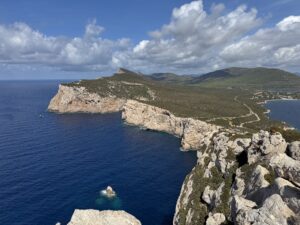
The limestone cape that, seen from Alghero’s walls, looks like a sleeping giant. It is about 25 kilometres from town, the cliffs drop more than a hundred metres sheer into the sea and a lighthouse stands at the tip.
At the top there is a car park and viewpoints over the islet of Foradada with a hole right through it, Piana island and, on a clear day, all the way to Stintino. In our opinion the sunset here is even better than from the walls, because the sun goes down into open sea. In season the car park is often full in the evening, and from June to October parking on the road to Neptune’s Grotto is only allowed in marked bays.
18. Neptune’s Grotto (Grotta di Nettuno)
The best-known sight in the whole north-west is a stalactite cave under the cliffs of Capo Caccia, with an underground saltwater lake. You reach it either by boat from Alghero harbour (April to November) or on foot down the Escala del Cabirol, a staircase of 654 steps. Entry is €18 (about £15), with the boat paid separately. The cave closes in rough seas and strong wind, and from June to October you must buy your ticket in advance. We cover the boats, the steps, the shuttle bus and booking in a separate article on Neptune’s Grotto.
Around Alghero: places where a car helps
We usually hire a car so we can explore the surroundings without depending on buses. That is why we have tips for you beyond the town as well.
19. Anghelu Ruju necropolis
About ten kilometres north of Alghero, by the road to Porto Torres, lies the largest prehistoric burial site in Sardinia. It was found by chance in 1903 while the Sella e Mosca winery was building its estate. Archaeologists uncovered 38 tombs cut into the sandstone, known in Sardinia as domus de janas, “fairy houses”. The oldest date from the late Stone Age, roughly 3200 to 2800 BC.
In July 2025 UNESCO added the domus de janas to the World Heritage List, Anghelu Ruju among them. Symbols are carved into the tomb walls, including stylised bull’s horns. Entry is €7 (about £6); better value is the combined ticket with Palmavera or the Alghero Ticket.
20. Sella e Mosca winery and local wine
Across the road from the necropolis is Sella e Mosca, one of Italy’s best-known wineries, founded in 1899. It makes Vermentino, Cannonau and above all Torbato, a rare white grape the winery helped save. Cellar tours with tastings run by advance booking only, and the wine shop is open daily. Tasting prices depend on the number of wines; check the winery’s website for current ones.
For something smaller, try the cooperative Cantina Santa Maria la Palma, with wines from Cannonau and Cagnulari grapes, or the family-run Rigàterri winery. Whoever is driving should taste with care: the road back to town is full of bends.

Alghero: expert wine and olive oil tasting at a boutique winery


21. Porto Ferro and Lake Baratz
A wild beach on the open west coast, hidden behind a thick pine forest and guarded by three Aragonese watchtowers. Unlike the calm bay of Porto Conte, this is where the waves roll in, so it is the local surf spot, with the Bonga surf school for beginners and improvers alike. On the beach there is a simple wooden bar where you can have a beer at sunset.
Just behind the beaches lies Lake Baratz, the only natural lake in Sardinia, which you can walk around or explore on horseback. For us this is the best place for a day when Mugoni and Le Bombarde are packed.
22. Dolphins, snorkelling and Nereo cave
The sea between Capo Caccia and Piana island is a marine protected area and home to bottlenose dolphins. The best way to go is with the marine biologists of Progetto Natura: from June to October they combine dolphin watching with snorkelling, and in spring and autumn they go out for the dolphins only. Trips are postponed when it is windy.
Full-day boats and catamarans also leave the harbour, sailing round Capo Caccia and stopping for a swim in the coves of Cala de la Barca or Cala Tramariglio. Experienced divers head for Nereo cave, the largest underwater cave in the Mediterranean. Landlubbers with a strong stomach can try the via ferrata del Cabirol along a ledge high above the sea, though in summer it is in full sun all day.


Alghero: snorkelling boat trip in Porto Conte and Capo Caccia

Full-day trips from Alghero
Want something extra? We also recommend these full-day trips to places worth the drive.
23. Bosa and the SP105 coast road
Bosa lies about 45 kilometres south of Alghero and is, in our view, the prettiest small town in Sardinia. The drive along the SP105 coast road takes roughly 45 minutes: the road runs high above the cliffs, past the Sa Mesa de S’Atentu viewpoint looking back towards Alghero and the Grifone nature reserve, where griffon vultures nest on the rocks.
Bosa itself is the river Temo with a palm-lined riverside and old tanneries, the pastel houses of the Sa Costa quarter stacked up the hill, and Malaspina castle above them. Try the local sweet wine, Malvasia di Bosa. If you want a swim, there is Bosa Marina beach below the town and, a little further on, the rock pools of Cane Malu and the cove of Cumpoltitu; both need a short walk.
24. Stintino and La Pelosa beach
An hour’s drive north lies La Pelosa, the beach that is the reason many people fly to north-west Sardinia in the first place. A shallow lagoon with aquarium-clear water, white sand and a 16th-century Aragonese watchtower on the islet just offshore.
In the 2026 season, from 15 May to 15 October, no more than 1,500 people a day are allowed on it. Entry costs €3.50 (about £3), children under 12 go free, and you can book only on the official website spiaggialapelosa.it: 500 places can be reserved any time in advance and 1,000 are released 48 hours before the day. You must put a proper beach mat under your towel and rinse your feet before leaving so that no sand is carried away. We list everything you can be fined for on Sardinian beaches in our article Sardinia: what to watch out for. From June to September the seasonal Sardabus runs from the airport and from Alghero to Stintino.
25. Asinara National Park and its white donkeys
This island at the very north-western tip of Sardinia was first a quarantine station, then for decades a maximum-security prison, and only after that a national park. It is home to rare white donkeys, which are albinos.
From Alghero you drive to Stintino and take a fast boat from there to the port of Fornelli; other boats leave from Porto Torres. Private cars are not allowed on the island, so you get around by e-bike, on a tourist train, in a guided off-road vehicle or on foot. For a single day, a guided trip is the most practical choice, because the island is large and the beaches are far apart.


Alghero entry fees: what things cost
Most sights in and around town are run by the municipal Fondazione Alghero, which also sells them as a bundle, the Alghero Ticket. Pound amounts are rounded.
| What | Full price | Note |
|---|---|---|
| Neptune’s Grotto (Grotta di Nettuno) | €18 (about £15) | reduced €10 (ages 6 to 17), under-6s free; boat extra |
| MACOR Coral Museum / MUSA archaeological museum | €7 (about £6) | reduced €5 |
| San Francesco church and cloister | €6 (about £5) | under-12s free |
| Nuraghe Palmavera / Anghelu Ruju necropolis | €7 (about £6) | both combined €12; Anghelu Ruju reduced €5 |
| Porto Conte ecomuseum and park | €9 monthly (about £8) | annual €12, car supplement in the park €2 |
| Alghero Ticket | €35 (about £30) | family €70 for 2 adults and 3 children under 17 |
| La Pelosa beach | €3.50 (about £3) | 15 May to 15 October, booking compulsory, under-12s free |
| ARST city bus | €1 (about 85p) | also the airport line and the Porto Conte line |
💡 When the Alghero Ticket pays off. Neptune’s Grotto, Palmavera, Anghelu Ruju and the Coral Museum come to €39 if bought separately, more than the €35 Alghero Ticket, and that is before San Francesco and the archaeological museum. If you want the cave plus at least two other sites, you save. If you are only here for the beaches and the cave, buy single tickets. You can get the Alghero Ticket online at algheroexperience.it, at the ticket desks of the sites included, at the tourist office at Via Cagliari 2 or in the Torre di Porta Terra.
How many days in Alghero?
- 1 day: the old town, the cathedral, the walls at sunset and a swim at Lido San Giovanni or Maria Pia.
- 2 to 3 days: add Neptune’s Grotto and Capo Caccia, Porto Conte with Palmavera, Mugoni or Le Bombarde, and a tasting at Sella e Mosca.
- 4 to 7 days: use Alghero as a base for the whole north-west. Add Bosa via the SP105, Anghelu Ruju, La Pelosa at Stintino, Asinara, Porto Ferro and Sassari, the island’s second-largest city, about forty minutes away by car.
Where to stay in Alghero
The key decision is not the number of stars but parking: the old town is inside the ZTL zone, so you either stay in the lanes and leave the car by the harbour, or stay outside the walls with your own parking and walk into the centre. We look at the island’s regions and types of accommodation in detail in our article Where to stay in Sardinia.
- Old town. The most atmosphere, B&Bs in stone houses, the walls two steps away in the evening. The downsides are noise from the bars in season and wheeling suitcases over the cobbles. For couples and anyone without a car.
- Seafront and the streets by the Lido. Ten to fifteen minutes’ walk to the centre, close to the town beach, easier parking. The best compromise for a first visit.
- Fertilia and Maria Pia beach. Peace and quiet, pine trees, family hotels with pools and campsites by the beach, close to the airport. You get into the centre by bus or bike.
- Porto Conte and Capo Caccia. Nature, Mugoni and Palmavera round the corner, silence in the evening. Harder without a car.
- Countryside and vineyards. Agriturismi and wine resorts inland. Car only.
Below are specific places in Alghero itself, in Fertilia, and in Stintino and Bosa, where it is worth staying the night if you do not want to drive back after a day trip. Each area has options for different budgets, and for a special night in Alghero there is Villa Las Tronas, which we mention further down. Booking.com ratings are as of September 2026.
Alghero: old town, harbour and the Lido
- Aigua (old town): Rooms in a historic house inside the ZTL, 150 metres from the harbour and five minutes’ walk from the cathedral. You make breakfast yourself from supplies waiting in the room when you arrive, and there is a microwave and kettle too. For couples without a car who want the walls just round the corner.
- San Francesco Heritage Hotel (old town): A hotel in a 14th-century monastery, 200 metres from the cathedral. Rooms are simple and air-conditioned, breakfast is a sweet Italian one, and in the evening you can sit in the hotel bar. If you want to sleep inside the walls but with a reception desk rather than in an apartment, this is the place.
- Hotel Catalunya (by the harbour): A four-star hotel opposite the marina, five minutes’ walk from the old town. It stands outside the walls, so the ZTL is not your problem, and on the top floor is the Blau Skybar. The restaurant serves breakfast only.
- Hotel Florida (Lido San Giovanni): By Lido San Giovanni beach, 800 metres from the historic centre, with two pools, two hot tubs and rooms with a balcony, some with a sea view. Breakfast is a buffet. A good compromise for families: the beach outside the window and the centre within walking distance.
Fertilia and Le Bombarde
- Hotel Fertilia (Fertilia): Among the pines, five minutes’ walk from the beach and five minutes’ drive from the airport, with free parking and the Sardinian restaurant Da Bruno. Rated 8.1 on Booking.com. Good for your first or last night and for anyone travelling by car.
- Hotel Dei Pini (Le Bombarde beach): Right on Le Bombarde beach in Porto Conte park, with its own beach, a pool overlooking the sea and free parking. The bus into central Alghero stops outside. For people who want to walk straight into the water in the morning and have peace in the evening.
- Camping Village Laguna Blu (Fertilia): A campsite with rooms and mobile homes 20 metres from the beach and about 4 km from Alghero. It has a supermarket, a restaurant with pizzeria, a playground, a laundry and free parking, rated 7.9 on Booking.com. A cheaper option for families, though getting around without a car is harder from here.
Stintino and La Pelosa
- Residence Hotel La Pelosetta (Stintino, La Pelosa): Apartments with a kitchenette right by La Pelosa beach, all with a sea view, and free parking. The catch: according to Booking.com there are only ceiling fans, no air conditioning. Rated 7.8.
- Hotel Silvestrino (Stintino): In the village, 100 metres from the sea and five minutes’ drive from La Pelosa. Air-conditioned, simply furnished rooms and a well-known restaurant serving fish and Sardinian wines. If you like an evening stroll around the harbour, you will be happier here than by the beach.
- Hotel Cala Reale (Stintino): A complex of several buildings on the Gulf of Asinara, with a pool, tennis courts and a playground. It is a kilometre to the sea and three to La Pelosa. Rated 8.9 on Booking.com, probably the most comfortable choice in Stintino for families with children.
Bosa
- Palazzo Pischedda (Bosa): A boutique hotel 50 metres from the old Ponte Vecchio bridge, rooms looking out over the river Temo or Malaspina castle, a restaurant with a terrace and free parking, which is not a given in old Bosa. Rated 8.9.
- Corte Fiorita Albergo Diffuso (Bosa): A “scattered hotel” in two historic houses, one on the bank of the Temo, the other 200 metres further towards the centre. Rooms and apartments, some with a balcony or a view. For anyone who wants to stay among the colourful houses; the sea is about 3 km away.
- Hotel Isola Rossa (Bosa Marina): 250 metres from the main beach at Bosa Marina, with a pool in a shady garden and a bar. Rated 8.6. For when you are going to Bosa mainly for the sea and only want to stroll into town.
If you would rather choose yourself, search for accommodation in Alghero or, for families and quiet by Maria Pia beach, accommodation in Fertilia. To spend a night elsewhere and stretch out a trip to La Pelosa, look for accommodation in Stintino, and for a stopover along the SP105, accommodation in Bosa.
For one night to remember, the best-known address in town is Villa Las Tronas Hotel & SPA, a former residence of the Italian royal family on a rocky promontory above the sea, a few minutes’ walk from the walls.
Allow for the tourist tax. From 2026 Alghero charges it at the same rate all year round, and you pay it only for the first seven consecutive nights:
| Type of accommodation | Tax per person per night |
|---|---|
| Hotel with 4 stars or more | €4 (about £3.40) |
| Hotel up to 3 stars, B&B, apartment, campsite (tent or caravan pitch) | €2 (about £1.70) |
| Campsite or caravan site with accommodation rented from the campsite | €1 (about 85p) |
For July and August the best seaside places sell out well in advance. Book with free cancellation, even six months ahead.
A little history: why Alghero speaks Catalan
It all started with the Genoese. The Doria family built a fortified port here, between 1102 and 1112 according to the regional tourism portal Sardegna Turismo. Archaeologists, going by excavations in the old town, place the founding of the town as late as the mid-13th century. Either way, it was a Genoese base guarding the north-west of the island and the coral fisheries.
The turning point came with the Crown of Aragon. On 27 August 1353 the Aragonese-Catalan fleet defeated the Genoese in the battle of Porto Conte, and a few days later the commander Bernat de Cabrera rode into town. The locals rebelled that same autumn, so in 1354 King Peter IV “the Ceremonious” sailed over in person. The siege dragged on, heat and malaria wore down the army, and the town only surrendered in November 1354. Then came what makes Alghero unique: the king expelled the Sardinian and Genoese inhabitants and repopulated the town with people from Catalonia, Valencia, Majorca and Aragon. After another revolt in 1372 the expulsions were repeated. Hence the nickname Barceloneta, little Barcelona, and hence the Catalan on the street signs.
Catalan Alghero was above all a fortress. At first the Aragonese simply maintained the Genoese walls with their 26 towers; Ferdinand the Catholic ordered a major rebuild in the 16th century. Only the seaward side was ever finished. In 1501 Alghero was made a royal city, and in 1541 Emperor Charles V stopped here. To this day the whole sea wall survives, along with eight 16th-century towers in town and another eleven watchtowers along the coast. The landward side began to be demolished after 1867, when Alghero was struck off the list of strategic fortresses.
The money came from coral. In 1355 the king granted the new inhabitants a series of privileges, and in 1375 an exemption from the coral tax, which other fishermen paid at a fifth of their catch. For centuries coral boats from Catalonia, Liguria, Provence and Campania anchored in the harbour. Fishermen paid part of their catch into a fund, the Caixa del Corall, as a pension, and the same fund paid for chapels in the cathedral.
The Catalan era ended after the War of the Spanish Succession. After a brief spell of Austrian rule, Sardinia passed to the House of Savoy in 1720, which made Italian the official language in the 1760s. On the street and at home, though, people kept speaking Catalan, and it only began to retreat in the 20th century. Sardinia recognised it in 1997 and the Italian state in 1999 as a minority language.
How to get to Alghero
We flew in, but there are of course other ways.
- By plane. Alghero-Fertilia airport, officially Riviera del Corallo, is one of Sardinia’s three main airports. Flights from the UK are seasonal and the routes change from year to year, so check the current list on the airport’s website before you plan around it; flights, ferries and the island’s other airports are covered in our planner Sardinia holiday guide.
- From the airport to Alghero town. The bus stops are to the right of the arrivals hall, about 150 metres from the entrance. The ARST city line marked ALFA runs into the centre and terminates on Via Catalogna by the old town. A ticket costs €1, and in summer 2026 (22 June to 15 September) the bus ran every 30 minutes from 5:00 to 23:26. You can buy tickets from the machine in the terminal, in the DropTicket, Tabnet or Around Sardinia apps, or on board, where since June 2026 you can pay contactless by card or phone at no extra cost. Paying cash to the driver costs 50 cents more.
- From Olbia and Cagliari. Olbia is about 136 kilometres away, Cagliari 243. From Olbia airport there is a direct Sun Lines bus, by reservation only. By train you go via Sassari, where you change to the local train to Alghero (Trenitalia tickets are not valid on it). Buses also run from Alghero airport to Sassari, Bosa, Nuoro and, via Oristano, to Cagliari.
- By car. You can hire a car right at the airport. You do not need one for the town, but it helps for the wineries, Bosa and La Pelosa. Car hire companies, insurance and deposits are covered in our article Sardinia booking tips.
Getting around Alghero: buses, the ZTL and parking
Since 22 June 2026 the ARST city lines have had new numbers, 1 to 6, with Via Catalogna as the interchange. Tickets are bought the same way as for the airport line, and there are also 27 ARST sales points in town, mostly tobacconists and newsagents.
The old town is a ZTL (zona a traffico limitato), a restricted traffic zone monitored by cameras. Non-residents may not enter without a permit, and the fine will be posted to your home address abroad, sometimes months later. If your accommodation is inside the walls, ask your host in advance whether they will register your number plate with the town hall so you can unload your luggage.
You park around the harbour and along the seafront. Blue lines are paid (meter or app), white ones are usually free and yellow ones are reserved for residents, deliveries or disabled drivers. In August it pays to park further from the harbour and walk a few minutes.
When to visit Alghero
Summer is dry and hot (an average of 32 °C during the day in July and August), June and September are around 28 °C, and winter is mild and wet. In our view the best months are June and September. In July and August Italians arrive on holiday, and around Ferragosto in mid-August everywhere is full. April and May are ideal for walks around Porto Conte and Capo Caccia, but the sea is too cold for swimming. October is usually still warm, just with more rain, and towards the end of the month the beach bars start closing.
Watch the wind. When the mistral blows from the north-west, Neptune’s Grotto closes and boat trips are postponed, though Porto Ferro gets waves for the surfers. Weather month by month, including sea temperatures, is in our article Weather in Sardinia.
Events worth catching include Holy Week (Setmana Santa) with night-time processions through the old town, the New Year’s Cap d’Any de l’Alguer with concerts and several days of events, and 29 September, the feast of the patron saint, St Michael.
What to eat in Alghero
Alghero’s cooking is Sardinian with a Catalan accent: mostly fish and seafood, though there is plenty of meat, cheese and pasta on the menu too.
- Aragosta alla catalana, Catalan-style lobster. Boiled lobster with raw tomatoes and onion, the town’s most famous and most expensive dish.
- Polpo all’agliata, octopus in a sauce of tomatoes, sun-dried tomatoes and garlic.
- Culurgiones, hand-pleated parcels filled with potato, pecorino and mint, and malloreddus, small Sardinian gnocchi.
- Seadas (sebadas), a fried pastry filled with melted young cheese and drizzled with honey.
- Menjar blanc, Alghero’s milk pudding of Catalan origin.
- Mirto, a dark liqueur made from myrtle berries, drunk after a meal.
With wine: Vermentino and Torbato with fish, Cannonau and Cagnulari with meat, sweet Malvasia di Bosa with dessert.
Local and international guides keep agreeing on a few addresses: the pizzeria Al Vecchio Mulino in the old town, cheap focaccia and sandwiches at Bar Focacceria Milese by the harbour, Sardinian cooking at Trattoria Lo Romanì, and Mabrouk, a fishing family’s restaurant where there is no menu and they bring whatever came in that day. For something sweet, people go to the Roberto Murgia Dolci in Corso pastry shop.
For an evening view over the town, go up to the Blau Skybar on the ninth floor of Hotel Catalunya.
What we would do differently
We would not go up on the walls just for the sunset. The evening is lovely but crowded. The best time on the bastions is around eight in the morning, when locals are out running, fishermen are coming back into the harbour and there are more gulls than people on the promenade.
We would try the dishes we had never heard of. Anyone happy to splash out can order Catalan lobster. We would rather taste menjar blanc, seadas with bitter honey and a wine made from Torbato, a grape you will hardly find anywhere else.
We would not try to go everywhere. La Pelosa, Asinara, Bosa, Capo Caccia and the cave in one week means more hours in the car than on the beach. Pick two day trips and leave the other days for Mugoni, a book and a long lunch.
Alghero FAQ
What are the best things to do in Alghero?
In town: the walls with their promenade above the sea, the Catalan old town, Santa Maria cathedral and its bell tower, San Francesco and its cloister, San Michele with its tiled dome and the Coral Museum. Around town: Le Bombarde and Mugoni beaches, Porto Conte park, Nuraghe Palmavera, Capo Caccia with Neptune’s Grotto, the Anghelu Ruju necropolis and the Sella e Mosca winery.
How do I get from Alghero airport to the town centre?
Take the ARST city bus, line ALFA, which terminates on Via Catalogna; a ticket costs €1. In summer 2026 it ran every 30 minutes from 5:00 to 23:26. You can pay contactless by card on board at no extra charge.
What are the best beaches near Alghero?
In town, Lido San Giovanni and the quieter Maria Pia with its pine wood. About ten kilometres north are Le Bombarde and Lazzaretto, with cooler water, and in the bay of Porto Conte the calm, shallow Mugoni. Porto Ferro is the one for surfing. An hour away is La Pelosa, where entry must be booked in advance.
Why do they speak Catalan in Alghero?
In 1354 the Crown of Aragon captured the town and replaced its inhabitants with settlers from Catalonia, Valencia, Majorca and Aragon. Their language has survived to this day and has been officially recognised since 1997, which is why the old town has bilingual signs.
How many days do you need in Alghero?
One day is enough for the town itself. With two or three days you can add the beaches, Porto Conte park, Nuraghe Palmavera and Neptune’s Grotto. For four to seven days Alghero makes a good base for trips to Bosa, La Pelosa and Asinara.
Do you need a car in Alghero?
Not for the old town and the main beaches. You can walk to the town beaches, and city line 5 runs to Le Bombarde, Mugoni, Palmavera and Capo Caccia. A car is useful for the wineries, Anghelu Ruju, Porto Ferro, Bosa and La Pelosa.
What is the weather like in Alghero in October?
The average daily high is around 24 °C and the low around 14 °C. There is more rain than in summer, about 75 mm a month on average. It is a good month for walks and day trips, though towards the end of the month the beach bars start to close.
Where to next
- Sardinia holiday guide: a planner for the whole trip. Package or independent, flights, ferries, car hire, regions of the island and itineraries.
- Neptune’s Grotto: by boat or down 654 steps, tickets, booking and when the cave is closed.
- Things to do in Sardinia: the most interesting places across the whole island, for when Alghero is not your only stop.
- Where to stay in Sardinia: which part of the island suits which kind of holiday.
- Sardinia: what to watch out for: fines for taking sand, ZTL zones, parking and other traps.
- Best beach campsites in Italy: if you are still weighing Sardinia against other parts of the Italian coast.
Potřebujete pomoct s cestováním?
-
Ubytování 🏨
Vyberte si to nejlepší ubytování, ať už jste kdekoliv, přes Booking.com. -
Půjčení auta 🚗
Auto si snadno najdete přes Booking.com, kde máte často slevu díky ubytování, nebo Rentalcars.com, kde porovnáte nabídky většiny půjčoven. -
Zážitky 🎟️
Přes GetYourGuide.com si vyberete z nejrůznějších výletů i zážitků po celém světě, navíc se zrušením zdarma do 24 h předem.