Last updated 7.10.2026
Stand on the sea walls of Alghero and look west: on the horizon lies a long white headland that resembles a giant asleep in the sea. That is Capo Caccia. At its foot, barely a metre above the waterline, opens the cave that draws more than 150,000 visitors a year. Neptune’s Grotto (Grotta di Nettuno in Italian) is the best-known cave in Sardinia, and what sets it apart is the way in. You either arrive by boat right at the mouth, or you walk down 654 steps cut into a sheer cliff face. Both options have a catch. Boats stay in port when the sea is rough, and the steps bake in the afternoon sun. On top of that, new parking rules apply to anyone driving out from summer 2026.
If you are still deciding where to base yourself on the island and how long to stay, start with our Sardinia holiday planner. Alghero itself, the town most people set off from, has its own guide: things to do in Alghero.
Neptune’s Grotto at a glance
- Location: at the foot of Capo Caccia, roughly 24 to 25 km west of Alghero. About half an hour by car, or 35 to 40 minutes by boat from the harbour.
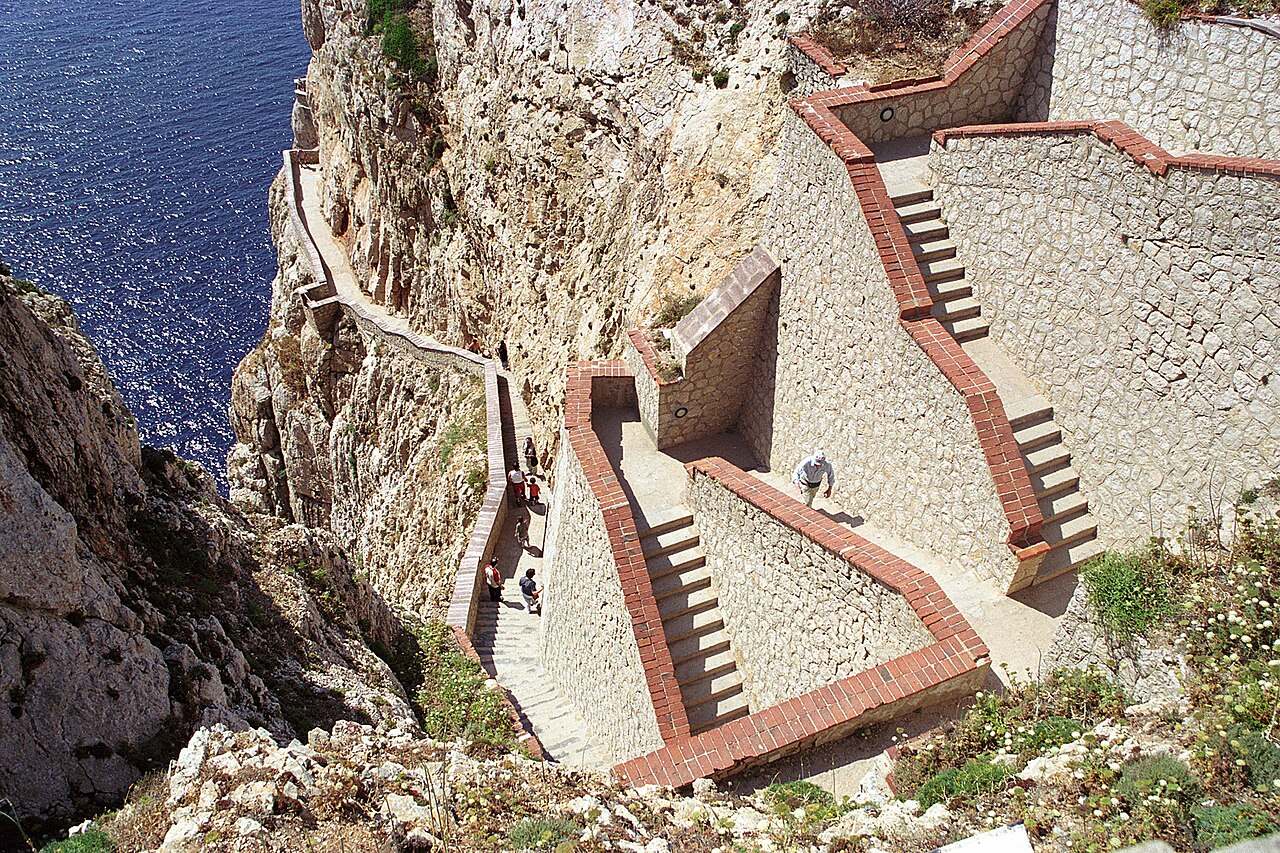
- Two ways in: by boat from Alghero harbour (April to October), or on foot down the Escala del Cabirol, which according to the cave’s operator has 654 steps and a drop of 119 metres.
- 2026 entry fee: €18 (about £15) for adults, €10 (about £8.50) for ages 6 to 17 and students under 26, free for under-6s. The boat is paid separately.
- Guided tours only, starting on the hour. The official website gives a length of about 30 minutes. The temperature inside stays at 18 to 20 °C all year.
- Buy your ticket online in advance at algheroexperience.it. From June to October there is no ticket office at the cave on Capo Caccia, and walkers need a booked time slot.
- New for 2026: from June to October you may not park along the road to Capo Caccia. You leave the car for free at the Casa Gioiosa car park and take a shuttle bus to the cave (€5 return).
- It closes when the sea is up. In rough seas the cave shuts for everyone, including those coming down the steps, and the decision can be made at the last minute.
What is Neptune’s Grotto?
The grotto is a karst cave, hollowed out of the limestone of Capo Caccia, a 168-metre headland, by seawater and rain working together. It formed slowly and is thought to be around two million years old. In Catalan, which is still spoken in Alghero, it goes by the name Cova de Neptú.
Sources disagree on how long the passages are, with figures anywhere between 2.5 and 4 kilometres, but only a few hundred metres are open to visitors. Fortunately that is the stretch worth seeing: large chambers, columns of stalactites and stalagmites, and Lake La Marmora, a saltwater lake around 120 metres long that is connected to the sea. The operator lists it among the largest underground salt lakes in Europe.
The official story credits the discovery to an Alghero fisherman called Ferrandino at the end of the 18th century. For the next 150 years or so the only way in was by water; the footpath down the cliff came much later.
Neptune’s Grotto by boat or by the steps?
This is the one decision that shapes your whole visit. Whichever way you arrive, you end up at the same entrance and join the same guided tour. What differs is the journey, the price and how tired you will be afterwards.
| Boat from Alghero | Escala del Cabirol (on foot) | |
|---|---|---|
| Starting point | Alghero harbour, Banchina Dogana quay | The small square (piazzale) at the end of the SP55 road on Capo Caccia |
| Season | 1 April to 31 October (official 2026 information says April to November) | All year, whenever the cave is open |
| Journey | 35 to 40 minutes each way | About 15 to 20 minutes down, a little longer back up |
| Extra cost | Boat ticket €15 to €18 per adult, depending on the operator | Nothing, apart from the €5 summer shuttle bus from the car park |
| Time slot | Not needed, but you must already hold a cave ticket before boarding | Compulsory, even if you buy your ticket at a ticket office |
| Difficulty | Easy, fine for small children | 654 steps and 119 m of ascent, in full sun in the afternoon |
| Main risk | Boats do not sail when there are waves | Heat, fatigue, and arriving late means losing your slot |
Our rule of thumb: with small children, with anyone who has bad knees or heart trouble, and at midday in July or August, take the boat, no question. If you have a car, a decent level of fitness and can make a morning tour, walk down the steps. In our view the staircase is half the experience.
Escala del Cabirol: how many steps are there really?
Search online and you will find every figure between 450 and 660, with 650, 656 and 660 all popular. The official number from the cave’s operator, Fondazione Alghero, is 654 steps with a height difference of 119 metres, spread over a staircase roughly 400 metres long.
In Alghero’s Catalan the name means “roe deer steps”, although in English (as in Czech) it is usually called the Goat’s Steps. The staircase zigzags down the cliff face and opened in 1954.
The operator’s official 2026 leaflet warns that the steps are carved out of the rock and uneven in places, so it is easy to trip, and that stones can fall from the cliff above. The operator advises people with heart or breathing problems not to use the staircase.
Neptune’s Grotto boat trip from Alghero harbour
Two companies run boats to the cave, and both leave from the Banchina Dogana quay in Alghero harbour. The trip takes about 40 minutes and follows the whole Riviera del Corallo, past the headlands of Capo Galera and Punta Giglio to the cliffs of Capo Caccia, where the boat moors right by the entrance, facing the islet of Foradada.
- Frecce delle Grotte (boats Freccia delle Grotte, Attilio Regolo and Deborah): according to its own website it runs from 1 April to 31 October, and a ticket costs €18 (about £15) for adults and €9 (about £8) for children aged 5 to 12. Listed departures are at 10:45, 11:45, 13:45 and 14:45, returning 2 hours 45 minutes later each time, with a 9:00 sailing for groups only. Phone +39 368 353 6824 or +39 331 722 9999.
- Linea Grotte Navisarda: boats for up to 240 passengers. Its website promises “one tour every hour” until 31 October, with times varying through the season. The town’s tourist portal gives a price of €15 (about £13) for adults and €8 for children aged 3 to 12; check the 2026 fares at the ticket desk. Phone +39 079 950603.
The boat ticket does not include entry to the cave, and this is the mistake people make most often. You must have your cave ticket before you board, either bought online or at the cave’s ticket office in the harbour (June to October, daily from 9:00 to 15:20 according to the tourist portal). The boat ticket itself is bought from the operator at the harbour, no booking needed. Bear in mind that this is a there-and-back service: Alghero has no sightseeing cruises that tour the beaches and stop at the cave along the way.
By boat from Cala Dragunara in Porto Conte
A lesser-known option. Navisarda also runs boats from a small jetty on Cala Dragunara beach in the bay of Porto Conte, just a few kilometres from the cave. There are two departures a day in the shoulder season and up to four at the peak, but the ticket desk here only sells to groups of ten or more. Prices are €16 for adults, €8 for children under 12 and free for under-3s. If there are only two of you, phone ahead and arrange it. The beach has a bar and sunbed hire, so it works well for a swim after the tour.

Alghero: Boat trip with snorkelling at Porto Conte and Capo Caccia

Alghero: Mini yacht trips with boat cruise, snorkelling and snacks

Alghero: Boat trip to the hidden coves of Porto Conte with aperitivo and snorkelling
Neptune’s Grotto tickets and prices for 2026
There is a single entry fee for the cave, however you get there. The official website still labels its price list “2025 rates”, but the operator’s 2026 leaflet gives the same amounts. Older articles online quote €14 and a child rate for ages 7 to 14; that is out of date.
| Category | 2026 price |
|---|---|
| Adults | €18 (about £15) |
| Reduced: children and teenagers aged 6 to 17, university students under 26 with a student card, Alghero residents, school groups of 15 pupils or more | €10 (about £8.50) |
| Groups of 25 or more with a booking | €12 per person (about £10) |
| Free: children under 6, people with disabilities and their companion, the third and every further child in a family up to age 17, licensed guides | €0 |
| Alghero Ticket (the cave plus the main sights and museums in town) | €35 per person (about £30), €70 per family (2 adults and 3 children) |
There is also a reduced off-season rate for residents of Sardinia, which visitors cannot use.
Where to buy tickets and how booking works
Official sales go through the website and app of Alghero Experience, run by the town’s foundation, Fondazione Alghero. GetYourGuide and similar sites mostly sell packages that combine a boat or a guide from Alghero. Before you buy one, check whether it actually includes the cave entry or only the transport.
- From June to October there is no ticket office on Capo Caccia. Buy online, at the ticket office by the Casa Gioiosa car park (if you are coming by car and shuttle bus) or at the ticket office in Alghero harbour (if you are coming by boat). Turn up at the cave without a ticket and you are out of luck. From November to May the ticket office on Capo Caccia is open throughout opening hours.
- Walkers need a booked time slot. If you are coming down the steps, booking a specific tour is always compulsory, even when you buy the ticket at a ticket office. One booking covers up to 8 people, and children under 6 do not need one.
- When to arrive: in season, if you are using the shuttle bus, be there an hour before the time on your voucher; out of season, at least 40 minutes early at the square on Capo Caccia. The voucher time is when the tour starts at the entrance down by the sea, not when you should reach the top. Arrive late and you lose your booking.
- Cancellations: you cancel the booking yourself in your user account. If the cave closes because of the weather, you can rebook the tour free of charge or request a refund by emailing rimborsi@fondazionealghero.it.
💡 Work backwards from your tour time. With an 11:00 tour and a car in high season, you need to be at the Casa Gioiosa car park by 10:00 at the latest. Alghero is about half an hour’s drive away, often more in August, so leave your hotel at around 9:30. In summer the morning slots are often gone by late morning, so book at least a day or two ahead.
Neptune’s Grotto opening hours and tour times
The cave is open every day, weekends included, except 24 and 25 December, always provided the sea allows it. Tours start on the hour. The official website only lists the summer timetable, 9:00 to 19:00 (last entry); the seasonal breakdown comes from the Alghero tourist portal:
| Period | First tour | Last tour |
|---|---|---|
| Good Friday (or 1 April) to the end of September | 9:00 | 19:00 |
| End of September and October | 9:00 | 17:00 |
| November to Easter | 10:00 | 15:00 |
How long does the tour take? The official website and the 2026 leaflet both say about 30 minutes; older sources and the boat operators say 40 to 45. Allow 30 to 45 minutes for the cave itself, plus roughly 40 minutes for the steps down and back up if you walk, or about an hour and a half on the water if you take the boat. From Alghero, plan on half a day in total.
When the sea is rough: cave closures
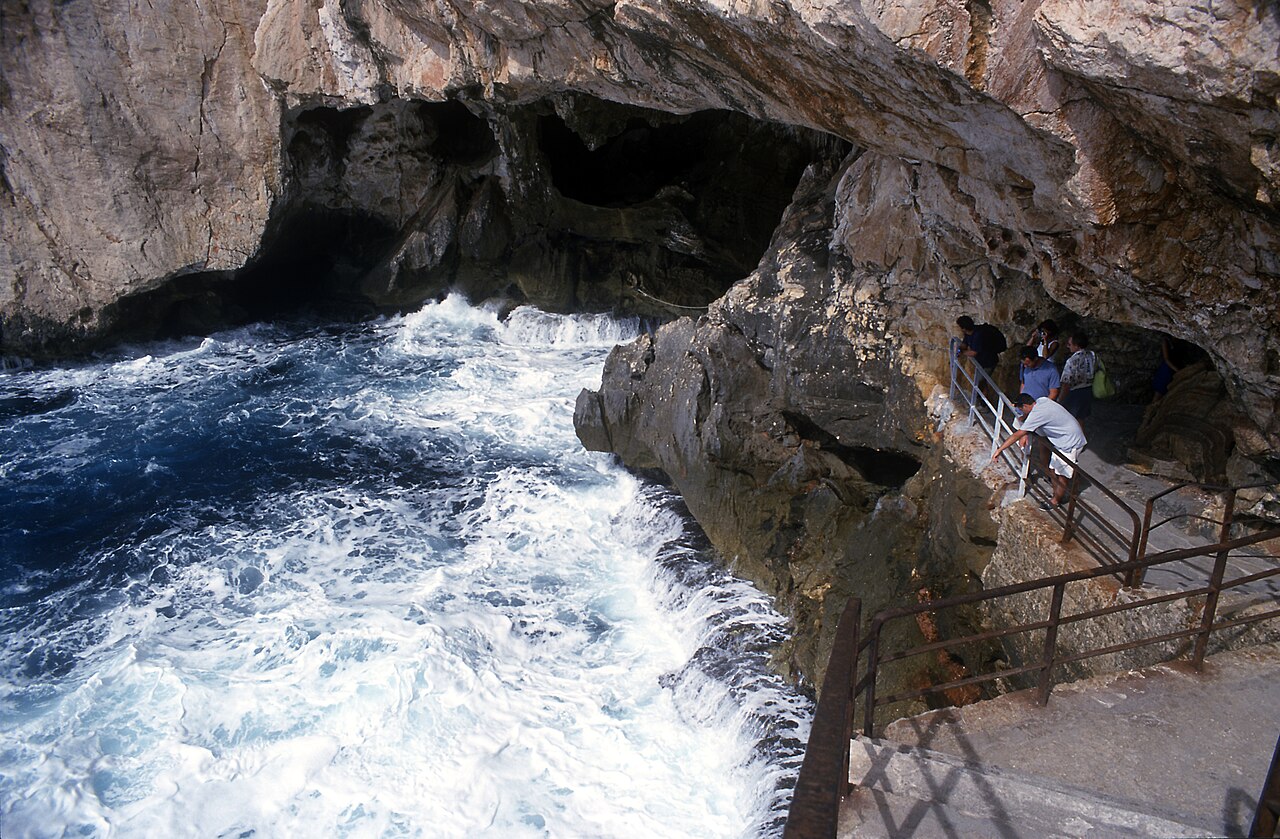
The entrance sits only about a metre above the water, right at the base of a cliff that faces north-west into the open sea. When the mistral blows and the swell builds, waves wash over the walkway by the entrance. At that point the whole cave closes, not just the boat service, so walking down the steps will not help. Closures happen in high season too (on 17 September 2026, for example) and sometimes at the last minute.
How to check whether it is open:
- phone the cave ticket office: +39 345 741 8361,
- phone the Alghero tourist information office: +39 079 979054 (then press 1, 1, 1 in the menu),
- look at the cave’s official Facebook or Instagram page in the morning, or at algheroexperience.it,
- if you are going by boat, ask at the harbour; the operators are the first to know about cancellations.
We would not leave the cave for the last day of the trip. If it is closed on Tuesday, it is usually running again by Thursday, and you will have a spare day in hand. Why the north-west gets more wind than the rest of the island, and which month is calmest, is covered in our guide to the weather in Sardinia.
How to get to Neptune’s Grotto by car: road, parking and the Casa Gioiosa shuttle
From Alghero you take the SS127bis to Fertilia and then the provincial road SP55 past Porto Conte to the very end of Capo Caccia. That is 24 to 25 kilometres, roughly 30 to 35 minutes’ drive. From Sassari the route is the SS291, then the SP55bis and SP55; allow 40 to 45 minutes. The last few kilometres are narrow and run along the ridge of the headland.
June to October: Casa Gioiosa car park and shuttle bus
Until last year people parked wherever they could, in summer often in a long line along the SP55. Since 22 June 2026 a new system has been running on a trial basis:
- From June to October, stopping and parking along the road to the cave is banned outside the designated car parks. Signs and barriers have gone up along the verge.
- You leave the car at the Casa Gioiosa car park on the way to Capo Caccia. The first 4 hours are free.
- A shuttle bus runs to the cave every 15 minutes from 8:00 to 19:00. Return tickets are sold by the driver: €5 (about £4) for adults, €3 for children aged 4 to 14, €10 for a family (2 adults and 3 children).
- Casa Gioiosa has a cave ticket office and wi-fi, so you can buy your ticket and download the audio guide there.
The town describes this as a pilot project for the 2026 season; whether it continues in future years has not yet been decided.
November to May: straight to the top
Out of season you drive all the way to the square (piazzale) above the staircase, where parking is free but spaces are few. By the square there is a snack bar with the only toilets on the whole visit; there are none in the cave or on the staircase.
Bus from Alghero to Neptune’s Grotto
Without a car, two buses will take you to Capo Caccia. Both leave from the Via Catalogna stop in central Alghero, a short walk from the harbour.
ARST line 5 (formerly 9321), all year
This public line, run by the regional operator ARST, operates all year round. Online, and even on the cave’s official website, it still appears under its old number, 9321; under Alghero’s new local numbering it is line 5 Alghero – Porto Conte – Capo Caccia. The journey takes about 47 minutes via Fertilia, Lazzaretto beach, Maristella, Mugoni beach and Tramariglio.
Only a minority of services go all the way to Capo Caccia, though; the rest terminate at the Hotel Porto Conte in Maristella. In the timetable valid at the end of September 2026, three buses a day ran through to Capo Caccia:
| Departs Alghero, Via Catalogna | Arrives Capo Caccia | Returns from Capo Caccia |
|---|---|---|
| 9:15 | 10:02 | 12:00 |
| 15:10 | 15:57 | 16:05 |
| 17:10 | 17:57 | 18:05 |
The timetable changes with the season; check the current version in the ARST timetable. The morning bus gets you there at 10:02, in time for the 11:00 tour, and the bus back leaves at 12:00. Tight, but doable. Miss it and the next one is not until four in the afternoon.
Cattogno Beach Bus, May to September
In season, the private Beach Bus run by Cattogno Viaggi works its way along the beaches west of Alghero (Le Bombarde, Lazzaretto, Mugoni, Tramariglio) to the cave on Capo Caccia and on to Porticciolo, with more frequent services in July and August. A single ticket costs €5 from the driver, in cash or by card, and day tickets are also available. The ride takes about 50 minutes.
From Sassari you first need to get to Alghero by train or bus and change there; allow roughly two hours each way.
What you see inside Neptune’s Grotto
Guides lead the tours in Italian and English, so English speakers are well covered. There is also a free audio guide in nine languages, including English, German and Polish, which runs as a web app on your phone and has seven stops. There is no signal in the cave, so download it in advance from audioguide.grottadinettuno.it, using the wi-fi at Casa Gioiosa, on the square on Capo Caccia or at the harbour. And bring your own earphones: you are not allowed to listen without them.
The route follows a walkway along the side wall of the cave and climbs gradually into the upper parts of the chambers:
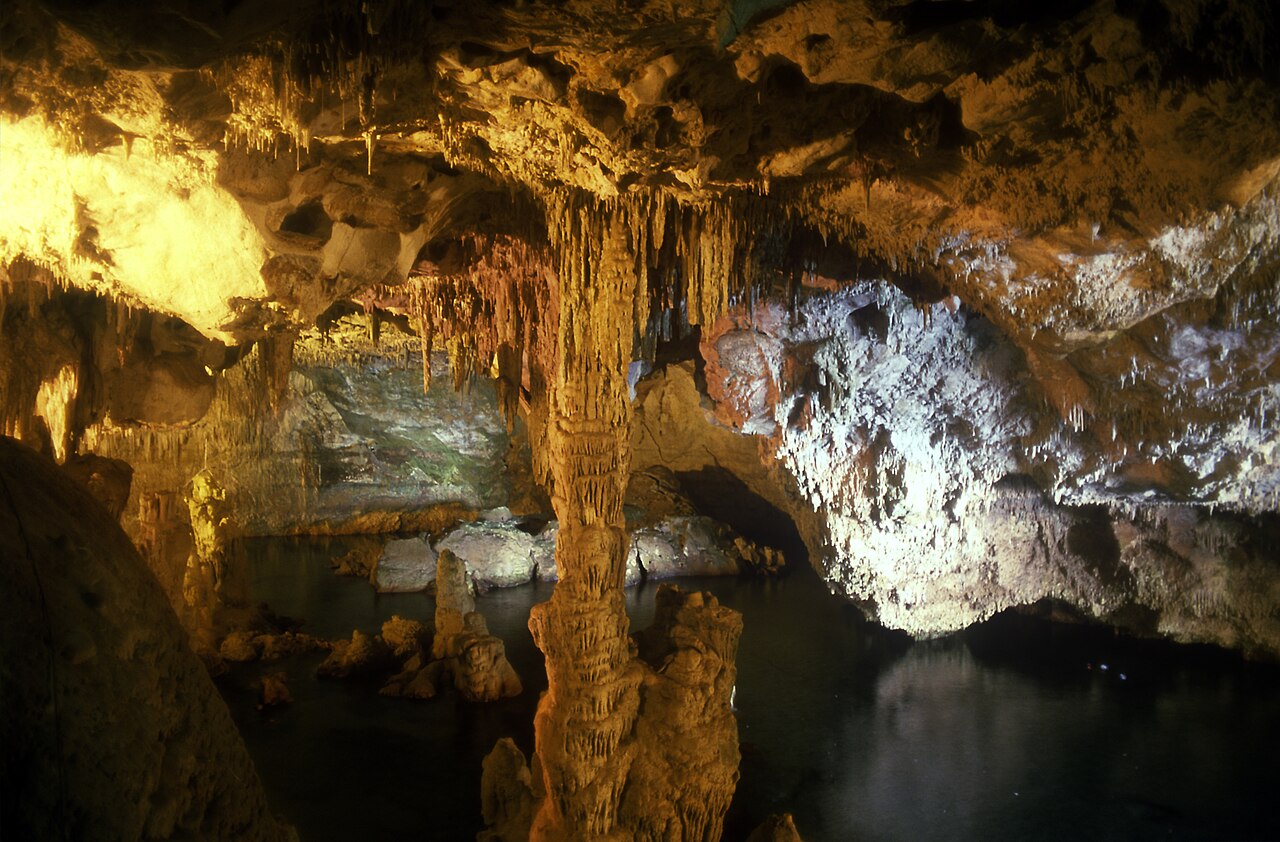
- Lake La Marmora, just inside the entrance, where daylight from the mouth gives the walls a green-blue sheen.
- The Acquasantiera (“holy water font”), a stalagmite about two metres tall with hollows of rainwater that birds drink from.
- The Sala della Reggia, or Royal Hall, which we think is the finest spot on the tour. Nine-metre columns are mirrored in the lake, and a little further on the ceiling rises to 18 metres.
- The Sala Smith with the Grande Organo, the Great Organ, the largest column in the cave.
- The Tribuna della Musica, a balcony looking down over the Royal Hall and the lake. This is where the tour ends.
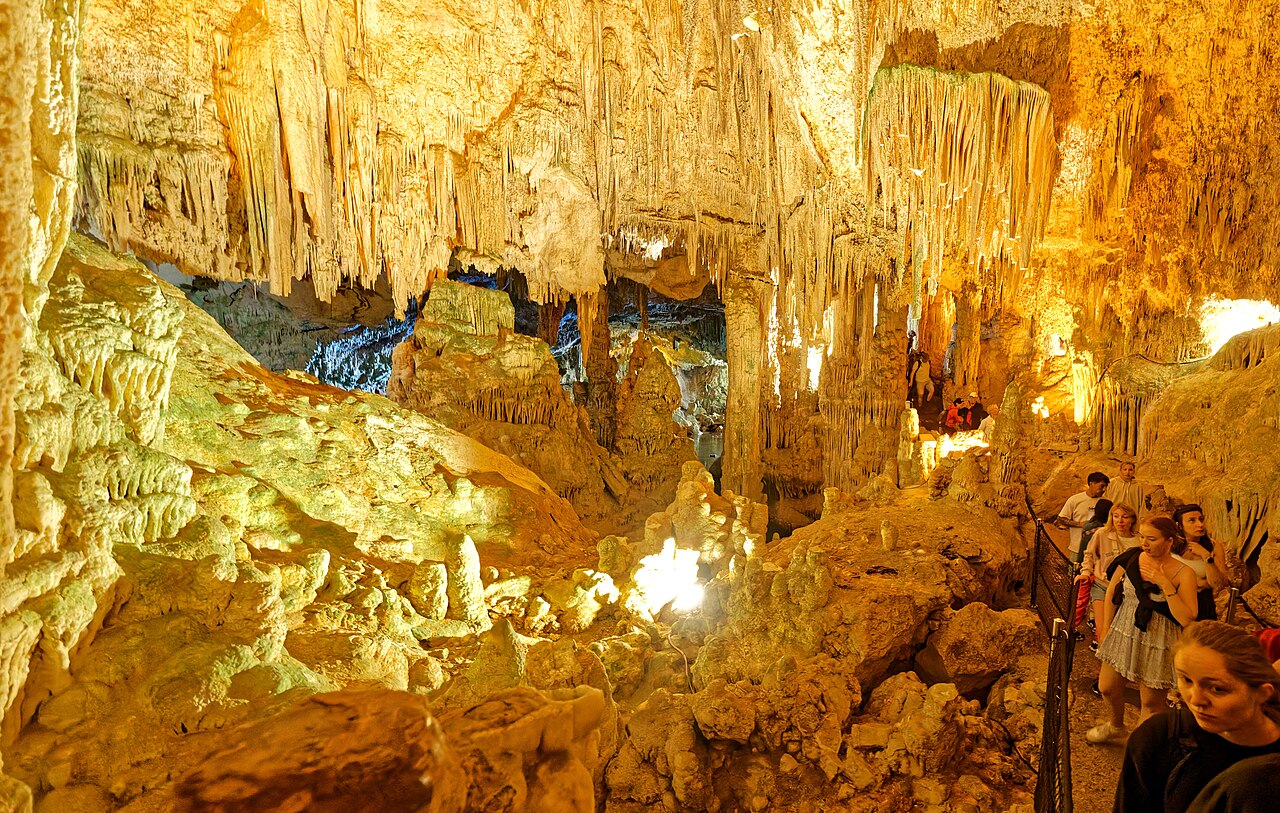
Is Neptune’s Grotto worth it? To be honest, in season it is crowded. In August there can be around 200 people inside at once, and because the groups from the boats and from the steps meet at the same entrance, you shuffle along in a queue. Unless you are at the front of your group, you mostly hear the echo of the commentary, which is why the audio guide on your phone pays off. We still think the cave is worth it, just do not expect to have it to yourself. For a quieter visit, go in May, in October or on the first tour of the morning.
Visitor rules and what to bring
Some of the operator’s rules catch out people who come straight from the beach:
- Clothing: you will not be let in wearing swimwear or bare-chested. Shoes must have a good grip, so no flip-flops. People in unsuitable footwear can be turned away at the top of the staircase.
- Food and drink: no food or drink may be taken into the cave, except water in a reusable (or insulated) bottle.
- Not allowed: touching or leaning on the formations, smoking (e-cigarettes included) and jumping into the water.
- Dogs are allowed inside on a lead and wearing a muzzle.
- Accessibility: the cave is not accessible to wheelchair users or people with severely limited mobility, because there are steps inside as well.
- Inside the humidity is high, the wet floor is slippery and the ceiling is low in places.
- Photography is allowed; according to guidebooks, without flash.
If you are walking, pack water, a cap and sun cream. You will not need a jumper in the cave in summer, but by November one comes in handy.
💡 Going up is harder than going down, and the afternoon is worse than the morning. The staircase faces the sea and from midday in summer it is in full sun. The operator explicitly advises against using the steps in the hottest hours. If you want to walk in July or August, book the first tours at 9 or 10 o’clock, or the last one of the afternoon once the sun is lower.
A short history of Neptune’s Grotto
According to the cave’s operator, the limestone that forms Capo Caccia rose from the sea in the Upper Cretaceous, roughly 70 million years ago. Rainwater carrying dissolved carbon dioxide then seeped into the cracks, slowly dissolving the rock and carving out hollows that the sea went on to attack. The cave itself is thought to be around two million years old.
Nobody knows who first rowed inside. The official version names Ferrandino, a fisherman from Alghero, at the end of the 18th century, with 1795 often given as the year. Yet right next door, in the bay of Porto Conte, the Romans had a port called Portus Nymphaeus in the 1st century, and traces of much older inhabitants have been found in the neighbouring Grotta Verde. It is hard to believe nobody had looked in before.
For roughly 150 years after its discovery the cave could only be reached by boat, and only in summer. Excursions were organised by a committee in Alghero. People gathered in the evening at the harbour below the town walls, set off around midnight and crossed in darkness lit only by lamps on the boats. They reached the entrance at dawn; the sailors went in first and lit hundreds of candles. A small boat then ferried the guests across the lake to a little beach, where on special occasions there was dancing and an orchestra played from the Tribuna della Musica balcony. Those early visitors also did plenty of damage, which is why one chamber is called the Sala delle Rovine, the Hall of Ruins. Charles Albert, later King of Sardinia, came three times: once with the naturalist and cartographer Alberto La Marmora, after whom the salt lake by the entrance is named, and once with his son Victor Emmanuel, the future King of Italy.
Walking in has only been possible since the mid-20th century. According to the operator, the Escala del Cabirol (“roe deer steps” in Alghero Catalan, Goat’s Steps to most English speakers) opened in 1954. A plaque at the start of the path commemorates it, and the design is attributed to the architect Antoni Simon Mossa. Some guidebooks and encyclopaedias give 1959 instead, most likely the year from which the cave counted as open to the public.
The caves of Capo Caccia were once home to the Mediterranean monk seal, which has since disappeared from the area. Today the whole area is protected: Porto Conte Regional Park was created in 1999 and the Capo Caccia – Isola Piana marine reserve in 2002.
Capo Caccia, Grotta Verde and the area around Neptune’s Grotto
The cave lies in the middle of the protected area of Porto Conte Natural Park and the Capo Caccia – Isola Piana marine protected area. If you come by car, set aside more time for Capo Caccia than just the cave.
Capo Caccia and the lighthouse
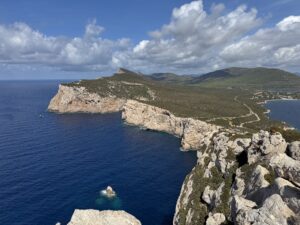
The cliffs of the headland drop straight into the sea, and at the tip stands a lighthouse, reached by the road above the staircase. Peregrine falcons and griffon vultures nest here, and from March to May so do gulls, which defend their nests aggressively, so keep well back from the cliff edge.
For us the best moment on Capo Caccia is sunset. The headland faces west over the open sea, so the sun sinks below the horizon with not a single hill in the way. If you have a car, book the last afternoon tour and stay up top until dark. Just remember that in the 2026 season the shuttle bus ran until 19:00.


Isola Foradada and the viewpoint
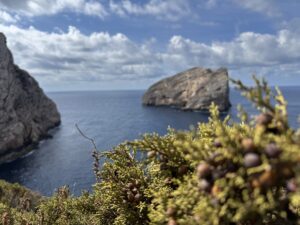
This is the islet with a natural tunnel through it that you see directly opposite the cave entrance as you arrive by boat. From above, you look down on it from the Belvedere della Foradada viewpoint, a short way from the road above the staircase. In our opinion this view is the best photo of the whole trip.
Grotta Verde, Grotta dei Ricami and Nereo
Grotta Verde, the Green Cave, lies on the other side of the peninsula and takes its name from its moss-covered rocks. Traces of Neolithic settlement have been found inside, but it is not open to visitors. Grotta dei Ricami (the Lace Cave), in the cliffs facing Alghero, can only be reached from the sea. And underwater around the headland lies Grotta di Nereo, which the dive operators describe as the largest underwater cave in the Mediterranean, visited by thousands of divers every year.
Porto Conte, Le Prigionette and beaches on the way
The road to Capo Caccia skirts the bay of Porto Conte, with places to stop on the way there or back:
- Mugoni beach on the inner side of the bay, with shallow, calm water. Good for families with children, and on the bus route.
- Le Prigionette (Arca di Noè, also the name of the bus stop), a nature reserve you explore on foot or by bike.
- Lazzaretto and Le Bombarde beaches, closer to Alghero, both served by the regular bus and the Beach Bus.
On the way back to Alghero, right by the road, stands Nuraghe Palmavera, a prehistoric stone settlement. We cover it, along with the old town, the walls and the wineries, in our guide to Alghero. For places all over the island, see our overview of what to see in Sardinia. And if you would like to compare the grotto with the island’s other big sea cave, Grotta del Bue Marino on the east coast is covered in our article on the Gulf of Orosei.


Where to stay near Neptune’s Grotto
There is next to nothing right by the cave, as the whole headland is a protected area. The nearest options are apartments at Pischina Salida, and those need booking well in advance. In practice you have three choices:
- Alghero is the best base for most people. Boats leave from the harbour straight for the cave, buses from the Via Catalogna stop, and in the evening there are plenty of places to eat and stroll. Neighbourhoods and food tips are in our guide to Alghero. Places to stay in Alghero.
- Fertilia, a small town close to the airport and halfway to Capo Caccia. It is quieter than Alghero, and the drive to the cave is a little shorter. Places to stay in Fertilia.
- Maristella and Porto Conte, scattered houses above the bay with two good beaches. The cave is about ten minutes away by car, and most line 5 buses terminate here. Without a car, though, there is nothing to do in the evening. Places to stay in Maristella.
Hotels in Alghero
- San Francesco Heritage Hotel (old town): Simple air-conditioned rooms in a 14th-century monastery, 200 metres from the cathedral and five minutes’ walk from the harbour where the boats to the cave leave. Sweet Italian breakfast, rated 8.1 on Booking. The catch is the car: the nearest parking is some way outside the walls.
- Hotel Catalunya (by the harbour): A four-star hotel opposite the marina, so the boats to Capo Caccia are literally across the road, and the old town is five minutes away. It stands outside the walls, has its own car park and, on the top floor, the Skybar Blau with views over the bay. The restaurant serves breakfast only; rated 8.7.
- Villa Las Tronas Hotel & SPA (Lungomare Valencia): For a special stay: a former royal residence on the seafront, ten minutes’ walk from the centre. Outdoor pool with sea views, a spa with an indoor saltwater pool, free parking and a 9.1 rating.
Hotels in Fertilia
- Hotel Fertilia (Fertilia): An unpretentious hotel among pine trees, five minutes’ walk from the beach and five minutes’ drive from the airport, with free parking and the Da Bruno restaurant, which is open to non-residents and cooks fresh fish. Handy if you land in the evening and want to head for Capo Caccia in the morning without driving through Alghero.
- Camping Village Laguna Blu (Fertilia): A campsite with rooms and mobile homes 20 metres from the beach, about 4 km from Alghero. It has an outdoor pool, a supermarket, a pizzeria, a playground and free parking, and scores 7.9 on Booking. The budget choice for families with a car.
Hotels in Porto Conte and near Maristella
- El Faro Hotel & Spa (Porto Conte): In our view the best location in the area: the hotel sits right on the water in the bay of Porto Conte, looking across to Capo Caccia, which is closer from here than from Alghero. It has a stone terrace with sunbeds above the sea, an outdoor pool and a spa with a sauna, rated 9.3. One for a special occasion; in the evening you will not get anywhere without a car.
- Hotel Baia di Conte Club & Resort (Mugoni beach): A resort 200 metres from Mugoni beach with two pools, a private beach, a kids’ club and free parking. For families who want the sea, a pool and children’s activities in one place. Expect evening entertainment, and a rating of only 7.1.
- Agriturismo Porticciolo (Porticciolo): Self-contained air-conditioned cottages with covered verandas in Porto Conte park, 400 metres from Porticciolo beach and 16 km from Alghero. A working farm with animals, a big playground, sweet breakfast and an 8.8 rating. A quiet choice north of the headland; do not come without a car.
We would stay in Alghero and drive out to Capo Caccia for one full day: the cave in the morning, a swim at Mugoni in the afternoon and sunset on the headland. How to choose accommodation across the island and what it costs in different months is covered in our guide to where to stay in Sardinia.
What we would do differently
If we went to Neptune’s Grotto again, we would not treat it as a box to tick in one morning. What we remember most from the whole trip is not the chambers full of stalactites but the steps: the blue depths opening up below you, the gulls watching from the cliff, a new stretch of coastline appearing at every bend. Stop, sit on the wall and look at Foradada for a while. The cave will not go anywhere, but your time slot will, so set off half an hour earlier than you need to.
After the tour we would not drive straight back to Alghero. Instead we would take one of the turnings down to the bay of Porto Conte and have a late lunch at a beach bar, with a glass of local Vermentino or Cannonau. And we would take fewer photos: in a queue of two hundred people you cannot really photograph the cave properly, and one shot of the Royal Hall is enough.
Neptune’s Grotto FAQ
How much are Neptune’s Grotto tickets?
In the 2026 season, adult entry costs €18 (about £15). The reduced price of €10 applies to children and teenagers aged 6 to 17 and to students under 26. Children under 6 go free, as do the third and every further child in a family. The boat from Alghero (€15 to €18) and the shuttle bus from the car park (€5) are paid separately.
How many steps are there at Neptune’s Grotto?
According to the cave’s operator, the Escala del Cabirol staircase has 654 steps and climbs 119 metres over a length of roughly 400 metres. Going down takes about 15 to 20 minutes, coming back up a little longer.
Do I need to book Neptune’s Grotto tickets online?
If you are walking down the steps, booking a specific time slot is always compulsory. From June to October there is also no ticket office on Capo Caccia, so you need your ticket in advance: online at algheroexperience.it, or from the ticket office at the Casa Gioiosa car park or in the harbour. By boat you do not book a time, but you must have bought your cave ticket before boarding.
Is entry to the cave included in the boat trip?
No. A boat ticket from Alghero covers only the trip there and back; entry to the cave is paid separately. With packages sold by third-party sites, check exactly what is included.
How long does a visit to Neptune’s Grotto take?
The guided tour itself lasts about 30 minutes according to the official website, although some sources say 45. Add the boat trip, about 40 minutes each way, or the steps, about 40 minutes there and back in total. From Alghero it is a half-day trip.
Is Neptune’s Grotto open in winter?
Yes, the cave is open all year except 24 and 25 December. From November to Easter, tours usually run from 10:00 to 15:00. In winter, however, there are no boats, so the steps are the only way in, and closures because of waves are more likely than in summer.
Where do you park for Neptune’s Grotto?
From June to October 2026, parking along the road to Capo Caccia is banned. You leave the car at the Casa Gioiosa car park, where the first 4 hours are free, and take the shuttle bus to the cave, which runs every 15 minutes. From November to May you park in the small car park right above the staircase.
Is there a bus from Alghero to Neptune’s Grotto?
Yes. ARST line 5 (formerly 9321) runs all year from the Via Catalogna stop in Alghero, and the journey takes about 47 minutes. Only about three buses a day go all the way to Capo Caccia, though; the rest terminate in Maristella. From May to September there is also the private Cattogno Beach Bus, with tickets at €5.
Where to next
- Alghero: the Catalan town you set off from for the cave. Old town, walls, beaches, food and where to stay.
- Sardinia holiday planner: the whole trip in one place. Flights, ferries, car hire, which part of the island suits which kind of holiday, and itineraries.
- What to see in Sardinia: the island’s most interesting places, from north to south.
- Gulf of Orosei: coves on the east coast, boat trips and the island’s other famous sea cave, Grotta del Bue Marino.
- Sardinia: what to watch out for: fines for taking sand, parking, the mistral and other traps that are better known in advance.
Potřebujete pomoct s cestováním?
-
Ubytování 🏨
Vyberte si to nejlepší ubytování, ať už jste kdekoliv, přes Booking.com. -
Půjčení auta 🚗
Auto si snadno najdete přes Booking.com, kde máte často slevu díky ubytování, nebo Rentalcars.com, kde porovnáte nabídky většiny půjčoven. -
Zážitky 🎟️
Přes GetYourGuide.com si vyberete z nejrůznějších výletů i zážitků po celém světě, navíc se zrušením zdarma do 24 h předem.